Private label vs white label vs custom formulation: what you actually own
Private label skincare can put a product on shelf in weeks, but it rarely gives you the formula. This guide compares white label, private label and custom formulation on ownership, MOQ, timeline, differentiation and risk, and the contract clauses that decide what your brand owns.
By Dr. Premalatha, Ph.D., Life Science, Regulatory Consultant, Cosmetic Science Lab
Routes at a glance
- White label
- Stock product, your brand; manufacturer owns the formula
- Private label
- Adapted stock formula; usually still the manufacturer's [2]
- Custom formulation
- New formula; yours if the contract assigns it [1]
- Key clause
- IP assignment, agreed before development starts
- Common trap
- Paying for development without owning the result
- Start here
- New brand? Start here
Quick answer
- Private label skincare and white label skincare both use a manufacturer's formula, so the manufacturer usually owns it [2]. Custom formulation creates a new formula that you own, but only if the contract assigns it to you [1]. Choose white label to test demand, private label to adapt quickly, and custom to own a unique product.
- Without a written agreement, the manufacturer may own a formula you paid to develop [1].
- Exclusivity must be defined: what is protected, where, for how long, and at what order volume [2].
Take-home message for founders
- Ask "who owns the formula?" before you ask about price.
- Treat a private-label launch as a test, not an asset.
Take-home message for formulators
- Document every development step so ownership and know-how can be transferred.
- Write a tech-transfer pack any qualified manufacturer could follow.
01White label vs private label skincare: definitions
White label skincare is a manufacturer's existing stock product sold under your brand with no formula changes. Private label skincare is a manufacturer's stock formula adapted for you, such as a new fragrance, colour or active. In both, the manufacturer usually keeps the formula. Custom formulation creates a new formula, which you own only if the contract says so [1][2].
- Stock formula: a ready-made base the manufacturer sells to many beauty brands.
- Custom formulation: a formula developed for your brief by a chemist, such as through product formulation.
Is it white label skincare or private label? If you buy from a catalogue and only your logo changes, it is white label. If you can change the fragrance, texture or an active but the base stays the manufacturer's, it is private label. Some suppliers use the terms interchangeably, so check the contract, not the sales sheet [2].
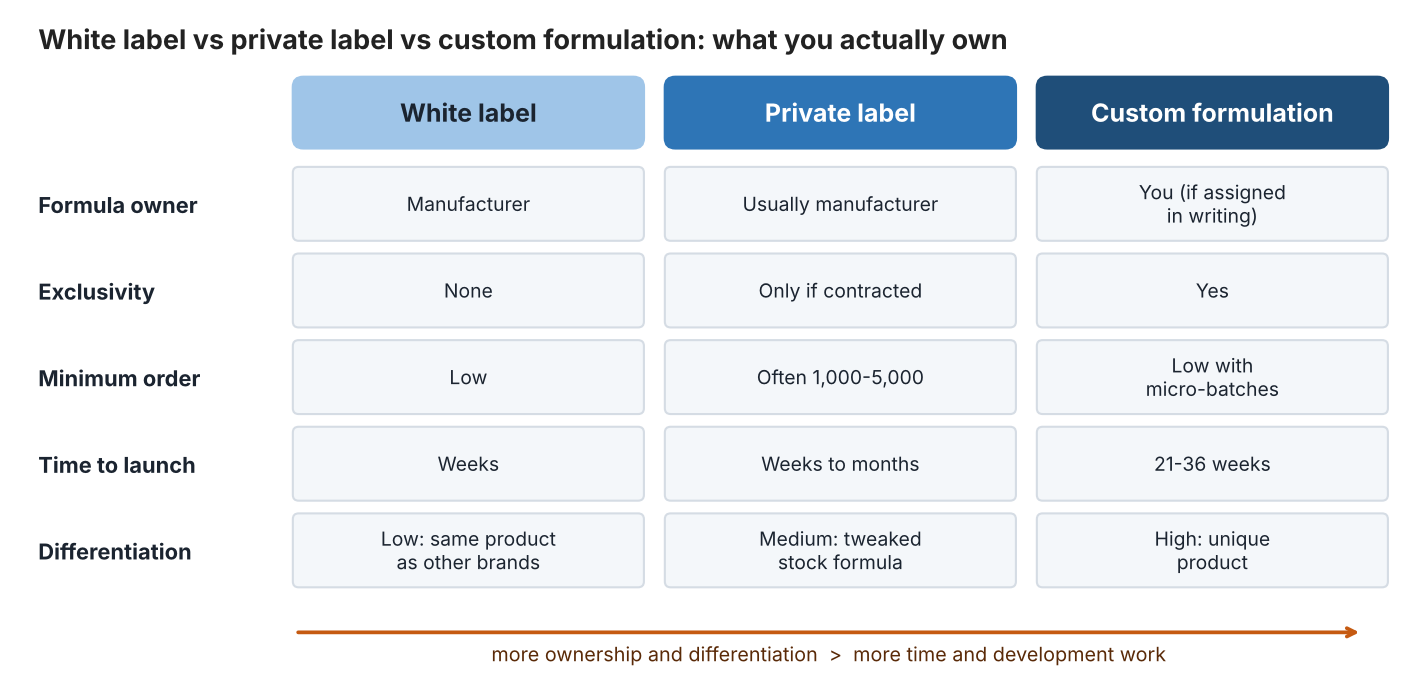
02Private label skincare compared: ownership, MOQ, timeline, differentiation and risk
| Attribute | White label | Private label | Custom formulation |
|---|---|---|---|
| Formula ownership | Manufacturer | Usually manufacturer [2] | You, if assigned in writing [1] |
| Minimum order (MOQ) | Low | Often 1,000–5,000 units | Low with micro-batches |
| Timeline | Weeks | Weeks to months | Typically 21–36 weeks |
| Differentiation | Low: same product as other brands | Medium: tweaked stock formula | High: unique product |
| Main risk | Competitors sell the same product | Losing the product if you switch supplier | Longer timeline and development cost |
03Formula ownership clauses explained
The contract, not the route name, decides what you own. Check these clauses before signing:
| Clause | What it does | What to ask for |
|---|---|---|
| IP assignment | States who owns the formula and know-how created during development | Assignment of the final formula and all development IP to you, agreed before work starts [1] |
| Exclusivity | Stops the manufacturer selling the same product to others | A defined scope (formula, fragrance, pack, territory), term and any volume conditions [2] |
| Confidentiality | Protects the formula and your brief | Mutual NDA signed before you share anything |
| Technology transfer | Lets you move production | Full formula, specifications and process on request or at termination (tech transfer and scale-up) |
| Regulatory responsibility | Allocates the Responsible Person role, safety report and product file | Named owner for each, with your access guaranteed [2][3]; see Responsible Person and the Product Information File |
| Quality and recall | Defines acceptable product, inspection and recall costs | Specification, retained samples and a recall process [2] |
04Step by step: choose a route and protect what you own
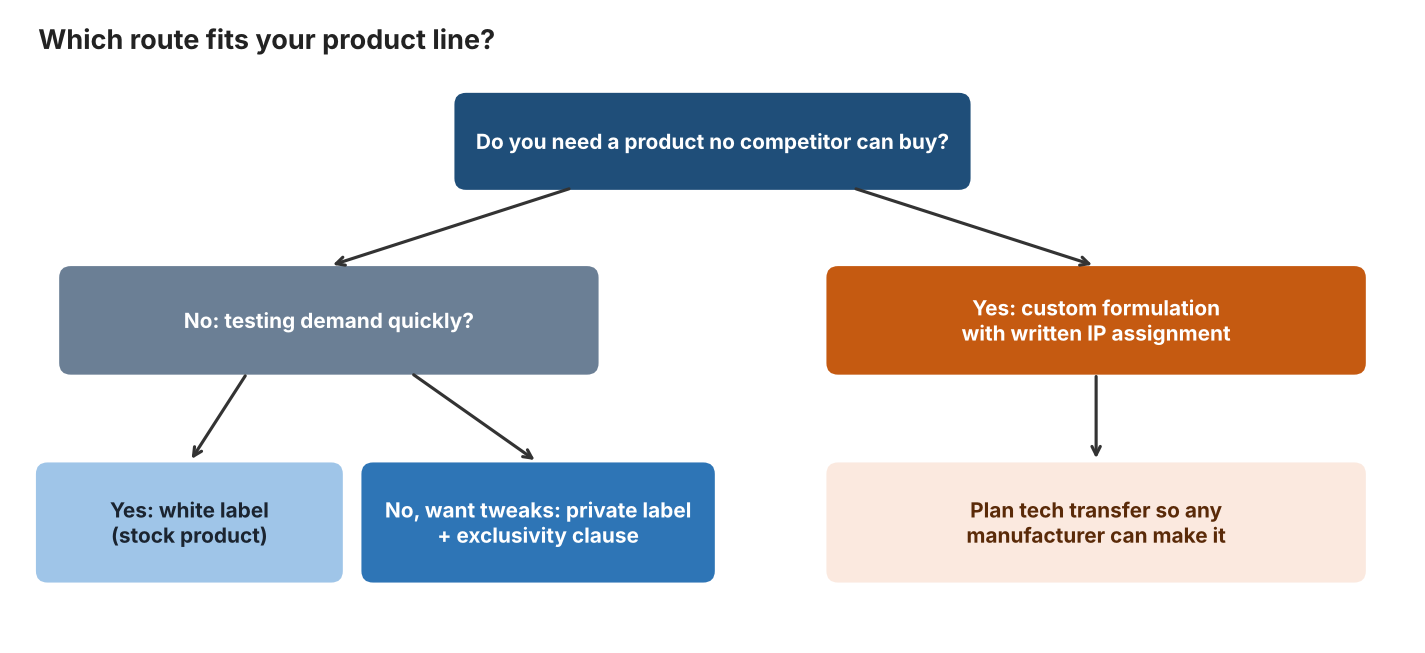
- Decide what must be unique.
If competitors must not be able to buy your product, only custom formulation or an exclusive private label will do.
- Ask who owns the formula.
Get the answer in writing before any development work starts; without it, the manufacturer may own it [1].
- Define exclusivity precisely.
Name the formula, fragrance, pack or territory protected, the term, and any volume conditions [2].
- Allocate regulatory duties.
Agree who is the Responsible Person and who holds the safety report and product file [2][3].
- Secure a technology transfer.
Require the full formula, specifications and process instructions on request or at termination.
- Size the first order.
Match the MOQ to real demand; launch with few SKUs.
05Worked example
A founder plans a three-product hair care and bath and body line: shampoo, body wash and a hero scalp serum. This example is illustrative.
- Shampoo and body wash: white label stock formulas test demand quickly and cost-effectively. Both can be sold by competitors, so they are entry products.
- Hero scalp serum: custom formulation with a written IP assignment, made in micro-batches so the first run matches demand.
- Clean beauty positioning: the custom brief excludes chosen ingredients; the white label products are checked against the same list (Clean, natural & Ayurvedic).
If the scalp serum sells, the founder can later replace the white label skincare products with custom versions without losing the hero product.
Result: fast launch on two products, one owned asset, and no 1,000-unit minimum on the riskiest SKU. Read more in how to start a skincare line.
06Common mistakes
- Paying for "custom" tweaks without an IP clause, then finding the manufacturer may own the result [1].
- Assuming exclusivity that the contract never defines [2].
- No access to the safety report or product file, The Responsible Person must hold both [3], so without them you cannot change Responsible Person, manufacturer or market without redoing the work.
- Ordering the full MOQ on every SKU before demand is proven.
- Copying the supplier's marketing claims. White label skincare products come with claims written for every brand that buys them; you still need evidence for the claims on your own label.
- No quality agreement, so batches drift from the agreed specification and the beauty standards your customers expect [2].
07For brands & formulators
Private label skincare is a fast way to test a product line. A formula you own is what builds long-term value.
Want a formula you own?
Our Prototyping & product development team develops custom formulas that you own outright, with a tech-transfer pack so any manufacturer can make them.
08Questions readers ask
Do I own the formula with private label skincare?
Usually not. The manufacturer normally keeps the base formula and know-how, and you buy finished goods [2]. Ownership changes only if the contract assigns it to you.
Is white label skincare cost effective?
For testing demand, yes: low development cost and fast launch. The trade-off is no exclusivity, so competitors can sell the same product.
Can I move from private label to custom formulation later?
Yes, but you start a new formula. A private-label formula you do not own cannot simply be taken to another manufacturer.
09References
- Asoulin A. Your product formula: who really owns it? EPGD Business Law; 20 Aug 2025. epgdlaw.com
- Solo A. White label skincare agreements in the UK. Sprintlaw UK; 16 Oct 2026. sprintlaw.co.uk
- Regulation (EC) No 1223/2009 on cosmetic products, Articles 2, 4, 10 and 11. Off J Eur Union. 2009;L342:59–209. eur-lex.europa.eu
- EcoMundo. Understanding MoCRA: key changes in US cosmetic regulations. 19 Jan 2023. ecomundo.eu
- US Food and Drug Administration. "Trade secret" ingredients. Content current as of 26 Mar 2024. fda.gov
- Directive (EU) 2016/943 of 8 June 2016 on the protection of undisclosed know-how and business information (trade secrets), Article 2(1). Off J Eur Union. 2016;L157:1–18. eur-lex.europa.eu
Update log
- Published by Cosmetic Science Lab
This article is general technical information, not legal, regulatory or medical advice. Confirm requirements for your product and market before launch.