How to start a skincare line: the real sequence and cost drivers
Most founders start with the product. The brands that last start with the customer, the channel and a route to a formula they can afford to make. This guide sets out the real order of decisions and where new beauty brands most often lose money.
By Dr. Premalatha, Ph.D., Life Science, Regulatory Consultant, Cosmetic Science Lab

Starting a skincare line at a glance
- Order of decisions
- Customer, channel, route, formula, pack, testing, registration, launch batch
- Market
- Indie brands hold about 32% of US beauty and personal care sales [1]
- Biggest money trap
- Private-label MOQs, often 1,000–5,000 units
- Slowest step
- Stability testing in the final pack
- Common mistake
- Booking testing after the pack is ordered
- Start here
- New brand? Start here
Quick answer
- How to start a skincare line: define your target customer and price, choose your sales channel, then pick a route (white label, private label or custom formulation). Brief the formula, choose packaging, budget for testing, register in each market, and only then order a launch batch sized to real demand.
- Indie brands now hold about 32% of US beauty and personal care sales, but their customer loyalty trails the big groups [1].
- Packaging influences 46% of US women buying beauty products [2].
- Every EU product needs a Responsible Person, a safety report and notification, whatever the brand's size [3].
- A US small-business exemption skips registration and listing, not safety, adverse-event or labelling rules [4].
Take-home message for founders
- Decide customer, channel and price before talking to manufacturers.
- Ask who owns the formula before you sign anything.
Take-home message for formulators
- Get the target price and pack in the brief; they set the ingredient budget.
- Test in the final pack from day one; a pack change means retesting stability.
01The real sequence: how to start a skincare line
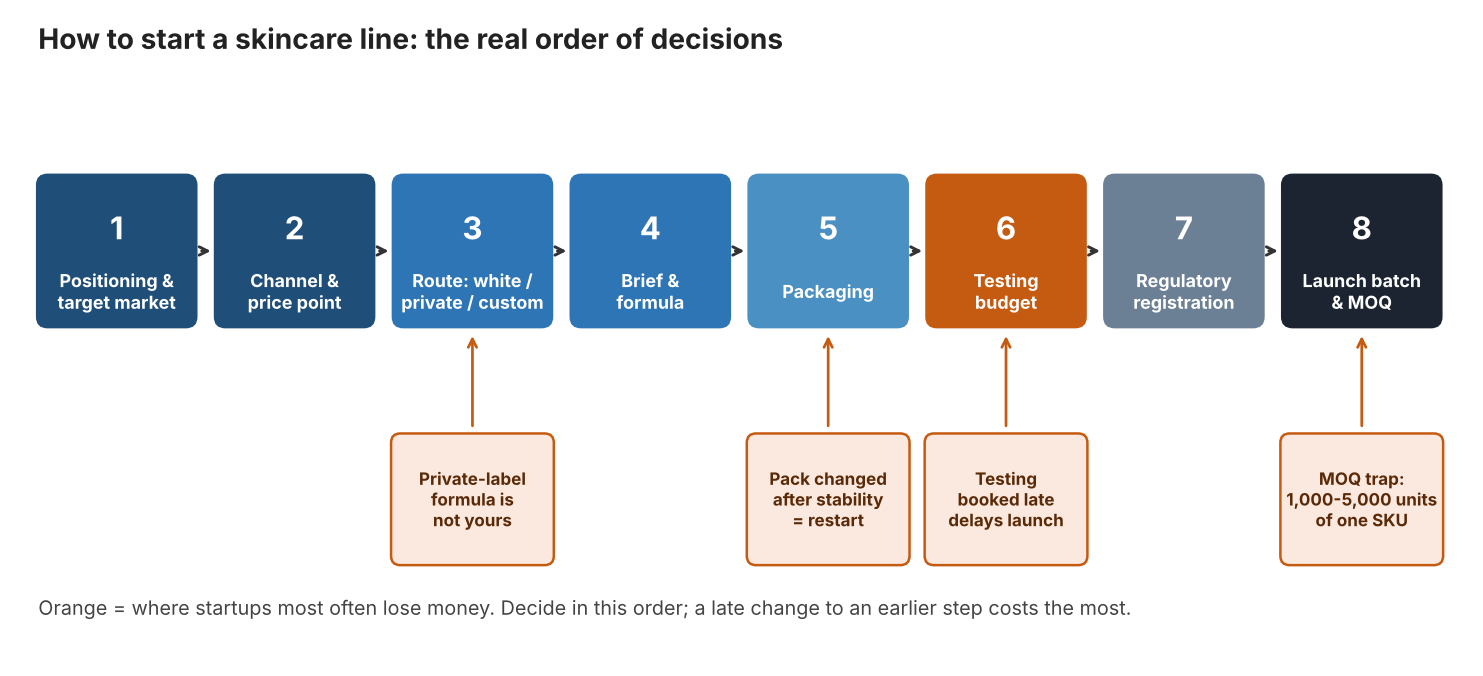
The order matters because each decision fixes the next. Change an early one late and everything after it is redone.
| Decision | What you settle | Cost of getting it late |
|---|---|---|
| 1 Positioning and target market | Who buys, what problem you solve, brand identity; market research and a simple business plan | Products that suit nobody in particular |
| 2 Channel and price point | Direct-to-consumer, marketplace or retail; target margin | A formula and pack you cannot sell at the price the channel needs |
| 3 Route | White label, private label or custom formulation | Losing the formula if you switch supplier |
| 4 Brief and formula | Product type, claims, benchmark (reverse engineering) and format (what is a serum?) | Reformulation after testing has started |
| 5 Packaging | Final pack chosen and tested with the formula | Stability data must come from the final pack, so a pack change means retesting [5] |
| 6 Testing budget | Stability, preservative efficacy, safety and claims tests | Launch delayed by months |
| 7 Regulatory registration | Responsible Person, safety report and notification per market [3] | Products that cannot legally be sold |
| 8 Launch batch and MOQ | First order sized to real demand | Cash locked in unsold stock |
02What the data shows
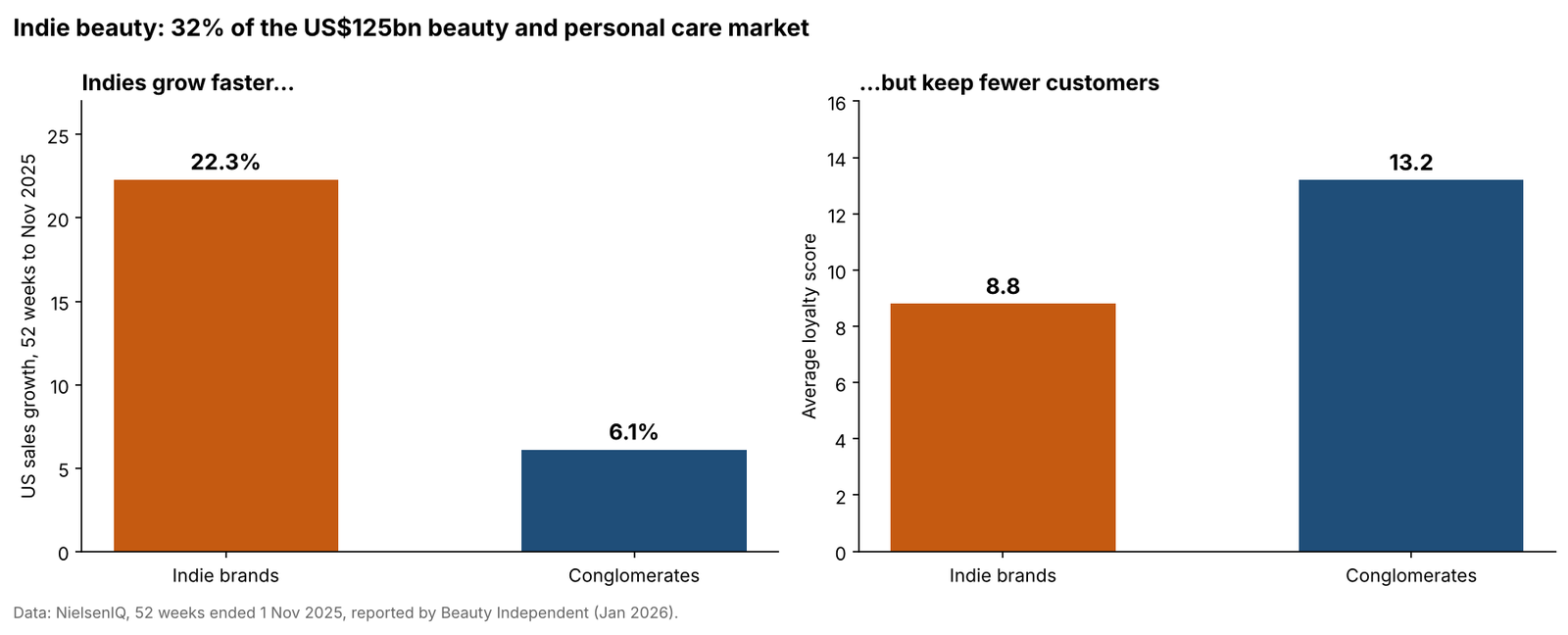
- Indie brands are winning share: 32% of the US$125 billion US beauty and personal care market, up from about 29% a year earlier. Indies grew 22.3% against 6.1% for conglomerates [1].
- Most indie sales are online: e-commerce is about 70% of indie beauty sales, so digital marketing and marketplace listings shape the channel decision [1].
- Keeping customers is harder: indie loyalty averages 8.8 against 13.2 for conglomerates, and once-hot brands often cool fast [1].
- Packaging sells: 46% of US women buying beauty products say packaging influences them, rising to 50% among millennials and Gen Z [2].
What this means for your marketing strategy: write the brief for one defined target audience and the channel where they already buy. Trial is easy to win online, but loyalty is not, so plan the second purchase (refills, routines, a hero product people reorder) as carefully as the launch [1].
03White label vs private label vs custom formulation
| Route | Who owns the formula | Minimum order | Best for |
|---|---|---|---|
| White label | Manufacturer | Low | Testing a market quickly |
| Private label | Usually the manufacturer | Often 1,000–5,000 units | Fast launches on a proven base |
| Custom formulation | You | Low with micro-batches | Unique products and freedom to switch manufacturer |
04Cost drivers, and where startups lose money
No two launches cost the same, but the drivers are predictable:
- Number of products: each SKU multiplies testing, registration and packaging costs. Launch with two or three.
- MOQ traps: a private-label minimum of thousands of units per SKU ties up cash before you know what sells. Micro-batch manufacturing keeps first runs small.
- Testing late: stability must run in the final pack [5]. Changing the pack after testing has started means retesting. See the pre-launch testing checklist and safety & stability testing.
- Claims: each claim needs evidence that matches its wording [6]. More claims, more studies.
- Markets: every market adds a registration file and label changes.
- Packaging and sourcing: custom moulds and decoration carry their own minimums; sourcing & procurement can use stock components.
Ordering thousands of units of packaging and product before stability and safety results are in. If anything fails, both the stock and the time are lost.
05Myths
- "Private label means it's my formula." Usually it is the manufacturer's; you cannot take it to another supplier.
- "Organic and natural claims are free." Like any claim, they need evidence [6]; see Clean, natural & Ayurvedic.
- "I need 5,000 units to start." Not with custom formulation and micro-batches.
06What to check on your label before launch
| Check | Why it matters |
|---|---|
| Responsible Person name and address (EU/UK) | Required on the label and tied to where the product file is kept [3]; see Responsible Person and the Product Information File |
| US contact for adverse events | A domestic address, domestic phone number or electronic contact, such as a website, is required under MoCRA [7] |
| Ingredient list (INCI) | In descending order of weight at the time of addition; ingredients below 1% may follow in any order [3]; see how to read an INCI list |
| Claims wording | Must match the evidence you hold [6] |
| Batch code and shelf life | Batch number; best-before date if shelf life is 30 months or less, otherwise period after opening [3] |
07For brands & formulators
Knowing how to start a skincare brand is mostly knowing the order. Decide the customer, channel and route first; then brief, pack and test in that sequence; and size the first batch to real demand.
Starting your skincare line?
Our Prototyping & product development team takes founders from brief to a tested, registered, launch-ready product with a formula you own and low-MOQ micro-batches.
08Questions readers ask
How do I start a skincare brand with no lab experience?
Decide your target market, channel and price first, then choose a route: white label, private label or custom formulation with a lab that provides the chemist. You do not need to hire one.
Should I choose private label or custom formulation?
Private label is faster but the formula usually belongs to the manufacturer. Custom formulation takes longer but you own the formula and can switch manufacturers.
What drives the cost of starting a skincare line?
The number of products, the route, packaging, the claims you want to make, the markets you launch in, and minimum order quantities. Testing and registration scale with claims and markets.
Do small skincare brands need to register products?
In the EU, every product needs a Responsible Person and notification regardless of size [3]. In the US, businesses with under $1 million (inflation-adjusted) in average annual US cosmetic sales over the past three years are exempt from facility registration, product listing and the coming GMP rules. The exemption does not cover eye-area, injected, internal-use or longer-than-24-hour products, and small businesses must still report serious adverse events, substantiate safety and label correctly [4].
09References
- Brown R. NIQ: indie beauty hits 32% of U.S. beauty market as growth triples conglomerates' pace. Beauty Independent; 28 Jan 2026 (NielsenIQ data, 52 weeks ended 1 Nov 2025). beautyindependent.com
- Global Cosmetic Industry. Beauty shoppers reveal their packaging attitudes (The Benchmarking Company survey, July 2023, more than 3,500 US consumers). gcimagazine.com
- Regulation (EC) No 1223/2009 on cosmetic products, Articles 4, 10, 11, 13 and 19. Off J Eur Union. 2009;L342:59–209. eur-lex.europa.eu
- Registrar Corp. MoCRA exemptions: which businesses qualify? registrarcorp.com
- Colipa (now Cosmetics Europe), CTFA. Guidelines on stability testing of cosmetic products. Brussels: Colipa; March 2004. cosmeticseurope.eu
- Commission Regulation (EU) No 655/2013 laying down common criteria for the justification of claims used in relation to cosmetic products. Off J Eur Union. 11 Jul 2013;L190:31–34. eur-lex.europa.eu
- EcoMundo. Understanding MoCRA: key changes in US cosmetic regulations. 19 Jan 2023. ecomundo.eu
Update log
- Published by Cosmetic Science Lab
This article is general technical information, not legal, regulatory or medical advice. Confirm requirements for your product and market before launch.