Cosmetic product development process: brief to shelf, stage by stage
Cosmetic product development turns a brief into a stable, safe, legal product on a shelf. This hub maps the seven stages CSL uses, the decision gate at the end of each, the formulation variables that decide success, and where projects most often fail.
By Dr. Premalatha, Ph.D., Life Science, Regulatory Consultant, Cosmetic Science Lab

Product development at a glance
- Stages
- Brief, formulation, prototype, testing, claims, regulatory, pilot and scale-up
- Typical timeline
- 21–36 weeks from brief to pilot batch
- Slowest step
- Stability: first accelerated read at about 12 weeks
- Key gate
- Golden sample sign-off before testing starts
- Common mistake
- Changing the formula after the golden sample
- Start here
- New brand? Start here
Quick answer
- Cosmetic product development runs in seven stages: brief and concept, formulation, prototype, testing, claims, regulatory, and pilot and scale-up. Each ends with a decision gate. A typical project takes 21–36 weeks from brief to pilot batch, because testing, claims and regulatory work run in parallel.
- Lock a written brief first: target user, benchmark, claims, markets, pack and cost.
- Sign off a golden sample before testing: stability data must come from the final formula and pack [1], so in practice a later change to formula, supplier or pack means repeating stability and preservative-efficacy testing.
- EU law requires a safety assessment and product file before launch [4].
- Every claim needs evidence that matches its wording [5].
Take-home message for formulators
- Fix use level, pH and process early; they drive stability, efficacy and scale-up.
- Run three lab batches on factory-grade raw materials before tech transfer.
Take-home message for brand owners
- Decide claims and markets in the brief; they set the testing plan and timeline.
- Budget time, not just money: stability sets the launch date.
01How the cosmetic product development process works
The process is a stage-gate model: each stage ends with a decision, and work only moves on when the gate is passed.
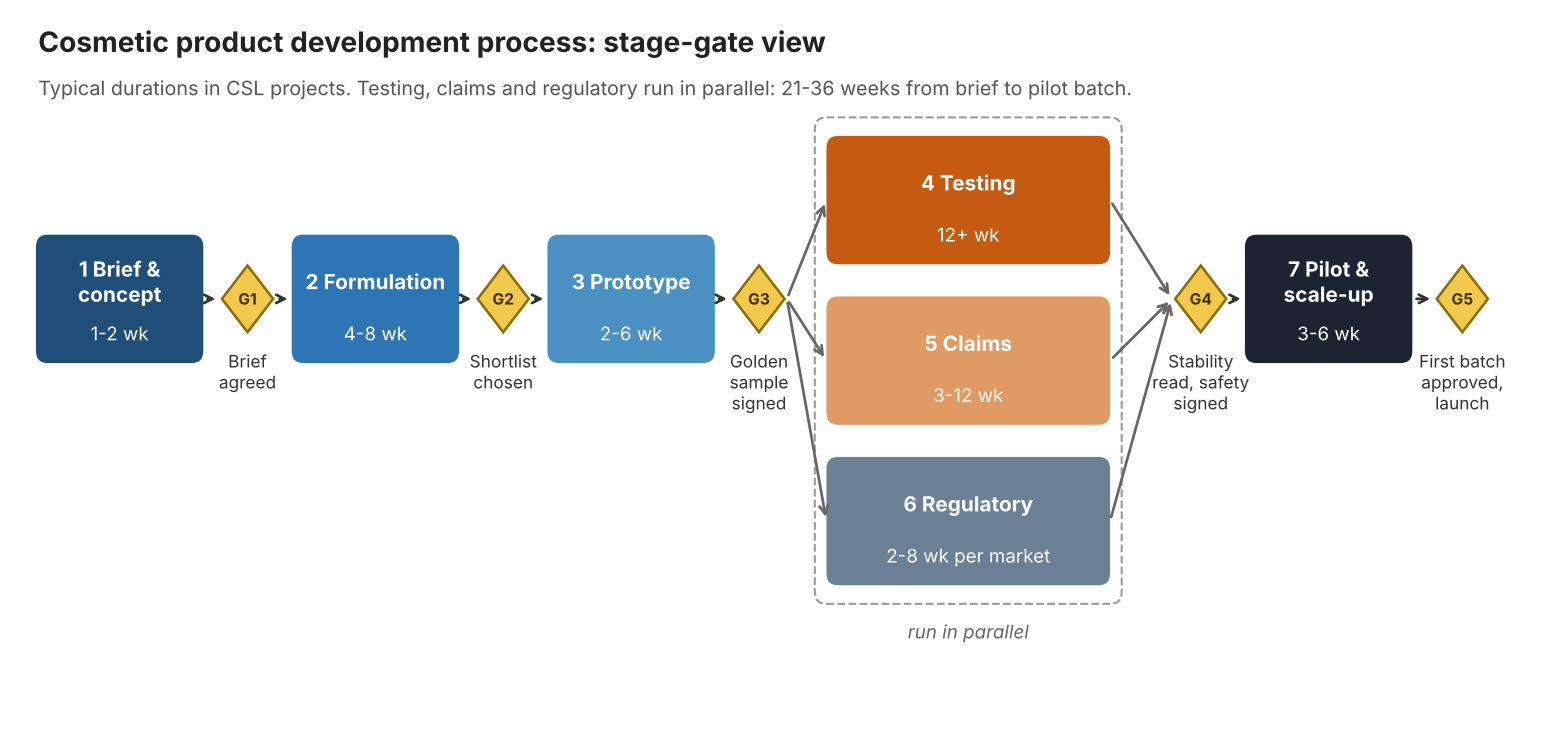
| Stage | What happens | Typical duration | Gate to pass | CSL service |
|---|---|---|---|---|
| 1 Brief and concept | Target user, benchmarking, claims wish-list, markets, pack and target cost agreed in writing | 1–2 weeks | Brief signed | Product formulation; Reverse engineering & benchmarking |
| 2 Formulation | Ingredients screened per market; bench trials; shortlist of formulas | 4–8 weeks | Shortlist chosen | Product formulation; Sourcing |
| 3 Prototype | Two or three directions; iterations on sensory, fragrance, colour and packaging | 2–6 weeks | Golden sample signed | Prototyping & product development |
| 4 Testing | Stability and compatibility in final pack, PET (28 days) and safety work [1][2] | 12+ weeks | First stability read | Safety & stability testing |
| 5 Claims | Patch tests (HRIPT about 6 weeks), use and efficacy studies scoped to wording [3][5] | 3–12 weeks | Claims supported | Claims & clinical support |
| 6 Regulatory | Safety assessment, product file, notifications and label review per market [4] | 2–8 weeks per market | Safety report signed; notified | Global regulatory |
| 7 Pilot and scale-up | Micro-batches, technology transfer and first production batch | 3–6 weeks | First batch approved; launch | Micro-batch manufacturing |
Why gates matter. A gate is a go or no-go decision with a named owner. Passing the brief gate fixes what you are building; passing the golden-sample gate fixes what gets tested. Skipping a gate does not save time. It moves the rework to a later stage, where every change restarts the clock.
Why stages 4 to 6 overlap. Stability takes months, so claims studies and regulatory files start as soon as the golden sample exists. The safety assessment then draws on stability, preservative and packaging data together [4], so all three must use the same formula and the same pack.
02The formulation variables that decide success
Four variables decide whether a formula survives testing and scale-up:
| Variable | What it controls | What goes wrong |
|---|---|---|
| Use level | Efficacy, cost and irritation of each active ingredient | In 12 commercial products, retinoid content fell 40–100% after 6 months at 40 °C (0–80% at 25 °C), and some held less than declared [9] |
| pH | Activity of acids and preservative performance | Glycolic acid is about 50% free acid at pH 3.8 but 18% at pH 4.5 [8] |
| Compatibility | Ingredient-ingredient and product-pack interactions | Separation, colour change or migration into packaging [1]; see plant actives and O/W stability |
| Process | Shear, heating and cooling rates, order of addition | Batches that pass in the lab but thin, separate or go grainy at scale; see tech transfer and scale-up |
These variables interact. A preservative system that works at pH 5.5 may fail at pH 6.5. An active that is stable in glass may degrade in a clear pump. A texture made at 1 kg may thin at 500 kg because shear falls in a larger vessel. That is why they are fixed in sequence: use level and pH during formulation, compatibility during prototyping, and process before technology transfer.
03Failure modes, and the stage that should catch them
| Failure | Shows up at | Should be caught at | Evidence |
|---|---|---|---|
| Microbial contamination | Market recall | Formulation and testing (PET) | 76.8% of 334 US FDA cosmetic recalls, 2011–2023 [6] |
| Banned or restricted substance | EU market surveillance | Brief and formulation screening | BMHCA behind almost 8 in 10 EU cosmetics alerts in 2025 [7] |
| Separation or viscosity drift | Stability or first production batch | Prototype and process lock | Accelerated and cycling tests are designed to expose it [1] |
| Unsupported claim | Regulator or competitor challenge | Brief (claim wording) | Evidence must match the claim [5] |
A late change to formula, supplier or pack after the golden sample. In practice stability and preservative-efficacy testing then have to be repeated, and the launch date moves by months.
04How CSL runs it
- Brief with a benchmark: we deformulate the product you want to beat, then write the brief around it.
- Market-screened formulation: ingredients checked against each market's lists, and against EU rules that ban animal testing for cosmetics [4].
- Clean, natural and sustainable briefs: see Clean, natural & Ayurvedic and clean beauty reformulation for eco-friendly ingredient and pack choices.
- Variables locked in order: use level and pH at formulation, pack compatibility at prototype, and process settings (tip speed, cooling rate, order of addition) before transfer, proven on three lab batches made with factory-grade raw materials.
- Specification fixed at sign-off: appearance, odour, pH, viscosity and density become the batch-release limits for every batch that follows.
- Parallel testing: stability, PET, claims and regulatory run together from the golden sample, with actives assayed over shelf life.
- Technology transfer: a transfer pack, pilot batch and approved first batch before launch.
For skincare product development, and for hair, body and colour products, the same seven stages apply to every launch of skincare products and beyond. Interested in product development jobs? See CSL careers.
Ready to move from brief to shelf?
Our Prototyping & product development team runs every stage, from the first brief to the approved first batch.
05Guides in this series
Each guide below goes deeper on one decision in the process, in the order a project meets them.
- Cosmetic chemist: when brands need one
What a cosmetic chemist does and when to hire, contract or use an external lab (brief and formulation).
- Cocamidopropyl betaine (CAPB) monograph
How to assess a raw material in depth, using a common surfactant as the example (formulation).
- Cosmetic formulation software: what AI can predict
What AI formulation tools can predict and what the lab still has to test (formulation and prototype).
- Packaging compatibility test for SPF
The pack tests to run before you order packaging (testing).
- Minimum order quantity (MOQ)
How MOQs set your first batch and cost per unit, and how to negotiate them (pilot and scale-up).
- Worked example: brief to pilot batch timeline
All seven stages in one illustrative project, about 31 weeks from brief to pilot batch.
06Questions readers ask
What are the stages of cosmetic product development?
Seven: brief and concept, formulation, prototype, testing, claims, regulatory, and pilot and scale-up. Testing, claims and regulatory work run in parallel.
How long does skincare product development take?
Typically 21 to 36 weeks from brief to pilot batch, less if a formula already exists. Stability testing sets the pace, with a first accelerated read at about 12 weeks.
What is a golden sample?
The approved reference batch signed off at the end of prototyping. It fixes the specification that testing, regulatory work and manufacturing all follow.
07References
- Colipa (now Cosmetics Europe), CTFA. Guidelines on stability testing of cosmetic products. Brussels: Colipa; March 2004. cosmeticseurope.eu
- ISO 11930:2019. Cosmetics — Microbiology — Evaluation of the antimicrobial protection of a cosmetic product. Geneva: ISO; 2019. iso.org. See also our ISO 11930 guide.
- Eurofins CRL. Human repeated insult patch test (HRIPT): study design. eurofinsus.com
- Regulation (EC) No 1223/2009 on cosmetic products, Articles 10, 11, 13 and 18 and Annex I. Off J Eur Union. 2009;L342:59–209. eur-lex.europa.eu
- Commission Regulation (EU) No 655/2013 laying down common criteria for the justification of claims used in relation to cosmetic products. Off J Eur Union. 11 Jul 2013;L190:31–34. eur-lex.europa.eu
- Venkatesh KP, Kadakia KT, Akbarpour A, Nambudiri VE. US Food and Drug Administration recalls of cosmetic and personal products from 2011 to 2023: a cross-sectional study. J Am Acad Dermatol. 2025;92(1):179–181. doi:10.1016/j.jaad.2024.09.040. DOI
- European Commission, Representation in Cyprus. Commission's 2025 Safety Gate report shows increased action against dangerous products. 5 Mar 2026. cyprus.representation.ec.europa.eu
- Cambier B, Barragan Ferrer D, Huysmans L, Cambier F, Barragan Ferrer JM. Formulating glycolic acid: balancing penetration, irritation and therapeutic outcomes in dermatology. Cosmetics. 2026;13(4):164. doi:10.3390/cosmetics13040164. DOI
- Temova Rakuša Ž, Škufca P, Kristl A, Roškar R. Retinoid stability and degradation kinetics in commercial cosmetic products. J Cosmet Dermatol. 2021;20(7):2350–2358. doi:10.1111/jocd.13852. DOI
Update log
- Published by Cosmetic Science Lab
This article is general technical information, not legal, regulatory or medical advice. Confirm requirements for your product and market before launch.