Barrier repair cream formulation for the UAE: why ceramides alone are not enough
UAE shoppers want barrier creams that survive 45 °C summers, cold air-conditioning and daily SPF. How to build the lipid system, emulsion and sensory profile that a "barrier repair" claim implies, and validate it for Gulf heat.
By CSL Formulation team, Cosmetic Science Lab · Reviewed by Shreya Rangarajan
Brief at a glance
- Market signal
- UAE facial skincare: USD 258.0 million in 2025, forecast USD 421.5 million by 2033; facial creams the largest segment at 38.91%
- Core problem
- "Contains ceramides" is a label fact, not a barrier-repair system
- Design target
- Ceramides + cholesterol + free fatty acids, starting near 3:1:1 molar, in a lamellar-rich emulsion
- UAE stresses
- 45–48 °C summers, cold dry air-conditioning, SPF and makeup layering, hot storage
- Main failure modes
- Ceramide crystallisation (graininess), tack, pilling, slow dry-down
- Claim boundary
- Cosmetic wording only; therapeutic claims move the product to a medicated pathway
Quick answer
- A ceramide on the INCI list shows presence, not function. Solubility, crystallisation and the emulsion decide whether it does anything.
- Lamellar or lamellar-rich emulsions mirror the skin's own lipid organisation [4], but they need tighter process control.
- In the UAE, tack, pilling and heaviness end repeat purchase faster than any efficacy gap. Validate structure, texture and pack under heat cycling before launch.
Take-home message for formulators
- Specify the level of each pure ceramide, not the premix
- Control melt, cooling and shear to stop recrystallisation
- Cap humectant load; test layering under SPF early
Take-home message for brand owners
- Brief sensory targets as clearly as lipid targets
- Budget for heat-cycling and lamellar-structure checks
- Keep claims cosmetic unless you plan a medicated registration
01Why barrier repair is a high-value need in the UAE
The UAE facial skincare market earned USD 258.0 million in 2025 and is forecast to reach USD 421.5 million by 2033, a 6.3% CAGR. Facial creams were the largest segment, at 38.91% of 2025 revenue [8]. Analysts link the country's skincare-first buying to extreme heat, air-conditioning exposure and desert conditions [9]. Barrier support sits at the centre of that demand, in pharmacy brands, K-beauty imports and private-label launches.
Three local pressures shape the brief:
- Environmental swings. During summer heat spells, the national weather authority has reported 45–48 °C inland, 39–46 °C on the coast and coastal humidity of 70–90% [10]. People then move many times a day into cold, dry, air-conditioned interiors.
- Active-heavy routines. Retinoids, exfoliating acids and in-clinic procedures are common, and consumers want products that keep skin comfortable alongside them.
- High sensory expectations. Heat makes heavy, greasy or tacky creams unacceptable. A cream that performs on paper but feels wrong in August will not be repurchased.
Many launches add ceramides to a standard cream and make a barrier claim. Few build the lipid system, emulsion structure and sensory profile the claim implies. That gap is where formulation quality becomes a competitive advantage.
02What the skin barrier actually consists of
The permeability barrier sits in the stratum corneum and is best described as "bricks and mortar" [1]. The bricks are corneocytes, flattened protein-rich cells. The mortar is the lipid matrix between them.
| Component | What it is | Why formulators care |
|---|---|---|
| Corneocytes | Flattened, protein-filled cells | Hold water inside via natural moisturising factor (NMF) [5] |
| Intercellular lipid matrix | Ceramides, cholesterol and free fatty acids in stacked bilayers | The main route for water loss; what barrier creams aim to supply |
| Corneocyte lipid envelope | Lipids bound to the cell surface | Anchors the lipid lamellae to the cells |
Three features of the lipid matrix matter to a formulator. Its composition is roughly equimolar ceramides, cholesterol and free fatty acids, with very little phospholipid [4]. Its organisation is stacked lamellar phases with mostly dense, orthorhombic packing, which is what limits water movement [4], [5]. And its diversity of ceramide subclasses, including long-chain and ultra-long-chain species, helps stabilise those phases [4].
Barrier integrity is usually measured as transepidermal water loss (TEWL). When lipid composition or packing is disrupted, TEWL rises and skin feels dry, tight or reactive [5].
03Why "contains ceramides" is not barrier repair
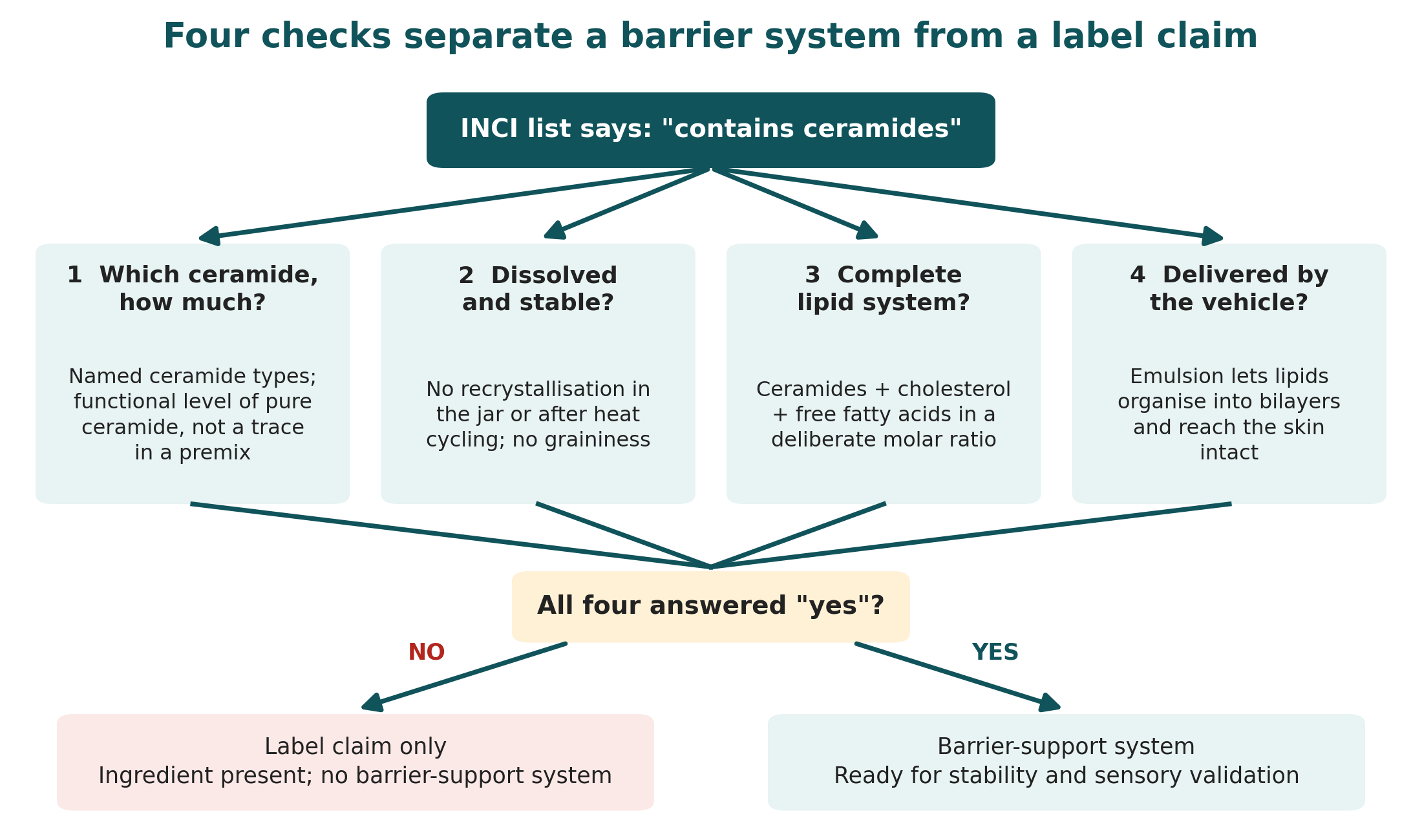
A ceramide on the label shows an ingredient is present. It does not show whether that ingredient can do anything once the cream is on skin. Four questions separate a real barrier system from a label claim:
- Which ceramide, and how much?
Commercial ceramides differ in head group and chain length (for example ceramide NP, AP, EOP). Some products carry a trace inside a premix, far below a functional level.
- Is it dissolved and stable?
Ceramides are high-melting and poorly soluble. If they recrystallise in the jar, they are no longer available to the skin.
- Is the lipid system complete?
Applying one or two of the three key lipids to disrupted skin delayed recovery, while complete mixtures allowed it [2], [3].
- Does the vehicle deliver it?
Emulsion type, droplet structure and surrounding emollients decide where the lipids end up.
04Ceramide solubility, crystallisation and graininess
Ceramides are the hardest part of the lipid system to process. Most are high-melting crystalline solids with limited solubility in common cosmetic oils and none in water. If the process does not allow for this, three failures follow: incomplete dissolution (ceramide added below its melting range, or into too little solvent oil), recrystallisation (ceramide dissolved hot comes out of solution on cooling or over weeks, faster under temperature cycling) and graininess (crystals feel gritty on application and show as specks or lost gloss).
| Lever | What it does | Trade-off to watch |
|---|---|---|
| Solvent-oil selection | Polar emollients and some esters improve ceramide solubility | Can change spreading and skin feel |
| Heating profile | Full melt above the ceramide melting range, held long enough | Energy and time; heat-sensitive ingredients go in later |
| Controlled cooling and shear | Influences crystal size and lamellar structure formation | Needs a validated, repeatable process at scale |
| Co-lipids and structurants | Cholesterol, fatty acids and fatty alcohols co-assemble with ceramides | Ratio shifts change viscosity and stability |
| Ceramide premixes or delivery systems | Pre-solubilised or encapsulated ceramides simplify processing | Check the real ceramide level and cost per functional dose |
A cream can pass release, then spend weeks in a summer warehouse, a delivery van or a parked car. Each hot–cold swing gives dissolved ceramide another chance to crystallise. The result is a cream that turns grainy months after launch, which consumers read as a spoiled product. Put heat-cycling and rub-out graininess checks in the first round of prototypes, not at the end.
05Designing the lipid system: ceramides, cholesterol and free fatty acids
The best-known reference is work by Man, Feingold and Elias on barrier-disrupted skin. Applying a single key lipid, or an incomplete pair, could delay barrier recovery [2]. An equimolar mix of ceramide, cholesterol and free fatty acid allowed normal recovery, and raising any one of the three up to a 3:1:1 molar ratio accelerated it [3]. A ceramide-dominant 3:1:1 is the version most cited in skin care.
The work was mainly in mouse skin, with only preliminary results in human skin [3]. It tested specific lipids in specific vehicles, not finished commercial creams, and it does not set a universal clinical standard. Treat 3:1:1 as a well-supported starting hypothesis and confirm performance in the finished formula.
| Lipid | Function in the matrix | Formulation notes |
|---|---|---|
| Ceramides | Main structural lipid; drive lamellar organisation | High-melting; solubility and crystallisation control are critical |
| Cholesterol | Adds fluidity and chain mixing; supports phase behaviour | Also high-melting; can crystallise if overloaded |
| Free fatty acids | Help packing; contribute to surface acidity | Long saturated chains (stearic, palmitic) favour tight packing; linoleic-rich oils play a separate, supportive role |
For the brief: choose barrier ingredients by function, supply and solubility, and state the level of each pure ceramide. Set a target molar ratio and check it in the final formula, including lipids that come from other ingredients. Match fatty-acid chain lengths to the packing you want, because generic plant oils do not supply the right fatty acids by themselves. Then plan how the ratio will be verified in production, through raw-material specifications and batch records.
06Lamellar emulsions versus conventional emulsions
The vehicle decides whether the lipid system reaches skin as an organised structure or as scattered droplets. In a conventional oil-in-water emulsion, barrier lipids stay inside droplets and must reorganise on skin by themselves. In a lamellar emulsion, emulsifiers and fatty alcohols form bilayer sheets around droplets and through the water phase. That structure resembles the stratum corneum's own organisation [4], and barrier lipids can be built into it.
| Factor | Conventional O/W | Lamellar or lamellar-rich |
|---|---|---|
| Similarity to skin lipids | Low | High |
| Ceramide integration | Lipids dispersed in droplets | Lipids can sit within bilayers |
| Sensory flexibility | Wide range of textures | Often richer; light textures take more work |
| Process sensitivity | Moderate | High: temperature, shear and cooling profile matter |
| Stability risks | Creaming, coalescence | Structure change on ageing, viscosity drift, crystallisation |
| Development and scale-up | Shorter | Longer; needs structure confirmation |
Lamellar structure is usually confirmed with polarised light microscopy, which shows characteristic "Maltese cross" patterns, and X-ray scattering where needed. Many successful products are hybrids: a lamellar-rich emulsion tuned for a lighter feel.
07Balancing humectants, emollients and occlusives
Barrier lipids rebuild structure; the moisturising system manages water while that happens [5].
| Class | Job | Examples | Risk when overused |
|---|---|---|---|
| Humectants | Attract and hold water in the upper stratum corneum | Glycerin, propanediol, sodium PCA, urea, hyaluronic acid | Tack, stickiness, pilling |
| Emollients | Fill surface gaps; soften and improve spread | Esters, squalane, plant oils, fatty alcohols | Greasiness; some disrupt lamellar phases |
| Occlusives | Slow water evaporation from the surface | Petrolatum, dimethicone, waxes, shea butter | Heavy, shiny finish; poor layering |
In the UAE this balance shifts across the day. In dry air-conditioned rooms, occlusion matters most because low ambient humidity raises TEWL. In humid outdoor heat, heavy occlusion feels suffocating and shiny. Most UAE briefs therefore favour moderate humectancy, light emollients and targeted occlusion, often from silicones or light waxes rather than high petrolatum levels.
High humectant loading is the most common sensory failure. Surface humectant feels sticky, especially in humid air; humectant-rich films with film-forming polymers can roll into flakes under SPF and makeup; and a wet, lingering finish delays the next routine step. The fixes: cap the total humectant load and split it across humectants with different feel, add fast-spreading emollients or sensory powders, review polymer choice for pilling, and test layering early with real SPF and foundation formats.
08Niacinamide as a barrier-support active
Niacinamide works from the other direction to the lipid system. In cultured keratinocytes it increased ceramide synthesis, and topical use raised stratum corneum ceramides and lowered TEWL in dry skin [6]. It supplies no lipid itself; it supports the skin's own production.
It is forgiving, but not formulation-free. Keep the formula at a moderate pH, typically around 5–7, because strongly acidic conditions can hydrolyse niacinamide to nicotinic acid, which is linked to transient flushing. Justify and test any pairing with low-pH acids, add it at a controlled temperature (often during cool-down), and check assay after stability storage. Our niacinamide flushing guide covers this in depth. Oil choice matters too: in a human study, sunflower seed oil preserved barrier integrity while olive oil damaged it [7].
09UAE sensory design: heat, air-conditioning, SPF and makeup
In the UAE, sensory design is part of efficacy: a cream that is not used every day cannot support the barrier.
| Use condition | What the skin experiences | Formulation response |
|---|---|---|
| Outdoor heat and humidity | Sweat and sebum; heavy products feel suffocating | Light emollients, low occlusive load, matte or soft-satin finish |
| Air-conditioned interiors | Low ambient humidity; faster surface drying | Enough lipid and targeted occlusion to limit water loss |
| Daily SPF | Sunscreen on top; film compatibility matters | Fast dry-down, no pilling; test with mineral and chemical SPF bases |
| Makeup layering | Foundation must sit evenly without sliding | Low residual tack, controlled slip, pilling tests with foundations |
| Storage and transport heat | Cars and warehouses can exceed test temperatures | Robust structure; test at elevated and cycling temperatures |
This often works best as two textures from one architecture: a lighter day cream with lower occlusion that layers under SPF, and a richer night cream that carries more lipid and occlusive load.
10CSL barrier-repair formulation architecture
CSL treats barrier repair cream formulation as six design layers on one validation base. Each layer answers a failure mode described above.
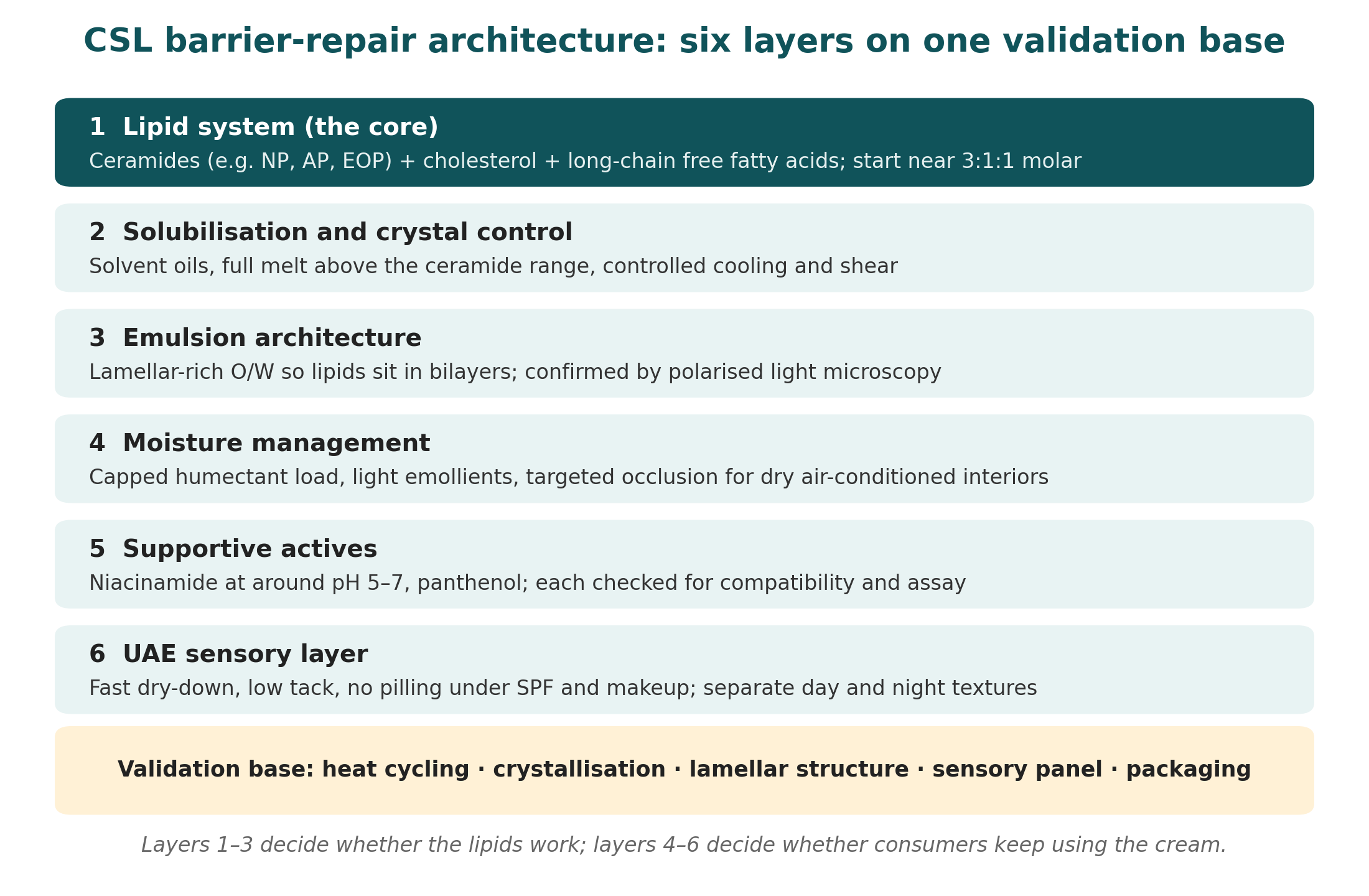
To show what architecture adds, a development programme can compare three prototype systems built around the same ceramide input. The outcomes below are design hypotheses to be tested, not results.
| Prototype | Lipid system | Emulsion | Design hypothesis |
|---|---|---|---|
| A: Standard + ceramide | Ceramide only | Conventional O/W | Easy to make; highest crystallisation risk; weakest skin match |
| B: Multi-lipid | Ceramide + cholesterol + FFA near 3:1:1 | Conventional O/W | Complete lipid set; still dispersed in droplets |
| C: Optimised lamellar | 3:1:1 lipids with crystal control | Lamellar-rich O/W, tuned for UAE | Best structural match; most process-sensitive |
We will review your brief or benchmark, recommend an architecture (A, B or C) and scope the validation. Request a feasibility review
11How CSL validates stability, sensory and packaging
Validation proves three things: the structure survives, the texture survives, and the pack protects both. CSL builds these checks into development rather than adding them before launch.
| Area | What CSL checks | Why it matters in the UAE |
|---|---|---|
| Physical stability | Appearance, pH, viscosity and separation at 5, 25, 40 and 45 °C and under heat cycling | Heat and cycling in storage and transport are the main stresses |
| Crystallisation | Microscopy for ceramide or cholesterol crystals; graininess on rub-out | Detects the most common barrier-cream failure early |
| Lamellar structure | Polarised light microscopy at start and after storage | Confirms the structure lasts beyond day one |
| Active stability | Niacinamide and other active assay after storage | Supports label and claim accuracy |
| Sensory performance | Panel: spread, absorption, tack, dry-down, residue, shine | Sensory drift after storage is a real risk |
| Layering | Pilling and finish under SPF and makeup | Reflects actual daily routines |
| Packaging | Weight loss, discolouration, deformation, dispensing | Airless and tube formats behave differently in heat |
| Microbiological | Preservative efficacy testing | Required for safe use and regulatory files |
A typical protocol stores each prototype at 5, 25, 40 and 45 °C, plus heat–cold cycling between −5 °C and 45 °C, with readouts at day 0 and at 1, 2 and 3 months: appearance, pH, viscosity, rub-out graininess, crystal microscopy and polarised light microscopy. A sensory panel at day 0 and 3 months scores spread, absorption, tack, dry-down, residue and pilling under a mineral and a chemical SPF, and the lead prototype is stored at 45 °C in its final pack. Our stability testing team runs these alongside formulation.
12Regulatory fit and claim wording in the UAE
GCC cosmetic rules are built on shared standards, mainly GSO 1943, GSO 2528 and GSO 2020, which are closely aligned with EU cosmetic rules [11]. Standard cosmetics sold in Dubai register with Dubai Municipality through the Montaji portal [12]. Claim wording matters as much as the formula: a therapeutic claim, such as treating eczema or relieving skin inflammation, can reclassify a cosmetic as a medicated product and move it to the Emirates Drug Establishment pathway [12]. Use cosmetic language, such as "supports the skin's moisture barrier", and see our guide to UAE cosmeceutical classification before finalising claims.
13Questions readers ask
Why do ceramide-only barrier creams underperform in the UAE?
Ceramides need cholesterol and free fatty acids to form the lamellar bilayers that limit water loss. Without those co-lipids and a vehicle that keeps them dissolved, the ceramide contributes little. UAE heat and dry indoor air make both water loss and texture problems show up faster.
What is the best ceramide to cholesterol to fatty acid ratio?
An equimolar mix supported normal recovery in barrier-disrupted skin, and raising one lipid up to a 3:1:1 molar ratio accelerated it. A ceramide-dominant 3:1:1 is a sound starting point, to be confirmed in the finished formula.
How does a lamellar emulsion improve a barrier cream?
It arranges emulsifiers and lipids in bilayer sheets that resemble the skin's lipid matrix, so barrier lipids can sit within that structure. The trade-off is a more sensitive process and more stability testing.
Why does a barrier cream turn grainy over time?
Usually ceramide or cholesterol recrystallises after production or during heat cycling. The fix lies in solvent-oil choice, heating and cooling profile, lipid ratio and sometimes a pre-solubilised ceramide.
Can a barrier cream be light enough to wear under SPF in a UAE summer?
Yes, with deliberate design: moderate humectant and occlusive loads, fast-spreading emollients, and pilling tests with real sunscreens and foundations during development.
Can a UAE barrier cream claim to treat eczema?
Not as a standard cosmetic. Therapeutic wording can push the product into medicated registration. Use cosmetic language unless the brand intends a medicated registration, and confirm classification with a regulatory specialist.
Building a barrier cream for UAE or GCC consumers?
Or fixing graininess, tack or pilling in an existing one? We design the lipid system, emulsion and sensory profile together, then validate them for Gulf heat.
14References
- Elias PM. Epidermal lipids, barrier function, and desquamation. J Invest Dermatol. 1983;80(Suppl):44s–49s. ScienceDirect
- Man MQ, Feingold KR, Elias PM. Exogenous lipids influence permeability barrier recovery in acetone-treated murine skin. Arch Dermatol. 1993;129(6):728–738. PubMed
- Man MQ, Feingold KR, Thornfeldt CR, Elias PM. Optimization of physiological lipid mixtures for barrier repair. J Invest Dermatol. 1996;106(5):1096–1101. PubMed
- Bouwstra JA, Ponec M. The skin barrier in healthy and diseased state. Biochim Biophys Acta. 2006;1758(12):2080–2095. PubMed
- Rawlings AV, Harding CR. Moisturization and skin barrier function. Dermatol Ther. 2004;17(Suppl 1):43–48. PubMed
- Tanno O, Ota Y, Kitamura N, Katsube T, Inoue S. Nicotinamide increases biosynthesis of ceramides as well as other stratum corneum lipids to improve the epidermal permeability barrier. Br J Dermatol. 2000;143(3):524–531. PubMed
- Danby SG, AlEnezi T, Sultan A, et al. Effect of olive and sunflower seed oil on the adult skin barrier: implications for neonatal skin care. Pediatr Dermatol. 2013;30(1):42–50. PubMed
- Grand View Research. UAE facial skincare market size and outlook, 2026–2033. Horizon Databook. Grand View Research
- Mordor Intelligence. UAE cosmetic products market: size, trends and forecast 2026–2031. January 2026. Mordor Intelligence
- Gulf News. Summer in Dubai: 48 degrees and counting (reporting National Centre of Meteorology forecasts). Gulf News
- ChemLinked. United Arab Emirates (UAE) cosmetic regulation. ChemLinked
- The Corpbridge. Cosmetic product registration in the UAE: 2026 requirements and process. June 2026. The Corpbridge
Update log
- Published by Cosmetic Science Lab
This article is general technical information, not legal, regulatory or medical advice. Confirm requirements for your product and market before launch.