Bakuchiol: what the evidence shows as a gentler retinol alternative
Bakuchiol is a plant-derived active often sold as a gentle alternative to retinol. Here is what the trials show, why the evidence is still thin, and how CSL formulation scientists use it.
By CSL Formulation team · Evidence checked by CSL scientists
At a glance
- What it is
- A plant compound from the seeds of Psoralea corylifolia (babchi); not a retinoid, though it affects some of the same skin pathways
- Main benefits
- Fewer visible fine lines and a more even-looking tone, with less irritation than retinol in one trial
- Levels tested in trials
- 0.5% twice daily in the key controlled trial; 1.5% in an open-label combination serum
- Time to results
- 8 to 12 weeks in published studies
- Watch for
- Small, mostly industry-funded evidence base; many studies test combination products
01What is it?
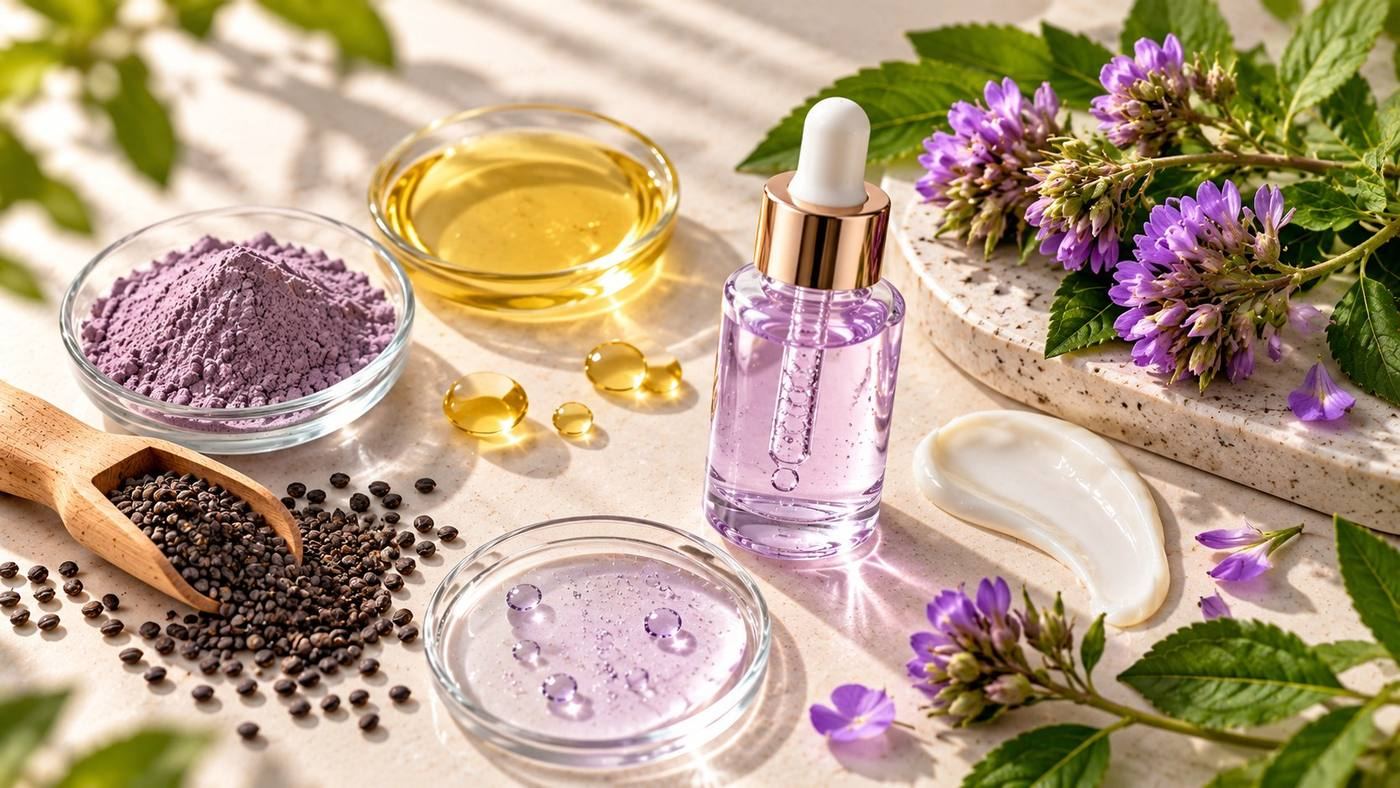
Bakuchiol is an oily compound extracted from babchi seeds, a plant used in traditional Indian and Chinese medicine. It is not related to vitamin A in structure. It became popular as a ‘retinol alternative’ after lab work showed it switches on some of the same genes as retinol.
02What it does
In lab studies bakuchiol changes gene activity in a retinol-like way, including genes linked to collagen. On skin, the best trial found fewer visible wrinkles and less uneven pigmentation after 12 weeks, similar to retinol but with less scaling and stinging. It is stable in light, which makes it easier to formulate than retinol.
03The evidence
Studies below were checked against the publisher, DOI or journal record on 26 Sep 2026. We list design and size so you can judge the strength of each result.
| Study | Design | Who and how long | What it found |
|---|---|---|---|
| Dhaliwal et al. 2019, British Journal of Dermatology (Oxford) Source | Randomised, double-blind trial against retinol | 44 adults, 12 weeks, 0.5% bakuchiol twice daily vs 0.5% retinol once daily | Both reduced wrinkle surface area and pigmentation, with no significant difference between them; wrinkles fell about 20% by week 12. Retinol caused more scaling and stinging. |
| Chaudhuri and Bojanowski 2014, International Journal of Cosmetic Science (Wiley) Source | Lab gene-expression study plus a small open-label clinical test | Women using a bakuchiol product twice daily for 12 weeks; no control group | Lab work showed retinol-like gene effects; users had fewer visible lines and better firmness and tone. Weak clinical evidence because there was no control group. |
| Bacqueville et al. 2020, Clinical, Cosmetic and Investigational Dermatology (Dove Press) Source | Open-label study, no control group | 43 women aged 45 to 65, 56 days, serum with 1.5% bakuchiol and vanilla extract | Firmness scores improved 35% and sagging 11% on average. No control group, a combination product, and all authors were employees of the sponsor. |
| Fanning et al. 2024, Journal of Drugs in Dermatology Source | Systematic review | 15 human trials in ageing skin, acne and post-inflammatory pigmentation | 12 of 15 trials were open-label with no control, 10 used combination products and 4 did not state the bakuchiol level. The authors judge the risk of bias high. |
| Lin et al. 2025, Scientific Reports (Springer Nature) Source | Network meta-analysis of randomised trials | 23 photoageing trials; only one bakuchiol trial qualified | For fine wrinkles, bakuchiol’s estimate versus placebo was not statistically significant (odds ratio 9.4, very wide confidence interval), because the data are so limited. |
Bakuchiol has one good randomised trial showing results similar to 0.5% retinol with better tolerance, and little else of high quality. It suits gentle, sensitive-skin or ‘retinol-alternative’ positioning, with modest claims such as ‘visibly smooths the look of fine lines’ supported by testing of the finished product. It should not be described as ‘natural retinol’ or as equal to retinol in general.
04How CSL formulation scientists use it
- The best-tested level is 0.5%, applied twice daily. CSL formulation scientists keep to tested levels and support any higher-strength claims with product-specific testing.
- Bakuchiol is oil-soluble and light-stable, so it works well in emulsions, oils and serums with an oil phase, and in daytime products.
- It pairs well with barrier and soothing ingredients, and can be combined with low-level retinoids in ‘gentle retinoid’ ranges.
- As with any new active, CSL formulation scientists run repeat-insult patch testing on the finished product and keep supplier purity specifications on file.
05Regulatory and claims
CSL regulatory specialists could not confirm a specific concentration limit for bakuchiol in the EU Cosmetics Regulation annexes, and confirm its status in each target market before launch. Because it is a plant-derived compound, supplier documentation on purity and origin is reviewed for each batch source. Claims stay cosmetic: ‘improves the look of fine lines’, not ‘repairs photodamage’.
06Questions brands ask
Is bakuchiol as good as retinol?
In one 12-week randomised trial of 44 people, 0.5% bakuchiol twice daily performed similarly to 0.5% retinol once daily, with less irritation. That is one small study, so ‘as good as retinol’ is too strong a general claim.
Is bakuchiol suitable for sensitive skin?
It caused less scaling and stinging than retinol in the key trial, which supports gentle positioning. That does not make it irritation-free for everyone, so the finished product still needs patch testing.
Can bakuchiol be used with retinol?
Yes. Some commercial products combine them, but most combination studies have no control group, so claims should reflect the tested product rather than each ingredient.
07References
- Dhaliwal S, Rybak I, Ellis SR, et al. Prospective, randomized, double-blind assessment of topical bakuchiol and retinol for facial photoageing. Br J Dermatol. 2019;180(2):289–296. Link
- Dhaliwal S, Rybak I, Ellis SR, et al. Assessment of topical bakuchiol and retinol for facial photoageing (plain language summary). Br J Dermatol. 2019;180(2):e45. Link
- Chaudhuri RK, Bojanowski K. Bakuchiol: a retinol-like functional compound revealed by gene expression profiling and clinically proven to have anti-aging effects. Int J Cosmet Sci. 2014;36(3):221–230. Link
- Bacqueville D, et al. Efficacy of a dermocosmetic serum combining bakuchiol and vanilla tahitensis extract to prevent skin photoaging in vitro and to improve clinical outcomes for naturally aged skin. Clin Cosmet Investig Dermatol. 2020;13:359–370. Link
- Fanning JE, McGee SA, Ibrahim OI. Human clinical trials using topical bakuchiol formulations for the treatment of skin disorders: a systematic review. J Drugs Dermatol. 2024;23(4):239–243. doi:10.36849/JDD.7763 Link
- Lin L, Chen X, Liu C, et al. Comparative efficacy of topical interventions for facial photoaging: a network meta-analysis. Sci Rep. 2025;15:26889. Link
Used in: Anti-ageing & wrinkles
Update log
- Evidence reviewed and page published by CSL scientists
This page summarises published research for brands and formulators. It is general information, not medical advice, and results in studies depend on the full formula tested.