Ceramides in skin care: what the evidence shows for barrier repair
Ceramides are the main lipids of the skin barrier. Here is what trials show for dry and eczema-prone skin, how strong the evidence is, and how CSL formulation scientists build them into stable creams.
By CSL Formulation team · Evidence checked by CSL scientists
At a glance
- What it is
- Skin-identical barrier lipids (for example ceramide NP, AP, EOP), often blended with cholesterol and free fatty acids, plus synthetic pseudo-ceramides
- Main benefits
- Lower water loss, better hydration and a more comfortable, less dry-feeling skin barrier
- Levels tested in trials
- 0.05% to 0.5% for individual ceramides; 3% pseudo-ceramide; many trials test whole branded creams without stating levels
- Time to results
- Barrier and hydration changes within 1 to 4 weeks; eczema-prone skin trials run 4 to 21 weeks
- Watch for
- Poor solubility and crystallisation, undisclosed levels in trials, and small or industry-funded studies
01What is it?
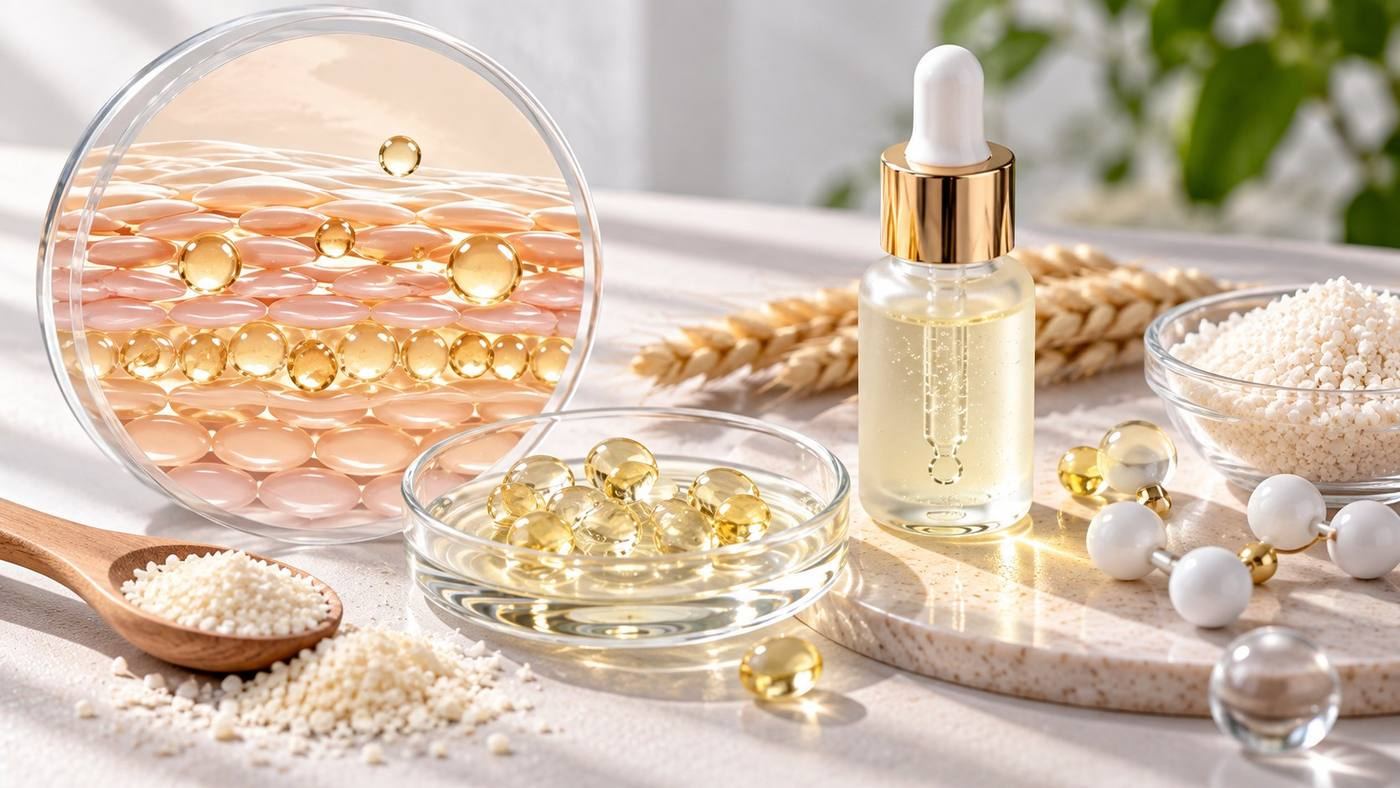
Ceramides are waxy lipids that make up about half of the lipid layer between the cells of the outer skin. Together with cholesterol and free fatty acids they form stacked layers that keep water in and irritants out. Dry and eczema-prone skin often has fewer or altered ceramides. Cosmetics use skin-identical ceramides, ceramide-dominant lipid blends and synthetic look-alikes called pseudo-ceramides.
02What it does
Applied ceramides can fill gaps in the lipid layers, so less water escapes through the skin. In trials this shows as lower transepidermal water loss (TEWL) and higher skin hydration within weeks. Visible benefits are less dryness, roughness and tightness; in eczema-prone skin they are used alongside, not instead of, medical care.
03The evidence
Studies below were checked against the publisher, DOI or journal record on 26 Sep 2026. We list design and size so you can judge the strength of each result.
| Study | Design | Who and how long | What it found |
|---|---|---|---|
| Dimmers et al. 2026, Skin Pharmacology and Physiology (Karger) Source | Randomised, double-blind, vehicle-controlled split-body trial | 50 adults with sensitive skin, 6 weeks, ceramide NP C15 emollient vs the same base without it (level not stated in abstract) | Both sides felt better; in people with a weak barrier the ceramide side cut water loss significantly more, with small shifts in skin bacteria. |
| Liu et al. 2026, Clinical, Cosmetic and Investigational Dermatology (Dove Press) Source | Double-blind, single-centre, before-and-after study | 32 women with sensitive skin, 28 days, 0.05% ceramide NP made from marula oil fatty acids | Water loss fell 3.7%, hydration rose 10.2% and redness fell 6.9% from baseline, with no side effects. Small changes and no untreated control group. |
| Kang et al. 2025, Cosmetics (MDPI) Source | Vehicle-controlled, double-blind, within-person study | 20 healthy women, 4 weeks, 0.2% ceramide NP with or without 0.02% to 0.5% ceramide ENP (an acylceramide) | Adding the acylceramide raised hydration by 26% more than ceramide NP alone and strengthened outer-skin cohesion. |
| Nugroho et al. 2023, Indian Journal of Dermatology (Wolters Kluwer) Source | Systematic review and meta-analysis | 5 studies of people with atopic dermatitis comparing ceramide moisturisers with other moisturisers | Eczema scores improved slightly more with ceramides (mean difference −0.98 SCORAD points), but water loss was not significantly different. |
| Okoshi et al. 2022, Dermatology and Therapy (Springer Nature) Source | Randomised, double-blind trial | 34 adults with mild-to-moderate atopic dermatitis, 2 weeks, steroid cream with 3% pseudo-ceramide vs the same steroid cream without it | Symptoms improved equally in both groups, but only the pseudo-ceramide cream raised skin moisture and lowered water loss. |
| Spada et al. 2021, Dermatologic Therapy (Wiley) Source | Randomised, placebo-controlled trial | 100 adults with moderate eczema, 28 days, ceramide-dominant physiological lipid cream and cleanser vs placebo products | Water loss and hydration improved only in the ceramide group (P = .03 and P < .0001); eczema scores fell in both groups with no difference between them. |
| Chamlin et al. 2002, Journal of the American Academy of Dermatology (Elsevier) Source | Open study without a control group (landmark) | 24 children with hard-to-treat atopic dermatitis, 20 to 21 weeks, ceramide-dominant lipid emollient in place of their usual moisturiser | Eczema scores improved in 22 of 24 children by 3 weeks and in all by the end; water loss kept falling after scores levelled off. |
Ceramides reliably help the skin barrier hold water, and this is the claim the evidence supports best. Their extra benefit over a well-made ordinary moisturiser is small and rests on modest trials, so wording such as “helps restore the skin’s moisture barrier” and “visibly less dry skin” fits the data better than disease-related claims.
04How CSL formulation scientists use it
- Ceramides are poorly soluble and can crystallise. CSL formulation scientists pre-dissolve them hot in a suitable oil or solvent phase and check for crystals under the microscope during stability testing.
- Blend with cholesterol and free fatty acids in a ceramide-dominant mix, or use lamellar (liquid-crystal) emulsions, to mimic the skin’s own lipid layers rather than adding a single ceramide as a label claim.
- Levels in published trials range from 0.05% to 0.5% for individual ceramides; the US safety review recorded leave-on use mostly up to 0.2%. Claim only what the tested form and level support.
- Ceramides pair well with humectants such as glycerin and with niacinamide, and suit fragrance-free formats for dry and eczema-prone skin.
05Regulatory and claims
The US Cosmetic Ingredient Review Expert Panel assessed 23 ceramides and concluded they are safe in cosmetics in current practices of use and concentration (Burnett et al. 2020). CSL regulatory specialists confirm the status of each ceramide or pseudo-ceramide in every target market. Claims stay cosmetic, such as “supports the skin barrier” and “relieves the feeling of dryness”; “treats eczema” is a medical claim.
06Questions brands ask
Are ceramides better than an ordinary moisturiser?
Slightly, on current evidence. A meta-analysis found a small extra improvement in eczema scores but no clear difference in water loss. Formula quality and regular use matter as much as the ceramide itself.
What is a pseudo-ceramide?
A synthetic lipid designed to behave like a natural ceramide in the skin’s lipid layers. A randomised trial of a 3% pseudo-ceramide cream showed better moisture and lower water loss than the same cream without it.
Why add cholesterol and fatty acids?
The skin barrier is built from all three lipids. Ceramide-dominant blends of the three are used in several of the trials and aim to rebuild the barrier’s layered structure.
07References
- Dimmers F, Reichert D, Nguyen T, et al. Monocentric, vehicle-controlled, double-blind study to assess the short- and long-term effects of a ceramide NP C15-containing emollient on the skin microbiome and the skin barrier function in sensitive skin. Skin Pharmacol Physiol. 2026;39(3):99–116. Link
- Liu Z, Zhu H, Yang Y, Chang H. Efficacy evaluation of N-acyl-phytosphingosine prepared from marula oil derived fatty acids in skin barrier repair. Clin Cosmet Investig Dermatol. 2026;19. Link
- Kang BG, Choi HK, Liu KH, et al. Identification of phytosphingosine-based 1-O-acylceramide in human stratum corneum and investigation of its role in skin barrier. Cosmetics. 2025;12(2):47. Link
- Nugroho WT, Sawitri S, Astindari A, et al. The efficacy of moisturisers containing ceramide compared with other moisturisers in the management of atopic dermatitis: a systematic literature review and meta-analysis. Indian J Dermatol. 2023;68(1):53–58. Link
- Okoshi K, Kinugasa Y, Ito S, et al. Efficacy of pseudo-ceramide-containing steroid lamellar cream in patients with mild to moderate atopic dermatitis: a randomized, double-blind study. Dermatol Ther (Heidelb). 2022;12:1823–1834. Link
- Spada F, Harrison IP, Barnes TM, et al. A daily regimen of a ceramide-dominant moisturizing cream and cleanser restores the skin permeability barrier in adults with moderate eczema: a randomized trial. Dermatol Ther. 2021;e14970. Link
- Chamlin SL, Kao J, Frieden IJ, et al. Ceramide-dominant barrier repair lipids alleviate childhood atopic dermatitis: changes in barrier function provide a sensitive indicator of disease activity. J Am Acad Dermatol. 2002;47(2):198–208. Link
- Taïeb A, Loden M, Schmid-Grendelmeier P. Evidence-based moisturizer selection for atopic dermatitis. JAAD Int. 2025;21:28–29. Link
- Burnett CL, Boyer IJ, Bergfeld WF, et al. Safety assessment of ceramides as used in cosmetics. Int J Toxicol. 2020;39(3 suppl):5S–25S. Link
Used in: Anti-ageing & wrinklesHydration & barrier repair
Update log
- Evidence reviewed and page published by CSL scientists
This page summarises published research for brands and formulators. It is general information, not medical advice, and results in studies depend on the full formula tested.