Glycerin in skin care: what the evidence shows for hydration and barrier
Glycerin is the workhorse humectant of skin care, with decades of controlled trials behind it. Here is what the evidence shows, how it compares with urea, and how CSL formulation scientists use it.
By CSL Formulation team · Evidence checked by CSL scientists
At a glance
- What it is
- Glycerin (glycerol), a simple water-binding alcohol that is also part of the skin’s own natural moisturising system
- Main benefits
- Better skin hydration; support for the skin barrier; smoother, less dry-looking skin
- Levels tested in trials
- 15% to 20% in emollient creams, often combined with paraffin, petrolatum or urea
- Time to results
- Hydration within hours to days; visible dryness improves over 2 to 4 weeks
- Watch for
- Sticky feel at high levels; most trials test glycerin with other ingredients, not alone
01What is it?
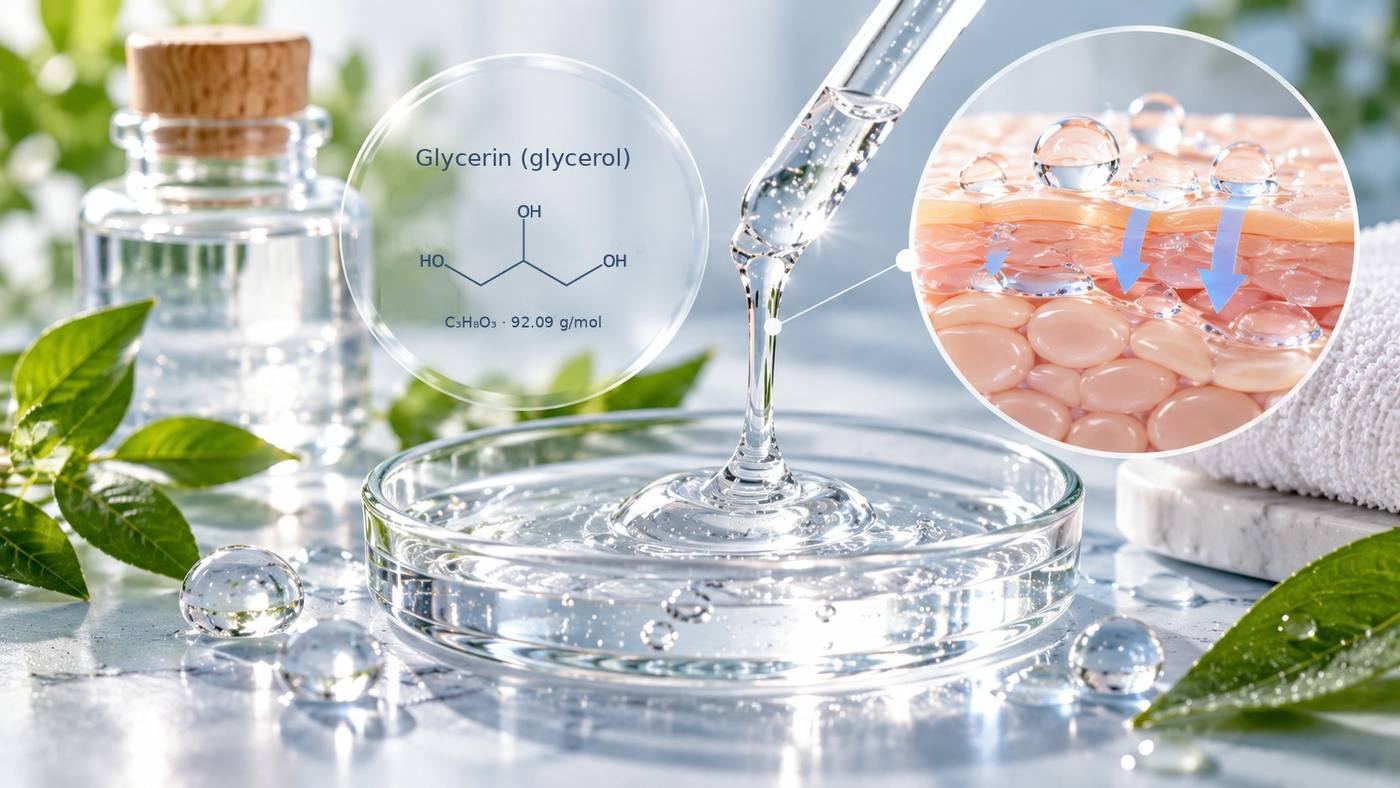
Glycerin is a small, water-loving molecule that the skin makes itself and moves through water channels in its cells. It is one of the most common ingredients in moisturisers. It is cheap, well tolerated and works in almost any water-based format.
02What it does
Glycerin draws water into the outer skin layer and keeps it there. It also helps the skin’s lipids stay in a flexible state and supports barrier function. The visible result is softer, smoother skin with less flaking and tightness.
03The evidence
Studies below were checked against the publisher, DOI or journal record on 26 Sep 2026. We list design and size so you can judge the strength of each result.
| Study | Design | Who and how long | What it found |
|---|---|---|---|
| Szepietowski et al. 2024, Dermatology and Therapy (Springer Nature) Source | Randomised, double-blind, vehicle-controlled phase 3 trial | 235 adults with severe dry skin linked to kidney disease, 28 days blinded then ≥84 days open-label, 15% glycerol with 10% paraffin | 60% responded versus 41% with vehicle (p=0.004), with lower dryness scores; treatment-related side effects in 5%, all local and mild to moderate. |
| Danby et al. 2022, Clinical and Experimental Dermatology (Oxford) Source | Observer-blinded, within-person randomised trial | 49 adults with atopic dermatitis, 28 days, 20% glycerol cream vs 20% glycerol with 2% urea vs paraffin cream vs no treatment | The urea-glycerol cream protected the barrier best (water loss −4.2 g/m²/h vs glycerol alone after irritant challenge); glycerol alone gave smaller gains, and the paraffin cream gave none. |
| Vaillant et al. 2020, Journal of Cosmetic Dermatology (Wiley) Source | Randomised, double-blind, four-arm crossover study | 51 healthy adults with dry skin, glycerol and petrolatum alone and combined | Glycerol drove the gain in skin hydration and petrolatum drove the reduction in water loss; the combination did both. |
| Lodén et al. 2002, Acta Dermato-Venereologica Source | Randomised, double-blind trial against placebo and a urea cream | 197 adults with atopic dermatitis, 30 days, 20% glycerin vs placebo vs 4% urea with 4% sodium chloride | Glycerin and urea improved dryness equally, but glycerin caused less smarting (10% vs 24% moderate or severe, p<0.001). |
| Lodén et al. 2001, Skin Research and Technology (Wiley) Source | Randomised, double-blind, parallel trial | 109 adults with atopic dermatitis, 30 days, 20% glycerine vs placebo vs 4% urea with 4% sodium chloride | Urea beat glycerine on dermatologist-rated dryness (p=0.024) and water loss (p=0.021); glycerine did not differ from its placebo. |
| Fluhr et al. 2008, British Journal of Dermatology (Oxford) Source | Narrative review | Human, laboratory and clinical data on glycerol in skin | Glycerol improves skin hydration, barrier function and mechanical properties, and protects against irritants; aquaporin-3 channels are key to its action. |
Glycerin is a proven, gentle humectant that improves hydration and supports the barrier, especially in well-built formulas with an occlusive partner. Head-to-head, low-dose urea can do slightly more for very dry skin, but glycerin stings less. Suitable claims: “hydrates”, “helps support the skin barrier” and “relieves the feeling of dry skin”.
04How CSL formulation scientists use it
- Everyday moisturisers typically use 3% to 10%; trials on very dry skin used 15% to 20%. Above about 10% manage stickiness with film-formers, silicones or powders.
- Pair glycerin with an occlusive such as petrolatum or paraffin: glycerin adds water, the occlusive stops it escaping.
- Glycerin works well with urea in dry-skin products and is a gentler choice than urea for sensitive, facial or stinging-prone skin.
- It is stable, pH-tolerant and compatible with almost all actives. Specify a refined, cosmetic-grade source and check it against the formula’s preservative system.
05Regulatory and claims
Glycerin is one of the most widely used cosmetic ingredients. CSL regulatory specialists confirm the status in each target market and check whether a product with high glycerin levels sold for eczema-prone skin moves into medical device or medicine rules. Claims stay cosmetic: “hydrates” and “supports the skin barrier”, never “treats eczema”.
06Questions brands ask
Is glycerin or urea better for dry skin?
It depends on the skin. In one trial 4% urea improved dryness slightly more than 20% glycerin; in another they matched, and glycerin caused less smarting. Glycerin suits sensitive skin; urea suits rough, very dry areas.
Can glycerin dry out skin in low humidity?
Not in trials. Paired with an occlusive, glycerin raised hydration in dry-skin studies. Formulas should still include an occlusive for very dry climates.
How much glycerin does a moisturiser need?
Everyday products work at a few percent. Trials on very dry skin used 15% to 20%, which needs careful texture work to avoid stickiness.
07References
- Szepietowski JC, Kemeny L, Mettang T, Arenberger P, et al. Long-term efficacy and tolerability of an emollient containing glycerol and paraffin for moderate-to-severe uremic xerosis: a randomized phase 3 study. Dermatol Ther (Heidelb). 2024;14(11):3033–3046. Link
- Danby SG, Andrew PV, Taylor RN, et al. Different types of emollient cream exhibit diverse physiological effects on the skin barrier in adults with atopic dermatitis. Clin Exp Dermatol. 2022;47(6):1154–1164. Link
- Vaillant L, et al. Combined effects of glycerol and petrolatum in an emollient cream: a randomized, double-blind, crossover study in healthy volunteers with dry skin. J Cosmet Dermatol. 2020;19(6):1399–1403. Link
- Lodén M, Andersson AC, Bergbrant IM, et al. A double-blind study comparing the effect of glycerin and urea on dry, eczematous skin in atopic patients. Acta Derm Venereol. 2002;82(1):45–47. Link
- Lodén M, Andersson AC, Andersson C, Frödin T, Öman H, Lindberg M. Instrumental and dermatologist evaluation of the effect of glycerine and urea on dry skin in atopic dermatitis. Skin Res Technol. 2001;7:209–213. Link
- Fluhr JW, Darlenski R, Surber C. Glycerol and the skin: holistic approach to its origin and functions. Br J Dermatol. 2008;159(1):23–34. Link
Used in: Hydration & barrier repair
Update log
- Evidence reviewed and page published by CSL scientists
This page summarises published research for brands and formulators. It is general information, not medical advice, and results in studies depend on the full formula tested.