Hyaluronic acid: what the evidence shows for hydration and fine lines
Hyaluronic acid is the best-known hydrating active in skin care. Here is what controlled trials show, why molecular weight matters, and how CSL formulation scientists use it well.
By CSL Formulation team · Evidence checked by CSL scientists
At a glance
- What it is
- A water-binding sugar polymer found naturally in skin, used in cosmetics as hyaluronic acid or sodium hyaluronate in low, medium and high molecular weights
- Main benefits
- Better skin hydration; smoother-looking skin; softer look of fine lines with lower-weight forms
- Levels tested in trials
- 0.1% at single weights from 50 to 2000 kDa; 0.5% multi-weight blend (50 to 3000 kDa)
- Time to results
- Hydration within days to weeks; fine-line changes after about 8 weeks
- Watch for
- Small, often industry-funded trials; claims that ignore molecular weight; tacky feel at higher levels
01What is it?
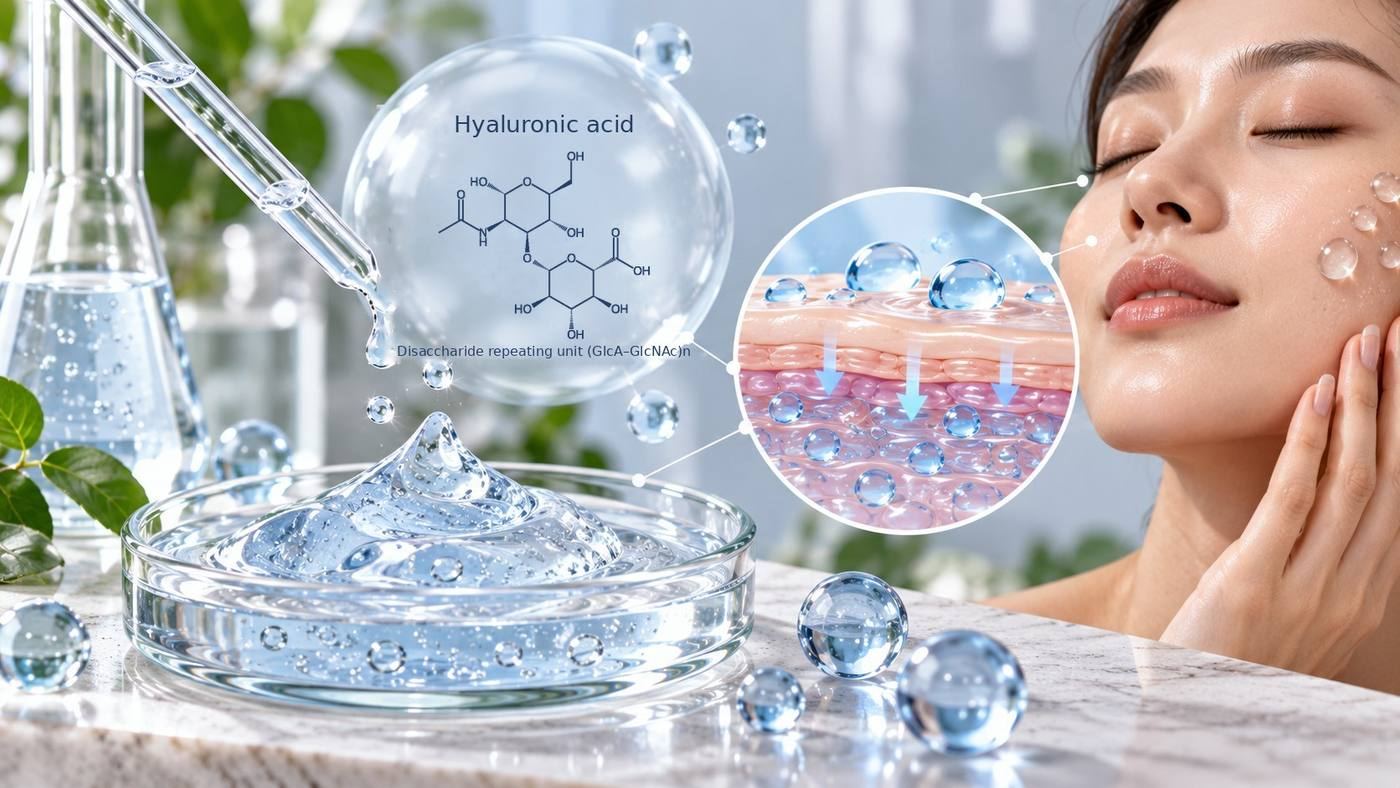
Hyaluronic acid is a sugar-based molecule that holds large amounts of water. The skin makes its own, and levels fall with age. In cosmetics it comes in different molecular weights. High-weight forms stay on the surface; lower-weight forms reach further into the outer skin layers.
02What it does
On the surface, hyaluronic acid draws in water and forms a light film that reduces the look of dryness. Lower-weight forms appear to reach deeper into the upper skin, and in trials they gave larger hydration gains and a small reduction in wrinkle depth. The visible result is plumper, smoother-looking skin while the product is in use.
03The evidence
Studies below were checked against the publisher, DOI or journal record on 26 Sep 2026. We list design and size so you can judge the strength of each result.
| Study | Design | Who and how long | What it found |
|---|---|---|---|
| Cheng et al. 2026, MI-PHARM 2025 proceedings (Springer Nature) Source | Systematic review of controlled trials (conference chapter) | 7 controlled trials, 316 participants, topical hyaluronic acid on photoaged facial skin | Hyaluronic acid may reduce wrinkle depth and improve hydration and elasticity, but most studies had moderate to high risk of bias. |
| Nobile et al. 2025, Cosmetics (MDPI) Source | Randomised, double-blind, placebo-controlled trial with four arms | 88 adults of mixed ethnicity, 56 days, cream with 0.5% sodium hyaluronate (50 to 3000 kDa blend) | The topical-only arm improved skin smoothness, elasticity and hydration more than placebo; oral plus topical use gave the largest gains. |
| Muhammad et al. 2024, Archives of Dermatological Research (Springer Nature) Source | Double-blind, randomised, vehicle-controlled trial on separate leg sites | 36 nursing-home residents aged 60 to 80 with dry skin, 4 weeks, low- vs high-weight hyaluronic acid vs vehicle | Low-weight hyaluronic acid gave higher skin hydration than high-weight (56.4 vs 52.4 units) and vehicle (49.0); no change in water loss or symptoms and no side effects. |
| Robinson et al. 2022, Journal of Cosmetic Dermatology (Wiley) Source | Open-label multicentre study, no control group | 48 adults enrolled (46 completed), 8 weeks, high-weight hyaluronic acid serum with peptides | Hydration and investigator-rated fine lines and texture improved versus baseline (p<0.0001). Weaker evidence: no control and a multi-ingredient product. |
| Pavicic et al. 2011, Journal of Drugs in Dermatology Source | Randomised, vehicle-controlled split-eye-area trial | 76 women aged 30 to 60, 60 days, 0.1% hyaluronic acid at 50, 130, 300, 800 or 2000 kDa | All weights improved hydration and elasticity versus vehicle; only the 50 and 130 kDa forms significantly reduced wrinkle depth. |
Topical hyaluronic acid reliably improves skin hydration, and lower-weight forms appear to do more than high-weight forms. Evidence for fine lines is limited to small trials, so claims should stay modest: “hydrates skin” and “reduces the look of fine lines caused by dryness”, not “fills wrinkles”.
04How CSL formulation scientists use it
- Use a blend of molecular weights: high weight for surface hydration and feel, low weight for deeper hydration. Match any weight-specific claim to the grade actually used.
- Trials used 0.1% to 0.5%. Above about 1% most grades turn viscous or tacky, so higher is rarely better.
- Hyaluronic acid pulls water from its surroundings. Pair it with an emollient or occlusive layer so moisture is held in the skin, especially in dry climates.
- It is stable across a broad pH range and compatible with most actives. Watch for thickening or loss of viscosity with high electrolyte loads and some preservatives, and check this in stability testing.
05Regulatory and claims
Hyaluronic acid and sodium hyaluronate are widely used cosmetic ingredients. CSL regulatory specialists confirm the status in each target market for the exact grade, including any low-weight or cross-linked form. Claims stay cosmetic: “hydrates” and “improves the look of fine lines”, never “repairs” or “regenerates” skin.
06Questions brands ask
Does molecular weight really matter?
Yes. In controlled trials, lower-weight forms gave larger hydration gains, and only the lowest weights reduced wrinkle depth. High-weight forms mainly hydrate the surface.
Does a cream work like a hyaluronic acid filler?
No. Injected fillers add volume under the skin. A topical product hydrates the outer layers and smooths the look of dryness-related lines.
What percentage should a serum contain?
Trials show benefits at 0.1% to 0.5%. A well-chosen blend at these levels is usually better than a high percentage of a single grade.
07References
- Cheng MY, Aziz Z, Badrul Hisham MD. The effectiveness of topically applied hyaluronic acid on facial photoaging: a systematic review. In: Computational and Data-Driven Approaches in Pharmaceutical Sciences. Springer; 2026. Link
- Nobile V, Roveda G, Spartà E, Tursi F. Oral intake and topical application of hyaluronic acid ameliorates skin aging signs: efficacy results of a placebo-controlled in&out trial. Cosmetics. 2025;12(2):52. Link
- Muhammad P, Novianto E, Setyorini M, et al. Effectiveness of topical hyaluronic acid of different molecular weights in xerosis cutis treatment in elderly: a double-blind, randomized controlled trial. Arch Dermatol Res. 2024;316(6):329. Link
- Robinson DM, Vega J, Palm MD, et al. Multicenter evaluation of a topical hyaluronic acid serum. J Cosmet Dermatol. 2022;21:3848–3858. Link
- Pavicic T, Gauglitz GG, Lersch P, et al. Efficacy of cream-based novel formulations of hyaluronic acid of different molecular weights in anti-wrinkle treatment. J Drugs Dermatol. 2011;10(9):990–1000. Link
Used in: Anti-ageing & wrinklesHydration & barrier repair
Update log
- Evidence reviewed and page published by CSL scientists
This page summarises published research for brands and formulators. It is general information, not medical advice, and results in studies depend on the full formula tested.