Peptides in skin care: what the evidence shows for fine lines
Peptides are short amino-acid chains sold for smoother, firmer-looking skin. Here is what the trials show, why most are industry-funded, and how CSL formulation scientists use them.
By CSL Formulation team · Evidence checked by CSL scientists
At a glance
- What it is
- Short amino-acid chains designed to mimic skin signals: signal peptides (palmitoyl pentapeptide-4), carrier peptides (copper tripeptide-1) and neurotransmitter-inhibiting peptides (acetyl hexapeptide-8)
- Main benefits
- Modest improvement in the look of fine lines, expression lines and skin smoothness
- Levels tested in trials
- 3 ppm palmitoyl pentapeptide-4; 2% acetyl hexapeptide-8 within a blend; many trials do not disclose levels
- Time to results
- 4 to 12 weeks in controlled studies
- Watch for
- Small, mostly sponsor-run studies; blends that make single-peptide effects hard to judge; limited skin penetration
01What is it?
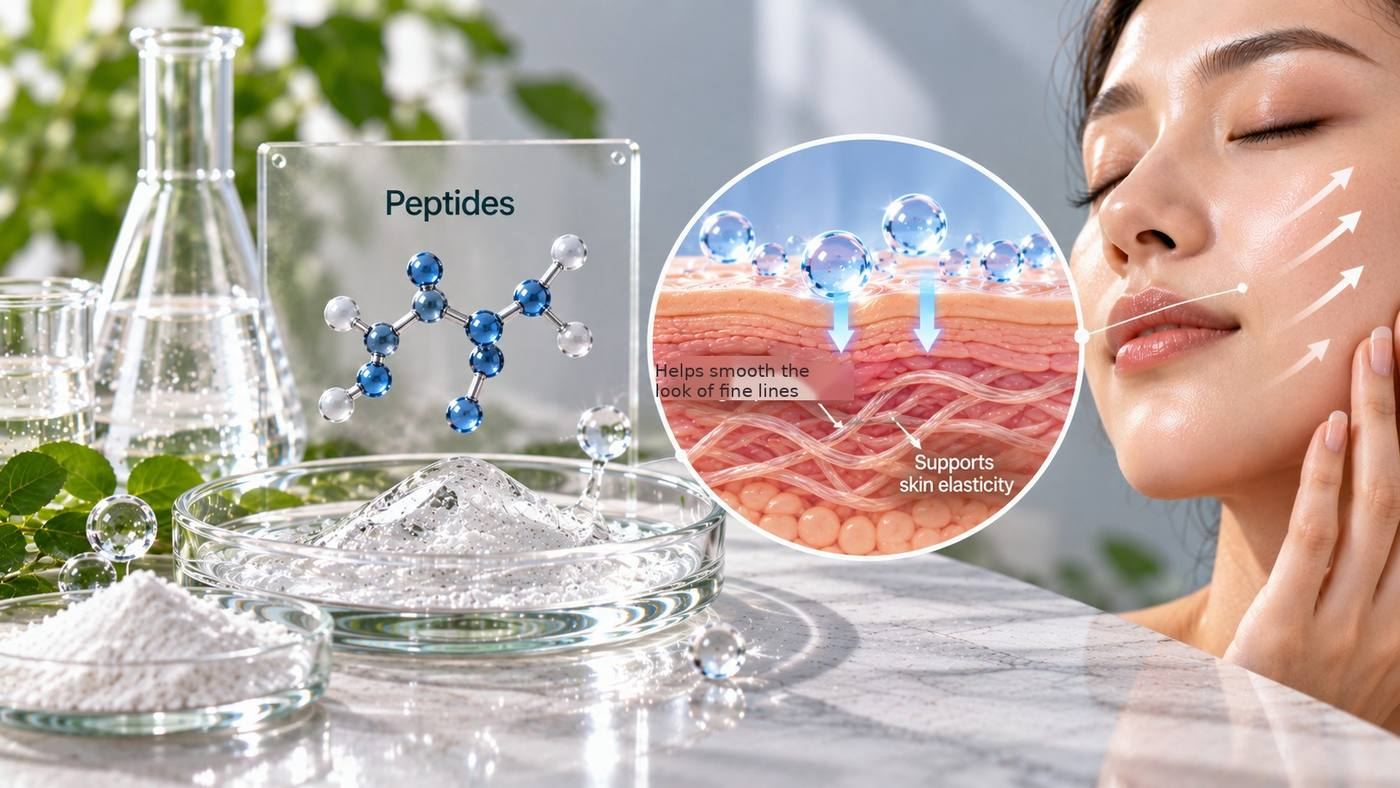
Peptides are short chains of amino acids, the building blocks of proteins. Cosmetic peptides are made to imitate fragments that skin uses as signals. They fall into three main groups: signal peptides that aim to boost collagen, carrier peptides that deliver trace metals such as copper, and neurotransmitter-inhibiting peptides that aim to relax expression lines.
02What it does
In lab studies, signal peptides encourage skin cells to make more collagen, and neurotransmitter-inhibiting peptides interfere with the nerve signal behind muscle contraction. On skin, the proposed result is smoother, firmer-looking skin. Many peptides are too large or water-loving to pass easily through the skin barrier, which is one reason the clinical effect is usually modest.
03The evidence
Studies below were checked against the publisher, DOI or journal record on 26 Sep 2026. We list design and size so you can judge the strength of each result.
| Study | Design | Who and how long | What it found |
|---|---|---|---|
| Nukaly et al. 2026, Frontiers in Medicine (Frontiers) Source | Systematic review and meta-analysis of randomised trials | 19 RCTs, 1,341 participants; 17 oral and only 2 topical peptide trials | Peptides were safe and pooled wrinkle scores improved modestly, driven mainly by oral trials; topical data were too few to pool, and the authors call for larger, standardised trials. |
| Lupin et al. 2026, Clinical, Cosmetic and Investigational Dermatology (Dove Press) Source | Randomised, double-blind, vehicle-controlled split-face trial | 36 adults aged 37–70 after botulinum toxin injection, 10 weeks, serum with 2% acetyl hexapeptide-8, a second 2% peptide (dipeptide diaminobutyroyl), 5% niacinamide and other actives | Greater improvement than vehicle, for example forehead lines 42.0% vs 27.3% and under-eye lines 44.7% vs 24.8%. Three authors are L’Oréal employees and the serum is a blend. |
| Lum et al. 2025, Journal of Drugs in Dermatology Source | Literature review | 10 human studies of acetyl hexapeptide-8, 312 participants (302 women) | All studies reported less visible wrinkles or scars, with no significant side effects, but the size and significance of the effect varied between studies. |
| Qian et al. 2025, Journal of Drugs in Dermatology Source | Randomised, double-blind split-face trial | Adults after non-ablative laser, 28 days, multi-component peptide formula vs a healing ointment | Healing matched the ointment, with faster and greater gains in several anti-ageing measures. Authors are employees of the product maker; the peptide level was not disclosed. |
| Nguyen et al. 2021, Journal of Clinical and Aesthetic Dermatology Source | Randomised, double-blind, placebo-controlled trial | 55 women aged 35–60, skin types I–VI, 12 weeks, serum with eight peptides plus other actives (levels not disclosed) | Median fine-line improvement of 50% at 12 weeks and better results than placebo at every time point. Funded by the brand, and three authors were its employees. |
| Wang et al. 2013, American Journal of Clinical Dermatology (Springer Nature) Source | Randomised, placebo-controlled trial | 60 Chinese adults (3:1 active to placebo), 4 weeks, acetyl hexapeptide-8 (Argireline) twice daily | Anti-wrinkle efficacy was rated 48.9% in the active group vs 0% with placebo, and skin roughness fell significantly only with the active. |
| Robinson et al. 2005, International Journal of Cosmetic Science (Wiley) Source | Randomised, double-blind, placebo-controlled split-face trial | 93 Caucasian women aged 35–55, 12 weeks, 3 ppm palmitoyl pentapeptide-4 (pal-KTTKS) | Significant reduction in the look of wrinkles and fine lines versus placebo by image analysis and expert grading, and the product was well tolerated. |
Peptides are well tolerated and a few placebo-controlled trials show modest gains in the look of fine lines, but the studies are small, short and mostly run by ingredient or product makers. Recent trials test blends, so the effect of any single peptide is hard to isolate. Claims such as ‘helps improve the look of fine lines’, backed by testing of the finished product, are appropriate; comparisons with injectable treatments are not.
04How CSL formulation scientists use it
- Use peptides at the supplier’s tested level and ask for the supplier’s own clinical data, noting whether it was controlled and independent.
- Peptides are generally water-soluble and sensitive to extreme pH and some preservatives. CSL formulation scientists check compatibility and confirm stability of the peptide in the finished product.
- Copper peptides give a blue tint and can interact with strong acids and chelating agents, so they are kept apart from low-pH acid products in the same formula.
- Peptides pair well with humectants, niacinamide and gentle retinoids in multi-benefit serums; claims should reflect the tested product, not each ingredient on its own.
05Regulatory and claims
CSL regulatory specialists confirm the status and any limits for each peptide in each target market. Claims stay cosmetic (‘improves the look of fine lines’); wording such as ‘Botox-like’ or ‘stimulates collagen production’ can move a product towards a medical claim and is avoided.
06Questions brands ask
Do peptides work like Botox?
No. Acetyl hexapeptide-8 is designed to interfere with the same nerve signal, but it is far weaker than an injectable treatment and does not penetrate skin well. Any effect on expression lines is small.
Which peptide has the best evidence?
Palmitoyl pentapeptide-4 and acetyl hexapeptide-8 each have at least one placebo-controlled trial, but both rest on a small number of short studies. Recent trials test blends, so no single peptide clearly stands out.
Why is peptide evidence often industry-funded?
Most cosmetic peptides are patented ingredients, and their suppliers or the brands using them run and publish the studies. Independent, vehicle-controlled trials are rare, so claims should be modest.
07References
- Nukaly HY, Halawani IR, Irtaza HM, et al. Oral and topical peptides for skin aging: systematic review and meta-analysis of randomized controlled trials. Front Med. 2026;13:1618306. Link
- Lupin M, Brieva P, Dayeh NR, White S. Enhanced efficacy of post-procedural skin care: a double-blind, randomized, vehicle-controlled, split-face clinical study assessing a novel neuropeptide serum following botulinum toxin injection. Clin Cosmet Investig Dermatol. 2026;19:1–9. Link
- Lum K, Hirpara MM, Pham C, Nguyen M, Mesinkovska N. Acetyl hexapeptide-8 as a topical alternative to botulinum toxin: a review of the literature. J Drugs Dermatol. 2025;24(4):e31. Link
- Qian KM, Kaminer M, Liao IC, et al. A multi-component reaction peptide augmenting the anti-aging benefits of non-ablative laser procedure. J Drugs Dermatol. 2025;24(2):188–195. doi:10.36849/JDD.8066R1 Link
- Nguyen TQ, Zahr AS, Kononov T, Ablon G. A randomized, double-blind, placebo-controlled clinical study investigating the efficacy and tolerability of a peptide serum targeting expression lines. J Clin Aesthet Dermatol. 2021;14(5):14–21. Link
- Wang Y, Wang M, Xiao S, Pan P, Li P, Huo J. The anti-wrinkle efficacy of argireline, a synthetic hexapeptide, in Chinese subjects: a randomized, placebo-controlled study. Am J Clin Dermatol. 2013;14:147–153. Link
- Robinson LR, Fitzgerald NC, Doughty DG, Dawes NC, Berge CA, Bissett DL. Topical palmitoyl pentapeptide provides improvement in photoaged human facial skin. Int J Cosmet Sci. 2005;27(3):155–160. Link
Used in: Anti-ageing & wrinklesHair fall & hair growth
Update log
- Evidence reviewed and page published by CSL scientists
This page summarises published research for brands and formulators. It is general information, not medical advice, and results in studies depend on the full formula tested.