Rosemary for hair: what the evidence shows for thinning and hair fall
Rosemary oil is one of the most talked-about hair ingredients, yet it rests on one human trial. Here is what that trial showed, its limits, and how CSL formulation scientists use rosemary responsibly.
By CSL Formulation team · Evidence checked by CSL scientists
At a glance
- What it is
- Rosemary (Rosmarinus officinalis) essential oil or leaf extract
- Main benefits
- Scalp care and fuller-looking hair; a supporting role in anti-hair-fall formulas
- Levels tested in trials
- Rosemary oil standardised to at least 20 mg cineole per mL, applied twice daily; animal work used leaf extract
- Time to results
- No change at 3 months; change seen at 6 months in the only trial
- Watch for
- Over-reliance on one trial; essential-oil irritation and fragrance allergens
01What is it?
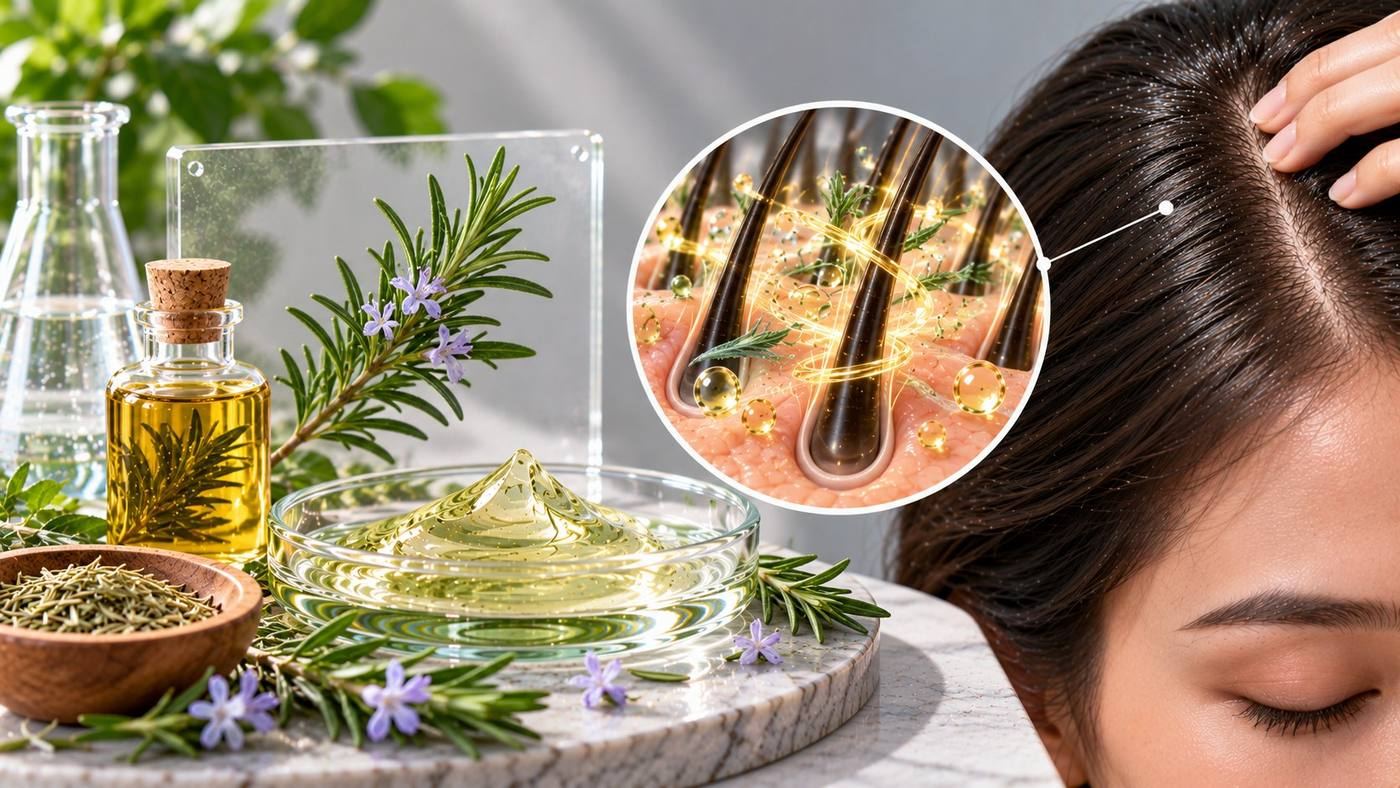
Rosemary is a culinary herb. In hair care it appears as an essential oil or as a leaf extract, which are chemically different. Its fame comes largely from one 2015 trial and later social media, not from a large body of research.
02What it does
In mice, rosemary leaf extract blocked 5-alpha-reductase, the enzyme that makes the hormone DHT, and supported regrowth after testosterone treatment. In the one human trial, men using rosemary oil saw hair counts rise over 6 months, much like the group using 2% minoxidil. Whether rosemary itself caused this, rather than time or massage, is not proven.
03The evidence
Studies below were checked against the publisher, DOI or journal record on 26 Sep 2026. We list design and size so you can judge the strength of each result.
| Study | Design | Who and how long | What it found |
|---|---|---|---|
| Panahi et al. 2015, SKINmed Source | Randomised, single-blind comparative trial against 2% minoxidil (no placebo) | 100 men with pattern hair loss, 6 months, rosemary oil (at least 20 mg/mL cineole) twice daily | Hair counts rose in both groups at 6 months (about 102 to 172 with rosemary, 102 to 175 with minoxidil), with no change at 3 months. Scalp itching was less common with rosemary. |
| Bin Rubaian et al. 2024, Clinical, Cosmetic and Investigational Dermatology (Dove Press) Source | Narrative review of botanicals for pattern hair loss | Review of herbal oils and extracts, focus on rosemary | Calls rosemary promising but notes human evidence rests on a single trial. |
| Ahmed et al. 2025, Skin Appendage Disorders (Karger) Source | Narrative review of herbal remedies | Review of rosemary, onion, saw palmetto and other herbs | Studies are small and short with little follow-up; larger randomised trials are needed. |
| Murata et al. 2013, Phytotherapy Research (Wiley) Source | Animal and laboratory study (not human) | Mice, rosemary leaf extract 2 mg/day topically; cell tests | Extract blocked 5-alpha-reductase by 82–95% and restored regrowth in testosterone-treated mice. |
| Patel et al. 2025, Cureus (Springer Nature) Source | Open-label, single-arm study, no control; manufacturer-funded | 32 women, 120 days, multi-ingredient serum with rosemary oil, caffeine, biotin and others | Reported 65% less hair fall and 38% higher density, but with no control group and many actives the effect of rosemary cannot be isolated. |
Rosemary has plausible lab and animal data and one small human trial, but no placebo-controlled evidence. It fits well as a supporting botanical, with claims kept to 'nourishes the scalp' or 'hair looks fuller', backed by testing of the finished product. Comparisons with minoxidil should not be used in marketing.
04How CSL formulation scientists use it
- Decide early between essential oil and leaf extract: they differ in chemistry, odour and safety profile, and the only human trial used the oil.
- Keep essential-oil levels low in leave-on scalp products and run a patch test; CSL formulation scientists check fragrance allergen content from the supplier's data.
- Use rosemary alongside better-studied actives such as caffeine, and test the finished formula for hair fall or fullness claims.
- Protect oils from light and air, and include an antioxidant to limit oxidation of terpenes.
05Regulatory and claims
Rosemary oil and extract are widely used in cosmetics. Essential oils contain fragrance allergens that may need to be declared on the label in the EU; CSL regulatory specialists check the exact limits and labelling in each target market. Claims such as 'regrows hair' or 'as effective as minoxidil' are medical claims and must not be used on a cosmetic.
06Questions brands ask
Is rosemary oil as good as minoxidil?
One 2015 trial found similar hair-count gains at 6 months with rosemary oil and 2% minoxidil, but it had no placebo group and was only single-blind. That is not enough to make any comparison claim.
Is rosemary extract the same as rosemary oil?
No. The only human trial used the essential oil; animal work used a leaf extract. Claims should match the form tested.
Is rosemary safe on the scalp?
It was well tolerated in the trial, with less itching than minoxidil. Essential oils can still irritate or sensitise, so levels and allergens need checking.
07References
- Panahi Y, Taghizadeh M, Marzony ET, Sahebkar A. Rosemary oil vs minoxidil 2% for the treatment of androgenetic alopecia: a randomized comparative trial. SKINmed. 2015;13(1):15–21. Link
- Bin Rubaian NF, Alzamami HFA, Amir BA. An overview of commonly used natural alternatives for the treatment of androgenetic alopecia, with special emphasis on rosemary oil. Clin Cosmet Investig Dermatol. 2024;17:2495–2503. Link
- Ahmed A, Alali AM, Abdullah E, Alharbi MN, Alayoubi HM. Herbal remedies for hair loss: a review of efficacy and safety. Skin Appendage Disord. 2025;11(4):360–371. Link
- Murata K, et al. Promotion of hair growth by Rosmarinus officinalis leaf extract. Phytother Res. 2013;27(2):212–217. Link
- Patel M, Tuli N, Patel N, Merja A. A clinical evaluation of the safety, efficacy, and tolerability of the Soulflower Rosemary Redensyl Hair Growth Serum, Tetragain, in healthy female subjects. Cureus. 2025;17(1):e77066. Link
Used in: Hair fall & hair growth
Update log
- Evidence reviewed and page published by CSL scientists
This page summarises published research for brands and formulators. It is general information, not medical advice, and results in studies depend on the full formula tested.