Modern organic UV filters: what the evidence shows for daily sunscreen
Daily broad-spectrum sunscreen is one of the best-proven ways to slow visible skin ageing. Here is the trial evidence, the new US status of bemotrizinol, and how CSL formulation scientists build modern filter systems.
By CSL Formulation team · Evidence checked by CSL scientists
At a glance
- What it is
- Carbon-based UV filters such as bemotrizinol (Tinosorb S), bisoctrizole (Tinosorb M) and avobenzone, used in combination
- Levels tested in trials
- SPF 15+ with 8% octinoxate and 2% avobenzone in the Nambour trial; bemotrizinol 6% in US safety studies
- Time to results
- Sunburn protection is immediate; slower skin ageing was measured after 4.5 years of daily use
- Watch for
- Photostability, skin absorption of some older filters, correct application amount and market-by-market approval
01What is it?
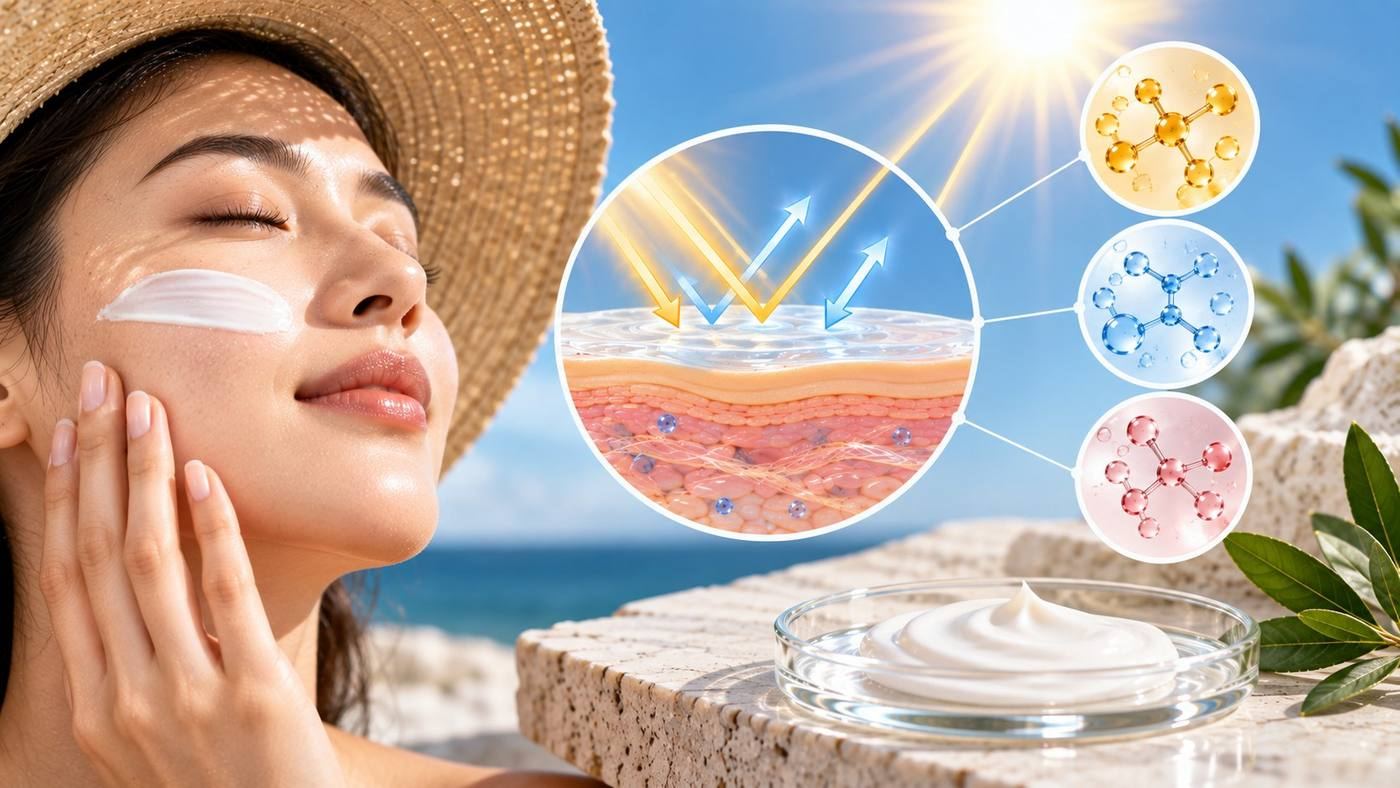
Organic UV filters are carbon-based molecules that absorb UV light. Newer filters such as bemotrizinol and bisoctrizole are large, photostable molecules that cover both UVB and UVA. They have been used in Europe and other markets for years, and bemotrizinol was added to the US sunscreen monograph in 2026.
02What it does
Each filter absorbs a band of UV and releases the energy harmlessly as heat. Combining filters gives broad, even cover from UVB through long UVA. Used daily, this reduces sunburn and the cumulative UV damage that shows as wrinkles, roughness and uneven tone.
03The evidence
Studies below were checked against the publisher, DOI or journal record on 26 Sep 2026. We list design and size so you can judge the strength of each result.
| Study | Design | Who and how long | What it found |
|---|---|---|---|
| Hughes et al. 2013, Annals of Internal Medicine (ACP) Source | Randomised controlled trial (Nambour, Australia) | 903 adults under 55, 4.5 years; daily SPF 15+ (8% octinoxate, 2% avobenzone) vs discretionary use | Daily users showed no detectable increase in skin ageing and 24% less ageing than the discretionary group (relative odds 0.76). |
| Green et al. 1999, The Lancet Source | Randomised controlled trial (Nambour, Australia) | 1,383 adults, 4.5 years; daily SPF 15+ broad-spectrum sunscreen to head, neck, arms and hands | Squamous-cell carcinoma was significantly reduced (rate ratio 0.61); no effect on basal-cell carcinoma. |
| Green et al. 2011, Journal of Clinical Oncology (ASCO) Source | Long-term follow-up of the randomised trial | 1,621 adults, followed about 10 years after the trial ended | 11 melanomas in the daily group vs 22 in the discretionary group (hazard ratio 0.50; P = 0.051); invasive melanoma fell more (HR 0.27). |
| Matta et al. 2020, JAMA Source | Randomised clinical trial (absorption) | 48 healthy adults, 4 days of maximal use; lotion and three spray types | Avobenzone, oxybenzone, octocrylene, homosalate, octisalate and octinoxate all exceeded FDA’s 0.5 ng/mL plasma threshold after one day; the authors say people should keep using sunscreen. |
| D’Ruiz et al. 2023, Regulatory Toxicology and Pharmacology (Elsevier) Source | Pilot maximal-usage pharmacokinetic study | 14 healthy adults, 6% bemotrizinol applied at maximal use | Only 13 of 299 plasma samples (4.3%) had measurable bemotrizinol; 7 of 14 people had none detectable. |
| Turner et al. 2025, Photodermatology, Photoimmunology & Photomedicine (Wiley) Source | Narrative review | Newer filters, including bemotrizinol and bisoctrizole | Bemotrizinol is allowed up to 10% in the EU; bisoctrizole shows about 0.01% skin penetration; neither bound oestrogen or androgen receptors in screening assays. |
The case for daily broad-spectrum sunscreen is strong: long-term randomised trials show less visible skin ageing and fewer squamous-cell carcinomas. Newer filters such as bemotrizinol offer the same protection with very low skin absorption. Suitable cosmetic claims include “helps prevent visible signs of sun ageing with daily use” and “broad-spectrum UVA/UVB protection”, backed by SPF and UVA testing of the finished product.
04How CSL formulation scientists use it
- Build a filter system, not a single filter: pair a photostable broad-spectrum filter such as bemotrizinol with UVB and long-UVA partners to hit the target SPF and UVA ratio.
- Stabilise avobenzone with partners such as bemotrizinol or octocrylene, and confirm photostability after irradiation.
- Check each filter against each launch market: bemotrizinol is now allowed in the US at up to 6%, but many EU-approved filters are still not permitted there.
- Formulate for daily wear: light textures, low stinging near the eyes and good spreadability improve how much people apply, which drives real protection.
05Regulatory and claims
In the EU, organic UV filters are cosmetic ingredients listed in Annex VI with maximum levels (bemotrizinol up to 10%). In the US, sunscreens are OTC drugs: FDA proposed adding bemotrizinol at up to 6% on 12 December 2025 and finalised it on 9 June 2026, the first new monograph filter in decades. Avobenzone and most older US filters were classed in FDA’s 2021 proposed order as needing more safety data. CSL regulatory specialists confirm allowed filters, levels, forms and label wording in each target market.
06Questions brands ask
Can US brands now use bemotrizinol?
Yes. FDA finalised bemotrizinol for OTC sunscreens up to 6% in June 2026. The US proposal excluded propellant aerosols and powders, so check the final order for the product form.
Are organic filters absorbed into the body?
Some older filters, such as oxybenzone and avobenzone, reach measurable blood levels. Bemotrizinol and bisoctrizole are large molecules with very low absorption.
Does daily sunscreen really slow ageing?
Yes. In a 4.5-year randomised trial, daily users showed 24% less skin ageing than people who used sunscreen when they chose.
07References
- Hughes MCB, Williams GM, Baker P, Green AC. Sunscreen and prevention of skin aging: a randomized trial. Ann Intern Med. 2013;158(11):781–790. Link
- Green A, Williams G, Neale R, et al. Daily sunscreen application and betacarotene supplementation in prevention of basal-cell and squamous-cell carcinomas of the skin: a randomised controlled trial. Lancet. 1999;354(9180):723–729. Link
- Green AC, Williams GM, Logan V, Strutton GM. Reduced melanoma after regular sunscreen use: randomized trial follow-up. J Clin Oncol. 2011;29(3):257–263. Link
- Matta MK, Florian J, Zusterzeel R, et al. Effect of sunscreen application on plasma concentration of sunscreen active ingredients: a randomized clinical trial. JAMA. 2020;323(3):256–267. Link
- D’Ruiz CD, Plautz JR, Schuetz R, et al. Preliminary clinical pharmacokinetic evaluation of bemotrizinol, a new sunscreen active ingredient being considered for inclusion under FDA’s OTC sunscreen monograph. Regul Toxicol Pharmacol. 2023;139:105344. Link
- Turner et al. Modernizing U.S. sunscreen regulations: how newer filters can improve public health. Photodermatol Photoimmunol Photomed. 2025;41:e70032. Link
- US Food and Drug Administration. FDA expands sunscreen options for the first time in 20 years (bemotrizinol final order). Press announcement, 9 June 2026. Link
- US Food and Drug Administration. Amending Over-the-Counter Monograph M020: Sunscreen Drug Products (bemotrizinol proposed order OTC000039). Federal Register, 12 December 2025. Link
- US Food and Drug Administration. Scientific review, bemotrizinol, OTC000039. 9 December 2025. Link
- US Food and Drug Administration. Proposed Order OTC000008: Amending Over-the-Counter Monograph M020, Sunscreen Drug Products. September 2021. Link
Used in: Sun protection
Update log
- Evidence reviewed and page published by CSL scientists
This page summarises published research for brands and formulators. It is general information, not medical advice, and results in studies depend on the full formula tested.