Mild surfactants: what the evidence shows for gentler cleansing
Amino-acid surfactants, glucosides, betaines and biosurfactants are sold as gentler than SLS. Here is what human studies show, where the evidence is thin, and how CSL formulation scientists build mild cleansers.
By CSL Formulation team · Evidence checked by CSL scientists
At a glance
- What it is
- Cleansing agents chosen for low irritation: amino-acid types (cocoyl glutamate, cocoyl glycinate, lauroyl sarcosinate), alkyl glucosides, amphoteric betaines and glycolipid biosurfactants, compared with SLS and SLES
- Main benefits
- Effective cleansing with less dryness, tightness and barrier disruption than harsh anionic systems
- Levels tested in trials
- Tested as finished cleansers rather than single ingredients; individual surfactant levels are rarely reported
- Time to results
- Mildness shows within days of repeated washing; skin comfort in dry or atopic skin assessed over 4 weeks
- Watch for
- Contact allergy to alkyl glucosides and to cocamidopropyl betaine impurities; 'mild' depends on the whole formula, not one ingredient
01What is it?
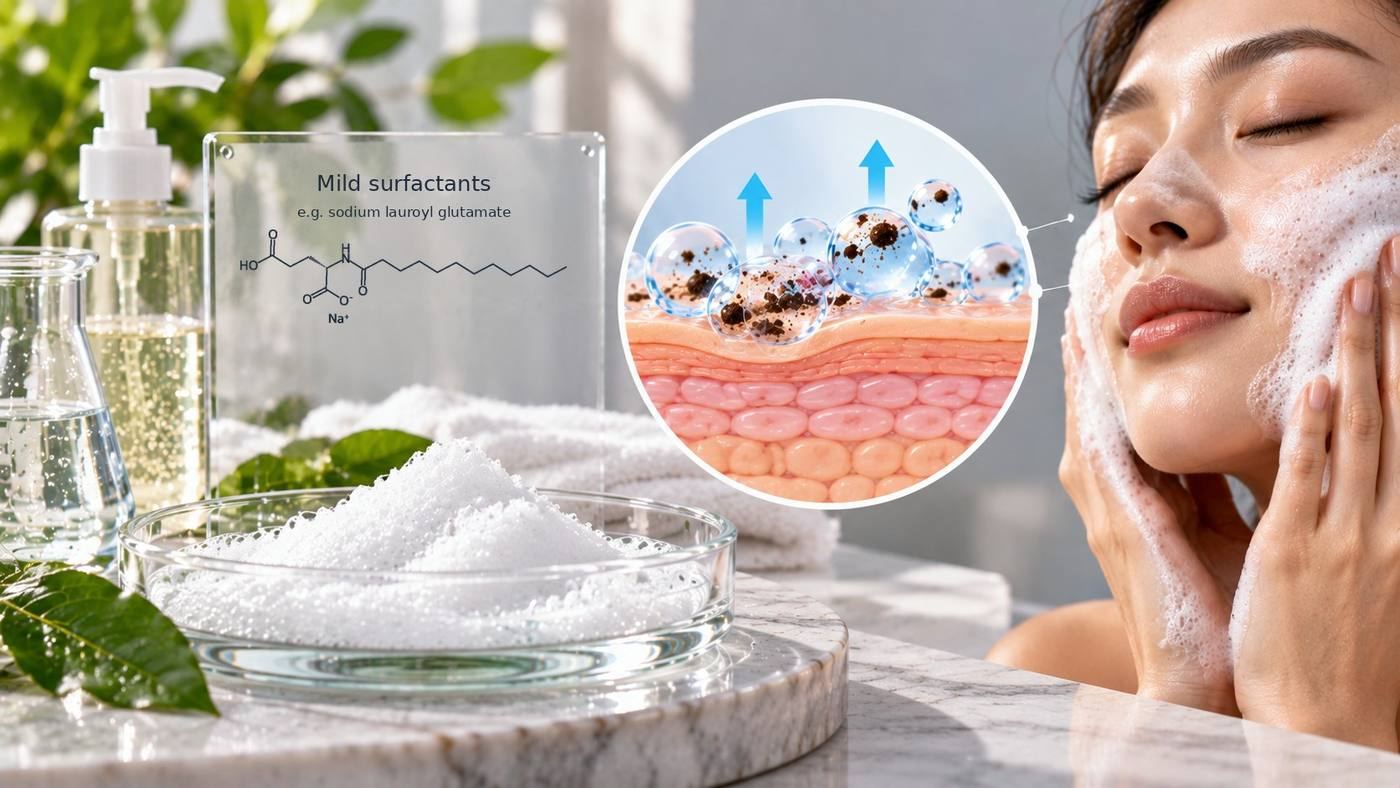
Surfactants are the cleaning ingredients in body washes, shampoos and facial cleansers. Sodium lauryl sulphate (SLS) is a strong, well-studied skin irritant and is used as the benchmark for harshness. 'Mild surfactants' is a loose group of alternatives: amino-acid surfactants, sugar-based alkyl glucosides, amphoteric betaines and newer fermentation-derived biosurfactants such as sophorolipids. Most are used in blends, often with a smaller amount of a stronger anionic surfactant.
02What it does
Harsh anionic surfactants bind to and swell skin proteins and strip barrier lipids, which shows as dryness, redness and raised water loss after repeated washing. Milder types, and blends with betaines or polymers, form larger, less penetrating micelles and interact less with proteins. In practice this means cleansers that remove dirt and make-up while leaving the skin barrier closer to its unwashed state.
03The evidence
Studies below were checked against the publisher, DOI or journal record on 26 Sep 2026. We list design and size so you can judge the strength of each result.
| Study | Design | Who and how long | What it found |
|---|---|---|---|
| Mijaljica et al. 2022, Molecules (MDPI) Source | Narrative review | Literature on soaps, syndets and surfactant classes | Non-ionic surfactants such as glucosides are the gentlest, betaines are less aggressive than anionics and improve blend mildness, while SLS is a potent irritant; syndets sit at pH 5.5–7.0 against 8.5–11.0 for soaps. |
| Zhao et al. 2024, Journal of Cosmetic Dermatology (Wiley) Source | Self-controlled study, no separate control group | Volunteers using a facial cleanser with sodium lauroyl sarcosinate for 3 weeks | Little change in skin biophysical measures, but microbial diversity fell and ceramides decreased, so even 'mild' amino-acid surfactants alter the skin surface. |
| Lavender et al. 2013, Journal of Obstetric, Gynecologic, and Neonatal Nursing (Wiley) Source | Assessor-blinded randomised non-inferiority trial | 307 healthy newborns, 4 weeks, SLS-free wash based on non-ionic and amphoteric surfactants versus water alone | Water loss at 14 days was the same as water alone (12.8 vs 12.5 g/m²/h; difference −0.08), with skin pH 5.5 in both groups. |
| Regan et al. 2013, Journal of Clinical and Aesthetic Dermatology Source | Laboratory tests plus open clinical and consumer studies (industry) | Sodium cocoyl glycinate body wash; 50 adults with dry skin, 41 people with mild-to-moderate atopic dermatitis over 4 weeks, 307 consumers | Scored 56 on a corneosurfametry mildness index versus 26 for SDS (SLS), and dryness, itch and rash scores fell slightly in eczema-prone users over 4 weeks. |
| Okamoto et al. 2017, Clinical, Cosmetic and Investigational Dermatology (Dove Press) Source | Open-label usage trial, no control group | 50 infants aged 3–24 months (9 with mild atopic dermatitis), 4 weeks, sodium cocoyl glutamate foaming cleanser with moisturiser | Dryness, redness and papules improved, no adverse events; water loss and hydration did not change significantly overall. |
| Patel et al. 2025, Cureus Source | Open-label study, no control group | 27 healthy adults of mixed skin types, 30 days, soap-free lotion with sodium cocoyl apple amino acids | Water loss fell 41% and hydration rose 91% with no adverse events. Weak evidence: no comparison group and the gains may reflect routine change. |
| Adu et al. 2023, Fermentation (MDPI) Source | In-vitro study (3D human skin model), not human | Lab-grown skin colonised with S. epidermidis, acidic sophorolipid versus SLES at 100 µg/mL | Sophorolipid did not harm tissue structure, filaggrin, skin bacteria or inflammatory markers relative to SLES. No human data yet. |
There is fair evidence that SLS-free cleansers built on amino-acid, glucoside and betaine blends are well tolerated, even on newborn and eczema-prone skin. Head-to-head human trials of single mild surfactants against SLS are scarce, and many studies are uncontrolled or industry-run. Suitable claims are 'gentle cleansing', 'sulphate-free' and 'helps maintain the skin's natural moisture barrier', backed by the finished product's own tests.
04How CSL formulation scientists use it
- Mildness belongs to the whole system: CSL formulation scientists blend a primary amino-acid or glucoside surfactant with a betaine, and may add polymers that enlarge micelles and reduce barrier damage (Walters et al. 2012).
- Glutamates and glycinates are pH-sensitive and often need a pH near neutral to stay clear and foam well; glucosides are high-pH raw materials that must be adjusted, and they thicken poorly, so rheology modifiers are planned early.
- Each 'mild' claim is checked on the finished product with repeat-wash or patch testing, because a mild surfactant at the wrong level or in the wrong blend can still be drying.
- For sensitive-skin or 'hypoallergenic' ranges, CSL formulation scientists weigh the known contact allergy to alkyl glucosides and to cocamidopropyl betaine impurities, and request low-impurity betaine grades from suppliers.
05Regulatory and claims
The common mild surfactants are not restricted by concentration in the main markets as far as CSL could confirm; CSL regulatory specialists confirm the status of each raw material in every target market. Cocamidopropyl betaine was the American Contact Dermatitis Society Allergen of the Year in 2004 and alkyl glucosides in 2017 (not 2023, which was lanolin). 'Sulphate-free' and 'gentle' claims must be truthful and supported by product testing, and should stay cosmetic: 'gentle on sensitive skin', not 'treats eczema'.
06Questions brands ask
Is sulphate-free always milder?
Not automatically. SLS is a known irritant, but mildness depends on the full blend, its level and pH. A well-built SLES and betaine blend can be milder than a poorly built sulphate-free one.
Are glucosides safe for sensitive skin?
They are gentle as cleansers, but decyl and lauryl glucoside cause contact allergy in a small share of people patch tested (around 1–2% in some clinic series), which is why they were named Allergen of the Year in 2017.
Is there human evidence for biosurfactants like sophorolipids?
Not yet in cleansing trials. Lab skin-model studies look favourable compared with SLES, but claims should wait for human testing of the finished product.
07References
- Mijaljica D, Spada F, Harrison IP. Skin cleansing without or with compromise: soaps and syndets. Molecules. 2022;27(6):2010. Link
- Zhao H, et al. The impacts of sodium lauroyl sarcosinate in facial cleanser on facial skin microbiome and lipidome. J Cosmet Dermatol. 2024;23(4):1351–1359. Link
- Lavender T, et al. Randomized, controlled trial evaluating a baby wash product on skin barrier function in healthy, term neonates. J Obstet Gynecol Neonatal Nurs. 2013;42(2):203–214. Link
- Regan J, Mollica L, Ananthapadmanabhan KP. A novel glycinate-based body wash: clinical investigation into ultra-mildness, effective conditioning, and improved consumer benefits. J Clin Aesthet Dermatol. 2013;6(6):23–30. Link
- Okamoto N, Umehara K, Sonoda J, et al. Efficacy of the combined use of a mild foaming cleanser and moisturizer for the care of infant skin. Clin Cosmet Investig Dermatol. 2017;10:393–401. Link
- Patel et al. Clinical evaluation of a soap-free cleansing lotion containing sodium cocoyl apple amino acids for effective impurity removal and skin barrier preservation in healthy adults with diverse skin types. Cureus. 2025;17(8):e90538. Link
- Adu SA, Twigg MS, Naughton PJ, Marchant R, Banat IM. Purified acidic sophorolipid biosurfactants in skincare applications: an assessment of cytotoxic effects in comparison with synthetic surfactants using a 3D in vitro human skin model. Fermentation. 2023;9(11):985. Link
- Walters RM, Mao G, Gunn ET, Hornby S. Cleansing formulations that respect skin barrier integrity. Dermatol Res Pract. 2012;2012:495917. Link
- American Contact Dermatitis Society Allergen of the Year timeline (cocamidopropyl betaine 2004; alkyl glucosides 2017; lanolin 2023). SmartPractice Allergen Bank. Link
- Ecofriendly surfactant is allergen of the year (report on Loranger C, et al. Dermatitis. 2017;28(1):5–13; 3,095 patients patch tested 2009–2016). MDedge Dermatology. Link
Used in: Microbiome-friendly
Update log
- Evidence reviewed and page published by CSL scientists
This page summarises published research for brands and formulators. It is general information, not medical advice, and results in studies depend on the full formula tested.