Alcohol denat in skincare: what the evidence says
Alcohol denat worries shoppers with sensitive skin. CSL scientists graded the published studies on TEWL and the skin barrier to see what alcohol really does, and why the answer depends on concentration.
By Dr. Premalatha, Ph.D., Life Science, Regulatory Consultant, Cosmetic Science Lab
Quick answer
- Is alcohol denat bad for skin? On intact skin, the studies show it is drying, not barrier-destroying. It lowers surface hydration but did not reliably raise TEWL or redness at the levels tested.
- Dose, contact time, how often it is used, occlusion and the rest of the formula decide the outcome, not the word "alcohol" on the label.
- Most human data come from hand sanitisers at 60–100% alcohol. Facial products at lower levels are rarely tested directly.
- Sensitive or damaged skin may sting; pairing alcohol with humectants such as glycerin softens the drying effect.
Take-home message for formulators
- Set the alcohol level by the job it does: solvent, quick-dry or penetration aid
- Pair it with glycerin or other humectants and test the finished product for TEWL and tolerance
Take-home message for brand owners
- "Alcohol-free" is a positioning choice, not a safety requirement
- Hazard databases score the ingredient, not its dose or formula
01Is alcohol in skincare bad for your skin?
Alcohol denat appears on the labels of many toners, gels and sunscreens, and it worries shoppers with sensitive skin. The claim usually runs like this: alcohol strips the skin barrier, raises transepidermal water loss (TEWL) and leaves skin dry and irritated. To test it, CSL scientists looked for human studies that measured TEWL, hydration or redness after alcohol exposure, plus lab studies that explain how alcohol acts on the outer skin layer, the stratum corneum.
What alcohol denat is. Alcohol denat is ethanol (ethyl alcohol) with a denaturant added so it cannot be drunk. In the EU, methanol may be used as a denaturant for ethanol and isopropyl alcohol at up to 5% of the alcohol content [7]. In a formula, alcohol dissolves actives and fragrance, helps gels and sunscreens dry quickly, and can help other ingredients penetrate the skin.
It is not the same as fatty alcohols such as cetyl or cetearyl alcohol. These are waxy emollients and thickeners that help hold an emulsion together.
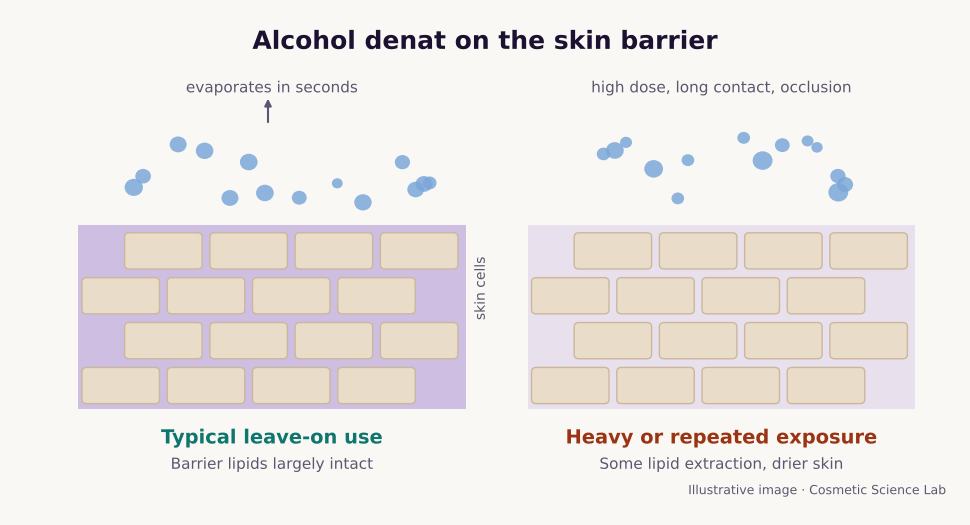
02What the studies show, graded
How we grade. A: controlled human study on intact skin with barrier measures. B: human study in another use setting, small or uncontrolled. C: lab or mechanistic study. Grades are CSL's assessment of how directly each study answers the skincare question.
| Study | n | Design | Result | Grade |
|---|---|---|---|---|
| Löffler et al. 2007, Br J Dermatol | 15 per group | Patch tests with ethanol, 1-propanol and 2-propanol at 60–100%; wash tests with 80% ethanol, alone and after 0.5% SLS | No significant change in barrier function or redness; skin hydration fell. Alcohol was significantly less irritating than detergent washing, and added no barrier damage on SLS-irritated skin [1] | A |
| Kramer et al. 2002, J Hosp Infect | 17 | Double-blind use trial of six alcohol hand rubs containing emollients; 10 people for 1 week, 7 for 2 weeks | TEWL, skin water content and surface sebum did not change significantly [2] | B |
| Cartner et al. 2017, Int J Cosmet Sci | 25 | Evaluator-blind forearm test: 70% ethanol, isopropanol and n-propanol, 20 or 100 times a day for 14 days, plus lab enzyme assays | Ethanol was the gentlest of the three, but 18 of 25 ethanol sites (72%) at 100 applications a day had stopped by day 12. Funded by a hand-hygiene company (GOJO) [3] | B |
| Silva et al. 2015, Biomed Biopharm Res | 13 | Within-subject: ethanol gel sanitiser on one hand for 29 days, other hand as control | TEWL rose between days 1 and 8 on the treated hand while skin hydration increased; control hand unchanged [4] | B |
| Pendlington et al. 2001, Food Chem Toxicol | 16 + pig skin | Simulated whole-body deodorant-spray use in volunteers, plus pig-skin penetration tests | Evaporation half-life on skin 11.7 s; about 1% of the dose absorbed when open vs about 21% when occluded over 24 h; no ethanol detected in blood [5] | B |
| Bommannan et al. 1991, J Control Release | Not stated | In vivo infrared spectroscopy after a 30-minute treatment with pure ethanol | Extracted measurable stratum corneum lipid; changes reversed within 24 h [6] | C |
Most human data come from hand sanitisers at 60–100% alcohol, because hospitals needed to know whether frequent use damages hands. Few studies test facial products at the lower levels found in serums, gels and toners, so conclusions at those levels are an inference, not a measurement.
03Why the dose changes the answer
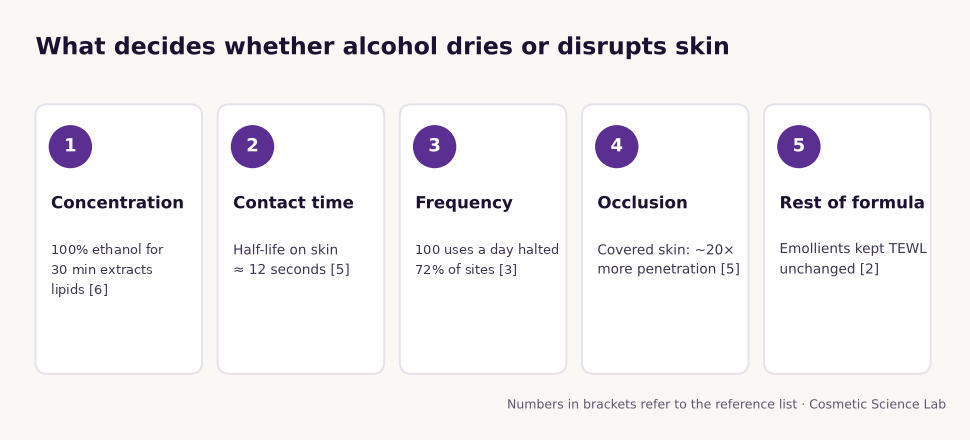
Five factors decide whether alcohol simply dries the skin surface or starts to disrupt the barrier.
- Frequency. At 100 applications a day, 72% of 70% ethanol sites had to stop by day 12, even though ethanol was the gentlest of the three alcohols tested [3].
- Occlusion. Covering the skin raised ethanol absorption about twentyfold, from about 1% to about 21% of the applied dose over 24 hours [5]. This is also why alcohol works as a penetration enhancer.
- The rest of the formula. Hand rubs with emollients left TEWL, skin water and sebum unchanged after one to two weeks of use [2]. A toner high in alcohol with no humectant has no such cushion.
04Alcohol denat: drying, not barrier-destroying
On intact skin, alcohol denat at the levels studied did not reliably raise TEWL or cause redness [1], [2]. It does lower surface hydration [1], and very frequent exposure can tip skin into irritation [3], [4]. For most leave-on products, the formula around the alcohol matters more than its presence on the label.
| Who | What to expect |
|---|---|
| Sensitive or damaged skin | Expect stinging, and choose lower-alcohol formulas with humectants. See sensitive skin. |
| Oily and acne-prone skin | Quick-dry gels are often well tolerated. See acne and oil control. |
| Shoppers using ingredient databases | Hazard lists score an ingredient, not its dose or formula, so they cannot replace use-level data. |
Pair alcohol with glycerin or other humectants, set the level by the job it does, and test the finished product for barrier and hydration with TEWL and tolerance studies rather than relying on ingredient data alone.
05Questions readers ask
Is alcohol denat the same as fatty alcohols like cetyl alcohol?
No. Alcohol denat is denatured ethanol, a fast-evaporating solvent. Fatty alcohols such as cetyl and cetearyl alcohol are waxy emollients and thickeners that soften skin.
Does alcohol denat damage the skin barrier?
On intact skin at the levels studied, it did not reliably raise TEWL or redness, but it lowered surface hydration. Very frequent, prolonged or occluded exposure can extract barrier lipids and irritate skin.
Is alcohol denat safe for sensitive skin?
It may sting on sensitive or broken skin. A lower level, plus humectants such as glycerin, makes it better tolerated; the finished product should be tolerance-tested.
Why do sunscreens and gels contain alcohol?
It dissolves filters, actives and fragrance, and makes the product dry quickly with a light, non-greasy feel.
Building a low-alcohol or alcohol-free formula?
Our formulation team sets alcohol levels by function and proves tolerance with TEWL, hydration and patch studies on the finished product.
06References
- Löffler H, Kampf G, Schmermund D, Maibach HI. How irritant is alcohol? Br J Dermatol. 2007;157(1):74–81. DOI
- Kramer A, Bernig T, Kampf G. Clinical double-blind trial on the dermal tolerance and user acceptability of six alcohol-based hand disinfectants for hygienic hand disinfection. J Hosp Infect. 2002;51(2):114–120. PubMed
- Cartner T, Brand N, Tian K, Saud A, Carr T, Stapleton P, Lane ME, Rawlings AV. Effect of different alcohols on stratum corneum kallikrein 5 and phospholipase A2 together with epidermal keratinocytes and skin irritation. Int J Cosmet Sci. 2017;39(2):188–196. DOI
- Silva H, Tavares L, Faria R, Delsin SD, Rodrigues LM. Assessing the impact of the regular use (4 weeks) of an alcohol-based hand sanitizer on TEWL and epidermal hydration. Biomed Biopharm Res. 2015;12(2):243–249. DOI
- Pendlington RU, Whittle E, Robinson JA, Howes D. Fate of ethanol topically applied to skin. Food Chem Toxicol. 2001;39(2):169–174. DOI
- Bommannan D, Potts RO, Guy RH. Examination of the effect of ethanol on human stratum corneum in vivo using infrared spectroscopy. J Control Release. 1991;16(3):299–304. DOI
- Regulation (EC) No 1223/2009 of the European Parliament and of the Council on cosmetic products, Annex III, entry 52 (methyl alcohol: denaturant for ethanol and isopropyl alcohol, maximum 5% as a % of ethanol and isopropyl alcohol). OJ L 342, 22.12.2009, p. 59. EUR-Lex
- Löffler H, Kampf G. Hand disinfection: how irritant are alcohols? J Hosp Infect. 2008;70 Suppl 1:44–48. PubMed
Update log
- Published by Cosmetic Science Lab
This article is general technical information, not legal, regulatory or medical advice. Confirm requirements for your product and market before launch.