Why cosmetics get recalled: FDA and Safety Gate data by cause
Five years of EU Safety Gate reporting and over a decade of FDA recalls, sorted by cause and mapped to the development stage that should have caught each one, with four recalls traced from root cause to fix.
By Dr. Premalatha, Ph.D., Life Science, Regulatory Consultant, Cosmetic Science Lab
Quick answer
- Most cosmetic recalls come from two causes. In the US, microbial contamination accounted for 76.8% of 334 FDA cosmetic recalls from 2011 to 2023 [1]. In the EU, banned substances dominate: the fragrance ingredient BMHCA was behind almost eight in ten cosmetics alerts on Safety Gate in 2025 [2]. Both are development failures that testing and formulation review can catch.
EU cosmetics alerts are rising, US recalls remain common, and both keep happening for the same few reasons. Cosmetics are now the most-alerted product category on the EU's Safety Gate. In the US, FDA enforcement reports show the same failure repeating for more than a decade. We compiled five years of Safety Gate reporting (2021–2025) with the latest analysis of FDA recalls [1], counted recalls by cause, and mapped each cause to the development stage that should have caught it.
01Cosmetic recalls by the numbers: 2021–2025
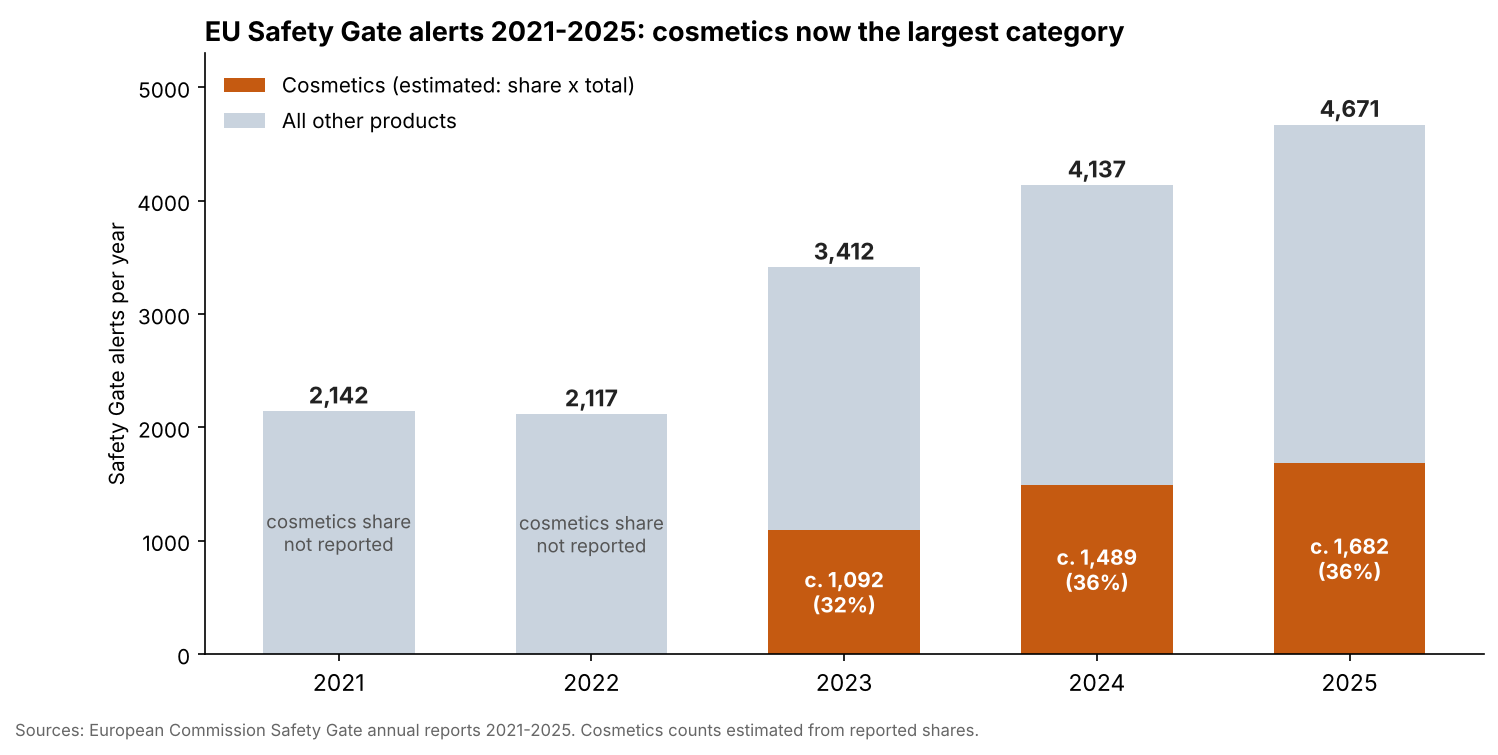
Safety Gate alerts across all non-food products more than doubled from 2022 to 2025 [2], and cosmetics have been the top category since 2023 [2][5][6].
| Year | All Safety Gate alerts | Cosmetics share | Cosmetics alerts (est.) | Main cosmetics cause |
|---|---|---|---|---|
| 2021 | 2,142 [3] | Not in top three | – | Not reported |
| 2022 | 2,117 [4] | Third-ranked category | – | Recently banned chemicals in perfumes and creams [4] |
| 2023 | 3,412 [5] | 32%, first category | c. 1,092 | Mostly BMHCA [5] |
| 2024 | 4,137 [6] | 36%, first category | c. 1,489 | BMHCA: 97% of chemical cosmetics alerts [6] |
| 2025 | 4,671 [2] | 36%, first category | c. 1,682 | BMHCA in almost 8 in 10 alerts; TPO first reported [2] |
Cosmetics alerts are our estimate (reported share × total). The Commission did not publish a cosmetics share for 2021 or 2022.
The US picture is different. A cross-sectional study of FDA Enforcement Reports counted 334 cosmetic recalls from 2011 to 2023, covering about 77 million units [1]. Microbial contamination caused 76.8% of them and inorganic contamination 10.2% [1].
02Why cosmetic recalls happen: each cause mapped to a development stage
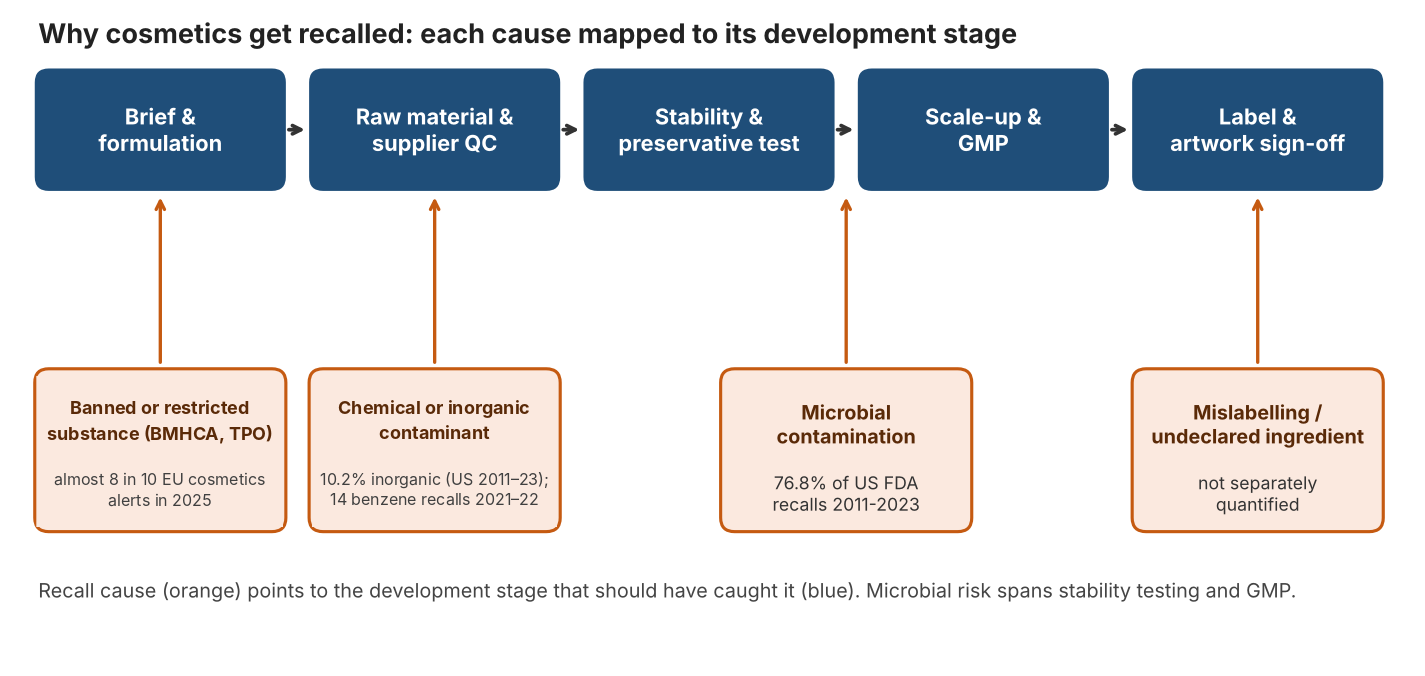
Every major cause traces back to a development step that was skipped, rushed or not repeated after a rule changed.
| Recall cause | Evidence | Stage that should catch it | Testing or formulation fix |
|---|---|---|---|
| Banned or restricted substance | BMHCA in almost 8 in 10 EU cosmetics alerts in 2025 [2] | Brief and formulation review | Screen every ingredient against EU Annex II/III and announced bans |
| Chemical or inorganic contaminant | Inorganic contamination in 10.2% of US recalls [1]; 14 US benzene recalls between April 2021 and October 2022, including OTC drugs [7] | Raw material and supplier QC | Impurity specifications and batch testing of propellants and raw materials |
| Microbial contamination | 76.8% of US recalls, 2011–2023 [1] | Stability, preservative testing and GMP scale-up | Challenge test (ISO 11930), microbial limits (ISO 17516), validated water and cleaning |
| Mislabelling or undeclared ingredient | Not separately quantified in the sources reviewed | Label and artwork sign-off | Reconcile the INCI list and allergen declarations against the final formula |
For the full sequence, see our hub guide Cosmetic product development process: brief to shelf, stage by stage.
03Four recalls from root cause to fix
Banned fragrance ingredient: BMHCA (EU)
| Step | Detail |
|---|---|
| What happened | Banned in the EU from 1 March 2022, yet the leading cause of cosmetics alerts on Safety Gate in 2023, 2024 and 2025 [5][6][2]. |
| Root cause | A likely root cause: existing formulas and fragrance compounds were not re-screened after the ban. |
| Who is affected | Perfumes and creams sold in the EU, including imported products. |
| How brands prevent it | Ingredient-level regulatory screening of every fragrance compound, with current supplier declarations on file. |
Benzene in aerosol dry shampoo (US)
| Step | Detail |
|---|---|
| What happened | October 2022: Unilever recalled select lots of Dove, Nexxus, Suave, TIGI and TRESemmé aerosol dry shampoos made before October 2021, sold nationwide [8]. |
| Root cause | The company's investigation traced the benzene to the propellant [8]. |
| Who is affected | Aerosol users; 14 US recalls between April 2021 and October 2022 involved benzene, including OTC sunscreens and antifungal sprays as well as cosmetics [7]. |
| How brands prevent it | Set a benzene specification for propellants and test incoming lots by headspace GC-MS. |
Microbial contamination in hygiene products (US)
| Step | Detail |
|---|---|
| What happened | 334 voluntary recalls in FDA Enforcement Reports, 2011–2023; 88.9% were Class II [1]. |
| Root cause | Mostly bacteria, chiefly Pseudomonas and Burkholderia [1], pointing to weak preservation or contaminated water. |
| Who is affected | Soaps, shampoos, wipes, lotions, makeup gels and tattoo ink; hygiene and cleaning products made up 51.5% of recalls [1]. |
| How brands prevent it | Preservative efficacy testing in final packaging and microbial release testing on every batch. |
TPO in nail products (EU)
| Step | Detail |
|---|---|
| What happened | Regulation (EU) 2025/877 banned TPO in cosmetics from 1 September 2025, with no sell-through period [9]. Nail polishes containing TPO appeared on Safety Gate for the first time in 2025 [2]. |
| Root cause | TPO was reclassified as a CMR 1B reproductive toxicant [9], and some brands had no reformulation plan. |
| Who is affected | Gel nail brands, distributors and salons. |
| How brands prevent it | Track substance reclassifications and build reformulation into the development roadmap before ban dates. |
04What MoCRA changes for US recalls
Most US cosmetic recalls remain voluntary. Under Section 611 of the FD&C Act, added by MoCRA, the FDA can now order a mandatory recall when a cosmetic is likely adulterated or misbranded and could cause serious harm or death, and the company declines to recall it voluntarily [10]. The FDA classifies recalls from Class I (serious harm likely) to Class III (harm unlikely), and lists them in its weekly Enforcement Reports [10].
05For brands & formulators
A product recall in cosmetics is rarely bad luck. The data shows predictable failures at four stages: formulation review, supplier QC, preservative testing and label sign-off. Building those checks into development is usually cheaper than a recall.
Product development: we build regulatory screening, stability and microbial testing into your development plan from brief to shelf.
06Questions readers ask
What is the most common reason for cosmetic recalls?
In the US, microbial contamination, at 76.8% of FDA cosmetic recalls in 2011–2023 [1]. In the EU, banned substances, led by the fragrance ingredient BMHCA [2].
Are cosmetic recalls mandatory?
Most are voluntary. Since MoCRA, the FDA can order a recall when a product could cause serious harm or death and the company refuses to recall it voluntarily [10].
How can brands prevent a product recall in cosmetics?
Screen formulas against current bans, set impurity specifications for raw materials, run preservative efficacy and microbial testing, and reconcile labels with the final formula.
07References
- Venkatesh KP, Kadakia KT, Akbarpour A, Nambudiri VE. US Food and Drug Administration recalls of cosmetic and personal products from 2011 to 2023: a cross-sectional study. J Am Acad Dermatol. 2025;92(1):179–81. doi:10.1016/j.jaad.2024.09.040. DOI
- European Commission, Representation in Cyprus. Commission's 2025 Safety Gate report shows increased action against dangerous products and stronger consumer protection. 5 Mar 2026. ec.europa.eu
- European Commission. Safety Gate: motor vehicles and toys top the list of dangerous non-food products. 26 Apr 2022. Republished by Wired-Gov. wired-gov.net
- European Commission, Representation in Cyprus. Safety Gate: chemical substances top annual list of health hazards in non-food products. 13 Mar 2023. ec.europa.eu
- CosmeticOBS. Safety Gate: cosmetics top the list of notified products in 2023. 18 Mar 2024. cosmeticobs.com; and European Commission, Representation in Germany. EU-Schnellwarnsystem für Produktsicherheit: Kosmetika am häufigsten gemeldet. 14 Mar 2024. ec.europa.eu
- SGS. SafeGuardS 112/25: European Commission publishes 2024 annual Safety Gate report. 31 Jul 2025. sgs.com; and European Commission, Representation in Ireland. List of dangerous products notified in Commission's Safety Gate in 2024. 16 Apr 2025. ec.europa.eu
- Hemenway C. Unilever adds to growing list of U.S. products recalled due to benzene. Insurance Journal. 26 Oct 2022. insurancejournal.com
- Unilever. Unilever issues voluntary U.S. recall of select dry shampoos due to potential presence of benzene [company announcement]. US Food and Drug Administration; 21 Oct 2022 (announced 18 Oct 2022). fda.gov
- European Commission, Transition Pathways. TPO in nail products: questions and answers. 2025. europa.eu
- US Food and Drug Administration. FDA recall policy for cosmetics. Content current as of 22 Oct 2026. fda.gov
Update log
- Published by Cosmetic Science Lab
This article is general technical information, not legal, regulatory or medical advice. Confirm requirements for your product and market before launch.