Beyond skin deep: preserving and proving a microbiome-friendly claim
Preserving a product is not the same as proving it is microbiome-friendly. The two tests, the endpoints that define the claim, the EU rules behind it, and an eight-gate decision tree from claim to evidence.
By CSL Claims and formulation teams, Cosmetic Science Lab · Reviewed by Dr. Premalatha, Ph.D., Life Science, Regulatory Consultant
Microbiome-friendly claims at a glance
- Two questions
- Is the product safely preserved? Does it adversely disrupt the skin microbiome?
- Two tests
- Preservative efficacy (challenge) testing; a defined microbiome endpoint
- Definition
- "Microbiome-friendly" has no harmonised definition; it must be defined as a measured endpoint
- EU rules
- Regulation 1223/2009 (safety, claims) and Regulation 655/2013 (six common claim criteria)
- Common mistake
- Weakening preservation in the belief that it helps the microbiome
- Continues from
- Part 1: the four biotic forms and their formulation demands
Quick answer
- Product preservation and skin microbiome compatibility are two different questions, answered by two different tests. Both must pass.
- Weaker preservation does not make a product microbiome-friendly. A contaminated product is unsafe, whatever its claim.
- There is no harmonised definition of "microbiome-friendly", so the brand must define it as a measured, comparative and time-bound endpoint.
- In the EU, the claim must meet the general substantiation criteria of Regulation 655/2013 [5].
Take-home message for formulators
- Pass challenge testing first, then test the microbiome endpoint
- Choose preservatives with both gates in mind
- Design the study around the exact claim wording
Take-home message for brand owners
- "Preservative-free" is not evidence of microbiome compatibility
- Write the claim before the study is commissioned
- Check local claim rules for every market you sell into
01From potential to proof
Part 1 set out the potential of microbiome cosmetics and the formulation demands of each biotic form [1]. As that market grows, more products will carry "microbiome-friendly" claims.
Proving such a claim raises two separate questions. Formulators who merge them put both product safety and claim credibility at risk.
02Two different questions
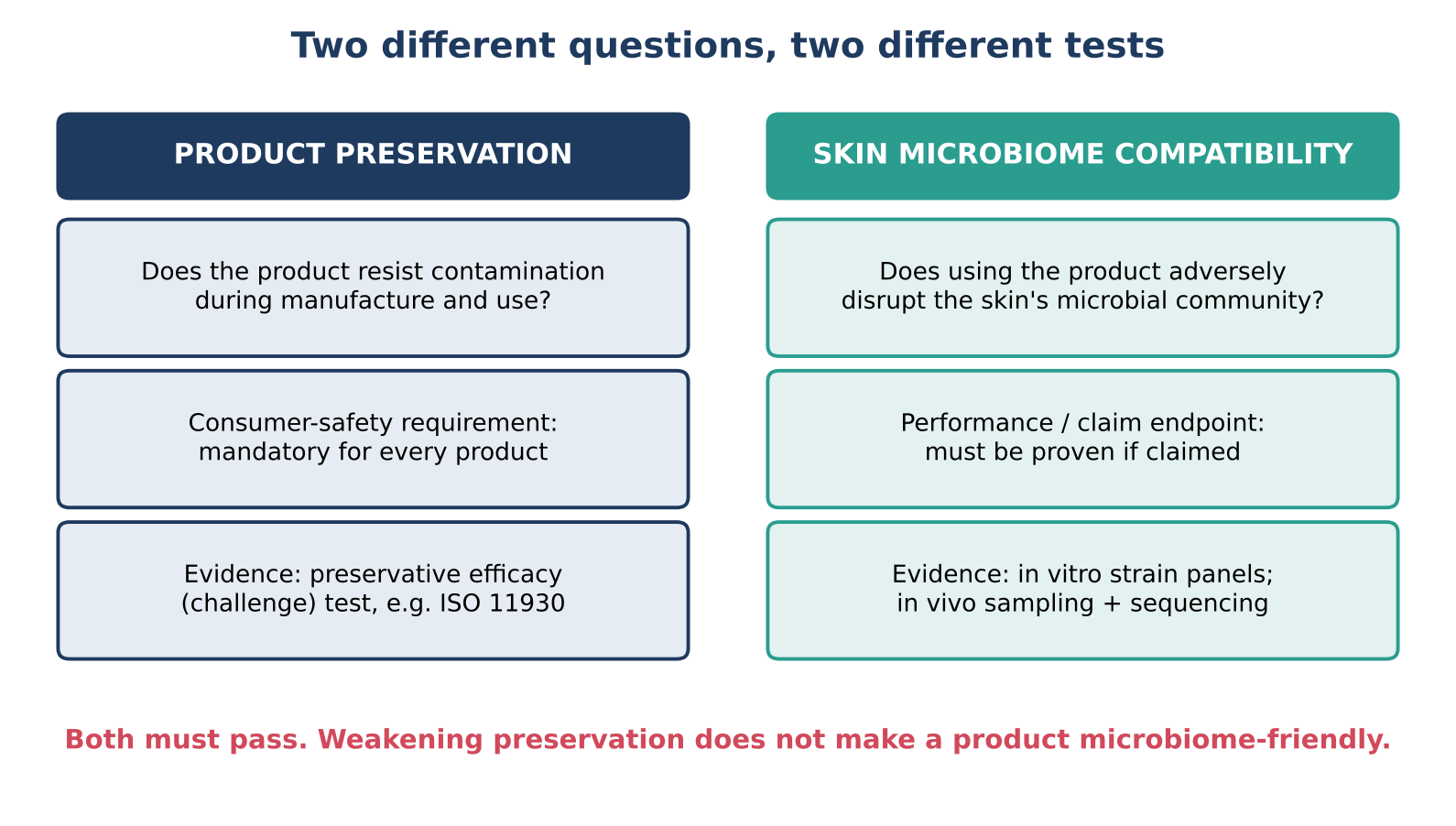
| Product preservation | Skin microbiome compatibility | |
|---|---|---|
| Question | Does the product resist contamination during manufacture and use? | Does using the product adversely disrupt the skin's microbial community? |
| Category | Consumer-safety requirement | Performance or claim endpoint |
| Typical evidence | Preservative efficacy (challenge) test, for example ISO 11930 [3]; microbial limits | In vitro strain panels; in vivo sampling and sequencing |
| When required | Always: the product must be safe [4] | Whenever the claim is made: it must be substantiated [5] |
03Why weaker preservation is not "microbiome-friendly"
It is tempting to assume that less preservative means less disruption on skin. That reasoning is unsafe. A poorly preserved product can carry uncontrolled organisms to the skin, the opposite of supporting a balanced microbiome.
The goal is a preservation system that passes challenge testing and, separately, shows no adverse effect at the chosen microbiome endpoint. Formulators reach it through preservative selection, hurdle design (water activity, pH) and protective packaging such as airless pumps. Lowering protection is not part of that toolkit. Our guide to ISO 11930 preservative efficacy testing explains how the safety gate is assessed.
Yes, if testing shows no adverse disruption at the chosen endpoint. Preservative choice and level should be selected and verified with both safety and the microbiome endpoint in mind.
A 2026 HAPPI trends review notes growing concern that aggressive skincare can cause dysbiosis, and that this concern is reshaping formulation strategy [6]. Non-disruptive design focuses on mild surfactant systems, a skin-compatible pH and avoiding over-exfoliation. Each choice still needs to be verified by testing rather than assumed.
04What "microbiome-friendly" means in practice
There is no harmonised definition. Mim and colleagues review how personal care products affect the skin microbiome and the culture-based, sequencing and artificial-skin approaches used to study it [2]. In practice, we treat the claim as a measured, comparative and time-bound endpoint.
| Endpoint | Typical method | What it shows |
|---|---|---|
| Commensal vs opportunist growth | In vitro panels of representative skin strains | Whether the formula favours one group |
| Community diversity | Skin swabs before and after use; 16S rRNA or shotgun sequencing | Whether diversity shifts with use |
| Key taxa balance | Relative abundance from sequencing | Shifts in the dominant genera |
| Skin physiology context | TEWL, surface pH, hydration | Barrier status alongside microbial data |
Study design matters as much as method. Sampling site, panel size, skin type, wash-out period and a comparison against an untreated site or reference product all shape what the data can support.
| Claim wording | Evidence it needs | Risk |
|---|---|---|
| "Microbiome-friendly formula" | In vitro panel showing no adverse effect on representative strains | Moderate: implies a skin effect if not qualified |
| "Respects the skin microbiome after 4 weeks of use" | In vivo before-and-after sequencing over 4 weeks, with stated panel | Lower, if the endpoint and panel are stated |
| "Rebalances the microbiome" | Evidence of a beneficial shift, not just no harm | High: a much stronger claim, and may imply a therapeutic effect in some markets |
A defensible claim reads like this: no adverse disruption of a stated endpoint, under stated use conditions, over a stated period.
05Claim substantiation: regulatory expectations
In the EU, Regulation 1223/2009 requires products to be safe and prohibits claims that imply characteristics or functions a product does not have [4]. Regulation 655/2013 sets six common criteria: legal compliance, truthfulness, evidential support, honesty, fairness and informed decision-making [5].
There is no microbiome-specific regulation yet. The general criteria still apply, so the evidence must match the exact claim wording. Brands selling into other markets should check local claim rules; our regulatory team can map them.
06The CSL microbiome formulation decision tree
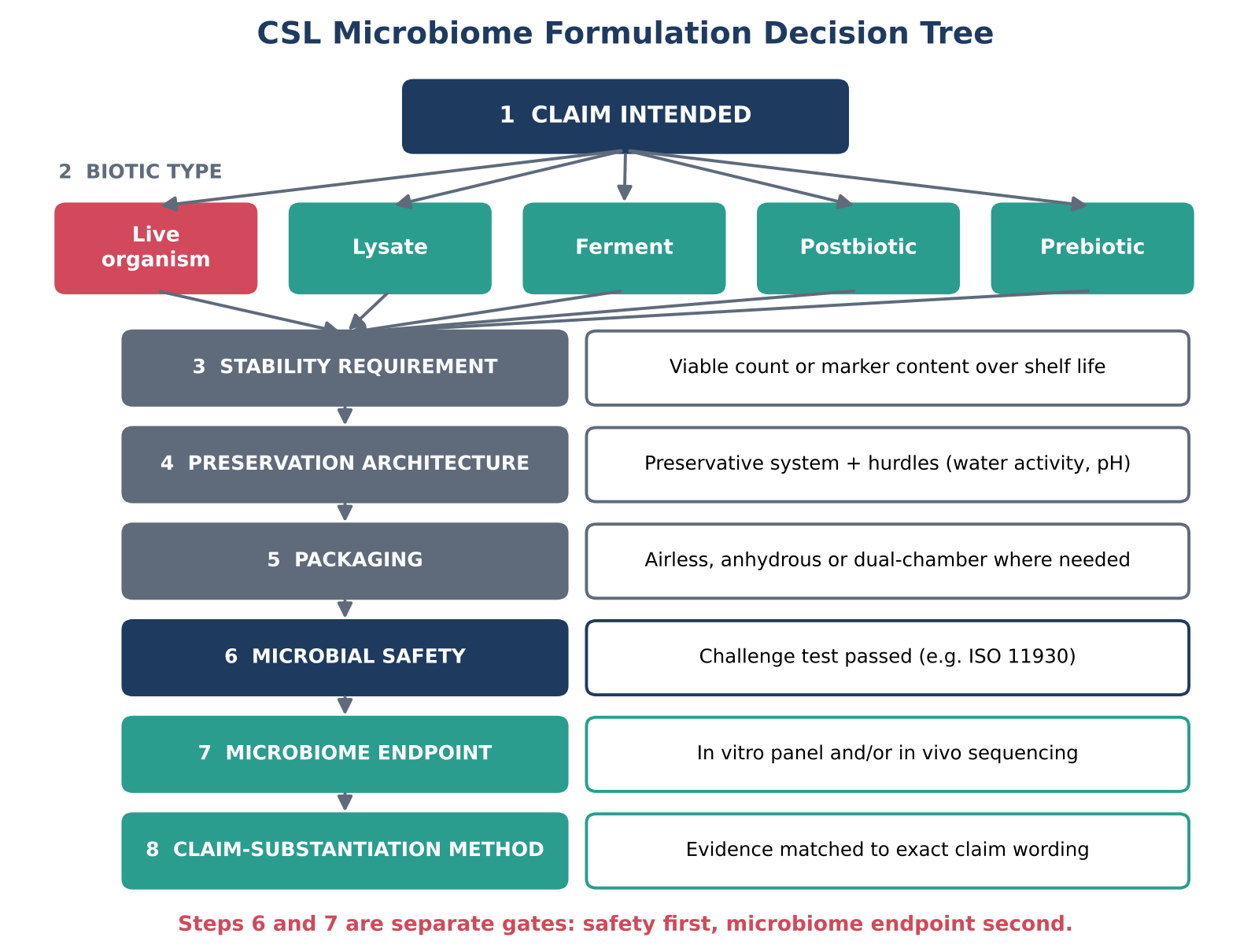
The tree starts with the claim, because the claim decides everything downstream. The biotic type sets the stability requirement, which shapes preservation and packaging. Microbial safety (gate 6) and the microbiome endpoint (gate 7) are separate gates, assessed in that order.
| Gate | Question the team must answer |
|---|---|
| 1. Claim intended | What exact wording will appear on pack and in marketing? |
| 2. Biotic type | Live organism, lysate, ferment, postbiotic or prebiotic? |
| 3. Stability requirement | Viable count, or marker content, at end of shelf life? |
| 4. Preservation architecture | Which preservative system and hurdles protect this formula? |
| 5. Packaging | Does the pack limit contamination, air and water loss? |
| 6. Microbial safety | Has the final formula passed challenge testing in its final pack? |
| 7. Microbiome endpoint | Which endpoint, method, panel and duration support the claim? |
| 8. Substantiation method | Does the evidence match the exact claim wording? |
Gate 1. If the team cannot write the final claim in one sentence, the study cannot be designed. We can help you fix the wording and the study together.
07Questions readers ask
Is a preservative-free product automatically microbiome-friendly?
No. Microbial safety and microbiome compatibility are separate questions. Every product must first be safely preserved, and any microbiome claim must be tested separately.
Is there an official definition of "microbiome-friendly"?
Not yet. The brand must define the claim as a measured endpoint and substantiate it under general claim rules, such as EU Regulation 655/2013.
What test supports a microbiome-friendly claim?
It depends on the wording. In vitro strain panels are common for screening and formula-level claims; in vivo sampling and sequencing before and after use support claims about effects on skin.
Preparing a microbiome-friendly launch?
Request a claim-substantiation review. We align your preservation system, testing plan and claim wording, and design the study that supports it.
08References
- Han JH, Kim HS. Skin deep: the potential of microbiome cosmetics. J Microbiol. 2024;62(3):181–199. DOI
- Mim MF, Sikder MH, Chowdhury MZH, et al. The dynamic relationship between skin microbiomes and personal care products: a comprehensive review. Heliyon. 2024;10(14):e34549. PMC
- International Organization for Standardization. ISO 11930:2019 Cosmetics — Microbiology — Evaluation of the antimicrobial protection of a cosmetic product. ISO
- Regulation (EC) No 1223/2009 of the European Parliament and of the Council of 30 November 2009 on cosmetic products. OJ L 342, 22.12.2009, p. 59–209. EUR-Lex
- Commission Regulation (EU) No 655/2013 of 10 July 2013 laying down common criteria for the justification of claims used in relation to cosmetic products. OJ L 190, 11.7.2013, p. 31–34. EUR-Lex
- Castañeda A, Jiménez J. What's new in the skin microbiome: 12 trends for formulators. HAPPI (Household & Personal Products Industry). 2 March 2026. HAPPI
Update log
- Published by Cosmetic Science Lab
This article is general technical information, not legal, regulatory or medical advice. Confirm requirements for your product and market before launch.