Skin deep: formulating microbiome cosmetics with prebiotics, probiotics, lysates and postbiotics
Prebiotics, live probiotics, lysates and postbiotics are four different formulation problems. What each demands for stability, viability and reproducibility, and what the research does and does not yet prove.
By CSL Formulation science team, Cosmetic Science Lab · Reviewed by Dr. Premalatha, Ph.D., Life Science, Regulatory Consultant
Microbiome cosmetics at a glance
- Market signal
- US$422.3 million in 2024, projected US$743.0 million by 2030 (9.9% CAGR)
- Core problem
- "Contains biotics" is a marketing description, not a formulation specification
- Four forms
- Prebiotic, live probiotic, probiotic lysate, postbiotic or ferment
- Hardest route
- Live cultures inside a product designed to stop microbial growth
- Most reproducible route
- Postbiotics and ferments, once the active fraction is defined
- Continues in
- Part 2: preservation, testing and microbiome-friendly claims
Quick answer
- Microbiome cosmetics use one of four biotic forms: prebiotics, live probiotics, probiotic lysates or postbiotics. Each creates a different formulation problem.
- Live cultures must survive a preserved product, which is the hardest route and needs viable counts proven to end of shelf life.
- Lysates and postbiotics are often confused. Under the ISAPP definition, a postbiotic contains inanimate microbial cells or their components; purified metabolites alone do not qualify [6].
- Postbiotics and ferments offer the most reproducible path, provided the specification defines strain, inactivation and measured markers.
Take-home message for formulators
- Name the biotic form in the brief, not just "probiotic"
- Ask suppliers for strain, inactivation method and markers
- Plan viability or marker testing to end of shelf life
Take-home message for brand owners
- A "probiotic" label does not guarantee living cells
- Choose the biotic form for stability, not for label appeal
- Oral probiotic data do not prove a topical benefit
01The microbiome formulation gap
A Research and Markets report values the global microbiome cosmetics market at about US$422.3 million in 2024 and projects US$743.0 million by 2030, a 9.9% CAGR [2].The growth is real. So is the gap between what labels promise and what formulas can deliver.
Han and Kim's 2024 review in the Journal of Microbiology links dysbiosis, an imbalance in the skin's microorganisms, with conditions such as acne and atopic dermatitis, and describes brands building products around prebiotics, probiotics and postbiotics [1].
For a formulator, each biotic form is a separate engineering problem. This article covers what each demands; Part 2 covers preservation, testing and claims.
02Four biotic forms, four formulation problems
| Biotic form | What it is | Main formulation challenge | Typical delivery |
|---|---|---|---|
| Prebiotic | A substrate selectively used by host microorganisms to confer a benefit [4] | Proving selectivity: supports commensals, not opportunists | Oligosaccharides and other sugars in aqueous bases |
| Live probiotic | Live microorganisms that confer a benefit when applied in adequate amounts [5] | Keeping cells viable in a preserved product | Anhydrous, encapsulated or dual-chamber formats |
| Probiotic lysate | Cells of a named strain broken open; no viable cells | Batch consistency of cell fragments | Aqueous concentrates |
| Postbiotic / ferment | Inanimate microorganisms and/or their components that confer a benefit [6] | Defining and standardising the active fraction | Ferment filtrates, heat-treated cells |
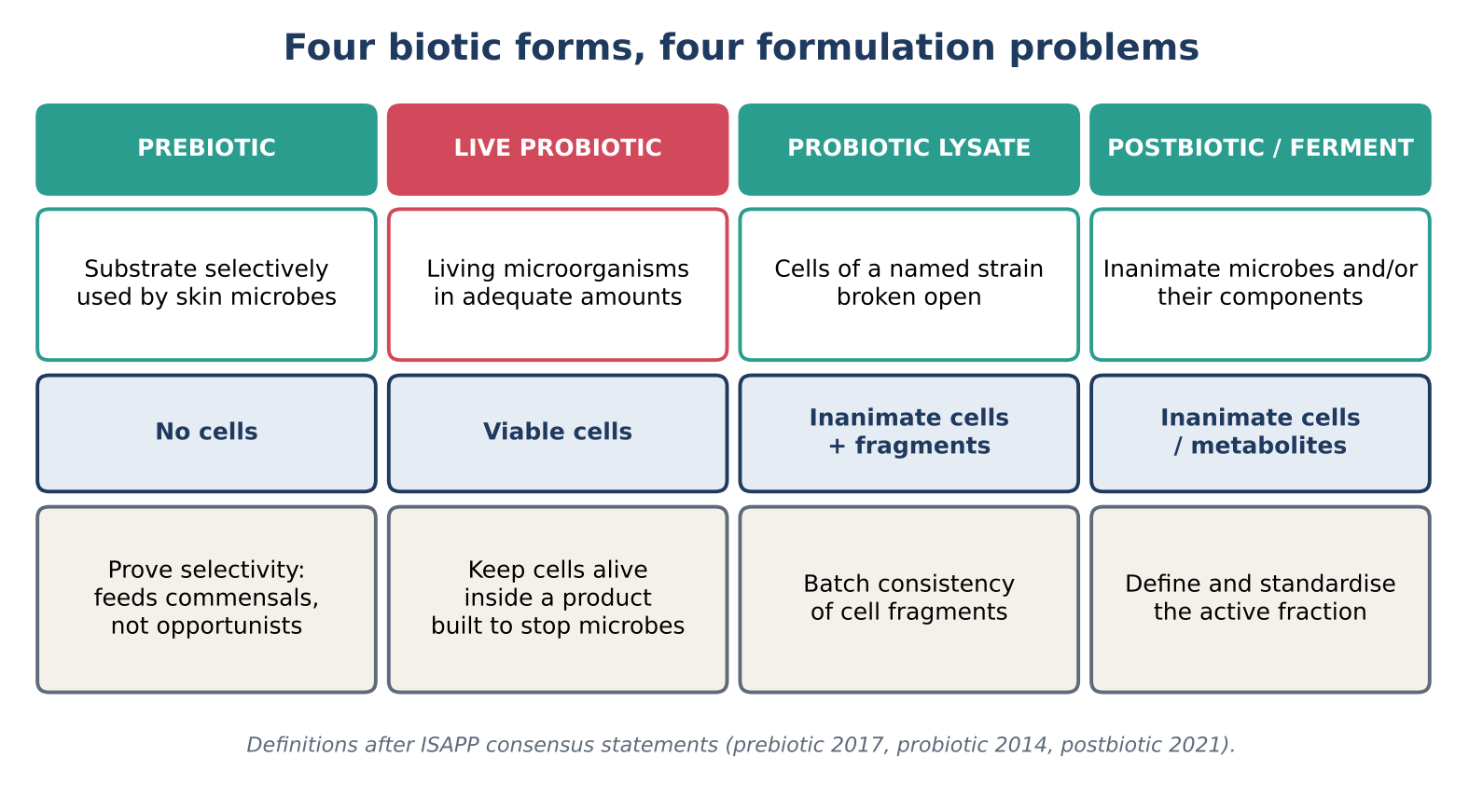
A "probiotic" label does not guarantee living cells. Many marketed products use lysates or postbiotics rather than live cultures, so the brief should state which form is intended and the supplier specification should confirm it. See also our pages on prebiotics, postbiotic lysates and ferments.
03Live cultures: the viability problem
A live probiotic must survive conditions designed to stop microbial growth. Most water-based cosmetics contain preservatives intended to kill or inhibit microorganisms, and a live strain is a microorganism.
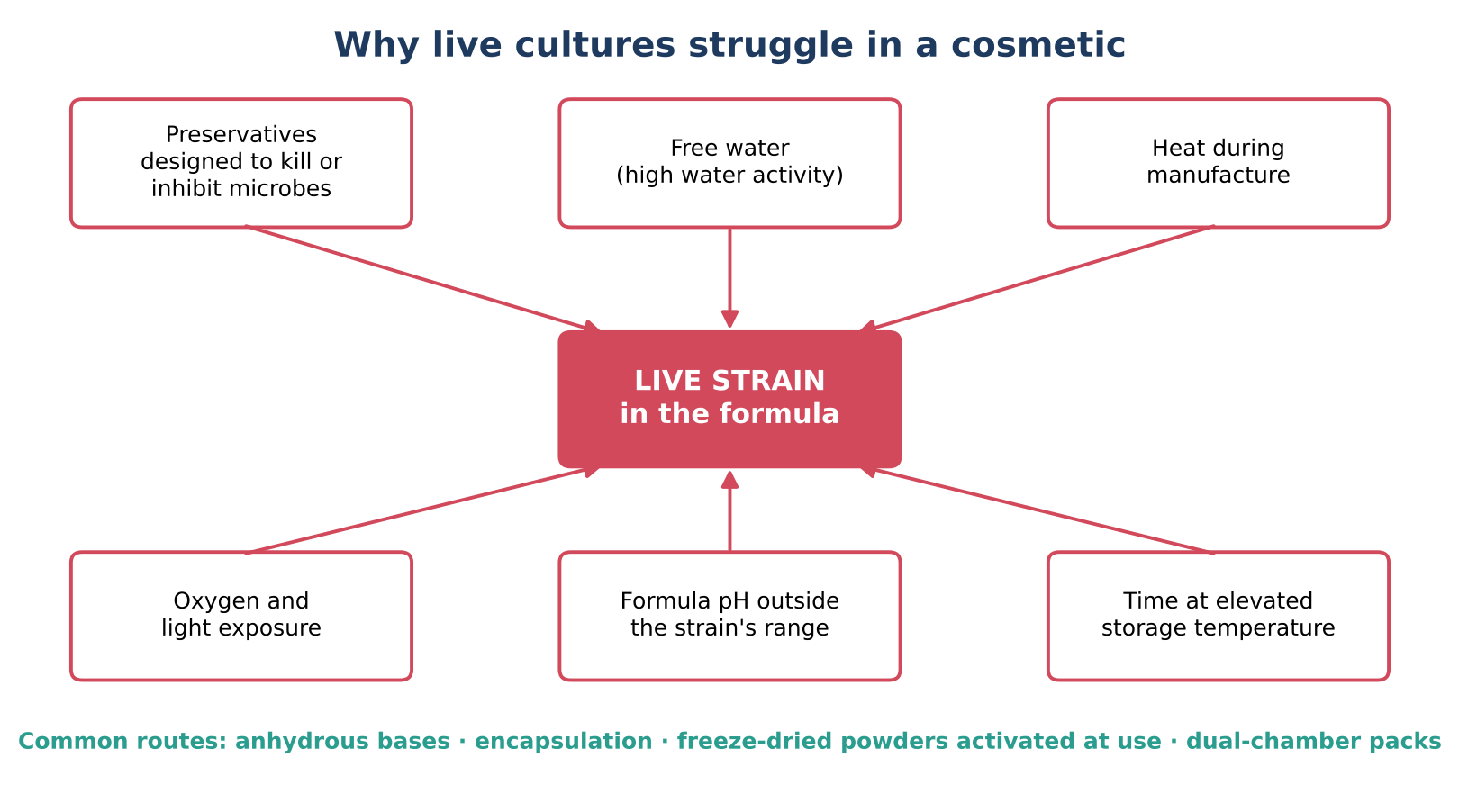
Formulators usually turn to anhydrous bases, encapsulation, freeze-dried powders activated at the point of use, or dual-chamber packs. Each route brings its own verification burden:
- Viability: viable counts at release and at end of shelf life, using a method that recovers the strain from the product matrix.
- Microbial safety: separate evidence that the product resists contamination and stays within microbial limits. A live culture does not exempt a product from preservative efficacy testing.
- Identity: confirmation that the organism counted is the declared strain, not a contaminant.
04Lysate vs postbiotic: clearing the confusion
The two terms are often used interchangeably. Under the 2021 ISAPP consensus, a postbiotic is a preparation of inanimate microorganisms and/or their components that confers a health benefit. Purified metabolites alone, without cell biomass, fall outside that definition [6].
So a lysate of a characterised strain can qualify as a postbiotic, while some cell-free ferment filtrates sold as "postbiotics" technically do not. The practical rule is to specify strain identity, inactivation method, whether cell fragments are present, and which markers are measured.
Not necessarily. Many marketed products use lysates or postbiotics rather than live cultures. Only the ingredient specification, covering strain, form and whether viable cells are present, tells you what is in the bottle.
05Postbiotic standardisation: the reproducible route
A 2026 HAPPI review of formulator trends, drawn from the 2025 IFSCC Congress, reports significant growth in postbiotic and fermentation-based technologies [3]. Fermentation-derived actives avoid live-culture viability problems and can be specified and controlled like any other active, but only if the specification is written properly.
| Area | What to specify | Why it matters |
|---|---|---|
| Origin | Strain name and taxonomic identity; fermentation medium and conditions | Effects are strain-specific; medium changes the output |
| Processing | Inactivation method and confirmation that no viable cells remain | Separates a postbiotic from a live culture |
| Composition | Defined markers, such as protein, polysaccharide, organic acid or a named metabolite | The only way to show batch-to-batch consistency |
| Quality | pH, solids and microbial limits per batch | Supports release testing and preservation design |
"Which markers do you measure on every batch, and what are the acceptance limits?" Without them, batch consistency, and any claim built on it, cannot be verified. We can review the specification with you.
06What the research shows, and what it does not prove
Recent reviews agree on the promise [1], [7]. The evidence also has limits that formulators should respect:
- Much of it comes from in vitro work or small clinical studies.
- Effects are strain-specific and do not transfer automatically from one strain to another.
- Benefits seen with oral probiotics do not prove topical efficacy.
- Mim and colleagues call for larger studies across age groups, genders and body sites [7].
Two further research frontiers appear in the same HAPPI review: links between the skin microbiome, the skin–brain axis and states such as stress and sleep, and more realistic "bio-real" in vitro models of native skin microbiota [3]. Product claims built on either would be premature today. Proving that a product is safely preserved and does not disrupt the skin microbiome is the subject of Part 2.
07Questions readers ask
Do probiotic skincare products contain live bacteria?
Some do, but many marketed products use lysates or postbiotics rather than live cultures. The ingredient specification, not the label, tells you which.
What is the difference between a probiotic lysate and a postbiotic?
A lysate is broken cells of a named strain. Postbiotic is the broader ISAPP category for inanimate microorganisms and/or their components, so a lysate can be one type of postbiotic. Purified metabolites without cell biomass are not postbiotics under that definition.
Can a product with live probiotics skip preservative testing?
No. The product must still be shown to resist contamination and meet microbial limits, which is one reason live cultures usually need anhydrous, encapsulated or dual-chamber formats.
Planning a prebiotic, probiotic or postbiotic product?
Request a microbiome-compatible formulation review. We assess your biotic choice, supplier specification, stability plan and route to substantiated claims.
08References
- Han JH, Kim HS. Skin deep: the potential of microbiome cosmetics. J Microbiol. 2024;62(3):181–199. DOI
- Research and Markets. Microbiome cosmetic products: global strategic business report. Research and Markets
- Castañeda A, Jiménez J. What's new in the skin microbiome: 12 trends for formulators. HAPPI (Household & Personal Products Industry). 2 March 2026. HAPPI
- Gibson GR, Hutkins R, Sanders ME, et al. Expert consensus document: the International Scientific Association for Probiotics and Prebiotics (ISAPP) consensus statement on the definition and scope of prebiotics. Nat Rev Gastroenterol Hepatol. 2017;14(8):491–502. PubMed
- Hill C, Guarner F, Reid G, et al. Expert consensus document: the International Scientific Association for Probiotics and Prebiotics consensus statement on the scope and appropriate use of the term probiotic. Nat Rev Gastroenterol Hepatol. 2014;11(8):506–514. PubMed
- Salminen S, Collado MC, Endo A, et al. The International Scientific Association of Probiotics and Prebiotics (ISAPP) consensus statement on the definition and scope of postbiotics. Nat Rev Gastroenterol Hepatol. 2021;18(9):649–667. DOI
- Mim MF, Sikder MH, Chowdhury MZH, et al. The dynamic relationship between skin microbiomes and personal care products: a comprehensive review. Heliyon. 2024;10(14):e34549. PMC
Update log
- Published by Cosmetic Science Lab
This article is general technical information, not legal, regulatory or medical advice. Confirm requirements for your product and market before launch.