Formulating niacinamide serums without the flush: how heat, pH and co-actives raise niacin
New 2025 data link niacinamide flushing to niacin formed in the bottle, not to the percentage on the label. What the study found, what it did not prove, and the process controls that keep a serum flush-free.
By CSL Formulation team, Cosmetic Science Lab · Reviewed by Shreya Rangarajan

Study at a glance
- Study
- Barré et al., Pierre Fabre Dermo-Cosmétique; EUROTOX 2025 poster, abstract in Toxicology Letters
- Products
- 31 niacinamide face products considered; 25 linked to clinical and cosmetovigilance data
- Measured
- Niacin (nicotinic acid) in 15 formulas by LC-UV, 33 measurements
- Key finding
- Hot addition (above 45 °C) linked to niacin mostly above 380 ppm; cooler addition mostly below 52 ppm
- Also linked
- Acidic pH, co-actives and more oily emollients in less-tolerated formulas
- Limits
- Conference abstract; observational; small sample; association, not proven cause
Quick answer
- Niacin forms mainly by hydrolysis, which speeds up with heat and with pH outside roughly 4–6 [2].
- Adding niacinamide during cool-down, buffering pH for the whole shelf life and managing co-actives are the main controls.
- Measure before you reformulate. Cutting the percentage often treats the symptom, not the cause.
Take-home message for formulators
- Add niacinamide below 40–45 °C and record the actual temperature
- Buffer the formula to hold pH 5–6.5 over shelf life
- Measure niacin, not just niacinamide, in stability
Take-home message for brand owners
- Ask your manufacturer what niacin level the serum reaches after hot storage
- Investigate complaints before lowering the percentage
- Test in the final pack under Gulf storage conditions
01Why niacinamide percentage does not tell the whole story
Two serums can both say "5% niacinamide" and still behave differently on skin. One is well tolerated. The other causes warmth, redness or tingling within minutes. Most online discussion blames the percentage, but the label shows only how much niacinamide was added, not what happened to it afterwards.
Processing temperature, formula pH, co-actives, vehicle and storage history can all change the final product. The most important change is the formation of niacin (nicotinic acid), a related form of vitamin B3 known to cause flushing [1], [3]. So the first question in a flushing complaint is not "Is our percentage too high?" It is "What is actually in the bottle now, and how did it get there?"
02Niacinamide versus niacin: the chemistry that matters
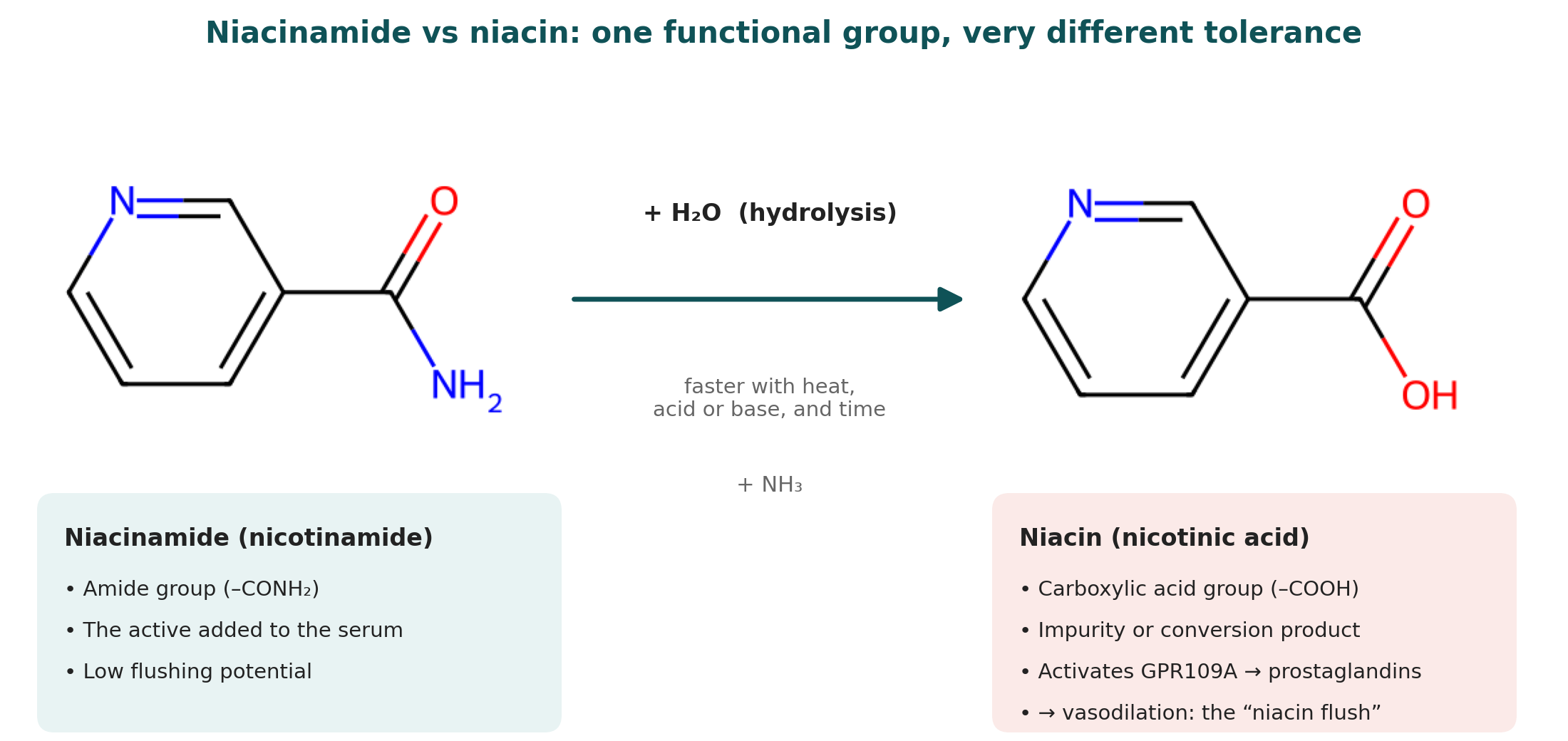
Niacinamide (nicotinamide) and niacin (nicotinic acid) are both forms of vitamin B3. The difference is one functional group: niacinamide is an amide, niacin is a carboxylic acid. Niacin activates a receptor called GPR109A (HCA2) on skin cells, which triggers release of prostaglandins that widen small blood vessels: the classic warm, red "niacin flush" [3], [4]. Niacinamide does not act on this receptor in the same way, which is why it is usually well tolerated [5].
| Property | Niacinamide | Niacin (nicotinic acid) |
|---|---|---|
| Chemical group | Amide | Carboxylic acid |
| Cosmetic role | Active ingredient (barrier, tone, sebum) | Not a target ingredient in leave-on serums |
| Flushing potential | Low | High: vasodilation via GPR109A and prostaglandins [3], [4] |
| How it appears in a serum | Added deliberately | Raw-material impurity or conversion product |
Niacinamide can hydrolyse: water attacks the amide bond, producing nicotinic acid and ammonia. The reaction is catalysed by both acid and base, and it speeds up with temperature [2]. Niacin in a finished serum can therefore come from two sources: residual nicotinic acid in the raw material, or conversion during the process and storage. A good investigation separates the two before changing anything else.
03What the latest research found, and what it did not prove
A 2025 study from Pierre Fabre Dermo-Cosmétique, presented as a poster at EUROTOX and published as an abstract in Toxicology Letters, examined why some niacinamide products are less well tolerated than others [1]. Of 31 face products considered, 25 were linked to clinical and cosmetovigilance (post-market complaint) data. Niacin was measured in 15 formulas by liquid chromatography with UV detection. In about one-third of the tested formulas, niacinamide was added above 45 °C.
| Factor | Well-tolerated formulas | Less-tolerated formulas |
|---|---|---|
| Niacinamide concentration | 1–6% | 0.5–4% |
| Other actives present | Mostly not | Mostly yes |
| Formula pH | Mostly skin-like | Acidic pH linked to moderate or poor tolerance |
| Emollient profile | More aqueous, fewer oily emollients | More oily emollients |
| Niacin level | Low in all cases | Much higher in all moderately tolerated cases |
The temperature result was the clearest. Most formulas where niacinamide was added hot contained niacin above 380 ppm. Nearly all formulas where it was added at lower temperatures contained less than 52 ppm [1]. And the less-tolerated products did not use more niacinamide: the percentage alone did not explain tolerance.
Niacinamide (122.1 g/mol) and niacin (123.1 g/mol) have almost the same molar mass, so each ppm of niacin corresponds to roughly one ppm of niacinamide lost. In a 5% serum (50,000 ppm niacinamide), ~52 ppm niacin is about 0.1% conversion and ~380 ppm is about 0.75%. The difference between a well-tolerated and a poorly tolerated product can be less than 1% conversion. A standard niacinamide assay, with release limits of several percent around label claim, will not see it. Only a direct niacin measurement will.
It is a conference abstract, not a full peer-reviewed paper. It is observational: the formulas differed in many ways at once, so no single factor was isolated. Samples were small, with niacin measured in only 15 formulas, and it shows association, not proven causation. Read it as: process temperature, pH and co-actives are credible risk factors worth controlling and testing, not guaranteed causes of every complaint.
04Why processing temperature matters
Niacinamide is often called "heat stable", and it does not oxidise the way vitamin C or retinol does. But hydrolysis still happens, and higher temperatures make it faster [2]. Thermal degradation depends on three things together: how hot the phase is, how long it stays hot (including hold times and slow cooling of large batches), and the pH and composition of that phase.
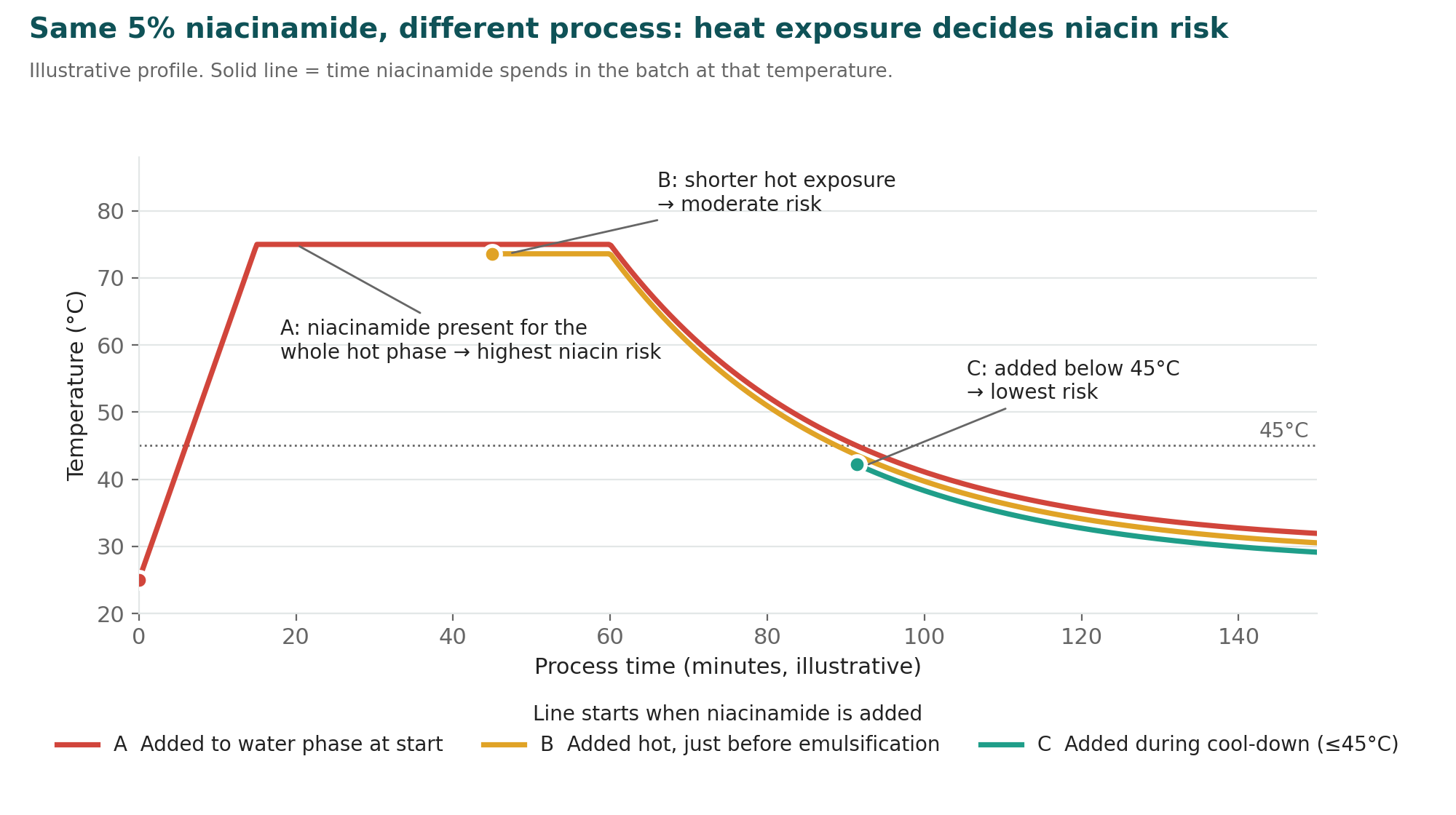
Many serums and emulsions heat the water phase to 70–80 °C for emulsification, gum hydration or preservative dissolution. If niacinamide goes in at the start, it sits hot for the whole process. Scale matters too: a 1 kg lab batch cools quickly, while a 500 kg batch can stay hot far longer, so a formula that looked fine in the lab can produce more niacin in production with the same written procedure.
| Process route | Heat exposure for niacinamide | Relative niacin risk |
|---|---|---|
| Added to water phase at the start, heated with the batch | High temperature, long duration | Highest |
| Added hot, just before emulsification | High temperature, shorter duration | Moderate |
| Added during cool-down (below ~40–45 °C) | Low temperature, short duration | Lowest |
| Cold-process serum, no heating step | Minimal | Lowest |
05Why pH, and pH drift, change the problem
Classic kinetic work measured niacinamide hydrolysis across a wide pH range and found the slowest rate between roughly pH 4 and 6, with catalysis by both acids and bases [2]. For serum design that gives a practical target of mildly acidic to near-neutral, commonly around pH 5–6.5, held for the whole shelf life, not just on the day of manufacture.
Many serums are lightly buffered or not buffered at all, so pH drifts: other ingredients degrade and release acids, the formula interacts with its pack, nicotinic acid formation itself lowers pH slightly, or the batch was over-corrected with strong acid or base. A serum released at pH 5.8 that drifts to 4.5 after months of hot storage is a different product from the one that passed release.
| Consideration | Why it matters |
|---|---|
| Buffer capacity | Too weak and pH still drifts; too strong can affect skin feel and tolerance |
| Target pH | Must suit niacinamide and every other active in the formula |
| Compatibility | Some buffer salts affect thickeners, electrolyte-sensitive polymers or clarity |
| Measurement | Track pH at every stability time point, not only at release |
Citrate, lactate and phosphate buffers are common choices, selected for the target pH and compatibility with other actives.
06When to add niacinamide during cool-down
Cool-down addition shortens the time the active spends hot, and the 2025 data support it [1]. Consider it when the process heats the water phase above ~50 °C, the batch is large and cools slowly, the formula pH sits at the low end of the stable range, acids or other actives are present, or the product is being reformulated after complaints.
- Pre-dissolve
Dissolve niacinamide in a portion of water held back from the main phase.
- Add below the set temperature
Commonly 40–45 °C, and record the actual addition temperature on the batch record.
- Check pH after addition
Adjust with the chosen buffer system, not by adding strong acid.
- Watch for side effects
A large late addition can affect viscosity, clarity or emulsion stability.
- Validate at scale
Cooling time and mixing differ between lab and production.
Cool-down addition is not a cure-all. If pH is poorly controlled or the raw material already contains niacin, a cooler process reduces the problem but does not remove it.
07Niacinamide with vitamin C and acids: chemistry, not myths
The popular claim is that vitamin C and niacinamide "cancel each other out". The chemistry is more specific. They can form a yellowish complex in solution, generally regarded as reversible and mainly an aesthetic issue. The bigger issue is pH: L-ascorbic acid serums are usually formulated around pH 3–3.5, well below niacinamide's most stable window [2], and at low pH, especially with heat, hydrolysis is faster over shelf life. The same logic applies to AHAs and BHAs at low pH, and the 2025 data linked acidic formulas and co-actives with poorer tolerance [1].
| Myth | Formulation reality | Practical option |
|---|---|---|
| "Niacinamide and vitamin C cancel each other out" | Reversible complex; main risk is low pH plus time and heat | Use a higher-pH vitamin C derivative in the same formula, or separate products |
| "Niacinamide can never be used with acids" | Risk depends on final pH, acid load and storage | Keep final pH within niacinamide's window; consider PHAs or milder acids |
| "If it doesn't flush on day one, it's stable" | Niacin can build up over shelf life | Measure niacin and pH through accelerated stability |
08Multi-active serums need system-level tolerance assessment
A "niacinamide serum" may also contain zinc PCA, acids, retinoids, vitamin C derivatives, enzymes, fragrance and penetration enhancers. Co-actives affect tolerance in three ways: chemically (lowering pH or catalysing hydrolysis), biologically (irritating actives make skin more reactive, so a little niacin is felt more), and through the vehicle (penetration enhancers, alcohols or solvents speed delivery). The 2025 study found most less-tolerated formulas combined niacinamide with other actives [1].
| Co-active | Main consideration with niacinamide |
|---|---|
| L-ascorbic acid | Low-pH conflict; consider derivatives or separate products |
| AHAs / BHAs | Final pH and acid load; tolerance of combined exfoliation |
| Retinoids | Additive irritation potential; not a chemical conflict |
| Zinc PCA | Generally compatible; check clarity and pH |
| Peptides | Generally compatible; check pH suits both |
| Penetration enhancers / high alcohol | May increase delivery and perceived warmth |
| Fragrance / essential oils | Separate sensitisation and irritation risk |
A tolerance claim for a multi-active serum should be supported by testing the final formula through our claims and clinical team, not borrowed from data on niacinamide alone.
09Gulf storage and distribution: stability does not end at the factory
A serum can leave the factory with low niacin and reach the consumer with more, because hydrolysis continues slowly in the bottle and heat speeds it up [2]. In the UAE and wider GCC, products can sit in containers at port, in warehouses without full temperature control, in delivery vans and parcel lockers, and in cars and bathrooms. Stability testing for this market should include elevated-temperature storage and temperature cycling, track niacin and pH over time, and test the serum in its final pack, since some packs lose water and concentrate the formula.
"What niacin level does this serum reach after accelerated storage at elevated temperature?" If nobody has measured it, the risk is unknown. We can measure it for you.
10CSL investigation path for a flushing complaint
When a customer reports warmth or redness from a niacinamide serum, CSL measures before it reformulates.
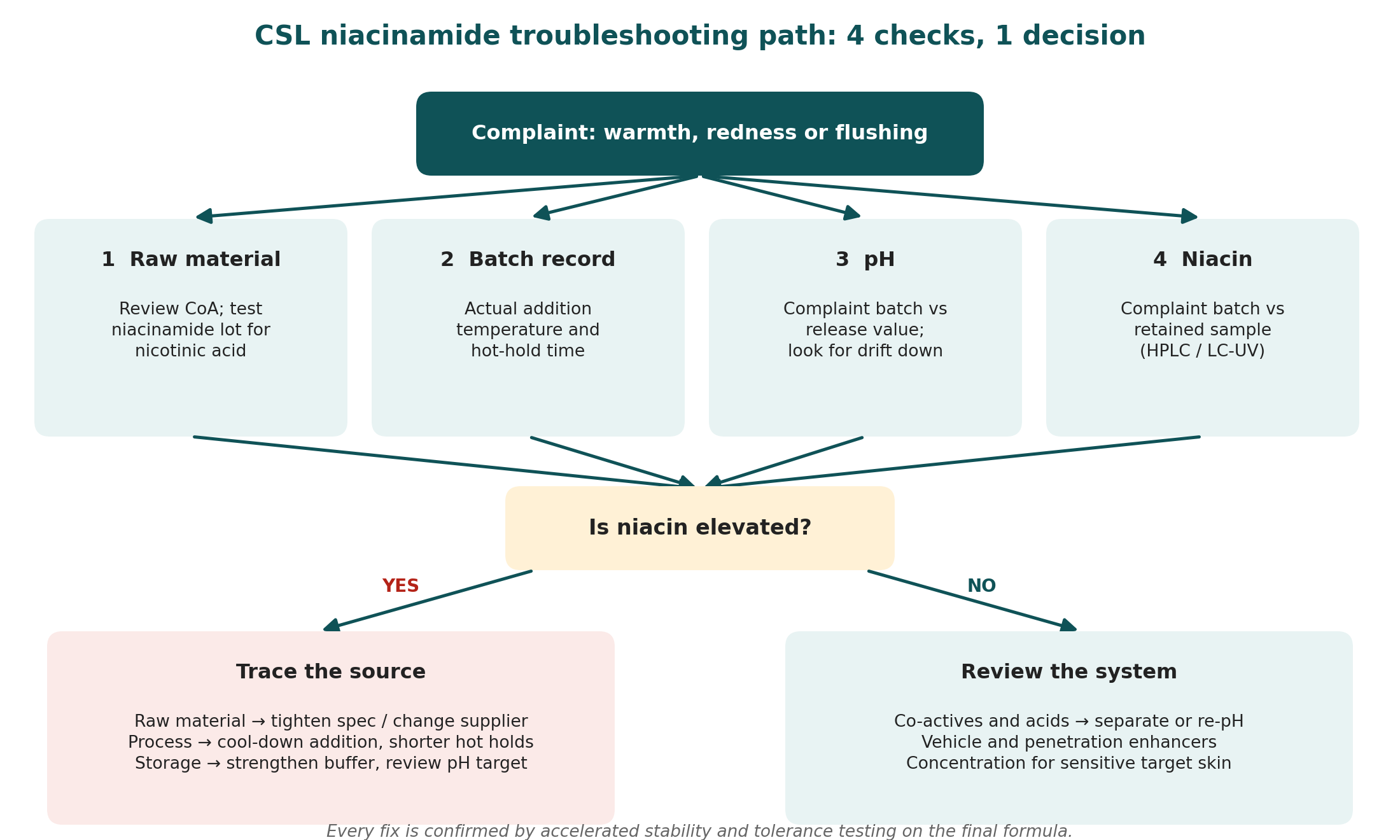
- Raw material
Review the certificate of analysis and, where possible, test the niacinamide lot for nicotinic acid. A contaminated lot explains the problem without any process fault.
- Batch record
Confirm the actual temperature when niacinamide was added and how long the batch stayed hot. Compare with lab-scale batches.
- pH
Measure the complaint batch now and compare it with the release value. A downward drift points to hydrolysis or instability elsewhere in the formula.
- Niacin
Measure niacin in the complaint batch and in a retained sample stored under controlled conditions. The difference shows how much formed during distribution and storage.
If niacin is elevated, trace its source: raw material, process or storage. If niacin is low, look at the co-active system, vehicle and concentration. Either way, confirm the fix with accelerated stability and tolerance testing on the final formula.
11What to measure in reformulation and stability
For niacinamide, "looks, smells and feels the same" is not enough, because niacin can rise without any visible change.
| Parameter | Method | What it tells you |
|---|---|---|
| Niacin (nicotinic acid) | HPLC / LC-UV | Direct measure of conversion; the key tolerance-linked marker |
| Niacinamide assay | HPLC / LC-UV | Active content over shelf life |
| pH | Calibrated pH meter | Drift toward the less stable range |
| Colour | Visual and instrumental | Yellowing from complexes or degradation of other ingredients |
| Odour | Panel check | Possible degradation of other components |
| Viscosity | Viscometer | Thickener performance, often linked to pH drift |
| Appearance and clarity | Visual | Precipitation, haze or separation |
| Pack compatibility | Weight loss, visual | Water loss and interaction with packaging |
Suggested conditions: room temperature (control), 40 °C and 45 °C storage; time points at 0, 2, 4, 8 and 12 weeks with longer real-time follow-up; several hot–cold cycles to mimic Gulf transit; and testing in the final commercial pack. There is no universal regulatory limit for niacin in niacinamide cosmetics. The 2025 figures of about 52 ppm and 380 ppm are reference points, not safety thresholds [1]; set an internal niacin specification at release and end of shelf life and confirm it with tolerance testing.
12When to change concentration, and when to change the process
| What the investigation shows | Most likely fix |
|---|---|
| High niacin in the raw material | Change supplier or tighten the raw-material specification |
| Niacin rises during manufacture | Move niacinamide to cool-down; shorten hot holds |
| Niacin rises during storage, pH drifts down | Add or strengthen the buffer system; review pH target |
| Low pH needed for another active | Separate actives, use a higher-pH derivative, or redesign the system |
| Low niacin, but irritation remains | Review co-actives, vehicle and penetration enhancers |
| Low niacin, clean system, reactions on sensitive skin only | Review concentration for the target consumer |
Concentration is the right lever when niacin is low, the system is clean and reactions still occur in a sensitive target group; a lower level such as 2–5% may suit them better. In most other cases, flushing is a process and system problem, and fixing the process protects the product's claims and the brand's reputation.
13Questions readers ask
Why can one niacinamide serum cause redness while another does not?
Products with the same niacinamide percentage can differ in pH, process temperature, co-actives, vehicle and storage history. These factors change how much niacin forms, and niacin is known to cause flushing.
Can niacinamide convert to niacin?
Yes. Niacinamide can hydrolyse to nicotinic acid (niacin). The reaction is catalysed by acids and bases and speeds up with heat.
Does pH matter in a niacinamide serum?
Yes. Hydrolysis is slowest around pH 4–6 and faster outside that range. Holding pH stable over shelf life with a suitable buffer helps limit niacin formation.
Should niacinamide be added during cool-down?
It is often a sensible precaution. Recent data link lower addition temperatures with much lower niacin levels in finished products.
Is 10% niacinamide better than 5%?
Not automatically. A well-made 5% serum with controlled pH, low niacin and a clean co-active system can be better tolerated, and just as effective for its claims, as a poorly processed product at a higher level.
Can niacinamide and vitamin C be used together?
Yes, with formulation judgement. In a single formula the main risk is the low pH of L-ascorbic acid combined with time and heat. Higher-pH vitamin C derivatives or separate products reduce that risk.
Flushing complaints on a niacinamide serum?
We review your raw-material specification, process, pH, co-active system and stability data, measure niacin directly, and recommend the fix, before you cut the percentage.
14References
- Barré M, Prigent E, Beaube M, Falip A, Berrada Gomez MP, Ferret PJ. P07-01 Niacinamide's impact on cutaneous tolerance of dermo-cosmetic products. Toxicol Lett. 2025;411(Suppl):S99. Conference abstract. ScienceDirect
- Finholt P, Higuchi T. Rate studies on the hydrolysis of niacinamide. J Pharm Sci. 1962;51(7):655–661. PubMed
- Benyo Z, Gille A, Kero J, et al. GPR109A (PUMA-G/HM74A) mediates nicotinic acid-induced flushing. J Clin Invest. 2005;115(12):3634–3640. PubMed
- Kamanna VS, Ganji SH, Kashyap ML. The mechanism and mitigation of niacin-induced flushing. Int J Clin Pract. 2009;63(9):1369–1377. PubMed
- Gehring W. Nicotinic acid/niacinamide and the skin. J Cosmet Dermatol. 2004;3(2):88–93. PubMed
Update log
- Published by Cosmetic Science Lab
This article is general technical information, not legal, regulatory or medical advice. Confirm requirements for your product and market before launch.