Alpha arbutin: what the evidence shows for dark spots and uneven tone
Alpha arbutin is a popular, gentle brightening active, but most human data come from small or combination studies. CSL formulation scientists explain the evidence, the new EU limits and how to use it well.
By CSL Formulation team · Evidence checked by CSL scientists
At a glance
- What it is
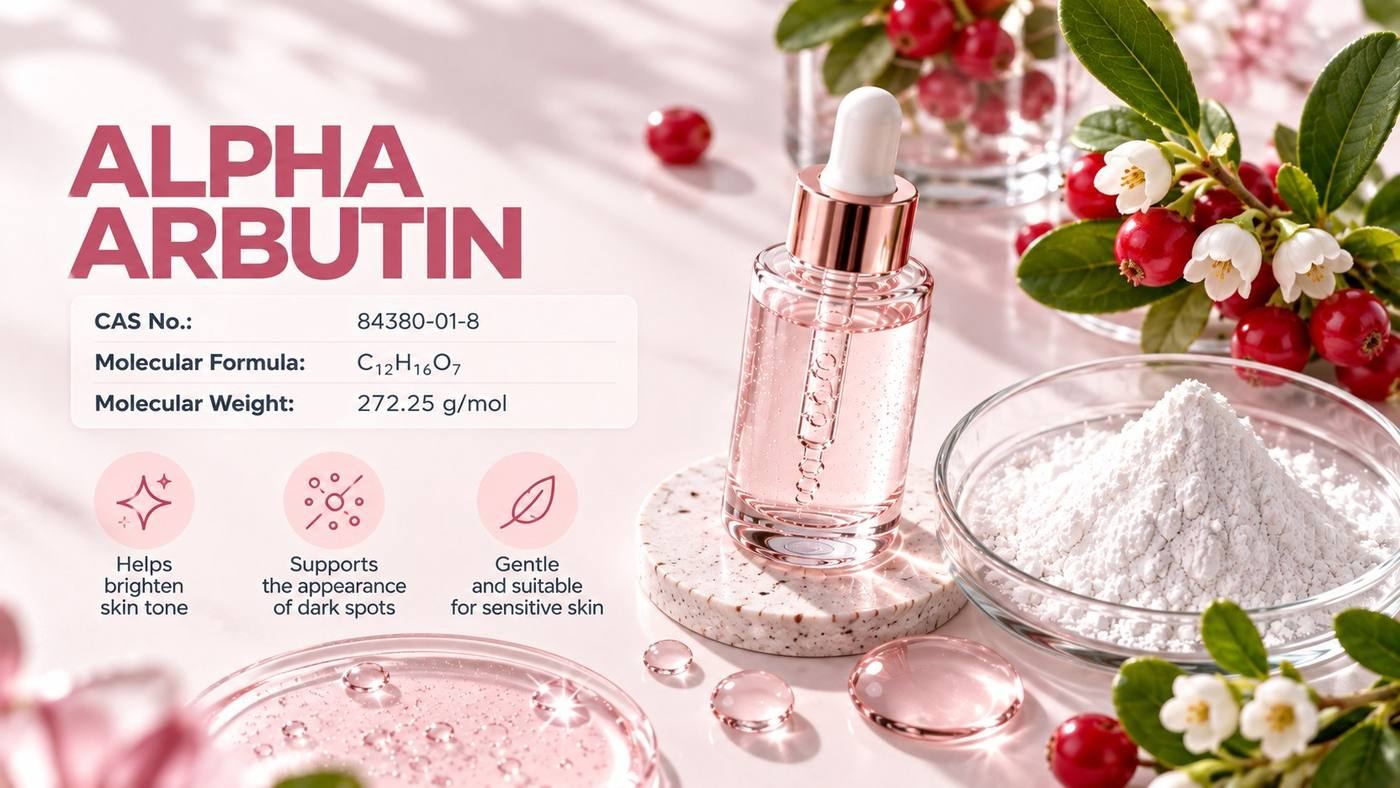
- A sugar-bound form of hydroquinone (hydroquinone alpha-glucoside), made by enzymes; beta-arbutin is the plant-derived form
- Main benefits
- Lighter-looking dark spots and a more even-looking tone, with good tolerance
- Levels tested in trials
- 2% alpha arbutin with 10% THBG; 5% alpha arbutin with 2% kojic acid; about 2.5% plant arbutin in an extract cream
- Time to results
- 8 to 12 weeks in clinical studies
- Watch for
- EU limits (2% face, 0.5% body), breakdown to hydroquinone at low pH or heat, and few single-ingredient trials
01What is it?
Alpha arbutin is hydroquinone with a glucose molecule attached. That bond makes it far gentler and more stable than hydroquinone itself. Beta-arbutin is the natural form found in bearberry and other plants; alpha arbutin is the enzyme-made form used in most modern serums.
02What it does
Arbutin competes with the skin’s own building block for melanin and slows the enzyme tyrosinase, so less pigment is made. Over two to three months this can show as lighter-looking dark spots and a more even-looking tone. It does not remove pigment that is already deep in the skin, so daily sunscreen remains essential.
03The evidence
Studies below were checked against the publisher, DOI or journal record on 26 Sep 2026. We list design and size so you can judge the strength of each result.
| Study | Design | Who and how long | What it found |
|---|---|---|---|
| Tantanasrigul et al. 2025, Journal of Cosmetic Dermatology (Wiley) Source | Randomised, evaluator-blinded split-face pilot trial | 27 adults with melasma, 12 weeks plus 4-week follow-up, 5% alpha arbutin with 2% kojic acid twice daily vs triple combination cream (4% hydroquinone, tretinoin, steroid) once daily | Melanin index and mMASI did not differ between sides at 12 weeks, though doctors rated the prescription cream better; redness was less common with the arbutin cream (11% vs 41% at week 8) and pigment returned less after stopping. |
| Gabhane et al. 2025, Journal of Cosmetic Dermatology (Wiley) Source | Open-label study, no control group | 124 Indian women, skin types III–IV, melasma or dark spots, 90 days, 2% alpha arbutin with 10% trihydroxybenzoic acid glucoside plus SPF 55 sunscreen | mMASI fell 18.4% (4.80 to 3.92) and spot melanin fell 16.3%, with no irritation reported. No comparison group, and the sunscreen alone may explain part of the gain. |
| Hatem et al. 2022, Drug Delivery (Taylor & Francis) Source | Comparative split-face clinical study | People with melasma, about 2 months (20 patients as reported in a later review), alpha arbutin in chitosan nanoparticle gel vs plain alpha arbutin gel | The nanoparticle side showed greater falls in mMASI and in skin melanin, suggesting delivery strongly affects results. Exact figures are not reported here. |
| Zhang et al. 2025, Clinical, Cosmetic and Investigational Dermatology (Dove Press) Source | Retrospective case series, no control group | 27 people with melasma, 3–6 months, microneedling with a tranexamic acid liquid containing 1% arbutin | mMASI fell 37.6% on average (5.43 to 3.39) with mild side effects, but arbutin’s own share of the effect cannot be separated. |
| Morag et al. 2015, Journal of Cosmetic Dermatology (Wiley) Source | Randomised, double-blind, placebo-controlled trial | 102 women with melasma or sun spots, 8 weeks, cream with Serratula quinquefolia leaf extract supplying 2.51% arbutin (beta form) | Lightening was seen in 75.9% of women with melasma and 56% with sun spots in the active group (66.7% overall); the cream was well tolerated. |
| Gan and Rodrigues 2024, American Journal of Clinical Dermatology (Springer Nature) Source | Narrative review of melasma treatments | Review of new and existing topical, oral and procedural treatments | Places arbutin as a popular over-the-counter add-on for mild cases, with a small evidence base compared with hydroquinone, thiamidol or tranexamic acid. |
Alpha arbutin is a well-tolerated brightening active with a plausible mechanism, but its human evidence is thin: there is no large vehicle-controlled trial of alpha arbutin on its own, and the best studies pair it with kojic acid or other actives. It suits cosmetic claims such as “helps reduce the look of dark spots” and “evens the look of skin tone”, ideally supported by testing of the finished product and partnered with sunscreen.
04How CSL formulation scientists use it
- In the EU, CSL formulation scientists keep alpha arbutin at or below 2% in face creams and 0.5% in body lotions; the 5% level used in one trial is not permitted in EU face products.
- Arbutin can break down into hydroquinone in very acidic conditions or with heat, so formulas are usually kept around pH 4–7, the active is added below about 40 °C, and hydroquinone is checked in stability samples.
- It combines well with niacinamide, tranexamic acid and kojic acid, which act at other steps of pigmentation, and is gentle enough for sensitive or darker skin tones.
- Delivery matters: one split-face study found nanoparticle-carried alpha arbutin worked better than a plain gel, so vehicle choice and penetration testing are worth the effort.
05Regulatory and claims
Commission Regulation (EU) 2024/996 of 3 April 2024 added both forms to Annex III: alpha arbutin up to 2% in face cream and 0.5% in body lotion, arbutin (beta) up to 7% in face cream, with hydroquinone kept to unavoidable traces. New products had to comply from 1 February 2025 and all products on the market from 1 November 2025. The limits follow SCCS opinion SCCS/1642/22, which judged these levels safe, including combined use, provided hydroquinone stays at trace level. CSL regulatory specialists confirm the status in each other target market and keep claims cosmetic, such as “brighter, more even-looking skin”, not “treats melasma”.
06Questions brands ask
Is alpha arbutin just hydroquinone in disguise?
It is a bound form of hydroquinone, and a very small amount can be released on skin. The EU safety committee concluded that alpha arbutin is safe at up to 2% in face cream as long as free hydroquinone stays at trace level.
Is alpha arbutin better than beta-arbutin?
Alpha arbutin is usually described as more potent and more stable, which is why it is used at lower levels. Direct head-to-head human trials are lacking, and the EU allows higher levels of beta-arbutin (7%) than alpha arbutin (2%) in face cream.
Can products sold in the EU use 5% alpha arbutin?
No. Since 1 February 2025 new EU face products are limited to 2% alpha arbutin, and since 1 November 2025 this applies to every product on the market. Body lotions are limited to 0.5%.
07References
- Tantanasrigul P, et al. The efficacy of topical cosmetic containing alpha-arbutin 5% and kojic acid 2% compared with triple combination cream for the treatment of melasma: a split-face, evaluator-blinded randomized pilot study. J Cosmet Dermatol. 2025;24(1):e16562. Link
- Gabhane P, Patil A, Dharmadhikari S, Shah S, Khandhedia C, Mehta D. Efficacy and safety of a topical formulation containing trihydroxybenzoic acid glucoside and α-arbutin, applied along with a sunscreen: a noncomparative, prospective, interventional study in Indian females with facial melasma or dark spots. J Cosmet Dermatol. 2025;24(2):e70017. Link
- Hatem S, et al. Functionalized chitosan nanoparticles for cutaneous delivery of a skin whitening agent: an approach to clinically augment the therapeutic efficacy for melasma treatment. Drug Deliv. 2022;29(1):1212–1231. Link
- Zhang M, Ke J, Jiao Y, Ma L. Efficacy and safety evaluation of microneedling combined with tranexamic acid-arbutin liquid excipients in the treatment of melasma: a retrospective study. Clin Cosmet Investig Dermatol. 2025. Link
- Morag M, Nawrot J, Siatkowski I, et al. A double-blind, placebo-controlled randomized trial of Serratulae quinquefoliae folium, a new source of β-arbutin, in selected skin hyperpigmentations. J Cosmet Dermatol. 2015;14(3):185–190. Link
- Gan C, Rodrigues M. An update on new and existing treatments for the management of melasma. Am J Clin Dermatol. 2024;25(5):717–733. Link
- Ghasemiyeh P, Fazlinejad R, Kiafar MR, et al. Different therapeutic approaches in melasma: advances and limitations. Front Pharmacol (Frontiers). 2024. (Source for the Hatem 2022 patient number and duration.) Link
- Commission Regulation (EU) 2024/996 of 3 April 2024 amending Regulation (EC) No 1223/2009 as regards the use of Vitamin A, Alpha-Arbutin and Arbutin and certain substances with potential endocrine disrupting properties in cosmetic products. OJ L, 2024/996. Link
- Scientific Committee on Consumer Safety. Opinion on the safety of alpha-arbutin and beta-arbutin in cosmetic products. SCCS/1642/22. Final opinion, 2023. Link
Used in: Hyperpigmentation & even toneBrightening & radiance
Update log
- Evidence reviewed and page published by CSL scientists
This page summarises published research for brands and formulators. It is general information, not medical advice, and results in studies depend on the full formula tested.