Centella asiatica: what the evidence shows for calming and skin repair
Centella asiatica, also called cica, is a popular soothing botanical. Here is what the small human studies show, how strong the evidence is, and how CSL formulation scientists use it in calming products.
By CSL Formulation team · Evidence checked by CSL scientists
At a glance
- What it is
- A plant extract (gotu kola, cica) and its active triterpenes, mainly madecassoside and asiaticoside
- Main benefits
- Calmer, less red-looking skin; support for the skin barrier and hydration; better-looking healing skin after procedures
- Levels tested in trials
- 0.05% standardised extract gel; 2.5% to 5% extract; 7% extract cream; undisclosed levels in combination creams
- Time to results
- Days for redness after procedures; 2 to 4 weeks for hydration and barrier; up to 12 weeks for scar appearance
- Watch for
- Variable extract quality; small, mostly single-centre studies; occasional allergic reactions
01What is it?
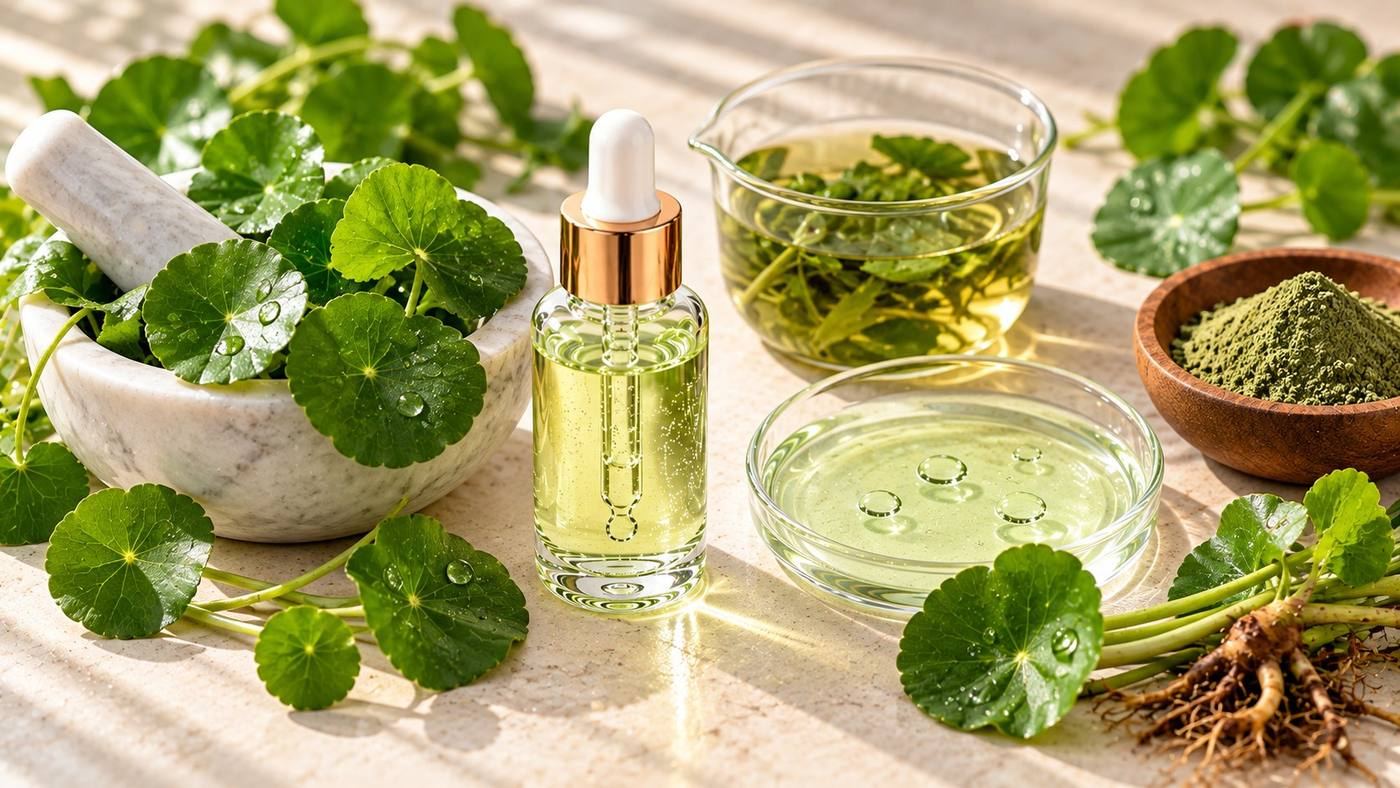
Centella asiatica is a creeping herb used for centuries in Asian traditional medicine for wounds. Cosmetic extracts are standardised to its triterpenes: madecassoside, asiaticoside and their acids. Products marketed as "cica" usually contain one or more of these.
02What it does
The triterpenes calm inflammation, support collagen production and help the skin barrier recover. In small studies this shows as less redness after laser treatment, better-looking scars, higher skin hydration and lower water loss.
03The evidence
Studies below were checked against the publisher, DOI or journal record on 26 Sep 2026. We list design and size so you can judge the strength of each result.
| Study | Design | Who and how long | What it found |
|---|---|---|---|
| Su et al. 2025, Journal of Cosmetic Dermatology (Wiley) Source | Prospective observational study, no control group | 88 Chinese women with sensitive skin, 4 weeks, cream with Centella leaf extract, ceramide NP and panthenol | Sensitive skin score fell 66% at 2 weeks and 76% at 4 weeks, with lower water loss and higher hydration. Combination product, so Centella's own share is unclear. |
| Handayani et al. 2025, Pharmacia (Pensoft) Source | Narrative review of 2016 to 2025 evidence | Mechanisms, preclinical and human studies of Centella in skin care | Human studies report better hydration, water loss, elasticity, wrinkles and scars, but the authors describe them as small and heterogeneous. |
| Witkowska et al. 2024, Pharmaceutics (MDPI) Source | Review of mechanisms and clinical studies | Topical Centella for wound healing; 6 human studies summarised | Human studies were small (23 to 200 people) and extracts often poorly specified; results were positive but not formally graded. |
| Damkerngsuntorn et al. 2020, Journal of Integrative and Complementary Medicine Source | Randomised, double-blind, placebo-controlled split-face trial | 30 adults after Er:YAG laser for acne scars, 3 months, 0.05% standardised extract (about 51% madecassoside, 38% asiaticoside) | Less redness on the Centella side over follow-up (p=0.046) and better-looking wounds on days 2, 4 and 7; skin instrument readings did not differ. |
| Jenwitheesuk et al. 2018, Evidence-Based Complementary and Alternative Medicine (Hindawi) Source | Randomised, double-blind, placebo-controlled trial | 30 people with skin-graft donor sites (23 completed), 12 weeks, 7% Centella extract cream | Better pigmentation and total scar scores than placebo from week 4 to 12. Some people withdrew because of allergic reactions. |
| Ratz-Łyko et al. 2016, Indian Journal of Pharmaceutical Sciences Source | Controlled volunteer study | 25 healthy adults, forearms, 4 weeks, 2.5% and 5% extract in emulsion and gel | The 5% emulsion raised hydration by 25% and cut water loss by 18%, and reduced induced redness more than placebo. |
Centella asiatica has plausible biology and small, positive human studies for calming redness and supporting barrier recovery. The evidence is too thin for strong claims. Wording such as "helps soothe the look of redness" and "supports the skin barrier" fits; tested finished-product claims are best.
04How CSL formulation scientists use it
- Specify the material: a standardised extract or pure madecassoside or asiaticoside gives more consistent results than a generic extract. Trials used 0.05% standardised extract up to 5% to 7% crude extract.
- Madecassoside is water-soluble and suits serums, gels and light creams; asiatic and madecassic acids are less soluble and need careful solubilising.
- Pairs well with barrier ingredients such as ceramides and panthenol, which is how most recent calming products use it. Support any claim with testing of the finished product.
- Check botanical raw material for contaminants and microbial load, and run patch testing: allergic reactions, though uncommon, were reported in trials.
05Regulatory and claims
Centella asiatica extracts and their triterpenes are used widely in cosmetics. No specific EU restriction was confirmed in this review; CSL regulatory specialists confirm the status in each target market. Wound and scar healing are medical claims, so cosmetic wording should stay with appearance and comfort, such as "helps calm the look of redness", never "heals wounds" or "treats scars".
06Questions brands ask
Is madecassoside the same as Centella asiatica?
Madecassoside is one of the main active compounds in the plant. Some products use the purified compound, others a whole extract; results depend on which and how much.
Does Centella repair the skin barrier?
Small studies show higher hydration and lower water loss with Centella creams. The best recent data come from combination products, so its own effect is hard to separate.
Is Centella suitable for sensitive skin?
Generally yes, and it is well tolerated in studies. Allergic reactions are uncommon but have been reported, so finished products should be patch tested.
07References
- Su Z, Zheng Y, Yi J, Lai W, Ye C. The effectiveness and safety of a skin care product with Centella asiatica leaf extract, ceramide NP, and panthenol in subjects with sensitive skin: a prospective, observational study. J Cosmet Dermatol. 2025;24(7). Link
- Handayani R, Febriyanti RM, Muhaimin M, Chearunisaa AY. Centella asiatica (L.) Urb. in skin health and cosmeceuticals: mechanisms, clinical evidence, and advanced delivery systems. Pharmacia. 2025;72:1-13. Link
- Witkowska K, Paczkowska-Walendowska M, Garbiec E, Cielecka-Piontek J. Topical application of Centella asiatica in wound healing: recent insights into mechanisms and clinical efficacy. Pharmaceutics. 2024;16(10):1252. Link
- Damkerngsuntorn W, Rerknimitr P, Panchaprateep R, et al. The effects of a standardized extract of Centella asiatica on postlaser resurfacing wound healing on the face: a split-face, double-blind, randomized, placebo-controlled trial. J Integr Complement Med. 2020;26(6):529-536. Link
- Jenwitheesuk K, et al. A prospective randomized, controlled, double-blind trial of the efficacy using Centella cream for scar improvement. Evid Based Complement Alternat Med. 2018;2018:9525624. Link
- Ratz-Łyko A, Arct J, Pytkowska K. Moisturizing and antiinflammatory properties of cosmetic formulations containing Centella asiatica extract. Indian J Pharm Sci. 2016;78(1):27-33. Link
Used in: Sensitive skin
Update log
- Evidence reviewed and page published by CSL scientists
This page summarises published research for brands and formulators. It is general information, not medical advice, and results in studies depend on the full formula tested.