Urea in skin care: what the evidence shows for dry skin and barrier
Urea is part of the skin's own moisturising system and one of the best-tested humectants for dry, rough skin. Here is what trials show and how CSL formulation scientists use it at low and high levels.
By CSL Formulation team · Evidence checked by CSL scientists
At a glance
- What it is
- A small, water-loving molecule that is a natural part of the skin's natural moisturising factor (NMF)
- Main benefits
- Better skin hydration, a stronger-looking barrier, smoother and less rough, flaky skin
- Levels tested in trials
- 2% to 10% in moisturisers for dry and eczema-prone skin; 30% to 40% for very rough, thickened skin such as feet
- Time to results
- Hydration within days; visible dryness and roughness improve over 2 to 8 weeks
- Watch for
- Stinging on broken or inflamed skin and on the face; breakdown to ammonia in poorly buffered or hot-stored formulas
01What is it?
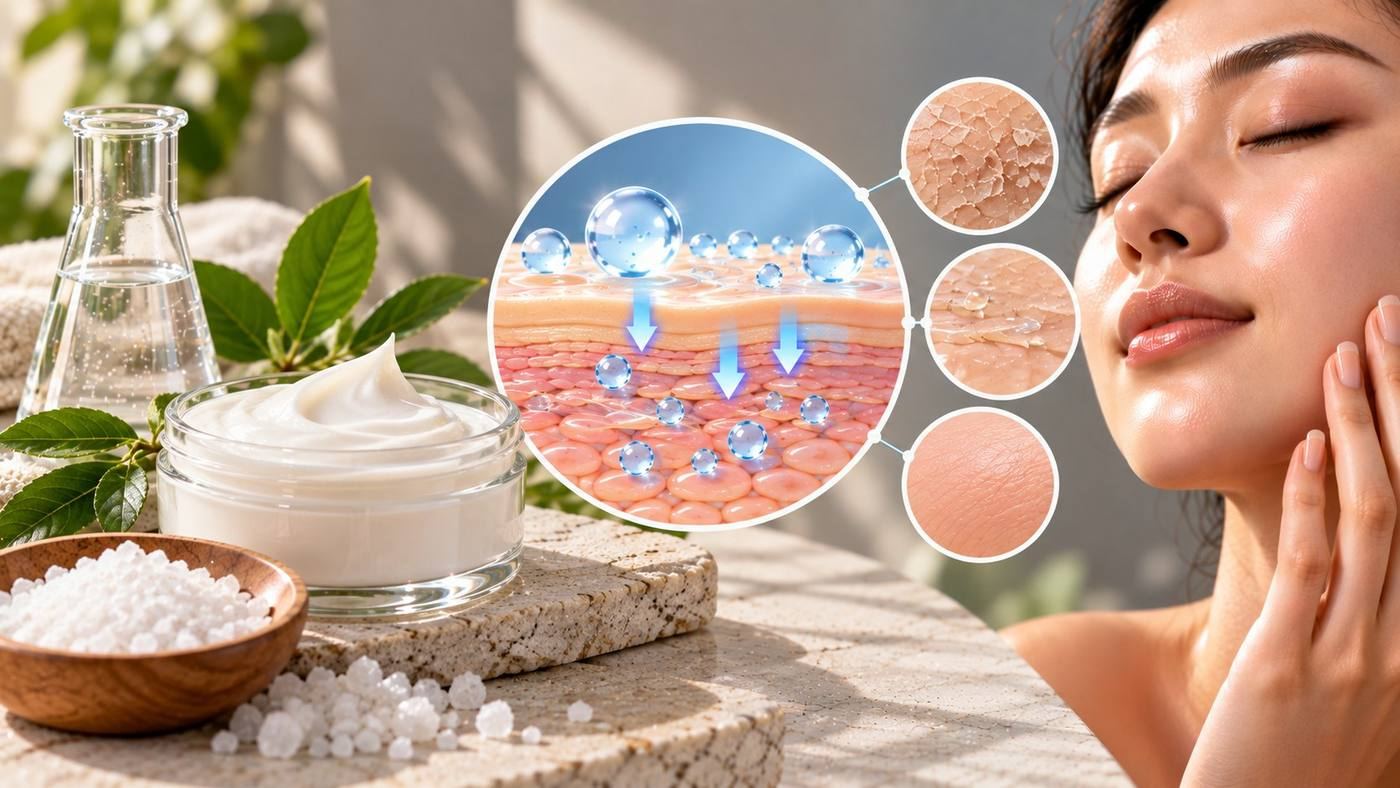
Urea is a small molecule the skin makes itself as part of its natural moisturising factor. Dry skin, and skin prone to eczema, tends to have less of it. In cosmetics it is used at a few percent as a humectant in everyday moisturisers, and at much higher levels in products for very rough skin on the feet, elbows and knees.
02What it does
At low levels urea draws water into the outer skin layer and, in laboratory and clinical work, supports the proteins and lipids that make up the barrier. At higher levels it loosens the bonds that hold dead cells together, so thick, rough skin softens and sheds more easily. The visible result is softer, smoother, less flaky skin that loses less water.
03The evidence
Studies below were checked against the publisher, DOI or journal record on 26 Sep 2026. We list design and size so you can judge the strength of each result.
| Study | Design | Who and how long | What it found |
|---|---|---|---|
| Jawed et al. 2025, Annals of Medicine and Surgery (Wolters Kluwer) Source | Systematic review | 33 studies of topical urea at 5% to 40% in ichthyosis, atopic dermatitis, dry skin, psoriasis and other conditions | Urea improved hydration, dryness and barrier measures across conditions and was well tolerated, but the authors found it was not clearly better than other established treatments on its own. |
| Maletin et al. 2026, Journal of Cosmetic Dermatology (Wiley) Source | Open-label study, no control group | 47 adults with dry lower legs, 60 days, 10% urea lotion with thermal water twice daily | Skin hydration rose 55% and elasticity 55%, redness fell 30–35% and quality-of-life scores improved 61%, with no side effects. Weaker evidence: no comparison group and manufacturer-funded. |
| Danby et al. 2022, Clinical and Experimental Dermatology (Oxford) Source | Observer-blinded, within-person randomised controlled trial | 49 adults with atopic dermatitis, 28 days, 2% urea with 20% glycerol vs 20% glycerol vs simple paraffin cream vs no treatment | The urea-glycerol cream cut water loss after an irritant challenge by about 9 g/m²/h versus both no treatment and paraffin cream, raised hydration and NMF; the paraffin cream gave no barrier benefit. |
| Åkerström et al. 2015, Acta Dermato-Venereologica Source | Randomised, double-blind, controlled multicentre trial | 172 adults and children with atopic dermatitis, 6 months, 5% urea barrier cream vs a reference moisturiser | Risk of eczema returning fell 37% (hazard ratio 0.63); median time to relapse was 22 vs 15 days, and 26% vs 10% stayed eczema-free at 6 months. |
| Lodén et al. 2010, Acta Dermato-Venereologica Source | Open, randomised, parallel-group trial | 53 adults with cleared hand eczema, 26 weeks, 5% urea barrier-strengthening moisturiser vs no treatment | Median time to relapse was 20 days with the moisturiser vs 2 days without (p = 0.04), though 90% relapsed within 26 weeks. Not blinded. |
Urea is a well-evidenced humectant for dry and rough skin. Low-level (2–5%) urea in a good cream base improves hydration and helps the barrier, and higher levels soften very rough skin, but most trials test complete branded formulas in eczema-prone skin rather than urea alone. Suitable cosmetic claims: “intensely hydrates”, “helps strengthen the skin barrier” and “smooths rough, dry skin”.
04How CSL formulation scientists use it
- Match the level to the job: about 2% to 5% for face and body moisturisers, 5% to 10% for very dry body skin, and 20% or more only for rough areas such as heels, elbows and knees.
- Urea slowly breaks down to ammonia in water, which raises pH and can cause odour. CSL formulation scientists buffer the formula (lactate or similar systems), avoid high heat during manufacture and confirm pH and odour in real-time stability testing.
- Urea pairs well with glycerin, lactic acid and ceramides, and with an occlusive base; the best-performing trial cream combined 2% urea with 20% glycerol.
- Urea can sting on cracked, inflamed or facial skin, especially at higher levels. Tolerance testing on the target skin type is essential, and lower levels or glycerin-led formulas suit sensitive skin.
05Regulatory and claims
Urea is widely used in cosmetics, and Cosmetics Europe's ingredient database states that minimum and maximum urea contents in cosmetic products are not regulated by law. The International Society of Atopic Dermatitis has applied for 5% urea and 15–20% glycerol moisturisers to be added to the WHO Essential Medicines List, so high-level products or eczema claims can move a product towards medicine or medical device rules. CSL regulatory specialists confirm the status in each target market, including the US, for the exact level and claims, and keep wording cosmetic: “relieves the feeling of dry skin”, not “treats eczema”.
06Questions brands ask
What urea level should a moisturiser use?
For everyday face and body products, a few percent is enough: trials showed barrier benefits at 2% to 5%. Levels of 10% and above are better kept for very dry body skin and rough feet.
Does urea sting?
It can, mainly on broken, inflamed or facial skin and at higher levels. The sensation is usually mild and short-lived, but tolerance testing on the target skin type is still needed.
Is urea better than glycerin?
They work well together. The strongest barrier result in a recent trial came from 2% urea combined with 20% glycerol, which beat a simple paraffin cream and no treatment.
07References
- Jawed I, Abdul Qadir MU, Farwa UE, et al. Effect of topical treatment with urea in ichthyosis, atopic dermatitis, psoriasis, and other skin conditions: a systematic review. Ann Med Surg. 2025;87(1):276–284. Link
- Maletin N, Spasić B, Golušin Z, et al. Evaluation of a 10% urea lotion for xerosis: clinical and patient-reported outcomes from a prospective study. J Cosmet Dermatol. 2026;25(3):e70801. Link
- Danby SG, Andrew PV, Taylor RN, et al. Different types of emollient cream exhibit diverse physiological effects on the skin barrier in adults with atopic dermatitis. Clin Exp Dermatol. 2022;47(6):1154–1164. Link
- Åkerström U, Reitamo S, Langeland T, et al. Comparison of moisturizing creams for the prevention of atopic dermatitis relapse: a randomized double-blind controlled multicentre clinical trial. Acta Derm Venereol. 2015;95:587–592. Link
- Lodén M, Wirén K, Smerud KT, et al. Treatment with a barrier-strengthening moisturizer prevents relapse of hand-eczema: an open, randomized, prospective, parallel group study. Acta Derm Venereol. 2010;90(6):602–606. Link
- Cosmetics Europe. COSMILE Europe ingredient database: Urea (functions and regulatory note). Link
- International Society of Atopic Dermatitis. Application for inclusion of urea- and glycerol-based topical moisturisers in the WHO Model List of Essential Medicines. WHO 2025 EML Expert Committee, application A.30. Link
Used in: Hydration & barrier repair
Update log
- Evidence reviewed and page published by CSL scientists
This page summarises published research for brands and formulators. It is general information, not medical advice, and results in studies depend on the full formula tested.