Lactic acid: the gentler AHA that brightens and hydrates
Lactic acid exfoliates like glycolic acid but penetrates more slowly and helps the skin make its own barrier lipids. Here is the evidence, and why it suits dry and sensitive skin.
By CSL Formulation team · Evidence checked by CSL scientists
At a glance
- What it is
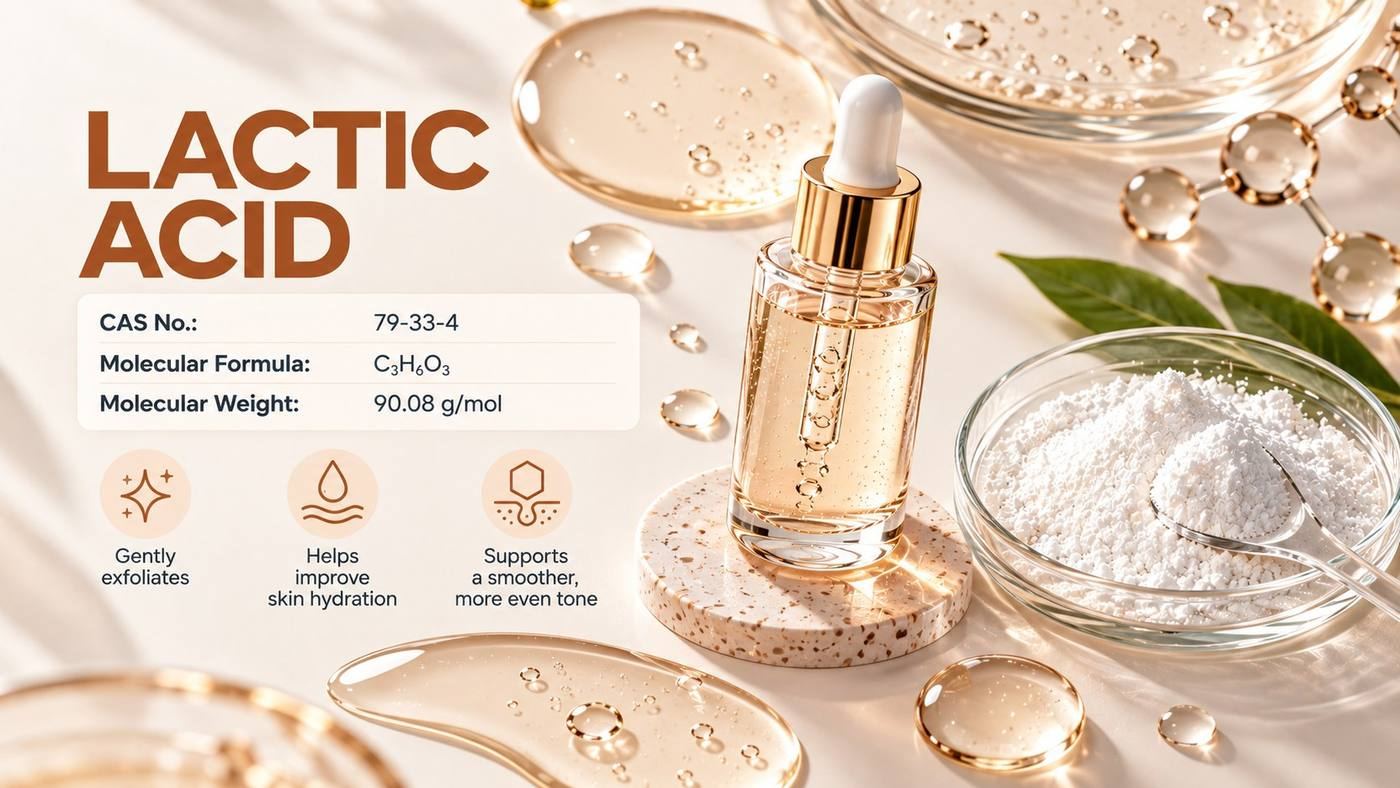
- An alpha hydroxy acid (AHA); molecular weight 90, larger than glycolic acid
- Main benefits
- Brighter, smoother skin; hydration; barrier support
- Levels tested
- 5–12% leave-on; 15–90% in-clinic peels
- Time to results
- Weeks for smoothness; 3 months for firmness
- Watch for
- Sun sensitivity; stricter EU limit than glycolic acid
01What is it?
Lactic acid is naturally present in skin as part of its natural moisturising factor. In cosmetics it exfoliates gently and also works as a humectant, drawing water into the outer layer.
02What it does
Besides loosening dead cells, the L-form of lactic acid raised ceramide levels in the outer skin layer by 48% and made the barrier more resistant to irritation (Rawlings 1996). At 12% it also thickened and firmed skin over three months (Smith 1996).
03The evidence
Studies below were checked against the publisher, DOI or journal record on 26 Sep 2026. We list design and size so you can judge the strength of each result.
| Study | Design | Who and how long | What it found |
|---|---|---|---|
| Goyal et al. 2025, Indian Dermatology Online Journal Source | Comparative study | 60 adults with melasma, 12 weeks, 90% lactic acid peel vs 40% pyruvic acid peel | Both reduced melasma scores and improved quality of life; lactic acid slightly, not significantly, better. |
| Malviya et al. 2025, Indian Dermatology Online Journal Source | Prospective comparative study | 70 adults with dark circles, 30% lactic acid vs 30% mandelic acid peel | Lactic acid reduced under-eye pigmentation more, with higher satisfaction; more flaking. |
| Feng et al. 2024, Clinical, Cosmetic and Investigational Dermatology Source | Review | Clinical studies of lactic acid peels | Summarises trials including 60% lactic vs 40% glycolic acid in melasma (effective rate 80.4% vs 67.5%). |
| Dayal et al. 2016, Journal of Cosmetic Dermatology Source | Comparative study, three arms | 90 adults with dark circles, 12 weeks | Over 50% improvement in 56.7% with 15% lactic acid and 73.3% with 20% glycolic acid; glycolic acid had more side effects. |
| Stiller et al. 1996, Archives of Dermatology Source | Double-blind, vehicle-controlled trial | 74 women aged 40–70, 22 weeks, 8% L-lactic acid cream | 71% improved in overall photodamage vs 40% on the base cream; less mottled pigmentation and sallowness. |
| Smith 1996, Journal of the American Academy of Dermatology (Elsevier) Source | Controlled comparison of strengths | 3 months, 5% vs 12% lactic acid twice daily | 12% firmed and thickened skin and improved lines; 5% gave surface benefits only. |
| Rawlings et al. 1996, Archives of Dermatological Research (Springer) Source | Mechanism study in human skin | Lactic acid isomers in lotions | L-lactic acid raised skin ceramides by 48% and improved barrier resistance to irritation. |
Lactic acid is the better-supported AHA when you want brightening with good tolerance and extra hydration. Glycolic acid is stronger for resurfacing.
04How CSL formulation scientists use it
- Specify L-(+)-lactic acid: the D-form had no ceramide benefit.
- Leave-on benefits were shown at 5–12%; peel results at 15–90% do not apply to retail products.
- Its humectant effect makes it a good fit for dry-skin, body and sensitive-skin products.
- It is still an AHA, so sun-sensitivity warnings apply.
05Regulatory and claims
AHAs have clear limits. In the US, the Cosmetic Ingredient Review found AHAs safe in retail products at 10% or less with a final pH of 3.5 or higher, and FDA recommends a “Sunburn Alert” label because AHAs raise UV sensitivity (about 18% more reddening after 4 weeks in FDA-sponsored studies). In the EU, the SCCNFP advised precautionary consumer limits of 4% at pH 3.8 or higher for glycolic acid and 2.5% at pH 5 or higher for lactic acid, with warnings to avoid the eyes and protect from UV. CSL regulatory specialists set concentration, pH and warnings for each target market.
06Questions brands ask
Lactic or glycolic acid for sensitive skin?
Lactic acid. It penetrates more slowly and caused fewer side effects in comparative studies.
Does lactic acid hydrate?
Yes. It is a humectant and, in its L-form, increased the skin’s own ceramides.
Why is the EU limit lower for lactic acid?
The EU scientific committee set a precautionary limit of 2.5% at pH 5 or higher for consumer products. Formulas for the EU are designed to that limit.
07References
- Goyal S, et al. 90% lactic acid peel vs 40% pyruvic acid peel in epidermal melasma. Indian Dermatol Online J. 2025;16(4):564–570. doi.org/10.4103/idoj.idoj_452_24
- Malviya A, et al. 30% mandelic acid peel vs 30% lactic acid peel in periorbital melanosis. Indian Dermatol Online J. 2025;16(6):916–920. doi.org/10.4103/idoj.idoj_1051_24
- Feng X, et al. Lactic acid chemical peeling in skin disorders. Clin Cosmet Investig Dermatol. 2024;17:901–909. doi.org/10.2147/CCID.S455700
- Dayal S, et al. 20% glycolic peel, 15% lactic peel and topical 20% vitamin C in periorbital melanosis. J Cosmet Dermatol. 2016;15(4):367–373. doi.org/10.1111/jocd.12255
- Stiller MJ, et al. Arch Dermatol. 1996;132(6):631–636. doi.org/10.1001/archderm.1996.03890300047009
- Smith WP. Epidermal and dermal effects of topical lactic acid. J Am Acad Dermatol. 1996;35(3):388–391. doi.org/10.1016/S0190-9622(96)90602-7
- Rawlings AV, et al. Effect of lactic acid isomers on keratinocyte ceramide synthesis and barrier function. Arch Dermatol Res. 1996;288:383–390. doi.org/10.1007/BF02507107
- US FDA. Alpha hydroxy acids. FDA page
Used in: Brightening & radianceHydration & barrier repair
Update log
- Evidence reviewed and page published by CSL scientists
This page summarises published research for brands and formulators. It is general information, not medical advice, and results in studies depend on the full formula tested.