Iron oxides in tinted sunscreen: visible light and melasma evidence
Iron oxides give tinted sunscreens their colour and block visible light that UV filters miss. Here is what melasma trials show and how CSL formulation scientists build tints that protect and match skin.
By CSL Formulation team · Evidence checked by CSL scientists
At a glance
- What it is
- Red, yellow and black iron oxide pigments used to tint sunscreens and make-up
- Main benefits
- Blocks visible light, especially blue-violet; helps keep pigmentation from darkening or returning
- Levels tested in trials
- Tinted broad-spectrum sunscreens with iron oxides (with pigmentary titanium dioxide in one trial); exact levels rarely reported
- Time to results
- 8 weeks to 5 months in melasma trials
- Watch for
- Shade range for all skin tones, even film for real protection, and undisclosed pigment levels
01What is it?
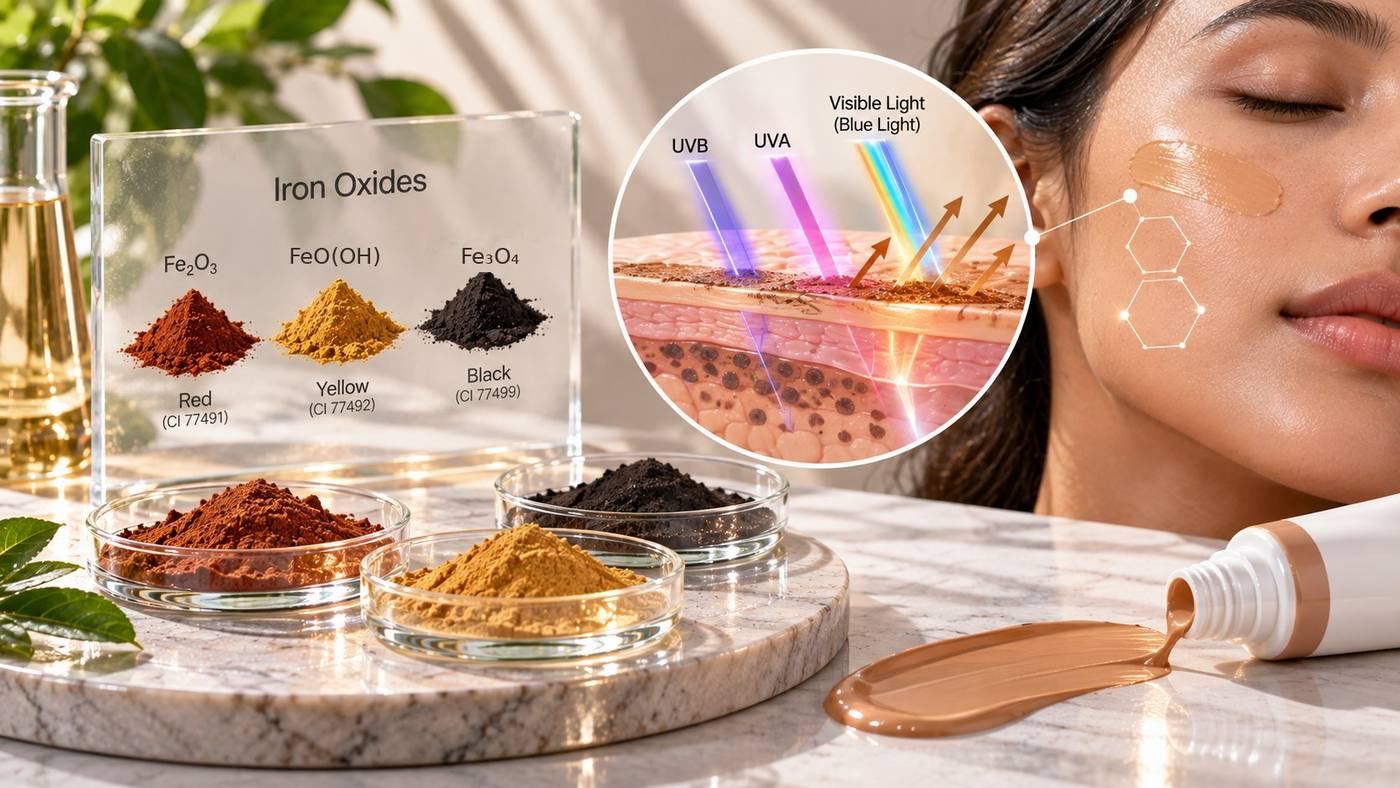
Iron oxides are mineral pigments that give make-up and tinted sunscreens their colour. UV filters do not block visible light, but a film of iron oxide pigment does. This matters most for people with darker skin tones and for pigmentation such as melasma.
02What it does
Visible light, especially blue-violet light, can trigger and deepen pigmentation in darker skin. Iron oxides absorb and scatter this light, adding a layer of protection on top of UV filters. In trials, tinted sunscreens helped fading treatments work better and reduced relapse over sunny months.
03The evidence
Studies below were checked against the publisher, DOI or journal record on 26 Sep 2026. We list design and size so you can judge the strength of each result.
| Study | Design | Who and how long | What it found |
|---|---|---|---|
| Castanedo-Cazares et al. 2014, Photodermatology, Photoimmunology & Photomedicine (Wiley) Source | Double-blind randomised trial | 68 Mexican patients with melasma using 4% hydroquinone, 8 weeks; tinted iron-oxide sunscreen vs SPF 50 untinted sunscreen | Melasma score fell 78% with the tinted sunscreen vs 62% with the untinted one. |
| Boukari et al. 2015, Journal of the American Academy of Dermatology (Elsevier) Source | Prospective randomised comparative trial | 40 women with melasma randomised (39 analysed), spring and summer; tinted sunscreen with iron oxides vs the same UV filters without visible-light protection | The tinted product led to significantly fewer relapses and lower melasma scores. |
| Polena et al. 2025, Journal of Cosmetic Dermatology (Wiley) Source | Randomised, investigator-blinded trial | 42 women with melasma, 5 months over summer; tinted sunscreen with iron oxides and pigmentary titanium dioxide vs untinted, same UV cover | Both prevented darkening, but the tinted product kept skin lighter and more even (lower ∆L*, ∆ITA° and ∆E); melasma scores improved similarly. |
| Cassiano et al. 2022, Dermatology and Therapy (Springer Nature) Source | Narrative review of melasma treatment | Summarises photoprotection trials including Castanedo-Cazares and Boukari | Supports broad-spectrum sunscreens with visible-light protection (iron oxides) as part of melasma care. |
| Mun et al. 2025, Photochemical & Photobiological Sciences (Springer Nature) Source | Perspective | Sunscreen advice for pigmentary disorders | Argues that advice for pigment-prone skin should include visible-light protection such as iron oxides, not UV filters alone. |
| Doan et al. 2026, Journal of Drugs in Dermatology Source | Product analysis and literature review | 37 US tinted sunscreens | Only 9.6% of responding brands disclosed iron oxide levels (under 1.4% to 10.4%); 6 brands claimed visible-light protection but only one described testing. |
Tinted sunscreens with iron oxides give extra, measurable help for melasma-prone skin, on top of good UV protection. The trials are small and focus on melasma, so claims should stay specific and tested: “helps protect against visible light” and “helps prevent the look of dark patches returning”, not “treats melasma”.
04How CSL formulation scientists use it
- Combine iron oxides with pigmentary titanium dioxide and a full UV filter system; iron oxides add visible-light cover, not UV protection on their own.
- Develop a wide shade range so people with darker skin, who benefit most, will wear enough of it.
- Use coated, well-dispersed pigments for an even film; streaks and gaps reduce visible-light protection.
- Test the finished product for visible-light protection before making any claim, and record the pigment levels used.
05Regulatory and claims
Iron oxides are used as cosmetic colourants; they are not listed as UV filters in the EU or as sunscreen actives in the US, so visible-light claims must rest on testing of the finished product. CSL regulatory specialists confirm colourant status and purity rules in each target market, and keep claims cosmetic, such as “helps protect against visible light”.
06Questions brands ask
Does a tinted sunscreen protect better than an untinted one?
For visible light, yes, if it contains enough iron oxides in an even film. In melasma trials tinted products kept skin more even than untinted ones.
How much iron oxide is needed?
There is no agreed level. Published products range from under 1.4% to about 10%, so protection should be measured on the finished formula.
Is visible-light protection only for melasma?
The best evidence is in melasma and darker skin tones. For other skin concerns the evidence is limited.
07References
- Castanedo-Cazares JP, Hernandez-Blanco D, Carlos-Ortega B, Fuentes-Ahumada C, Torres-Alvarez B. Near-visible light and UV photoprotection in the treatment of melasma: a double-blind randomized trial. Photodermatol Photoimmunol Photomed. 2014;30(1):35–42. Link
- Boukari F, Jourdan E, Fontas E, et al. Prevention of melasma relapses with sunscreen combining protection against UV and short wavelengths of visible light: a prospective randomized comparative trial. J Am Acad Dermatol. 2015;72(1):189–190.e1. Link
- Polena H, Queille-Roussel C, Graizeau C, Duteil L, Sayag M, Passeron T. Comparison of visible light-protective tinted sunscreen to untinted sunscreen to protect melasma patients during summer: a prospective randomized investigator-blinded study. J Cosmet Dermatol. 2025;24(10):e70450. Link
- Cassiano DP, Espósito ACC, Silva CN, et al. Update on melasma, part II: treatment. Dermatol Ther (Heidelb). 2022;12(9):1989–2012. Link
- Mun SJ, Lee V, Gupta M. Sunscreens in pigmentary disorders: time to revise the message. Photochem Photobiol Sci. 2025;24:215–225. Link
- Doan V, Rustad AM, Akuamoah J, Sulejmani P, Tran JM, Krueger L. Iron oxides in tinted sunscreen for hyperpigmentation: a product analysis and literature review. J Drugs Dermatol. 2026;25(5). Link
Used in: Sun protection
Update log
- Evidence reviewed and page published by CSL scientists
This page summarises published research for brands and formulators. It is general information, not medical advice, and results in studies depend on the full formula tested.