Titanium dioxide in sunscreen: evidence, safety and EU inhalation rules
Titanium dioxide is a mineral UV filter strongest in the UVB range. Here is what the evidence and EU safety reviews say, and how CSL formulation scientists use it in creams, tints and powders.
By CSL Formulation team · Evidence checked by CSL scientists
At a glance
- What it is
- Mineral (inorganic) UV filter and white pigment, in nano (UV filter) and pigmentary (colour) grades
- Main benefits
- Strong UVB and short-UVA cover; pigmentary grades add visible-light shielding in tinted products
- Levels tested in trials
- Up to 25%, the EU maximum and the level the US FDA proposes as safe and effective
- Time to results
- Protects as soon as an adequate layer is applied; long-term benefits come from daily use
- Watch for
- White cast, photo-reactivity of uncoated grades, and EU limits on sprays and loose powders
01What is it?
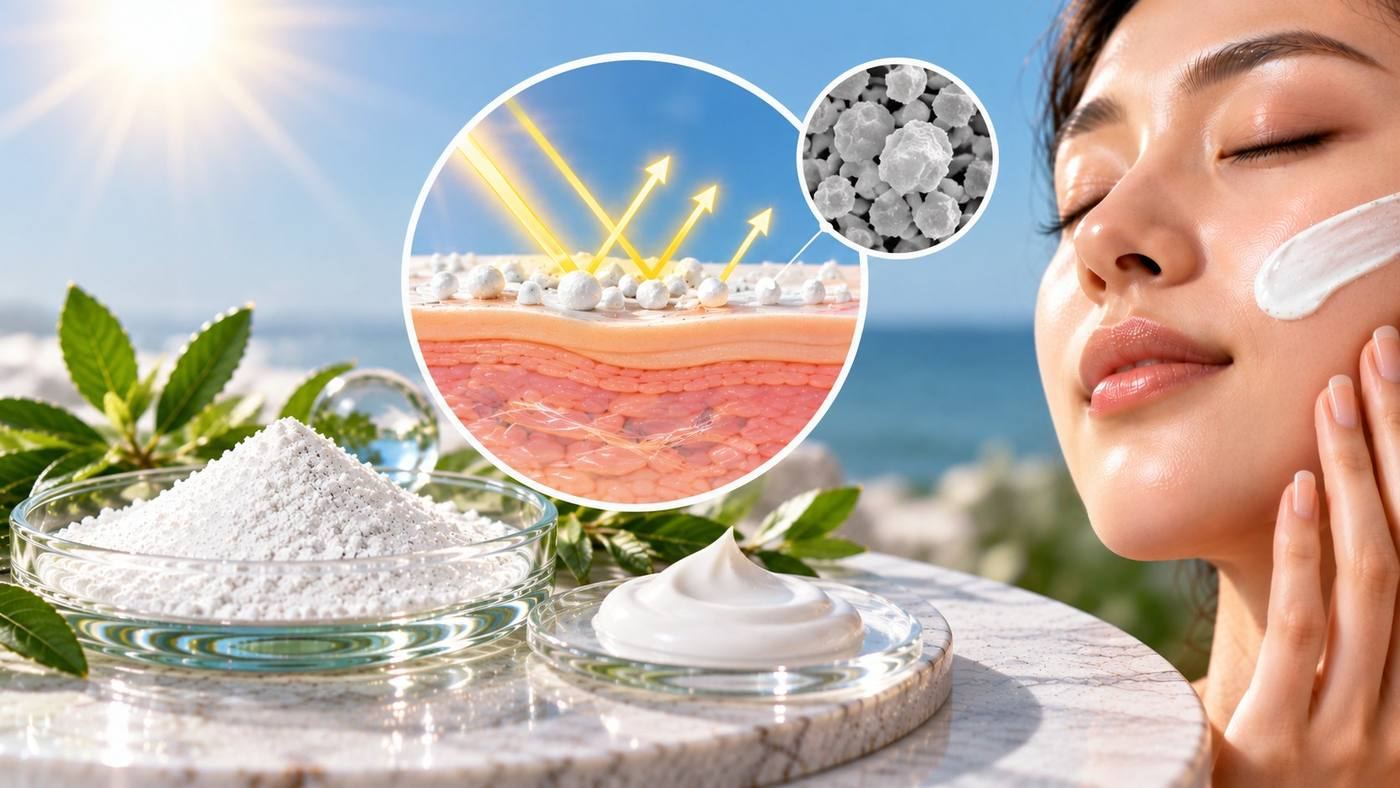
Titanium dioxide is a white mineral used both as a UV filter and as a colour pigment. Nano grades are used for UV protection because they look clearer on skin. Larger, pigmentary grades give white colour and help tinted sunscreens block visible light.
02What it does
Titanium dioxide absorbs and scatters UV light, mostly UVB and shorter UVA, so it is usually paired with a long-UVA filter such as zinc oxide or avobenzone. In tinted products, pigmentary titanium dioxide combined with iron oxides also blocks visible light, which matters for pigmentation-prone skin.
03The evidence
Studies below were checked against the publisher, DOI or journal record on 26 Sep 2026. We list design and size so you can judge the strength of each result.
| Study | Design | Who and how long | What it found |
|---|---|---|---|
| Polena et al. 2025, Journal of Cosmetic Dermatology (Wiley) Source | Randomised, investigator-blinded trial | 42 women with melasma, 5 months over summer; tinted sunscreen with iron oxides and pigmentary titanium dioxide vs untinted sunscreen with the same UV cover | Both prevented darkening, but the tinted product kept skin lighter and more even (lower ∆L*, ∆ITA° and ∆E); melasma scores improved similarly. |
| SCCS 2020, Opinion SCCS/1617/20 (EU safety opinion) Source | Risk assessment of inhalation exposure | Pigmentary titanium dioxide in hair sprays and loose face powders | Safe up to 25% in loose face powder; in aerosol hair sprays safe only up to 1.4% for consumers and 1.1% for hairdressers. |
| SCCS 2024, Scientific Advice SCCS/1661/23 (EU safety opinion) Source | Review of genotoxicity data | Titanium dioxide grades used in oral and lip products | Evidence could not exclude genotoxicity for almost all grades used in oral products, so no safe limits were set for oral or inhalation routes. |
| US FDA 2021, Proposed Order OTC000008 (regulatory review) Source | Review of the public safety and efficacy record for sunscreen actives | Titanium dioxide up to 25% in sunscreens | FDA proposed titanium dioxide as safe and effective (GRASE) up to 25%. |
| European Commission 2021, Regulation (EU) 2021/850 (regulatory decision) Source | Legal restriction following the SCCS opinion | Titanium dioxide powder with 1% or more particles of 10 µm aerodynamic diameter or less | From 1 October 2021: face loose powder max 25%, hair aerosol sprays max 1.4% (general public) or 1.1% (professional), no other uses that may expose the lungs. |
Titanium dioxide is a well-established UV filter for skin application, and in tinted formulas it adds useful visible-light shielding. The main issues are regulatory, not efficacy: inhalable formats and oral or lip products face tight EU limits. Claims should describe the tested product, for example “broad-spectrum protection” or “helps protect against visible light” when a tinted formula has been tested for it.
04How CSL formulation scientists use it
- Use coated grades (for example with silica, alumina or silicones) to limit photo-reactivity and help dispersion; always pair with a long-UVA filter.
- For tinted sunscreens, combine pigmentary titanium dioxide with iron oxides; visible-light protection depends on the pigment load and film, so test it.
- For powders and sprays, check particle-size data from the supplier: EU rules bite when 1% or more of particles are 10 µm or smaller.
- Avoid titanium dioxide in lip and oral products for EU launches unless the grade and use have been checked against the latest SCCS advice.
05Regulatory and claims
In the EU, titanium dioxide is an Annex VI UV filter up to 25% (entries 27 and 27a, nano). Regulation (EU) 2021/850 added an Annex III restriction for powder forms with 1% or more particles of 10 µm or smaller: 25% in face loose powders, 1.4% or 1.1% in hair aerosol sprays, and no other uses that may lead to inhalation, from 1 October 2021. In the US, FDA’s 2021 proposed order lists titanium dioxide as GRASE up to 25%. CSL regulatory specialists confirm current status in each market, including the evolving position on oral and lip products.
06Questions brands ask
Is titanium dioxide banned in the EU?
No. It remains an approved UV filter and colourant. The EU restricts powder forms that could be inhaled and has raised questions about oral products, not skin creams.
Can a titanium dioxide sunscreen be a spray?
Only within EU inhalation limits, and aerosol hair sprays are capped at 1.4%. Most mineral sunscreens are better as lotions, creams or sticks.
Why pair titanium dioxide with other filters?
It is strongest in UVB and short UVA. Adding zinc oxide or an organic long-UVA filter gives balanced broad-spectrum cover.
07References
- Polena H, Queille-Roussel C, Graizeau C, Duteil L, Sayag M, Passeron T. Comparison of visible light-protective tinted sunscreen to untinted sunscreen to protect melasma patients during summer: a prospective randomized investigator-blinded study. J Cosmet Dermatol. 2025;24(10):e70450. Link
- Scientific Committee on Consumer Safety. Opinion on titanium dioxide (TiO2) used in cosmetic products that lead to exposure by inhalation. SCCS/1617/20. Adopted 6 October 2020. Link
- Scientific Committee on Consumer Safety. Scientific advice on titanium dioxide (TiO2). SCCS/1661/23. Adopted 13 May 2024. Link
- US Food and Drug Administration. Proposed Order OTC000008: Amending Over-the-Counter Monograph M020, Sunscreen Drug Products. September 2021. Link
- Commission Regulation (EU) 2021/850 of 26 May 2021 amending Regulation (EC) No 1223/2009 on cosmetic products (CMR omnibus; titanium dioxide restrictions). Link
Used in: Sun protection
Update log
- Evidence reviewed and page published by CSL scientists
This page summarises published research for brands and formulators. It is general information, not medical advice, and results in studies depend on the full formula tested.