Onion extract for hair: what the evidence shows, and what it does not
Onion is a popular hair-care ingredient, but it rests on one small 2002 study in patchy hair loss. CSL formulation scientists explain what that study found and how to use onion extract with honest claims.
By CSL Formulation team · Evidence checked by CSL scientists
At a glance
- What it is
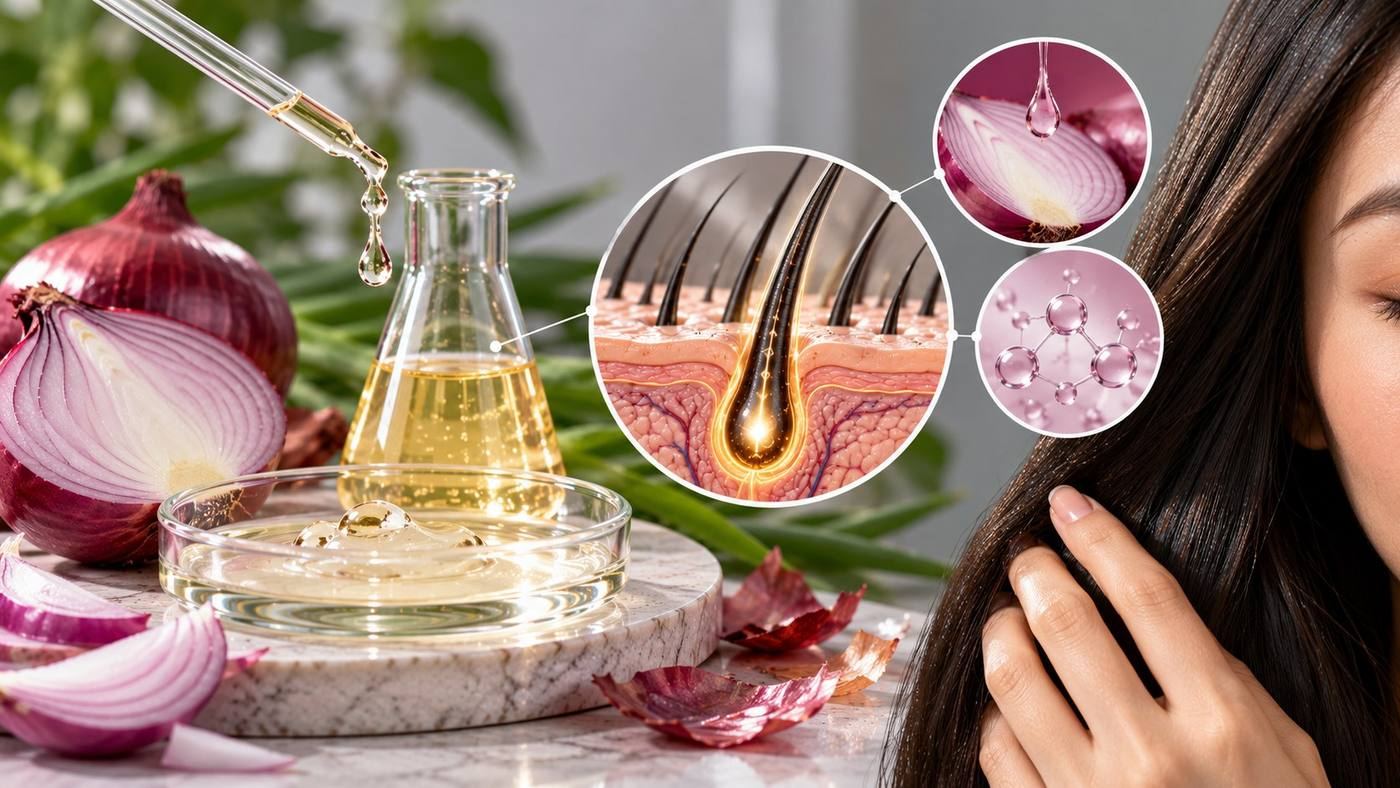
- Juice, extract or oil of the common onion (Allium cepa), rich in sulphur compounds and the flavonoid quercetin
- Main benefits
- Scalp care; widely marketed for hair fall, but human evidence is very thin
- Levels tested in trials
- Crude fresh onion juice, twice daily; no published trials of cosmetic onion extracts or oils found
- Time to results
- Regrowth seen from 2 to 6 weeks in the one study, in a medical condition
- Watch for
- Odour, scalp irritation, and claims that borrow from a medical study
01What is it?
Onion juice is a traditional home remedy for hair loss. Cosmetic products use onion extract or onion oil, which are not the same as the fresh juice that was studied. No published human trials of these commercial forms were found.
02What it does
The study authors suggested that onion's sulphur and phenolic compounds cause a mild irritant reaction on the scalp, which may distract the immune system in alopecia areata. Quercetin, a flavonoid found in onion, has protected scalp-derived cells in the laboratory, but that is not evidence that an onion product reduces ordinary hair fall or thinning.
03The evidence
Studies below were checked against the publisher, DOI or journal record on 26 Sep 2026. We list design and size so you can judge the strength of each result.
| Study | Design | Who and how long | What it found |
|---|---|---|---|
| Sharquie and Al-Obaidi 2002, Journal of Dermatology (Wiley) Source | Controlled trial against tap water; not blinded, randomisation not reported | 38 people with patchy alopecia areata (23 onion, 15 tap water), 2 months, crude onion juice twice daily | Regrowth in 86.9% with onion juice vs 13% with tap water (p<0.0001), better in men (93.7%) than women (71.4%). |
| Huanbutta et al. 2026, Phytomedicine Plus (Elsevier) Source | Integrative review of plant compounds for hair loss | Review of phytochemicals and delivery systems for alopecia | Lists onion among hair-regrowth botanicals but relies only on the 2002 study, and misreports its size as 62 participants. No newer onion trial is cited. |
| Ahmed et al. 2025, Skin Appendage Disorders (Karger) Source | Narrative review of herbal remedies | Review including onion juice, rosemary and other herbs | Notes onion's strong odour limits use, and that herbal studies are small, short and lack follow-up; larger randomised trials are needed. |
| Hwang et al. 2025, Journal of Integrative Dermatology Source | Narrative review of complementary therapies for alopecia areata | Review including onion juice, acupuncture and other non-drug options | Cites only the 2002 trial for onion and concludes that evidence for these therapies remains fairly limited and more research is needed. |
| Hosking et al. 2019, Skin Appendage Disorders (Karger) Source | Comprehensive review of complementary and alternative hair-loss treatments | Review across alopecia types; onion covered under natural products | Cites the 2002 study as the evidence for onion; overall, only a few alternative treatments are backed by multiple randomised trials. |
| Guo et al. 2025, Naunyn-Schmiedeberg's Archives of Pharmacology (Springer Nature) Source | Laboratory and mouse study (not human; quercetin, not onion) | Human dermal papilla cells stressed with DHT, plus a mouse model; pure quercetin | Quercetin limited DHT-induced cell damage and promoted hair growth in mice. This is early-stage work on a single onion constituent. |
There is no good evidence that onion extract reduces everyday hair fall or thinning. The only human trial was small, not blinded, used fresh juice and was in alopecia areata, a medical condition; reviews published up to 2026 still rely on it alone. Onion extract can be included for scalp care or brand story, but any hair fall claim must come from testing the finished product.
04How CSL formulation scientists use it
- Treat onion extract as a supporting botanical, and build performance on better-studied actives such as caffeine.
- Manage odour: CSL formulation scientists screen deodorised or low-odour grades and check odour stability over shelf life.
- Run a scalp tolerance test, since the proposed mechanism involves mild irritation.
- Any hair fall claim needs its own study on the finished formula, typically 3 months or more.
05Regulatory and claims
Onion extract is used in cosmetics, and CSL regulatory specialists confirm its status and labelling name in each target market. Alopecia areata is a medical condition, so the 2002 study cannot support cosmetic marketing, and claims such as 'regrows hair' or 'treats alopecia' are not allowed on a cosmetic. Keep wording to 'cares for the scalp' or claims proven on the finished product.
06Questions brands ask
Does onion juice regrow hair?
One 2002 study found regrowth in patchy alopecia areata, an autoimmune condition. It was small and not blinded, and it says nothing about ordinary thinning. Cosmetics cannot claim regrowth.
Is onion extract the same as onion juice?
No. The study used fresh crude juice. Commercial extracts and oils differ in composition and have not been tested in published hair trials that CSL could find.
Can an onion product claim to reduce hair fall?
Only if the finished product has been tested and shown to do so. The onion literature alone cannot support that claim.
07References
- Sharquie KE, Al-Obaidi HK. Onion juice (Allium cepa L.), a new topical treatment for alopecia areata. J Dermatol. 2002;29(6):343–346. Link
- Huanbutta K, Rattanachitthawat N, Thampithak A, Onnim P, Singh I, Sangnim T. Phytochemicals and novel delivery systems in alopecia management: an integrative review. Phytomedicine Plus. 2026;6(1):100949. Link
- Ahmed A, Alali AM, Abdullah E, Alharbi MN, Alayoubi HM. Herbal remedies for hair loss: a review of efficacy and safety. Skin Appendage Disord. 2025;11(4):360–371. Link
- Hwang A, Brady K, Liu R, Lio P. Complementary and alternative therapies for alopecia areata. J Integr Dermatol. 2025. Link
- Hosking AM, Juhasz M, Atanaskova Mesinkovska N. Complementary and alternative treatments for alopecia: a comprehensive review. Skin Appendage Disord. 2019;5(2):72–89. Link
- Guo T, Li W, Zheng W, Lin Y, Wen S. Quercetin rescues dihydrotestosterone-treated human dermal papilla cells via SHP2/AKT signaling to suppress autophagy and apoptosis. Naunyn Schmiedebergs Arch Pharmacol. 2025;398:7155–7170. Link
Used in: Hair fall & hair growth
Update log
- Evidence reviewed and page published by CSL scientists
This page summarises published research for brands and formulators. It is general information, not medical advice, and results in studies depend on the full formula tested.