Comedogenic ratings: where the 0–5 scale comes from and why it misleads
Most comedogenic ratings online trace back to rabbit ear tests from the 1970s and 1980s. Why the 0–5 scale shifts with concentration, why an ingredient's number does not transfer to a finished product, and what brands should test instead.
By Dr. Premalatha, Ph.D., Life Science, Regulatory Consultant, Cosmetic Science Lab

Quick answer
- What is the comedogenic scale? A 0–5 score for how strongly an ingredient produced comedones (clogged pores), mostly in the rabbit ear assay. 0 means none; 5 means severe.
- Oils are not one number. Coconut oil, cocoa butter, shea butter and argan oil differ in fatty acid profile, but use level and vehicle matter more than the oil's rating.
- A non-comedogenic claim should rest on testing the finished product on human skin, not on an ingredient chart.
Take-home message for formulators
- Screen ingredients with ratings if you must, then judge the whole formula
- Record use levels, because the published number was usually measured at far higher strength
Take-home message for brand owners
- Don't build a "non-comedogenic" claim from a checker tool
- Ask for finished-product human testing, and expect customers to compare your INCI list with online ratings
01Why comedogenic ratings matter
Shoppers with acne-prone skin search for a comedogenic rating before they buy, and online checkers turn an INCI list into a colour-coded score. That makes the scale commercially powerful: one "4" next to coconut oil can sink a product. Yet the numbers were never designed to rank finished products.
Comedogenic (forms comedones) is not the same as acnegenic (causes inflamed acne). Most ratings measure only the first.
02Where the 0–5 scale comes from
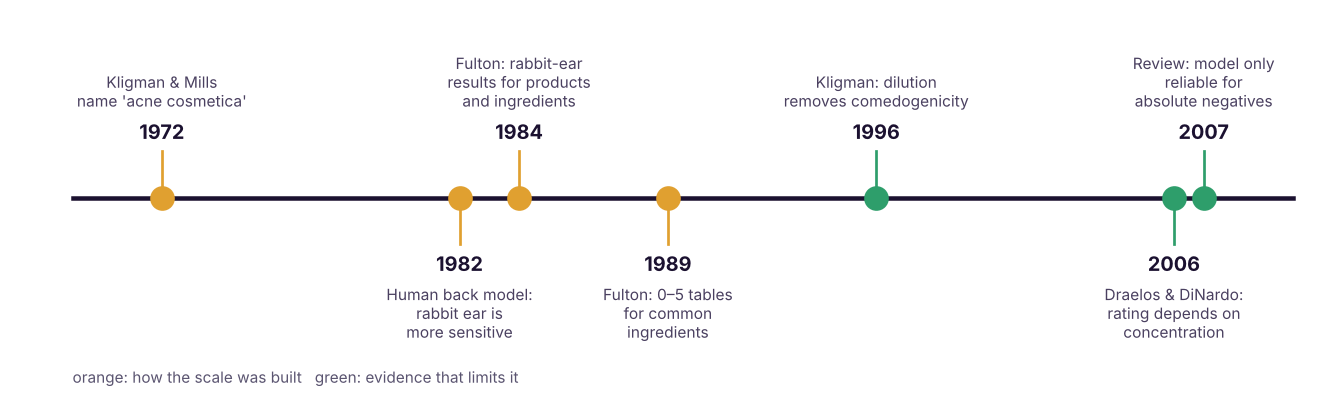
In 1972, Kligman and Mills described "acne cosmetica", mild acne linked to cosmetic use [1]. The workhorse test became the rabbit ear assay: ingredients were applied to the inner ear, and the follicles were graded for comedones. Fulton's group published rabbit-ear results for products and ingredients in 1984 [3], then tables of 0–5 scores for common skin care ingredients in 1989 [4]. Those tables still feed most online lists.
In 1982, Mills and Kligman added a human back model, applying substances under occlusion for a month. They found the rabbit more sensitive than human skin, and judged ingredients only weakly comedogenic in rabbits probably safe for most people, though acne-prone people may be an exception [2].
03The chemistry: fatty acids and oils
Plant oils and butters are mixtures of triglycerides, so their behaviour on skin follows their fatty acid profile. Researchers have hypothesised that sebum low in linoleic acid contributes to acne, and in a small one-month trial applying linoleic acid cut the overall size of microcomedones by almost 25% [8]. Oils rich in oleic acid or saturated stearic acid are not "bad", but they feel and behave differently.
| Oil or butter | Dominant fatty acids | What a single rating misses |
|---|---|---|
| Coconut oil | Lauric, myristic (saturated) | Often rated high, yet works well at low levels or in rinse-off products |
| Cocoa butter | Stearic, palmitic, oleic | Rated 4 in the 1989 rabbit-ear tables [4], yet finished products using comedogenic ingredients are not necessarily comedogenic [6] |
| Shea butter | Stearic, oleic | Grade and use level change feel and occlusion; see body butter formulation |
| Avocado oil | Oleic | Rich, slow-absorbing; vehicle decides the outcome |
| Argan oil | Oleic, linoleic | Usually rated low; still occlusive at high use levels |
04What the evidence says about the scale
Three findings explain why ratings do not transfer to finished products.
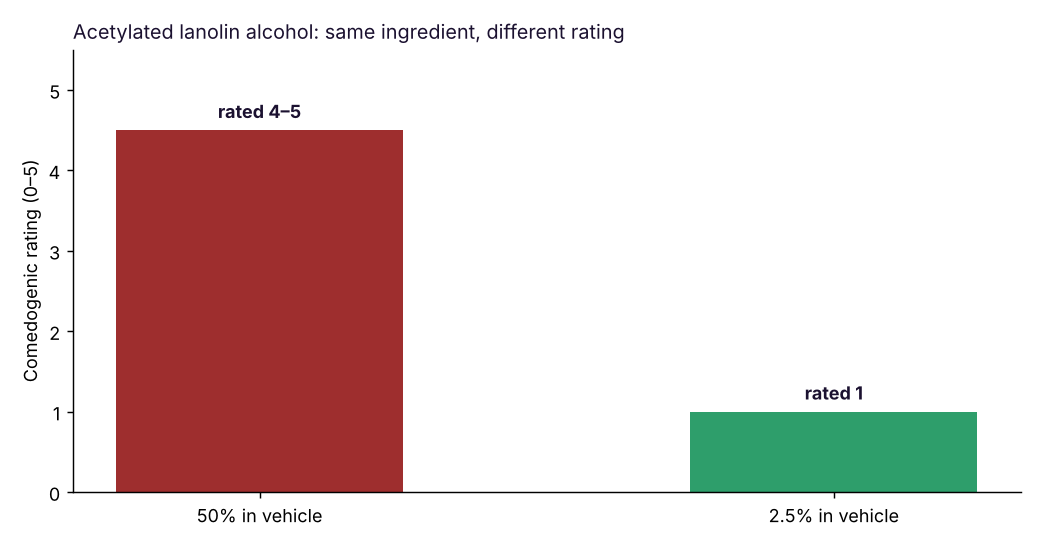
- Formulation context. You cannot tell from an ingredient list whether a product will be acnegenic [5]. Emulsifiers, other oils and the product type all change exposure.
- Model limits. A 2007 review judged the rabbit ear useful mainly for identifying absolute negatives [7].
05Formulation tips for acne-prone skin
- Set use levels first.
A "4" oil at 1% in a gel-cream is a different exposure from the same oil at 30% in a balm.
- Mind the vehicle.
A cleansing oil with a good emulsifier rinses away; a leave-on occlusive balm does not.
- Balance the fatty acids.
Blend linoleic-rich oils for a lighter feel, and add antioxidants because they oxidise faster.
- Test the finished product.
Support a non-comedogenic claim with a human comedogenicity study under dermatological supervision; see claims and clinical testing.
06For brands and formulators
If a competitor sells a "non-comedogenic" oil-based product, the INCI list shows the ingredients, not the use levels that make it work; deformulation and reading the INCI list recover that context. Our formulation team designs acne-friendly textures from the whole formula, not a ratings chart. Check single ingredients in our Ingredient A–Z, such as squalane or clays, and see our acne and oil control work.
07Questions readers ask
Is a comedogenic rating of 0 a guarantee?
No. It reflects a test result for the raw ingredient, usually in rabbits, not your skin or the finished product.
Is coconut oil comedogenic?
It is often rated high on online lists, but the effect depends on concentration and whether the product is rinse-off or leave-on.
What does "non-comedogenic" on a label mean?
It should mean the finished product was tested on people and did not increase comedones. Ask the brand what test supports it.
Need an acne-friendly formula that feels good?
We formulate, test and support non-comedogenic claims for skin care brands.
08References
- Kligman AM, Mills OH Jr. "Acne cosmetica". Arch Dermatol. 1972;106(6):843–850. PubMed
- Mills OH Jr, Kligman AM. A human model for assessing comedogenic substances. Arch Dermatol. 1982;118(11):903–905. doi:10.1001/archderm.1982.01650230031022. JAMA Network
- Fulton JE Jr, Pay SR, Fulton JE 3rd. Comedogenicity of current therapeutic products, cosmetics, and ingredients in the rabbit ear. J Am Acad Dermatol. 1984;10(1):96–105. doi:10.1016/s0190-9622(84)80050-x. PubMed
- Fulton JE Jr. Comedogenicity and irritancy of commonly used ingredients in skin care products. J Soc Cosmet Chem. 1989;40(6):321–333. SCC library
- Kligman AM. Petrolatum is not comedogenic in rabbits or humans: a critical reappraisal of the rabbit ear assay and the concept of "acne cosmetica". J Soc Cosmet Chem. 1996;47(1):41–48 (p. 46). SCC library
- Draelos ZD, DiNardo JC. A re-evaluation of the comedogenicity concept. J Am Acad Dermatol. 2006;54(3):507–512. doi:10.1016/j.jaad.2005.11.1058. PubMed
- Mirshahpanah P, Maibach HI. Models in acnegenesis. Cutan Ocul Toxicol. 2007;26(3):195–202. doi:10.1080/15569520701502815. PubMed
- Letawe C, Boone M, Piérard GE. Digital image analysis of the effect of topically applied linoleic acid on acne microcomedones. Clin Exp Dermatol. 1998;23(2):56–58. doi:10.1046/j.1365-2230.1998.00315.x. PubMed
Update log
- Published by Cosmetic Science Lab
This article is general technical information, not legal, regulatory or medical advice. Confirm requirements for your product and market before launch.