How to read an INCI list: order, the 1% line and what it hides
An INCI list is ranked by weight only until ingredients drop below 1%. How to read the order like a cosmetic chemist, find the 1% line, estimate what each ingredient is doing, and spot the five things a label never tells you.
By Dr. Premalatha, Ph.D., Life Science, Regulatory Consultant, Cosmetic Science Lab

Label at a glance
- What it is
- The legal ingredient list, written in INCI nomenclature (International Nomenclature of Cosmetic Ingredients)
- Exceptions
- Colourants (CI numbers) can go in any order at the end; "parfum" groups the fragrance; "may contain" covers shade ranges
- What it never shows
- Percentages, ingredient grade, supplier blends or process
- Who reads it
- Six in 10 skin care users, according to market research reported in 2026 [6]
Quick answer
- How do you read an INCI list? Start at the top: ingredients above 1% are listed in descending order of weight, so the first five usually make up most of the product. Find the 1% line, then read everything after it as low-level, unranked ingredients such as actives, preservatives, fragrance and colourants.
- A preservative such as benzyl alcohol or phenoxyethanol is a useful marker: everything after it is usually at 1% or less.
- Position is evidence, not proof. Chemists use it to bracket levels, then confirm them with analysis.
- Since 31 July 2026, new EU products must name 56 additional fragrance allergens above set thresholds [4].
Take-home message for formulators
- Treat INCI order as a constraint on use levels, not a recipe
- Expect actives and preservatives below the 1% line on most competitor labels
Take-home message for brand owners
- Shoppers read your list: an active named on the front but sitting after the preservative will be noticed
- Check your labels against the new EU allergen rules now
01How an INCI list is ordered
The EU, the US and Canada all apply the same core rule: ingredients appear in descending order of weight, but those present at 1% or less may follow in any order [1], [2], [3], [7]. Colourants are listed by Colour Index number (CI 77891, CI 19140) and may also appear in any order after the other ingredients [1], [2]. In the EU, that colourant freedom does not extend to hair dyes [1].
In the US, fragrance can be declared simply as "fragrance", and ingredients exempt as trade secrets can be replaced by the phrase "and other ingredients" at the end of the list [3]. In the EU, "parfum" covers the blend, but named allergens must be listed when they exceed 0.001% in leave-on or 0.01% in rinse-off products [4]. See our glossary entry on INCI names.
02What the data shows
In Label Insight's 2017 Ingredient Confusion study of more than 1,000 consumers, 45% said they trust a brand less when they see personal care ingredients on the label that they do not understand, and 61% of women were more likely to buy products with ingredients they recognised [5]. Interest has not faded: industry reporting in 2026 put the share of skin care users who read INCI lists at six in 10 [6]. Shoppers read the list, but few are taught how it is ordered.
03Worked example: estimating levels from position
This is how a cosmetic chemist starts any deformulation: read the list, place the 1% line, then bracket each level. Take a hydrating gel-cream:
Aqua, Butylene Glycol, Glycerin, Aloe Barbadensis Leaf Juice, Niacinamide, Simmondsia Chinensis Seed Oil, Cetearyl Alcohol, Sodium Hyaluronate, Tocopheryl Acetate, Xanthan Gum, Benzyl Alcohol, Citric Acid, Parfum, Linalool, CI 19140.
| Ingredient (INCI) | Est. % w/w | Chemist's reasoning |
|---|---|---|
| Aqua | 60–80 | Water is the base of most creams and lotions |
| Butylene Glycol, Glycerin | 3–8 | Humectants; above the 1% line and ranked by weight. See glycerin |
| Aloe Barbadensis Leaf Juice | 1–5 | An "aloe vera" claim, usually a diluted juice, not pure gel |
| Niacinamide | 2–4 | Must sit at or below glycerin; see niacinamide |
| Simmondsia Chinensis Seed Oil, Cetearyl Alcohol | 1–3 | Light oil phase and a fatty alcohol that builds body |
| Sodium Hyaluronate | 0.05–0.5 | The salt form of hyaluronic acid; works at low levels |
| Tocopheryl Acetate, Xanthan Gum | 0.1–0.5 | Antioxidant and thickener; typical low use levels |
| Benzyl Alcohol | ≤ 1 | Preservative: the practical 1% marker |
| Citric Acid, Parfum, Linalool, CI 19140 | < 0.5 | pH adjuster, fragrance, a labelled allergen and a colourant |
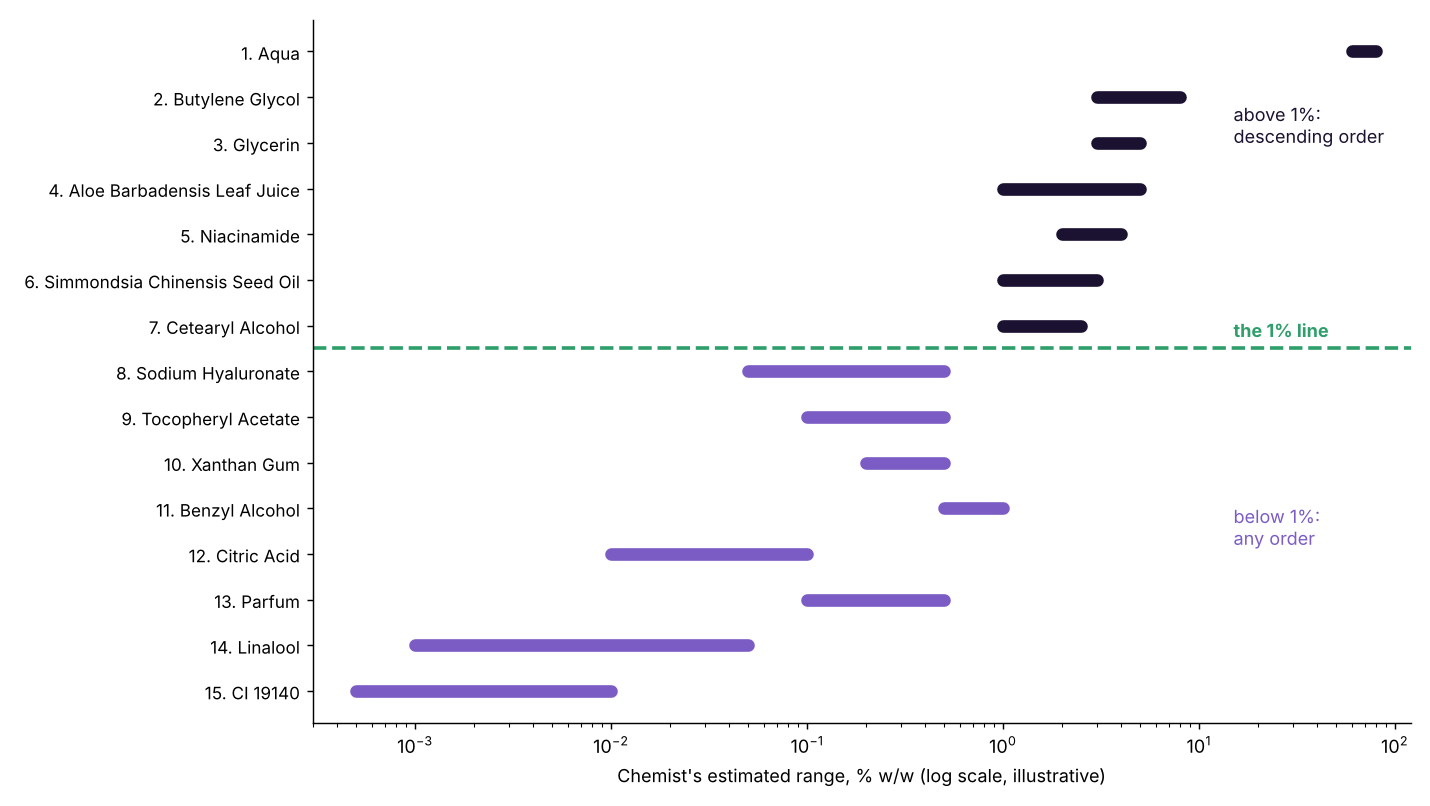
Note what the order cannot settle: sodium hyaluronate sits above benzyl alcohol, but below 1% that position says nothing about which is higher.
04What an INCI list hides
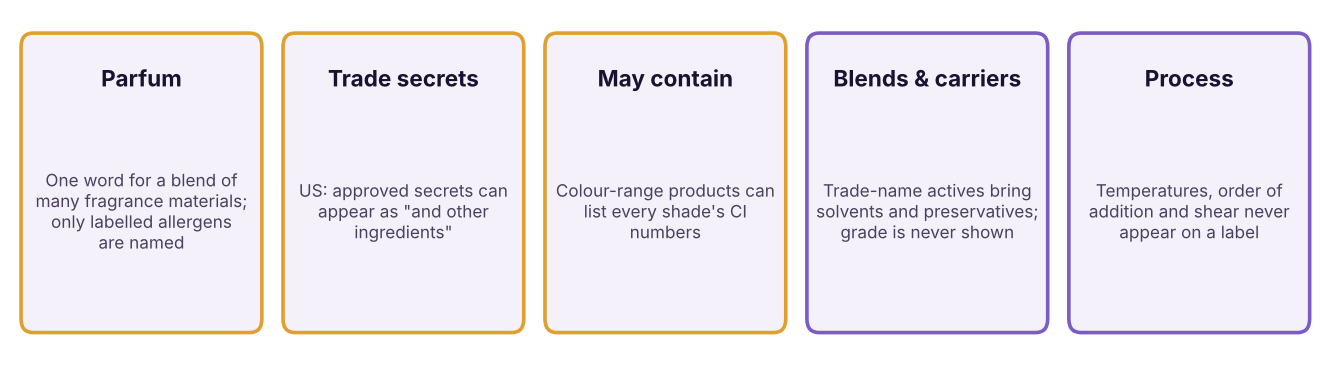
"May contain" is the trickiest. US rules let a shade range share one list of colour additives, some of which are not in every shade [3]; EU labels use the same idea, with "may contain" or the symbol "+/-", for decorative products sold in several shades [1].
05Myths about INCI lists
- "The first ingredient is the active." Usually it is water. Actives often sit below the 1% line and still work at those levels.
- "Alcohol on the label means drying alcohol." "Alcohol" or "Alcohol Denat." is ethyl alcohol; cetearyl alcohol is a fatty alcohol that softens skin.
- "Hyaluronic acid near the end means it is pointless." Sodium hyaluronate is effective at fractions of a percent.
06What to check on a label
- Find the preservative.
Everything after it is usually at 1% or less; the 1% line itself may sit a few places higher, as in the example above.
- Check the hero ingredient.
If the pack implies a high level, it should sit above that line.
- Read past "parfum".
If you react to fragrance, look for named allergens such as linalool or limonene [4].
- Check colour products.
Look for "may contain" or "+/-" before the CI numbers.
We decode competitor labels and confirm them in the lab. Request a deformulation.
07For brands and formulators
For a formulation team, an INCI list is the first data set in reverse engineering. Position brackets use levels, the preservative locates the 1% line and the CI numbers reveal the shade system. It narrows the search, but it is not a formula.
Our reverse engineering and benchmarking service starts exactly here, then confirms identities and levels with analytical methods such as GC-MS, HPLC and ICP-MS; see what GC-MS can and can't tell you. In one project, we decoded 98% of a benchmark body lotion. For your own label, our regulatory team checks INCI names, order and the new EU allergen requirements before you print; see also why Lilial keeps triggering EU alerts.
08Questions readers ask
Are ingredients always listed from highest to lowest?
Only above 1%. At or below 1%, and for colourants, the order is free.
What does "parfum" or "fragrance" mean on an INCI list?
It stands for a fragrance blend. In the EU, specific allergens inside it must be named once they pass the labelling thresholds.
Can I work out exact percentages from an INCI list?
No. You can bracket ranges from position, but exact levels need laboratory analysis.
Why does my product say "may contain"?
It is usually a shade range sharing one list of colourants, not all of which are in your shade.
Need to decode a competitor's INCI list?
Our chemists turn a label into a measured, reconstructed formula you can build on.
09References
- European Parliament and Council. Regulation (EC) No 1223/2009 on cosmetic products, Article 19(1)(g) (labelling). OJ L 342, 22.12.2009, p. 59. EUR-Lex
- Government of Canada. Cosmetic Regulations (C.R.C., c. 869), section 21.4: order of ingredients. Justice Laws
- US Food and Drug Administration. 21 CFR 701.3: Designation of ingredients. eCFR
- Bernardo P. EU fragrance allergen labelling under Commission Regulation (EU) 2023/1545. Obelis; 14 Sep 2026. Obelis
- Label Insight. 2017 Ingredient Confusion study (more than 1,000 consumers), reported in: Study: consumer demand for personal care ingredient information is on the rise. Drug Store News. Drug Store News
- Green E. Rising INCI scrutiny leaves consumers short on ingredient context. Personal Care Insights; 4 Sep 2026. Personal Care Insights
- Cosmetics Business. A guide on how to write cosmetics ingredient lists in EU, US and Canada. 10 Jul 2020. Cosmetics Business
Update log
- Published by Cosmetic Science Lab
This article is general technical information, not legal, regulatory or medical advice. Confirm requirements for your product and market before launch.