Dimethicone: what it does and is it safe?
Dimethicone is the silicone behind the silky feel of creams, primers and conditioners. What it does on skin and hair, what the safety evidence shows, and how it differs from the restricted cyclic silicones.
By Dr. Premalatha, Ph.D., Life Science, Regulatory Consultant, Cosmetic Science Lab
Quick answer
- What is dimethicone? A linear silicone polymer, polydimethylsiloxane (PDMS), that gives creams, primers and conditioners their smooth, silky feel.
- Is dimethicone safe? The Cosmetic Ingredient Review (CIR) panel concluded in 2022 that dimethicone is safe in cosmetics as currently used, when formulated to be non-irritating [1].
- Dermatology reviews describe it as hypoallergenic and non-comedogenic [4].
- The EU restrictions apply to the cyclic silicones D4, D5 and D6, not to linear dimethicone [6]. Residual cyclics in a dimethicone grade still count towards the 0.1% limit in the finished product.
Take-home message for formulators
- Pair dimethicone with a humectant for dry-skin claims
- Ask suppliers for residual D4, D5 and D6 data on each silicone grade
- Benchmark any silicone-free swap on spread, playtime and stability
Take-home message for brand owners
- Dimethicone itself is not restricted in the EU
- Cyclic silicones in leave-on products must be below 0.1% from June 2027
- Test before claiming "non-comedogenic"; do not rely on ingredient lists
01What is dimethicone?
Dimethicone is a silicone polymer: a long chain of repeating silicon-oxygen units, each carrying two methyl groups, capped at both ends. Its chemical name is polydimethylsiloxane (PDMS). Chain length sets its viscosity, from thin fluids for serums to thick gums for hair care. It is one of the most widely used silicones in skincare, yet it is often confused with the small cyclic silicones that regulators have restricted.
02What dimethicone does in skincare and hair care
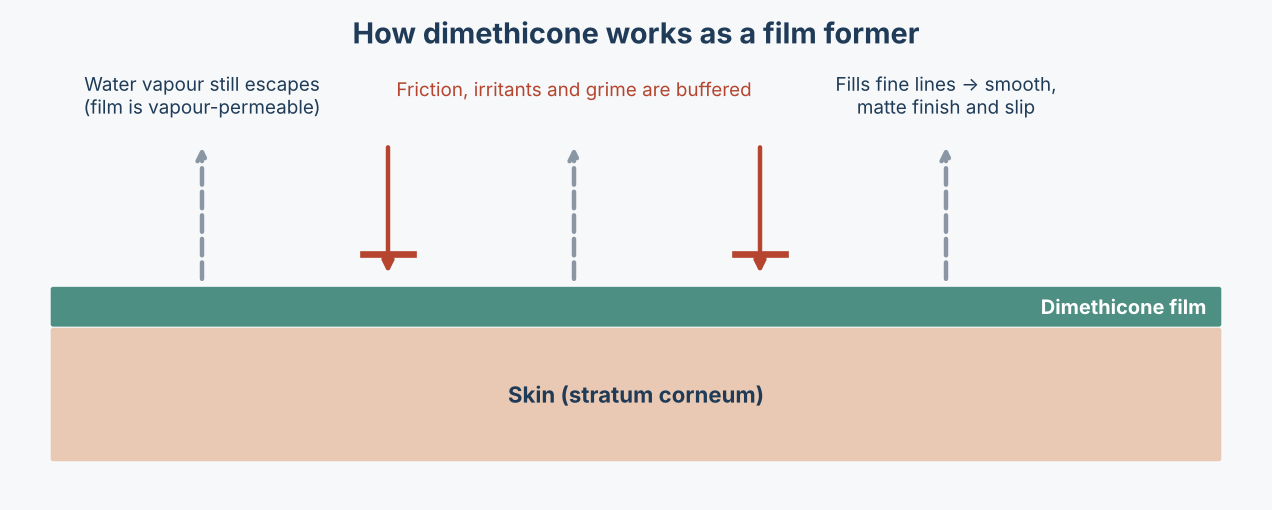
Dimethicone works at the surface, spreading into a thin, even film that still lets water vapour through [4].
- Film former: a light protective layer that buffers friction and irritants.
- Mild occlusive: slows some water loss without sealing the skin [5].
- Slip: makes lotions glide and spread evenly with less product.
- Optical smoothing: softens the look of fine lines and pores for a soft-focus, matte finish in primers.
- Hair care: coats the cuticle to cut frizz, add shine and reduce combing damage. See our hair care work.
03Is dimethicone safe? What the research shows
The evidence is reassuring, but thinner than most articles admit. Here is what four key sources actually did.
| Source | What it is | Key result | Limits |
|---|---|---|---|
| CIR Expert Panel, 2003 and 2022 [1], [2] | Safety assessment of dimethicone, methicone and related polymers (30 ingredients in 2022) | Safe in present practices of use and concentration, when formulated to be non-irritating | Review of existing, largely industry-submitted data; data insufficient for airbrush products that may be inhaled. CIR is funded by the Personal Care Products Council but states its reviews are independent [9]. |
| Becker et al., 2014 [3] | CIR assessment of 62 dimethicone crosspolymers | Safe in the practices of use and concentration assessed | Covers crosspolymers, not linear dimethicone |
| Kwon et al., 2013 [5] | Instrumental comparison of six creams at 30 minutes and 6 hours; the silicone oil was dimethicone | Dimethicone alone cut water loss more than glycerin or hyaluronic acid alone, but hydrated less. Glycerin plus dimethicone was best on both measures. | Sample size not reported in the abstract; short follow-up; single lab |
| Bains and Kaur, 2023 [4] | Narrative review of silicones in dermatology | Describes dimethicone as hypoallergenic, non-comedogenic and permeable to water vapour | No new data; comedogenicity is summarised, not measured |
For formulators: the CIR conclusions give strong regulatory comfort at standard use levels. Pair dimethicone with a humectant such as glycerin for dry-skin claims, and run your own non-comedogenicity test before putting that claim on pack.
04Dimethicone vs cyclic silicones: the D4, D5 and D6 restrictions explained
Not all silicones in skincare are the same. Dimethicone is a long linear chain that stays on skin. Cyclic silicones such as D4, D5 and D6 are small rings that evaporate, which is why they appear in light serums and dry-feel sprays.
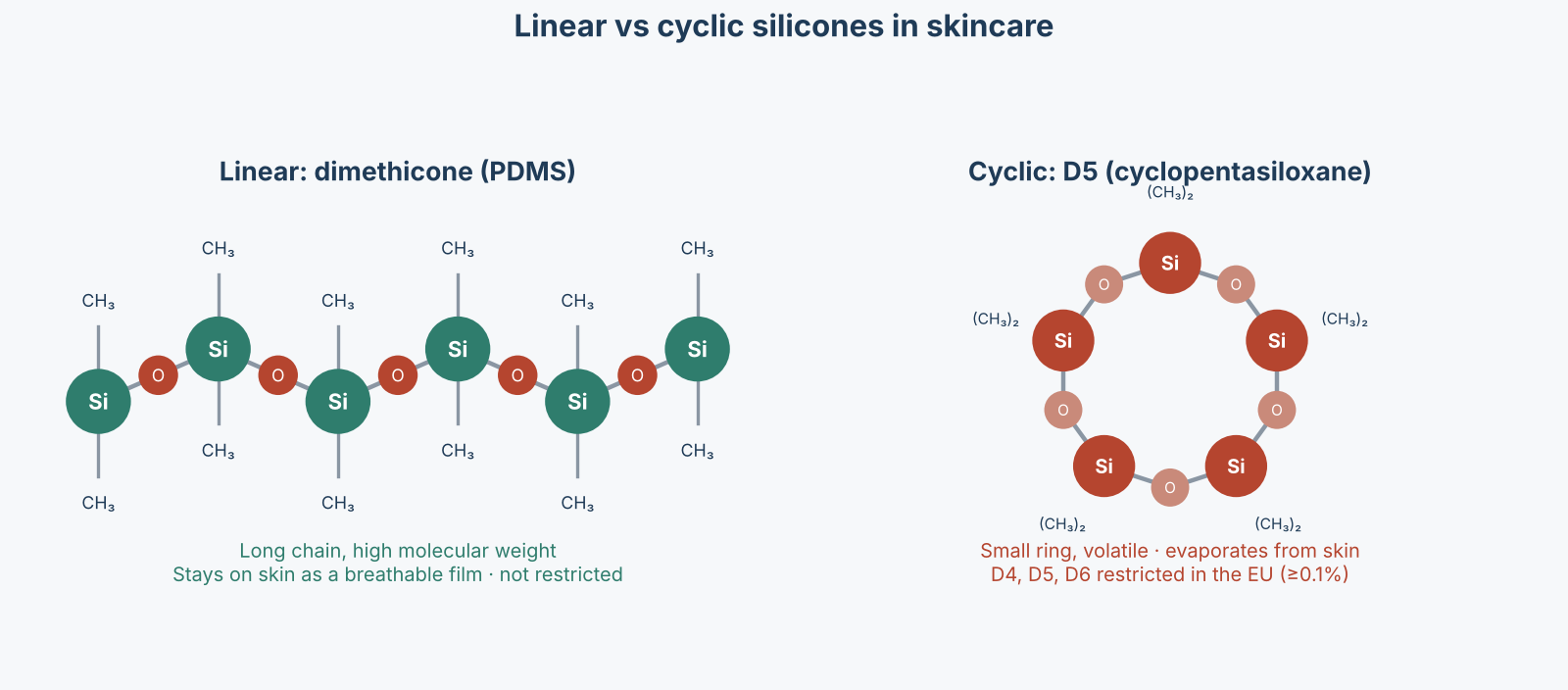
The EU has acted on the cyclics in stages. D4 has been a prohibited cosmetic ingredient since 2019 [8]. D4 and D5 have been restricted to below 0.1% in wash-off cosmetics since 31 January 2020 [7]. Regulation (EU) 2024/1328 extends the 0.1% limit for each of D4, D5 and D6 to other consumer and professional products from 6 June 2026, and to leave-on cosmetics, and D6 in wash-off cosmetics, from 6 June 2027 [6]. Linear dimethicone is not restricted.
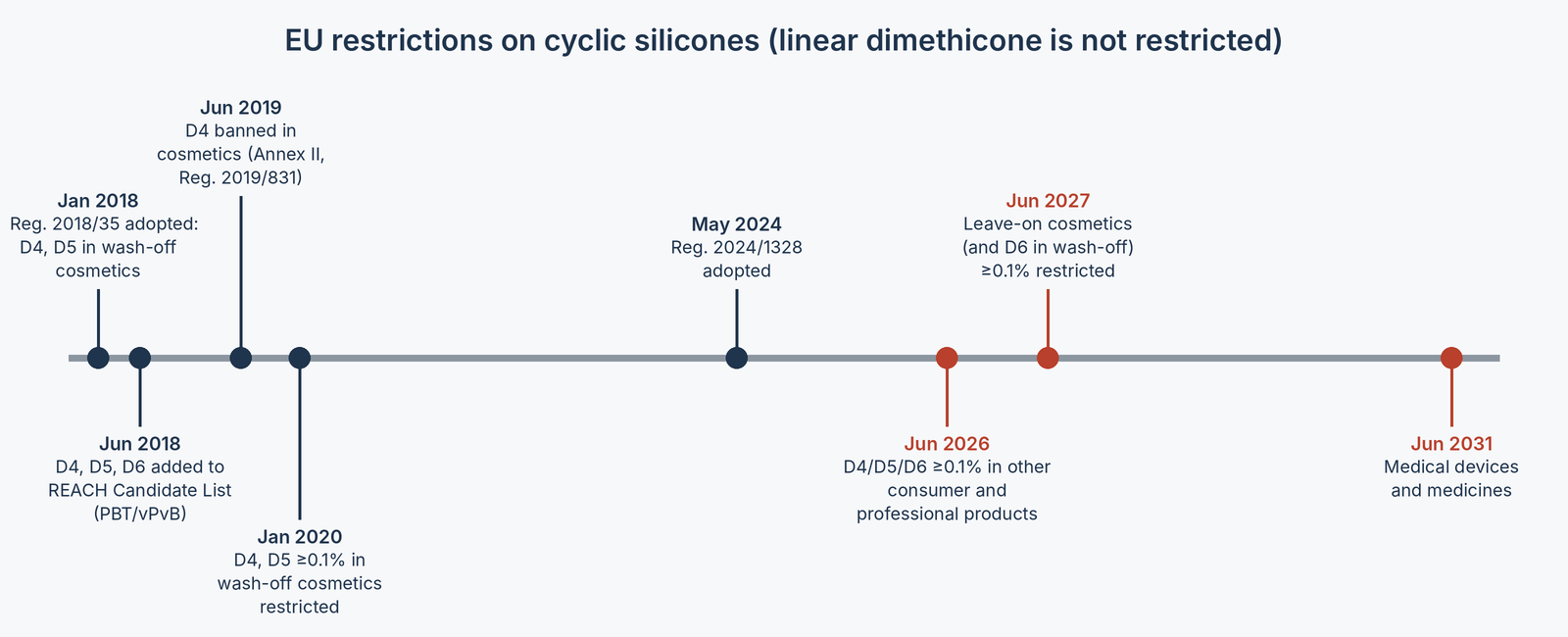
The 0.1% limit applies to D4, D5 and D6 in the finished mixture, including residues carried in from silicone polymers. Low-viscosity dimethicone grades can contain residual cyclics, so ask suppliers for residual D4, D5 and D6 data and keep it in your product file [6].
Biodegradability is the fair criticism of silicones. Some silicones do not break down readily, though evidence of build-up in the food chain remains inconclusive [4].
05Is dimethicone bad for your skin or hair?
For most people, no. A few caveats are worth knowing:
- Acne-prone skin: dimethicone itself is described as non-comedogenic, but it can hold heavier oils and sunscreen against the skin. Cleanse thoroughly at night.
- Dry skin: it slows water loss but does not add water. Look for formulas that pair it with glycerin or ceramides.
- Sensitive skin: allergy is rare. Reactions more often come from fragrance or preservatives in the same product.
- Hair: heavier silicones can build up and make fine hair limp. A clarifying shampoo every one to two weeks removes residue.
06For brands and formulators: replacing dimethicone
Silicone-free is now a mainstream brief, but no single ingredient copies dimethicone's slip, film and stability. Most reformulations blend two or three alternatives.
| Alternative | What it replaces | Sensory trade-off |
|---|---|---|
| Hemisqualane, C13–15 alkane | Cyclic silicones' fast, dry spread | Close match; higher cost |
| Squalane, coco-caprylate/caprate | Dimethicone slip | Slightly oilier after-feel |
| Plant starches, silica | Matte, soft-focus finish | Can feel powdery or chalky |
| Natural film formers (e.g. polysaccharides) | Protective film | Can feel tacky; weaker water resistance |
| Colloidal oatmeal, ceramides | Skin-protectant and barrier claims | Different mechanism; adds an active benefit |
Test the blend against your silicone benchmark on spreadability, playtime, residue and emulsion stability, and use sensory panels if texture claims are on pack. Silicone-free emulsions often need a stabiliser rework; for the basics, read what an emulsion is and why creams separate and our guide to choosing an emulsifier.
07Questions readers ask
Does dimethicone clog pores?
It is described as non-comedogenic. Breakouts usually come from heavier oils in the formula or poor cleansing, not from the silicone itself.
Is dimethicone banned in the EU?
No. The EU restricts the cyclic silicones D4, D5 and D6, not linear dimethicone. Residual cyclics in a dimethicone grade must still keep each of D4, D5 and D6 below 0.1% in the finished product.
Why does EWG Skin Deep list silicones?
EWG Skin Deep is a hazard-based database. Regulatory reviews weigh real exposure, which is why they reach different conclusions on many ingredients.
Is dimethicone the same as silicone?
Dimethicone is one type of silicone. "Silicone" covers many linear, cyclic and modified forms with different properties.
Reformulating with or without silicones?
Our formulation team matches silicone and silicone-free textures for skin and hair care brands, then proves stability before launch.
08References
- Cosmetic Ingredient Review Expert Panel. [Final amended safety assessment of dimethicone, methicone and 28 related ingredients.] Released 19 April 2022. CIR
- Nair B; Cosmetic Ingredient Review Expert Panel. Final report on the safety assessment of stearoxy dimethicone, dimethicone, methicone, … stearyl methicone, and vinyldimethicone. Int J Toxicol. 2003;22 Suppl 2:11–35. DOI
- Becker LC, Bergfeld WF, Belsito DV, et al. Safety assessment of dimethicone crosspolymers as used in cosmetics. Int J Toxicol. 2014;33(2 Suppl):65S–115S. DOI
- Bains P, Kaur S. Silicone in dermatology: an update. J Cutan Aesthet Surg. 2023;16(1):14–20. DOI
- Kwon SB, Lee GT, Choi SJ, et al. The effect of glycerin, hyaluronic acid and silicone oil on the hydration, moisturization and transepidermal water loss in human skin. Asian J Beauty Cosmetol. 2013;11(4):761–768. Abstract
- Commission Regulation (EU) 2024/1328 of 16 May 2024 amending Annex XVII to Regulation (EC) No 1907/2006 as regards D4, D5 and D6. OJ L, 2024. EUR-Lex
- Commission Regulation (EU) 2018/35 of 10 January 2018 amending Annex XVII to Regulation (EC) No 1907/2006 as regards D4 and D5. EUR-Lex
- Commission Regulation (EU) 2019/831 of 22 May 2019 amending the annexes to Regulation (EC) No 1223/2009 on cosmetic products (adds D4 to Annex II). EUR-Lex
- Cosmetic Ingredient Review. About CIR. CIR
Update log
- Published by Cosmetic Science Lab
This article is general technical information, not legal, regulatory or medical advice. Confirm requirements for your product and market before launch.