What is a serum? Serum vs ampoule vs essence vs moisturizer
Serums, ampoules, essences and moisturizers differ in base, viscosity and active concentration, not in any legal definition. Here is what each format does, what the studies show, and what to check on a serum label.
By Dr. Premalatha, Ph.D., Life Science, Regulatory Consultant, Cosmetic Science Lab
Quick answer
- What is a serum? A serum is a lightweight, low-viscosity skincare product, usually water-based, designed to deliver a higher concentration of one or two targeted actives than a moisturizer. You apply it after cleansing and before moisturizer. Serums treat; moisturizers seal. An ampoule is a stronger, short-course serum, and an essence is a thinner, hydrating layer used before it.
- A serum does not replace a moisturizer; petrolatum, the benchmark occlusive, cuts water loss by about 98% [2].
- For unstable actives such as retinoids, stability, not just the dose on the label, decides whether a serum works [3].
Take-home message for formulators
- Choose the format from the active's needs: solubility, pH and light sensitivity come before texture.
- Low viscosity cannot suspend particles or hide instability; budget for stability work.
- Plan packaging with the formula: airless and opaque for retinoids and vitamin C.
Take-home message for brand owners
- "Serum" is a positioning choice, not a legal category; the claim must still be proven.
- Higher active load raises cost, irritation risk and the testing burden.
- One serum and one moisturizer usually outperform one product that tries to do both.
01What is a serum?
A serum is defined by how it is built, not by law. EU cosmetics rules govern ingredients, labelling and claims, but no regulation defines serum, ampoule or essence as formats [1]. In formulation terms, three variables set a serum apart:
- Viscosity: low to medium, so the product spreads thinly and absorbs quickly.
- Active concentration: with little oil, emulsifier or occlusive to carry, the formula has room for a higher dose of a targeted active such as hyaluronic acid, niacinamide or vitamin C.
02What does a serum do?
A serum's job is delivery: it places an active on the skin in a form that can work, then leaves room for the next layer. Delivery depends on the active as much as the format. In a 60-day trial, all five hyaluronic acid creams tested improved hydration and elasticity, but only the low molecular weight versions (50 and 130 kDa) reduced wrinkle depth [4].
For acids, pH matters as much as percentage. At pH 3.8 about half of glycolic acid is in its active free form; at pH 4.5 only about 18% is [5]. What a serum does not do is seal. Water-based serums typically form little or no occlusive film, so water keeps evaporating from the skin surface.
03Serum vs ampoule vs essence vs moisturizer
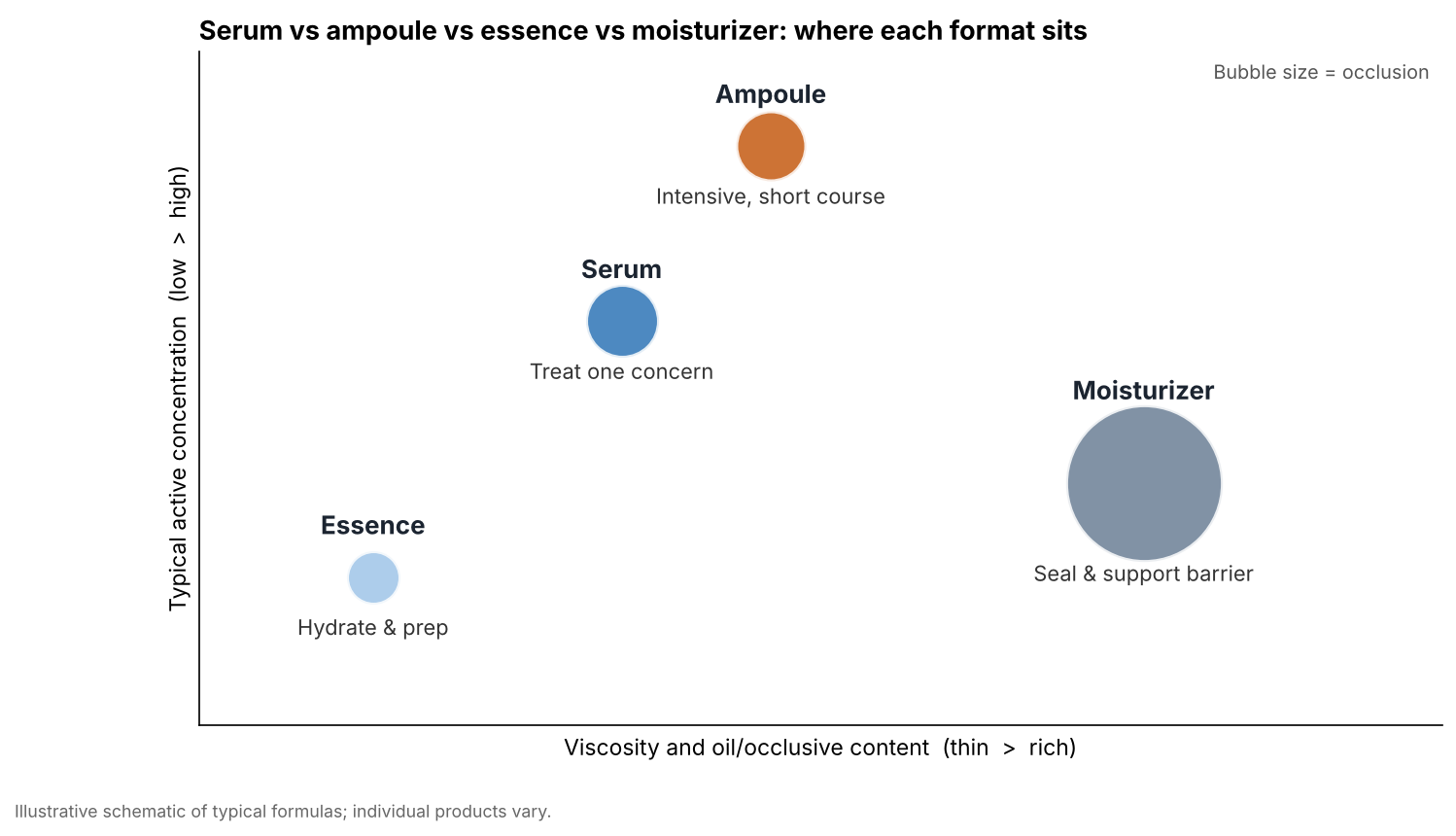
The four formats sit on one spectrum, from thin and hydrating to rich and sealing.
| Format | Typical base | Viscosity | Active concentration | Occlusion | Main job |
|---|---|---|---|---|---|
| Essence | Water, humectants, ferments | Very low | Low | None | Hydrate and prep the skin |
| Serum | Water gel or light oil | Low to medium | Moderate to high | Minimal | Treat one specific concern |
| Ampoule | Serum base, often single-dose | Low to medium | Highest | Minimal | Intensive, short-course treatment |
| Moisturizer | Oil-in-water emulsion | Medium to high | Low to moderate | Moderate to high | Seal in water, support the barrier |
Ampoule vs serum
An ampoule is a serum with a higher active load, often sold as single doses or a short course. The difference is concentration, not chemistry, and more strength can mean more irritation for sensitive skin.
Essence vs serum
An essence is thinner and lighter on actives. Its job is hydration, usually with humectants such as glycerin and ferment filtrates.
Serum vs moisturizer
A moisturizer is usually an emulsion containing oils and occlusives. Petrolatum, the benchmark occlusive, can reduce transepidermal water loss by about 98% [2]; a typical water-based serum offers little of that.
Layering order
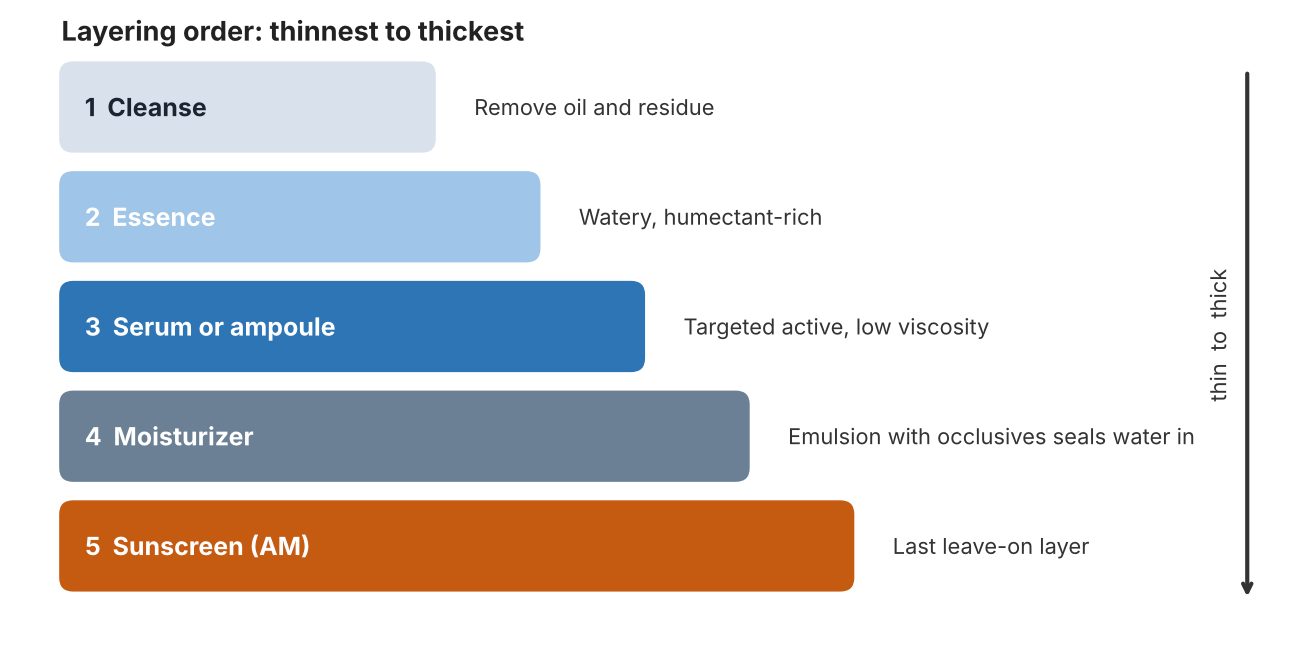
Apply thinnest to thickest: essence, then serum or ampoule, then moisturizer, then sunscreen in the morning. Each layer reaches the skin before an occlusive film forms.
PLANNING A SERUM LAUNCH? We match the format to your active, then prove it is stable.
04What the studies show
| Study | Year | Design | Finding | What it means for serums |
|---|---|---|---|---|
| Pavicic et al. [4] | 2011 | 76 women, 60 days, 0.1% hyaluronic acid at five molecular weights | All improved hydration and elasticity; only 50 and 130 kDa reduced wrinkle depth | For anti-ageing claims, molecular weight matters, not just "contains HA" |
| Temova Rakuša et al. [3] | 2021 | 12 commercial products, 16 retinoids, 6 months | Content fell 0–80% at 25 °C and 40–100% at 40 °C; light did more damage than heat; some products held less than declared | A retinol serum needs opaque, airless packaging and real-time stability data |
| Cambier et al. [5] | 2026 | Review of glycolic acid formulation | About 50% free acid at pH 3.8 versus 18% at pH 4.5 | The same percentage can deliver very different doses |
| Sethi et al. [2] | 2016 | Review of moisturizer evidence | Petrolatum reduces TEWL by about 98% | Serums do not replace an occlusive moisturizer |
None of these studies compares a serum and a cream carrying the same active head to head. Any claim that a serum format "works better" needs product-specific testing.
05Serum myths
- "Serums always contain more active." No minimum strength exists for the word, and some retinoid products have tested below their declared content [3].
- "A hyaluronic acid serum is all the hydration you need." Humectants attract water, but without an occlusive layer to slow evaporation, the skin keeps losing water; that is why moisturizers pair the two.
- "Stem cell serums regenerate your skin." Cosmetic stem cell ingredients are plant cell-culture extracts, and reviewers say benefits in human skin are still to be shown [6].
06What to check on a serum label
| Check | Why it matters |
|---|---|
| Ingredient order | In the EU, ingredients above 1% are listed in descending order of weight; those below 1% may appear in any order (Article 19(1)(g)) [7]. An active listed after the preservative is often under 1% (a rule of thumb, since most preservatives are used at or below 1%). |
| Active form | Hyaluronic acid molecular weight changes results [4]; retinol, retinal and retinyl esters differ in strength. |
| pH (for acids) | The free acid, not the label percentage, drives exfoliation and irritation [5]. |
| Packaging | Retinoids degrade fastest in light [3]; look for opaque, airless packs. |
| Claims | Under EU common criteria, claims must be supported by evidence [1]. |
| Sensitive skin | Choose fragrance-free formulas and lower acid strength; see also niacinamide serums without the flush. |
07For brands & formulators: how format changes cost, stability and claims
Format is a formulation decision with commercial consequences. Choose it from the active's needs, then price and test accordingly.
| Factor | How the format choice changes it |
|---|---|
| Cost | Serums spend the budget on actives in small packs; ampoules add single-dose packaging; moisturizers spend more on oils, emulsifiers and processing. |
| Stability | Water-based serums need robust preservation (ISO 11930 preservative efficacy testing) and pH control; low viscosity cannot suspend particles; emulsions risk separation. Plan stability testing early. |
| Claims | A higher active load supports targeted efficacy claims, but each one needs data from claims and clinical support; "lightweight" texture claims need sensory panels for "lightweight" claims. |
New to development? Start with New brand? Start here and How we work (brief to shelf), or bring us an active and we will recommend the format through product formulation.
BUILDING A SERUM, AMPOULE OR ESSENCE? Our Prototyping & product development team chooses the format from your active, then proves stability, packaging fit and claims before launch.
08Questions readers ask
What does a serum do for your face?
A serum delivers a concentrated active, such as hyaluronic acid, niacinamide or vitamin C, to target one concern. It does not seal water in; that is the moisturizer's job [2].
Ampoule vs serum: which is stronger?
An ampoule usually carries a higher active load and is used for a short course. The difference is concentration, not a different chemistry, and stronger is not always better for sensitive skin.
Serum vs moisturizer: do I need both?
Usually, yes. The serum treats and the moisturizer reduces water loss through occlusion. Very oily skin may manage with a serum and a light gel moisturizer.
Essence vs serum: what's the difference?
An essence is thinner and lighter on actives; it hydrates and preps. A serum is thicker and carries a targeted active at a higher dose.
Are serums suitable for sensitive skin?
Many are, if fragrance-free and moderate in strength. Higher-strength acids or retinol serums can irritate, so patch-test and introduce them slowly.
09References
- Commission Regulation (EU) No 655/2013 of 10 July 2013 laying down common criteria for the justification of claims used in relation to cosmetic products. Off J Eur Union. 11 Jul 2013;L190:31–4. eur-lex.europa.eu
- Sethi A, Kaur T, Malhotra SK, Gambhir ML. Moisturizers: the slippery road. Indian J Dermatol. 2016;61(3):279–87. doi:10.4103/0019-5154.182427. DOI
- Temova Rakuša Ž, Škufca P, Kristl A, Roškar R. Retinoid stability and degradation kinetics in commercial cosmetic products. J Cosmet Dermatol. 2021;20(7):2350–8. doi:10.1111/jocd.13852. DOI
- Pavicic T, Gauglitz GG, Lersch P, Schwach-Abdellaoui K, Malle B, Korting HC, Farwick M. Efficacy of cream-based novel formulations of hyaluronic acid of different molecular weights in anti-wrinkle treatment. J Drugs Dermatol. 2011;10(9):990–1000. PMID: 22052267. PubMed
- Cambier B, Barragan Ferrer D, Huysmans L, Cambier F, Barragan Ferrer JM. Formulating glycolic acid: balancing penetration, irritation, and therapeutic outcomes in dermatology. Cosmetics. 2026;13(4):164. doi:10.3390/cosmetics13040164. DOI
- Trehan S, Michniak-Kohn B, Beri K. Plant stem cells in cosmetics: current trends and future directions. Future Sci OA. 2017;3(4):FSO226. doi:10.4155/fsoa-2017-0026. DOI
- Regulation (EC) No 1223/2009 of the European Parliament and of the Council of 30 November 2009 on cosmetic products, Article 19(1)(g). Off J Eur Union. 2009;L342:59–209. eur-lex.europa.eu
Update log
- Published by Cosmetic Science Lab
This article is general technical information, not legal, regulatory or medical advice. Confirm requirements for your product and market before launch.