Minimum order quantity (MOQ) for skin and hair care launches: costs and how to negotiate
What sets a minimum order quantity, how it changes your cost per unit and how to negotiate it: a buyer’s guide for skin care and hair care startups planning a first batch. Part of our cosmetic product development process series.
By Dr. Premalatha, Ph.D., Life Science, Regulatory Consultant, Cosmetic Science Lab · Reviewed by Shreya Rangarajan
At a glance
- Covers
- Batch size, filling line, packaging MOQ, raw material MOQ, cost per unit
- Prices
- Illustrative units, not quotes
- For
- Brands and startups planning a first batch
Quick answer
- A minimum order quantity (MOQ) is the smallest order a supplier or manufacturer will accept.
- Your real MOQ is the highest of four: batch size, filling line, packaging and raw material MOQs.
- Bigger batches cut cost per unit but raise inventory risk and tie up working capital.
- Stock packaging, shared bulks and annual commitments are the easiest ways to lower MOQs.
Take-home message for formulators
- Design shared bases across sizes, shades or a shampoo and conditioner pair.
- Flag raw materials sold only in large drums early.
Take-home message for brand owners
- Budget on total cash out, not cost per unit alone.
- Never order packaging before compatibility testing passes.
01Why MOQ decides your launch budget
For a new brand, MOQs often shape the budget more than the formula does. ISO 22716 good manufacturing practice guidelines expect batch records, a quality release and retained samples for every batch [2], and EU rules require a batch number or other identifying reference on the pack [3]. Those fixed tasks cost much the same whether you make 500 units or 5,000.
02Where MOQs come from
| MOQ type | Why it exists | Tip |
|---|---|---|
| Batch size | Mixing vessels have a minimum working volume | Ask for the smallest vessel that suits your formula |
| Filling line | Set-up, changeover and line clearance | Book standard slots, not rush runs |
| Packaging MOQ | Moulds, print plates and colour matching | Use stock packs with a label or sleeve |
| Raw material MOQ | Suppliers sell in drums and bags | Buy through a partner that holds stock (sourcing & procurement) |
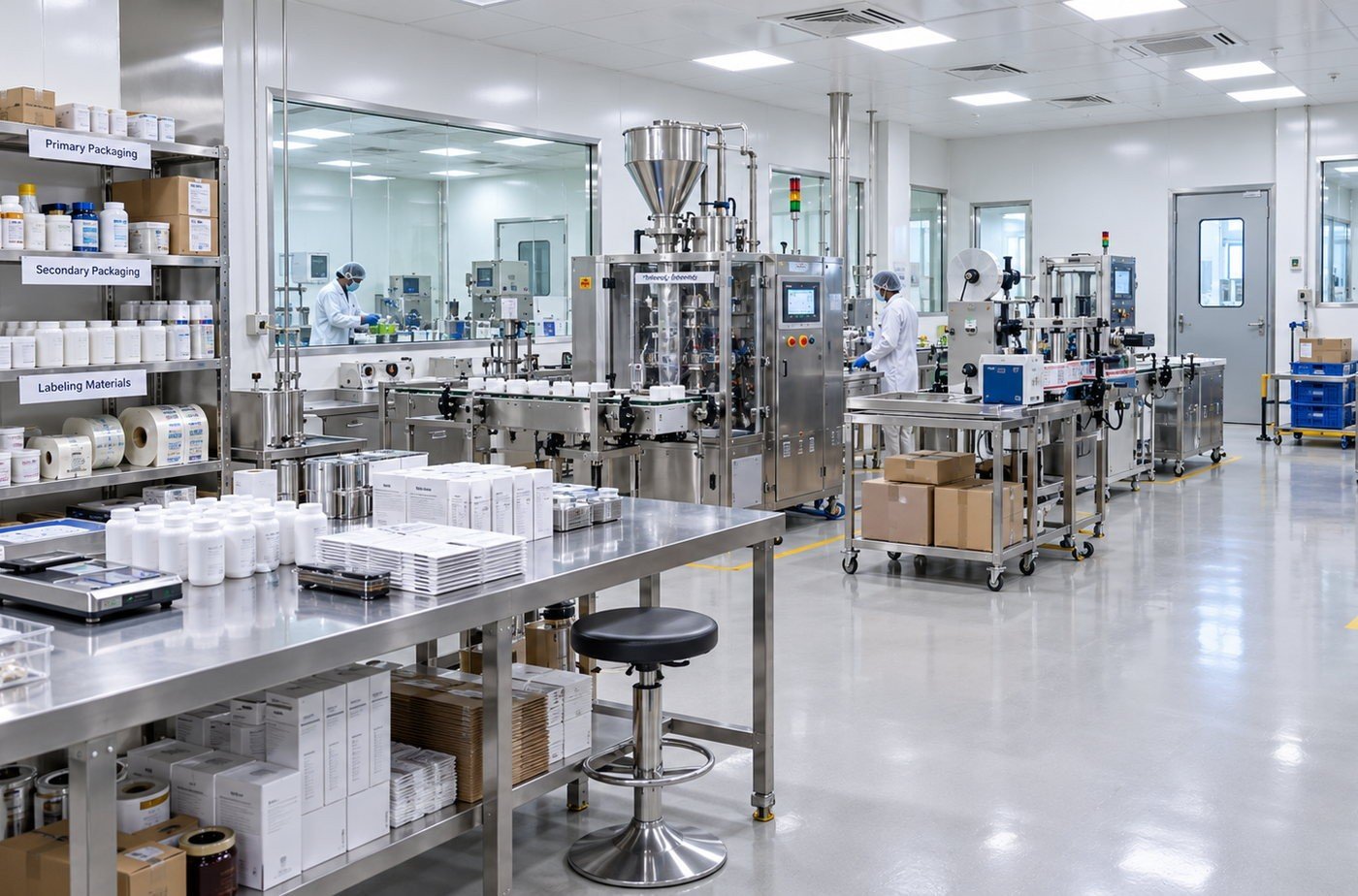
In our experience, packaging MOQs are often the highest. A custom-coloured or printed bottle can carry a far larger MOQ than the bulk, leaving a brand with more bottles than product.
03Worked example: cost per unit
Take a 50 ml face serum with a fixed set-up cost of 6,000 per batch (mixing, filling set-up, QC release, line clearance) and a variable cost of 1.80 per unit for bulk, pack and filling. These are illustrative units, not prices.
| Batch size | Fixed cost per unit | Variable cost per unit | Total cost per unit |
|---|---|---|---|
| 1,000 | 6.00 | 1.80 | 7.80 |
| 3,000 | 2.00 | 1.80 | 3.80 |
| 10,000 | 0.60 | 1.80 | 2.40 |
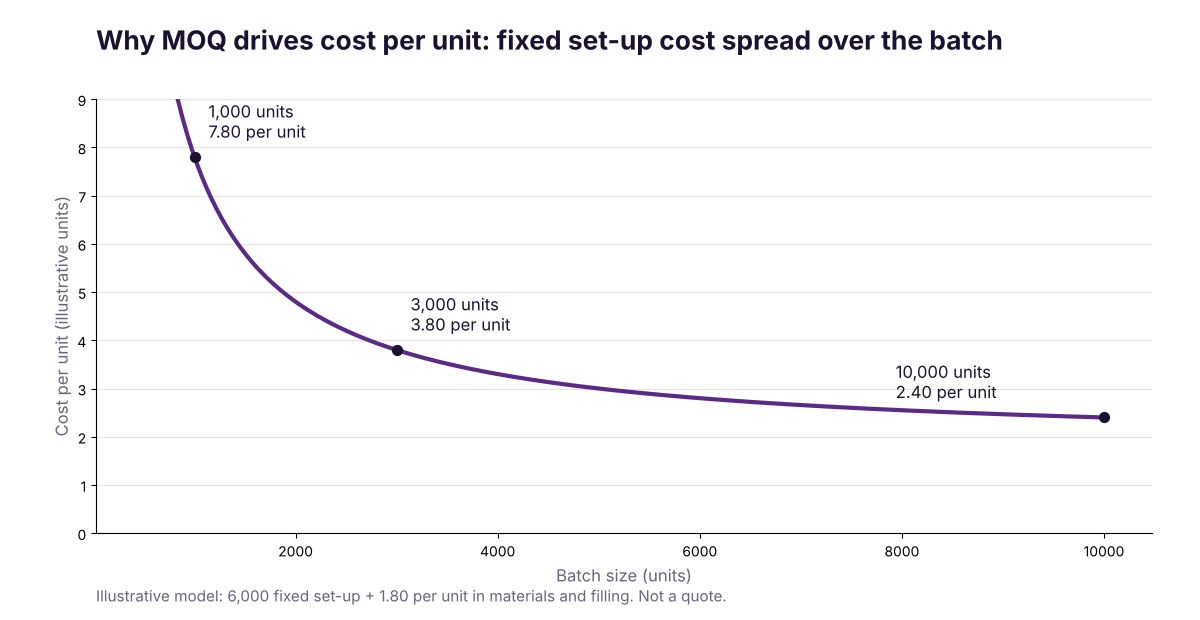
Ordering 10,000 units cuts cost per unit by about 69% compared with 1,000. But if you sell only 3,000 within the shelf life, the extra stock ties up working capital and may expire. That is inventory risk. The classic economic order quantity model balances set-up cost against holding cost [1]; for a launch, holding cost should include the chance that the formula, shade or claim changes.
04How to negotiate MOQ: six levers
- Stock packaging.
Use a stock bottle with a label or sleeve instead of custom moulds.
- Shared bulk.
Fill one bulk into several sizes or shades so the batch is bigger than any single SKU.
- Annual commitment.
Agree a yearly volume released in smaller call-offs.
- Staged pricing.
Accept a higher unit price on the first order, with a reduction at reorder.
- Raw material repacks.
Ask suppliers for repack sizes, or buy through a partner that holds stock.
- Realistic timing.
Avoid rush slots, which in our experience carry higher MOQs.
05Micro-batch or full MOQ?
| Route | Typical size | Best for | Trade-off |
|---|---|---|---|
| Micro-batch | Hundreds to a few thousand units | Market tests and first launches | Higher cost per unit |
| Full contract manufacturing | Set by the factory, often several thousand | Proven products with steady sales | More cash and stock risk |
Check the pack has passed its packaging compatibility test before committing either way. Then see how the whole process plays out in our brief-to-pilot-batch worked example.
Ready to plan your first batch?
CSL makes small batches sized to your requirement, then hands over a tech-transfer pack so any contract manufacturer can scale up. Our sourcing team buys raw materials in small and repack sizes.
06Questions readers ask
What is a minimum order quantity in cosmetics?
It is the smallest order a manufacturer, packaging supplier or raw material supplier will accept. For a finished product, the highest of those MOQs sets your first batch size.
Is MOQ per SKU or per batch?
It depends on the supplier. Ask whether the MOQ applies per SKU, per bulk batch or per order, and which component sets it.
Do labels for different markets change my MOQ?
Yes. If you sell in India, the UK and the US with different labels, one batch splits into smaller SKUs. A shared multi-market label, where each market's labelling rules allow it, keeps volumes up.
07References
- Harris FW. How many parts to make at once. Factory, The Magazine of Management. 1913;10(2):135–6, 152. Reprinted in: Oper Res. 1990;38(6):947–50. doi:10.1287/opre.38.6.947
- International Organization for Standardization. ISO 22716:2007. Cosmetics — Good Manufacturing Practices (GMP) — Guidelines on Good Manufacturing Practices. Geneva: ISO; 2007 (confirmed 2022). iso.org
- Regulation (EC) No 1223/2009 of the European Parliament and of the Council of 30 November 2009 on cosmetic products, Article 19(1)(e). Off J Eur Union. 2009;L342:59–209. eur-lex.europa.eu
Update log
- Published by Cosmetic Science Lab
This article is general technical information, not legal, regulatory or medical advice. Confirm requirements for your product and market before launch.