Cocamidopropyl betaine (CAPB) in body wash and baby care: sensitive-skin safety and limits
Cocamidopropyl betaine (CAPB) is a mild, coconut-derived surfactant used in body wash, shampoo and baby care. It is also a known contact allergen, and impurities from manufacture are thought to drive much of the risk. Here is what the evidence shows and how to use it in sensitive-skin products. Part of our cosmetic product development process series.
By Dr. Premalatha, Ph.D., Life Science, Regulatory Consultant, Cosmetic Science Lab · Reviewed by Shreya Rangarajan
At a glance
- What it is
- Amphoteric (zwitterionic) surfactant; INCI Cocamidopropyl Betaine; CAS 61789-40-0 (also 70851-07-9) [5]
- Main benefits
- Secondary surfactant, foam booster and viscosity builder; milder cleansing alongside SLS or SLES
- Levels used
- Supplied mainly as a solution of about 30% active with 4.6–5.6% sodium chloride [5]; use concentrations by product type are in the CIR report [1]
- Time to results
- Works on contact as a cleanser; no build-up period
01What is it?
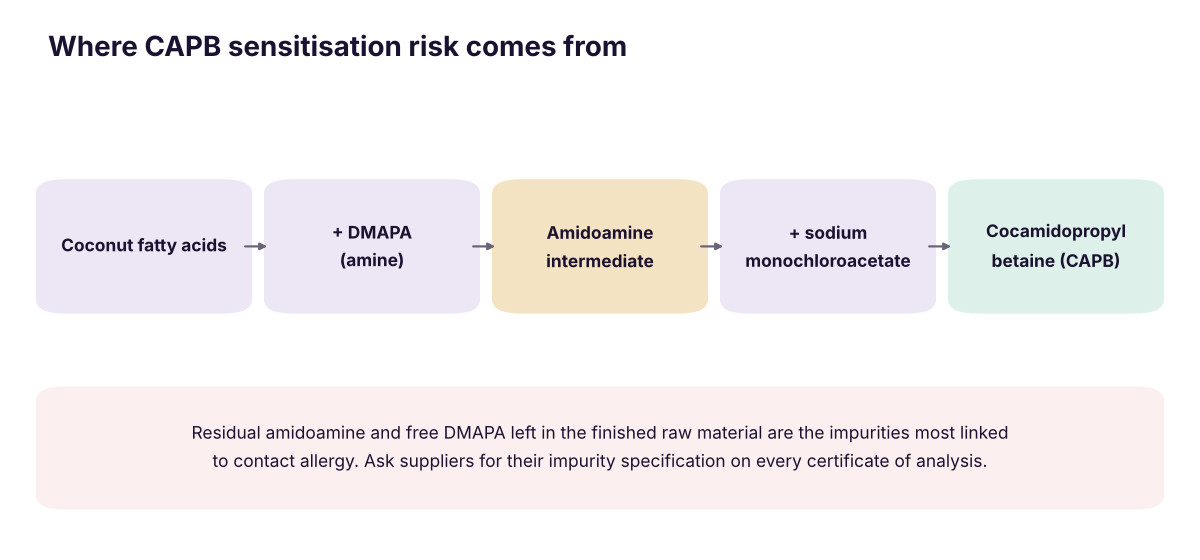
Cocamidopropyl betaine (CAPB) is made by reacting coconut or palm kernel fatty acids with dimethylaminopropylamine (DMAPA) to form an amidoamine, which is then reacted with sodium monochloroacetate to form the betaine [5]. It is sold as a pale aqueous solution that contains sodium chloride left over from manufacture [5].
02What it does
CAPB is rarely the only surfactant. In CSL's formulation practice, paired with a primary anionic surfactant such as sodium lauryl sulfate, it reduces irritation, stabilises foam and builds viscosity with salt. Because it is amphoteric, its charge shifts with pH, which suits the mildly acidic pH most cleansers target. In sulfate-free systems it pairs with glucosides, isethionates and amino acid surfactants.
03The evidence
Studies below were checked against the publisher, DOI or journal record on 5 Nov 2026.
| Study | Design | Who and how long | What it found |
|---|---|---|---|
| Burnett et al. 2012, International Journal of Toxicology [1] | Cosmetic Ingredient Review (CIR) safety assessment | Published and industry data across cosmetic uses | No other significant toxicity apart from sensitisation; safe when formulated to be non-sensitising, which may be based on a quantitative risk assessment |
| Jacob & Amini 2008, Dermatitis [2] | Narrative review of patch-test data | Patch-tested populations in published reports | Sensitisation estimated at 3.0% to 7.2%; amidoamine and DMAPA impurities thought to play a role; American Contact Dermatitis Society Allergen of the Year 2004 |
| Hervella et al. 2006, Actas Dermo-Sifiliográficas [3] | Case series (Spanish) | 3 patients with contact allergy | All reacted to DMAPA and none to purified CAPB, suggesting DMAPA is the main allergen |
That supports controlling impurities at the raw-material stage. Allergic contact dermatitis to CAPB usually shows as itchy, red patches where the product touches the skin, commonly the face (including the eyelids) and hands. Dermatologists confirm it by patch testing, and people who react are advised to avoid products that contain it [6].
CAPB is a safe, effective secondary surfactant for most users. The allergy risk is real but largely controllable through raw-material purity, so the decision is which grade you buy, not whether to use it.
04How CSL formulation scientists use it
- Specify low-amidoamine, low-DMAPA grades and ask for impurity data on every certificate of analysis (see raw material specs and CoA).
- Allow for the salt already in the CAPB solution before building viscosity, and plot a salt curve.
- Check whether the grade contains a preservative and account for it in the preservative system.
- In body wash and baby care, keep total surfactant low and pair CAPB with a very mild primary surfactant to reduce eye sting.
- "Hypoallergenic" and "tear-free" have no legal definition, so substantiate them: a patch test or HRIPT for the first, and in-vitro eye irritation methods (such as OECD TG 437 or 492) for the second.
05Regulatory and claims
In the EU, and in Great Britain under the retained UK Cosmetics Regulation, CAPB is not listed in the restricted annexes of Regulation (EC) 1223/2009, so no fixed maximum applies. Annex I does require the safety report to cover the purity of each ingredient and relevant impurities [4]. In the US, the CIR conclusion (an industry-funded expert panel, not an FDA rule) supports use in products formulated to be non-sensitising [1], and under MoCRA the responsible person must keep records supporting adequate safety substantiation [7]. India sets no CAPB-specific limit under the Cosmetics Rules, 2020; imports need CDSCO registration and local manufacture needs a state licence. In the GCC, products follow the general safety requirements of GSO 1943:2024, and halal claims are certified against GSO 2055-4:2021, which includes checking the source of raw materials. CSL confirms the status in each target market before launch.
Used in: Body wash & body careBaby & kidsSensitive skin
06Questions brands ask
Is cocamidopropyl betaine safe?
Yes, for most people at normal use levels. The CIR panel found no other significant toxicity apart from sensitisation and considers it safe when formulated to be non-sensitising [1].
Is CAPB natural?
It is made from coconut or palm kernel fatty acids but synthesised with DMAPA, so it is coconut-derived rather than natural in the strict sense.
Is CAPB the same as coco betaine?
No. Coco betaine has no amidopropyl link and is made without DMAPA. CIR assessed it separately with the other alkyl betaines [8].
Can I use CAPB in a sulfate-free shampoo?
Yes. It is widely used as a secondary surfactant in sulfate-free systems.
Next in this series: how cosmetic formulation software screens ingredients like CAPB. Back to what a cosmetic chemist does.
07References
- Burnett CL, Bergfeld WF, Belsito DV, Hill RA, Klaassen CD, Liebler D, et al. Final report of the Cosmetic Ingredient Review Expert Panel on the safety assessment of cocamidopropyl betaine (CAPB). Int J Toxicol. 2012;31(4 Suppl):77S–111S. doi:10.1177/1091581812447202
- Jacob SE, Amini S. Cocamidopropyl betaine. Dermatitis. 2008;19(3):157–60. PMID: 18627690. PubMed
- Hervella M, Yanguas JI, Iglesias ME, Larrea M, Ros C, Gallego M. Alergia de contacto a 3-dimetilaminopropilamina y cocamidopropil betaína [Contact allergy to 3-dimethylaminopropylamine and cocamidopropyl betaine]. Actas Dermosifiliogr. 2006;97(3):189–95. Spanish. PMID: 16796966. PubMed
- Regulation (EC) No 1223/2009 of the European Parliament and of the Council of 30 November 2009 on cosmetic products, Annex I, Part A. Off J Eur Union. 2009;L342:59–209. eur-lex.europa.eu
- HERA. Human and Environmental Risk Assessment on ingredients of household cleaning products: Cocamidopropyl betaine (CAPB). heraproject.com
- DermNet. Contact allergy to cocamidopropyl betaine. dermnetnz.org
- US Food and Drug Administration. Modernization of Cosmetics Regulation Act of 2022 (MoCRA). Updated 29 Oct 2026 [cited 2026 Nov 5]. fda.gov
- Burnett CL, Bergfeld WF, Belsito DV, Hill RA, Klaassen CD, Liebler DC, et al. Safety assessment of alkyl betaines as used in cosmetics. Int J Toxicol. 2018;37(1 Suppl):28S–46S. doi:10.1177/1091581818773354
Update log
- Evidence reviewed and page published by CSL scientists