Product development timeline: brief to pilot batch for a brightening skin care serum
A skin care startup needs a brightening serum taken from brief to pilot batch for launch in the EU and the Gulf. This worked example shows the product development timeline stage by stage, using the stage timings CSL publishes for every project. Part of our cosmetic product development process series.
By Dr. Premalatha, Ph.D., Life Science, Regulatory Consultant, Cosmetic Science Lab · Reviewed by Shreya Rangarajan
Worked example. An illustrative project built on the stage timings CSL publishes on How we work. It is not a specific client, and the figures are illustrative.
Project snapshot
- Client
- Skin care startup (worked example)
- Product
- Brightening serum, benchmarked against a vitamin C serum
- Result
- About 31 weeks from brief to pilot batch
Quick answer
- A typical product development timeline for a skin care serum runs 21 to 36 weeks from brief to pilot batch [1]; this worked example takes about 31.
- Stability in the final pack is the longest stage, so it starts as soon as the first prototype exists.
- Claims, safety work and regulatory files run alongside testing rather than after it.
- Fixing markets, claims and pack in the brief is what keeps the timeline from slipping.
01What the client wanted
A lightweight serum for dullness and uneven tone, with a similar texture to the benchmark but less colour change over shelf life. The brand wanted a "dermatologically tested" claim, halal-compatible raw materials for the GCC, and a fixed launch window. The founders also wanted to keep ownership of the formula so they could move to a larger contract manufacturer once sales were proven.
02Brightening actives are the easy part
The actives themselves were well understood. The difficulty was making them behave in one formula, one pack and two regulatory systems at the same time, inside a fixed window.
- Vitamin C and some of its derivatives can discolour as they oxidise, especially alongside niacinamide.
- Brightening actives can irritate sensitive skin.
- Claim rules differ between the EU, which sets common criteria for claims [5], and each GCC country.
- One testing programme had to support files for both markets.
- An airless pack protects the actives but raises packaging MOQs.
03Seven stages, overlapped where the data allowed
CSL's published process has seven stages [1]. Here they are grouped into five phases, with later stages starting as soon as early data allowed rather than waiting for each to finish.
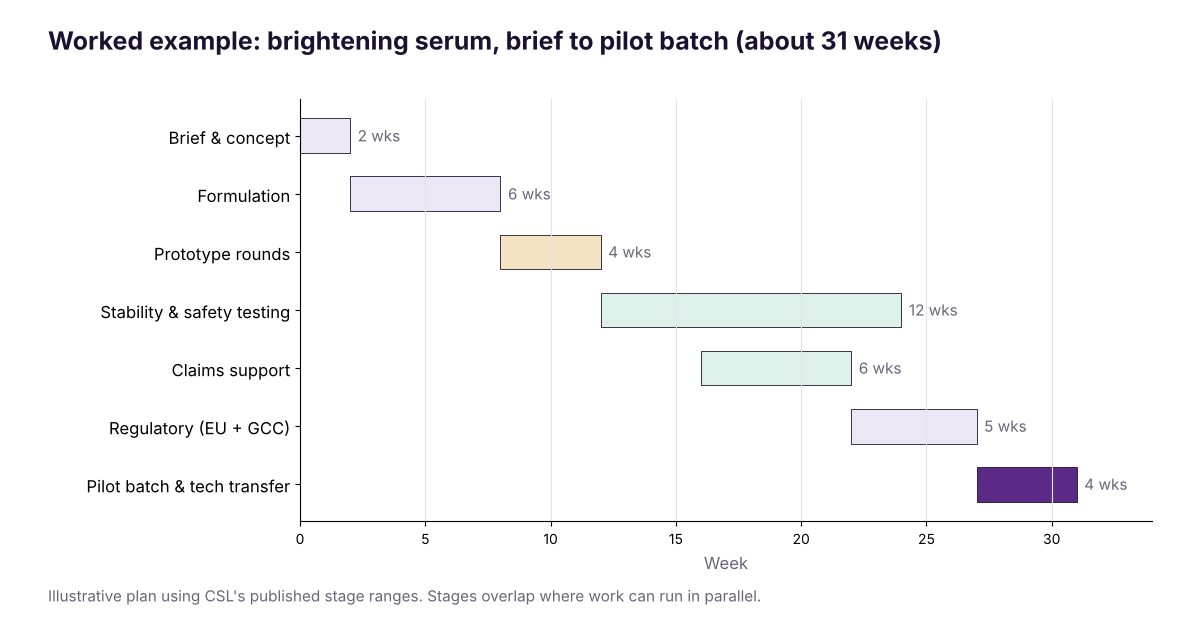
- Brief and formulate (weeks 1–8).
Benchmark, markets and claims fixed in the brief by a cosmetic chemist; every INCI screened against EU and GCC lists with formulation software, and each raw material assessed in depth, as in our CAPB monograph.
- Prototype (weeks 9–12).
Three sample rounds to refine texture and finish. In our projects, each extra round adds two to three weeks.
- Test in the final pack (weeks 13–24).
Accelerated and real-time stability in the airless pack from the first round [4], a packaging compatibility test, and a 28-day preservative challenge test [2].
- Claims and regulatory (weeks 17–27).
Patch testing for the claim, then the EU safety report, which draws on stability and microbiology data [3]; here the patch-test results also support the safety assessor's conclusion and the claim. Registration files for the two target GCC countries, with Arabic label review.
- Pilot and transfer (weeks 28–31).
A micro-batch for launch and a tech-transfer pack, avoiding a full-scale MOQ before sales data existed.
04A launch-ready serum, filed for two markets
| Measure | Prototype 1 | Final lab formula |
|---|---|---|
| Colour after 3 months at 40 °C | Visible yellowing | No visible change vs control |
| pH drift at 40 °C | More than 0.5 | Within ±0.2 |
| Panel preference for texture | 4 of 10 | 8 of 10 |
A stronger antioxidant system and a lower pH slowed colour change, and a lighter emollient lifted the texture score. The pH was kept in a range that also suits niacinamide, which can convert to nicotinic acid, a cause of flushing, if the pH is too low. Because testing ran in the final pack from the start, the airless pack was approved without a late change. Stability on the pilot batch itself continues after launch.
What the client received
- Formula and specification. Owned by the client, with full INCI and process notes.
- Stability and safety data. Final-pack stability, challenge test and patch-test results.
- Regulatory files. EU safety report and registration files for the two GCC countries.
- Pilot batch and tech-transfer pack. Ready for any contract manufacturer (tech transfer and scale-up).
05Lessons for your own product development timeline
- Fix markets and claims in the brief.
They decide the test plan, so changing them later means repeating work.
- Test in the final pack from day one.
Each pack type needs its own stability data [4], so switching pack after stability would in practice have meant repeating the programme.
- Plan for an extra prototype round.
In our projects, one extra sample round is common. Building two to three weeks of slack into the plan protects the launch date.
- Start with a pilot batch.
Real sales data comes before a full-scale order, and the tech-transfer pack keeps the brand free to choose a manufacturer.
Every project differs: a simple rinse-off product can move faster, while a new active, a clinical claim or extra markets will add time. Each stage links to a guide in this series: cosmetic chemist, cocamidopropyl betaine, formulation software, packaging compatibility test and minimum order quantity.
Plan a product of your own
We run the same seven stages for every project and give you dates for your product in the proposal.
06Questions readers ask
How long does it take to develop a skin care product?
A full project typically takes 21 to 36 weeks from brief to pilot batch, and less if you already have a formula [1]. Stability testing in the final pack is usually the longest stage.
Can stages run in parallel?
Yes. Claims work and regulatory files can start while stability is running, which is how this example fits inside 31 weeks.
07References
- Cosmetic Science Lab. How we work: seven stages, concept to shelf (CSL's published typical stage ranges). cosmeticsciencelab.com/process
- International Organization for Standardization. ISO 11930:2019. Cosmetics — Microbiology — Evaluation of the antimicrobial protection of a cosmetic product. 2nd ed. Geneva: ISO; 2019. Amended by ISO 11930:2019/Amd 1:2022. iso.org
- Commission Implementing Decision 2013/674/EU of 25 November 2013 on Guidelines on Annex I to Regulation (EC) No 1223/2009 on cosmetic products. Off J Eur Union. 2013;L315:82. eur-lex.europa.eu
- Cosmetics Europe, CTFA. Guidelines on stability testing of cosmetic products. Brussels: Cosmetics Europe; 2004 Mar. cosmeticseurope.eu
- Commission Regulation (EU) No 655/2013 of 10 July 2013 laying down common criteria for the justification of claims used in relation to cosmetic products. Off J Eur Union. 2013;L190:31–4. eur-lex.europa.eu
Update log
- Published by Cosmetic Science Lab
This article is general technical information, not legal, regulatory or medical advice. Confirm requirements for your product and market before launch.