Cosmetic chemist: when anti-ageing and acne skin care brands need one
US labour data puts the median chemist’s wage at $91,240 and projects 6% job growth to 2035. Here is what a cosmetic chemist does, how to become one, and when a skin care brand should hire one, contract one or use an external lab. Part of our cosmetic product development process series.
By Dr. Premalatha, Ph.D., Life Science, Regulatory Consultant, Cosmetic Science Lab · Reviewed by Shreya Rangarajan

The data behind this article
- Source
- U.S. Bureau of Labor Statistics, Occupational Outlook Handbook [1]
- Population
- Chemists employed in the US, all industries (about 84,900 jobs in 2025)
- Design
- National wage and employment statistics with 10-year projections
- Key finding
- Median annual wage $91,240 (May 2025); employment of chemists projected to grow 6% from 2025 to 2035
- Entry route
- At least a bachelor's degree in chemistry or a related field
- Funding
- Public data, US federal government
Quick answer
- A cosmetic chemist, or formulation chemist, designs formulas that are stable, safe and legal in each target market.
- Most roles need at least a bachelor's degree in chemistry or a related field [1]; in our experience many chemists start in lab or quality-control roles.
- In our view, anti-ageing and acne products need a chemist early, because actives, pH and claims interact.
- Startups selling in several markets often get more from an external lab than from one in-house hire.
Take-home message for formulators
Take-home message for brand owners
- Decide how you will engage a chemist before you write the brief.
- Ask every partner who owns the formula and which tests are included.
01What the data found
BLS reports a median annual wage of $91,240 for chemists in May 2025 and projects employment of chemists to grow 6% from 2025 to 2035 [1]. It lists a bachelor's degree in chemistry or a related field as the typical entry-level education, with some research roles requiring a master's or PhD [1]. The Society of Cosmetic Chemists (SCC) adds education courses, webinars, mentoring and 19 local chapters across North America for people moving into cosmetic science [2].
02What the data did not show
- Cosmetic-specific pay. The figures cover chemists in every industry, not cosmetic roles alone.
- Markets outside the US. Pay and demand differ in the UK, EU and India.
- Consultant or lab costs. The data says nothing about the cost of contracting a chemist.
- Skills. Analytical skills, research skills and raw-material knowledge matter as much as the degree, but are not measured.
03What a cosmetic chemist does
Cosmetic chemist and formulation chemist are often used interchangeably. In a typical week the role covers:
- Building and adjusting formulas in R&D, from benchtop prototypes to scale-up batches
- Choosing raw materials and checking supplier specifications
- Planning stability work and reviewing results with quality control
- Checking each ingredient against the regulatory rules of every target market
Regulatory duties have expanded. In the EU, every product needs a safety report signed by a qualified safety assessor [3], following the Commission's guidelines [4]. In the US, MoCRA (2022) requires the responsible person to keep records that support adequate safety substantiation [5].
04Anti-ageing and acne: where formulation gets hard
In our formulation practice, retinoids, vitamin C and exfoliating acids can be unstable or irritating at the wrong pH or level. Acne claims can also move a product across the cosmetic–drug boundary in markets such as the US, where acne medications are regulated as over-the-counter drugs [6]. Our anti-ageing and acne and oil control pages show the actives and tests involved.
05How to become a cosmetic chemist
Most roles start with at least a bachelor's degree in chemistry or a related field [1]. In our experience, the usual path is then an entry-level role as a lab technician or in quality control, followed by a move into product development. SCC education courses, webinars and chapter events offer cosmetic-specific training on top of a chemistry degree [2].
06When should a startup use an external lab?
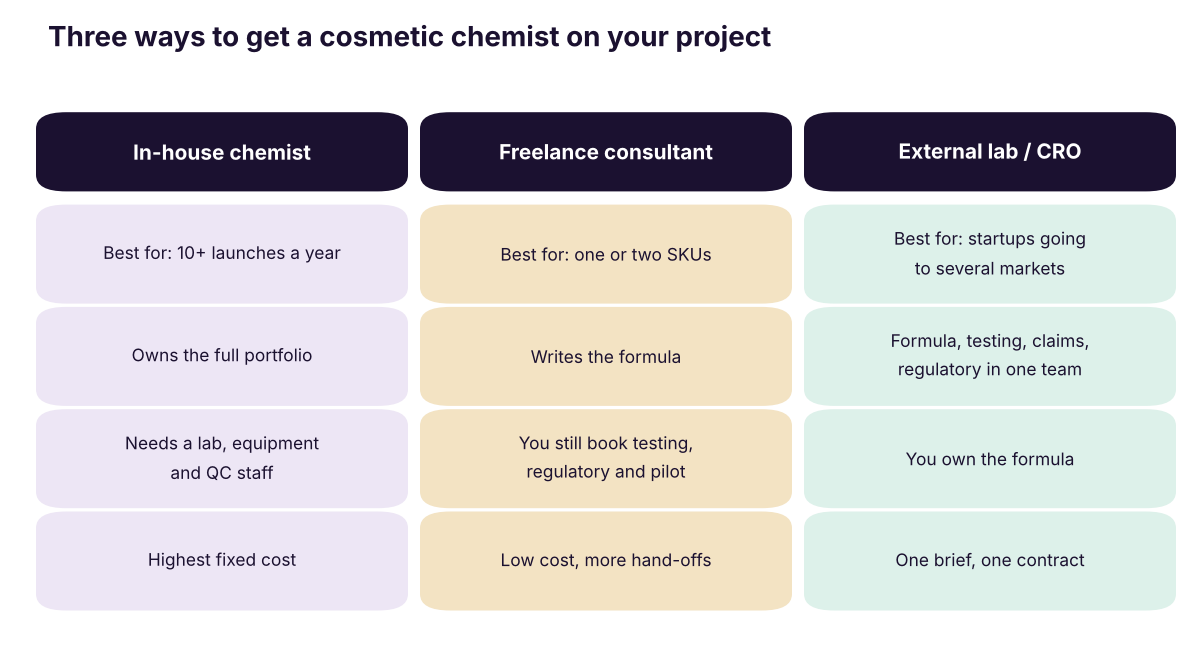
| Model | Best for | Watch out for |
|---|---|---|
| In-house chemist | Brands launching ten or more products a year | Lab, equipment and QC costs |
| Freelance consultant | One or two products in a single market | You manage testing, regulatory and manufacturing separately |
| External lab or CRO | Startups selling into several markets | Choose a partner that hands over the formula |
An external lab usually makes sense when you need testing as well as a formula, plan to sell in more than one market such as the EU, US and India, or want to own the formula and move to any contract manufacturer. In our experience, many brands start external and hire in-house once they have a steady pipeline. The chemist's next decision is which ingredients to use, as our cocamidopropyl betaine monograph shows.
07For brands and formulators
A chemist turns a brief into a formula you can test, file and manufacture. Engage one before the brief is final, not after the first samples disappoint.
Need a cosmetic chemist on your project?
CSL formulation chemists build new formulas, reformulate products and match benchmarks for skin, hair and personal care brands, and hand over the formula and its documentation.
08Questions readers ask
What does a cosmetic chemist do?
They design and adjust formulas, choose raw materials, plan stability work and check every ingredient against the rules of each target market.
How much does a chemist earn in the US?
The BLS median annual wage for chemists across all industries was $91,240 in May 2025 [1]. It does not publish a cosmetic-specific figure.
Should a startup hire a cosmetic chemist or use a lab?
For one or two products, a consultant or external lab is usually cheaper than a hire. An in-house chemist pays off once you launch many products a year.
09References
- U.S. Bureau of Labor Statistics. Chemists and materials scientists. In: Occupational Outlook Handbook. Washington (DC): BLS; last modified 27 Aug 2026 [cited 2026 Nov 5]. bls.gov
- Society of Cosmetic Chemists. Careers in cosmetic chemistry [brochure]. New York: SCC; 2020 [cited 2026 Nov 5]. scconline.org
- Regulation (EC) No 1223/2009 of the European Parliament and of the Council of 30 November 2009 on cosmetic products, Article 10 and Annex I. Off J Eur Union. 2009;L342:59–209. eur-lex.europa.eu
- Commission Implementing Decision 2013/674/EU of 25 November 2013 on Guidelines on Annex I to Regulation (EC) No 1223/2009 on cosmetic products. Off J Eur Union. 2013;L315:82. eur-lex.europa.eu
- US Food and Drug Administration. Modernization of Cosmetics Regulation Act of 2022 (MoCRA). Updated 29 Oct 2026 [cited 2026 Nov 5]. fda.gov
- US Food and Drug Administration. Is it a cosmetic, a drug, or both? (Or is it soap?). fda.gov
Update log
- Published by Cosmetic Science Lab
This article is general technical information, not legal, regulatory or medical advice. Confirm requirements for your product and market before launch.