Cosmetic formulation software: what AI can and can't predict in skin and sun care
Formulation software now promises to predict stability and sensory feel before a sample is made. We reviewed the published evidence and labelled each source honestly, so skin care and sun care brands know what AI can do today and where lab validation stays essential. Part of our cosmetic product development process series.
By Dr. Premalatha, Ph.D., Life Science, Regulatory Consultant, Cosmetic Science Lab · Reviewed by Shreya Rangarajan
Quick answer
- Cosmetic formulation software is strongest at rules and past data: regulatory screening, ingredient databases and choosing which samples to make.
- The best published test so far is one computational study on simple shampoos, where a large language model needed about half the training data of conventional machine learning [1].
- Ask any vendor what the model was trained on, how it was validated and how accurate it is in your sector.
01How we chose what we cite
- Peer-reviewed first. Published comparisons rank above vendor claims.
- Traceable. Every entry links to its DOI or the issuing body.
- Labelled honestly. Reviews, ISO reports, guidelines and supplier sources are marked as such.
- Method evidence is not product evidence. A model that works on shampoo is not proof it works on your serum.
02The claim
Software vendors and ingredient suppliers describe AI-powered formulation tools that suggest ingredient combinations, predict stability and flag regulatory problems before a sample is made [3]. In our experience, ingredient databases, which link INCI names to suppliers, specifications and regulatory status, are the foundation most tools build on, and rule-based regulatory screening is routine. Predictive modelling of how a formula will behave is newer, and the evidence is thinner.
03The evidence
Sources below were checked against the publisher, DOI or issuing body on 5 Nov 2026. More published trials are in our evidence library.
Large language models vs conventional machine learning for shampoo phase stability
Computational study · 812 four-ingredient shampoo formulations (294 stable) · 10 to 100 training samples
Llama 3 70B matched logistic regression and random forest with about half the training samples, and reached AUC above 0.7 from 20 samples. With ingredient names replaced by codes it fell below conventional machine learning. Single, simple product type.
Artificial intelligence in the design of emulsified cosmetics
Narrative review · published literature
Maps how AI is being applied to emulsion product design. Describes the field; does not test any single tool.
AI-modelled emollient selection by sensory profile
Supplier tool · supplier's own data, not peer-reviewed
Calculates emollient mixes to match a sensory and physico-chemical target, for example to replace silicones or mineral oil.
Guidelines on stability testing of cosmetic products
ISO/TR 18811:2018 · guidance, not a normative standard
Does not set fixed conditions or acceptance criteria; each manufacturer specifies and justifies its own stability protocol.
Stability testing in the final packaging
Industry guideline · Cosmetics Europe and CTFA
Recommends testing in packaging of exactly the same materials as the marketed product, with controls such as product in glass, and studying each pack type separately.
These are published studies and guidelines on methods and tools, not on products we have made.
04What it means for skin and sun care
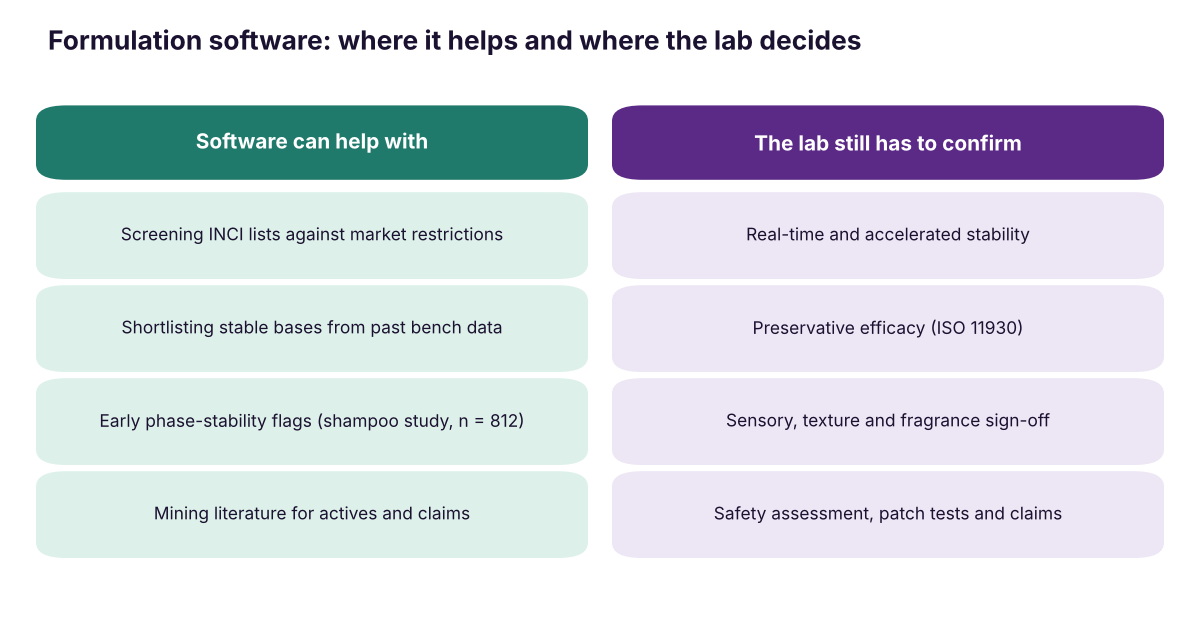
Software is strongest where the problem is rules or past data: regulatory screening against EU, US, India and GCC lists, ingredient databases, and shortlisting bases from your own bench trials. It is weakest where the answer depends on physical testing: stability in the final pack, preservative efficacy, sensory feel, and SPF and UVA protection. In sun care, treat any predicted SPF figure as a screening estimate only; pack claims must rest on results measured by a recognised method such as ISO 24444 or, where accepted, the newer ISO 23675 in-vitro method [6].
05How to bring formulation software into R&D
- Start with regulatory screening.
In our experience it is the lowest-risk place to start, with the clearest payback.
- Record every bench trial.
Log INCI, percentages, process and stability outcome, including failures.
- Use predictive modelling to choose samples.
Let the model pick which samples to make, then make them.
- Check predictions against the lab.
Compare after each round, and retrain or drop the model if it doesn't improve.
Failures matter as much as successes: the shampoo dataset included 518 unstable formulas, which is what let the models learn where the stability boundary lies [1].
06Questions to ask a software vendor
Before you pay for a tool, get clear written answers to three questions. A credible vendor should be able to answer all three in writing:
- What data was the AI model trained on, and does it include formulas like yours?
- How was it validated, and against which lab results?
- What accuracy did it reach on products in your sector, and how often is it retrained?
Sensory prediction tools, such as supplier emollient selectors [3], narrow the choice. In our practice, a trained sensory panel still confirms skin feel.
Treat cosmetic formulation software as a way to make fewer, better lab samples, not as a replacement for validation. A model trained on shampoo data should not be assumed to work on a mineral sunscreen emulsion. At CSL, AI tools screen ingredients and mine evidence; qualified scientists make every decision and sign every report.
Previously in this series: the cocamidopropyl betaine monograph. Next, once the formula is set it has to survive its pack: read our guide to the cosmetic packaging compatibility test.
Want AI-assisted screening with lab validation?
We use AI-assisted screening alongside bench trials for skin care and sun care, then confirm every result in the lab.
07Questions readers ask
Can AI predict cosmetic formula stability?
Partly. One published study predicted phase stability of simple shampoos from small training sets [1], but no tool replaces stability testing in the final pack [4][5].
Can software predict SPF?
It can give a screening estimate. The SPF on the pack must come from a recognised measurement method [6].
08References
- Bigan E, Dufour S. Prediction of shampoo formulation phase stability using large language models. Cosmetics. 2025;12(4):145. doi:10.3390/cosmetics12040145
- Solarte S, Porras A, Pradilla D, Alvarez Solano OA. Current perspectives on emulsified cosmetics: integration of artificial intelligence into product design. ACS Omega. 2025;10(33):36788–803. PMID: 40893291. doi:10.1021/acsomega.5c03316
- BASF SE. BASF sets a new standard for efficient product development of sustainable cosmetics with the launch of Emollient Maestro [news release P-22-144]. Ludwigshafen: BASF; 2022 Feb 17. basf.com
- International Organization for Standardization. ISO/TR 18811:2018. Cosmetics — Guidelines on the stability testing of cosmetic products. Geneva: ISO; 2018. iso.org
- Cosmetics Europe, CTFA. Guidelines on stability testing of cosmetic products. Brussels: Cosmetics Europe; 2004 Mar. cosmeticseurope.eu
- CTPA. ISO publishes new SPF test methods (ISO 23675:2024 in vitro and ISO 23698:2024 HDRS; ISO 24444:2019 in vivo). ctpa.org.uk
Update log
- Published by Cosmetic Science Lab
This article is general technical information, not legal, regulatory or medical advice. Confirm requirements for your product and market before launch.