Cosmetic packaging compatibility test for SPF and sun care: what to check before ordering
How to check that an SPF lotion and its bottle, tube or pump stay compatible for the whole shelf life: the tests, the conditions and how common packs compare. Part of our cosmetic product development process series.
By Dr. Premalatha, Ph.D., Life Science, Regulatory Consultant, Cosmetic Science Lab · Reviewed by Shreya Rangarajan
At a glance
- Key references
- ISO/TR 18811, Cosmetics Europe stability guidelines
- Covers
- Weight loss, paneling, stress cracking, pump function, extractables
- For
- Formulators, packaging and brand teams
Quick answer
- A cosmetic packaging compatibility test stores the product in its final pack, closure and pump, alongside a glass control [1].
- Core checks are weight loss, paneling, stress cracking, pump function and extractables.
- Treat any change of resin, supplier or recycled content as a new pack and retest.
Take-home message for formulators
- Oils and UV filters are frequent culprits [6].
- Start compatibility work with the first stability round, not after it.
Take-home message for brand owners
- Don't sign a packaging order until the compatibility results are in.
- A failed pack after 10,000 units is one of the most expensive mistakes a launch can make.
01How is a cosmetic packaging compatibility test done?
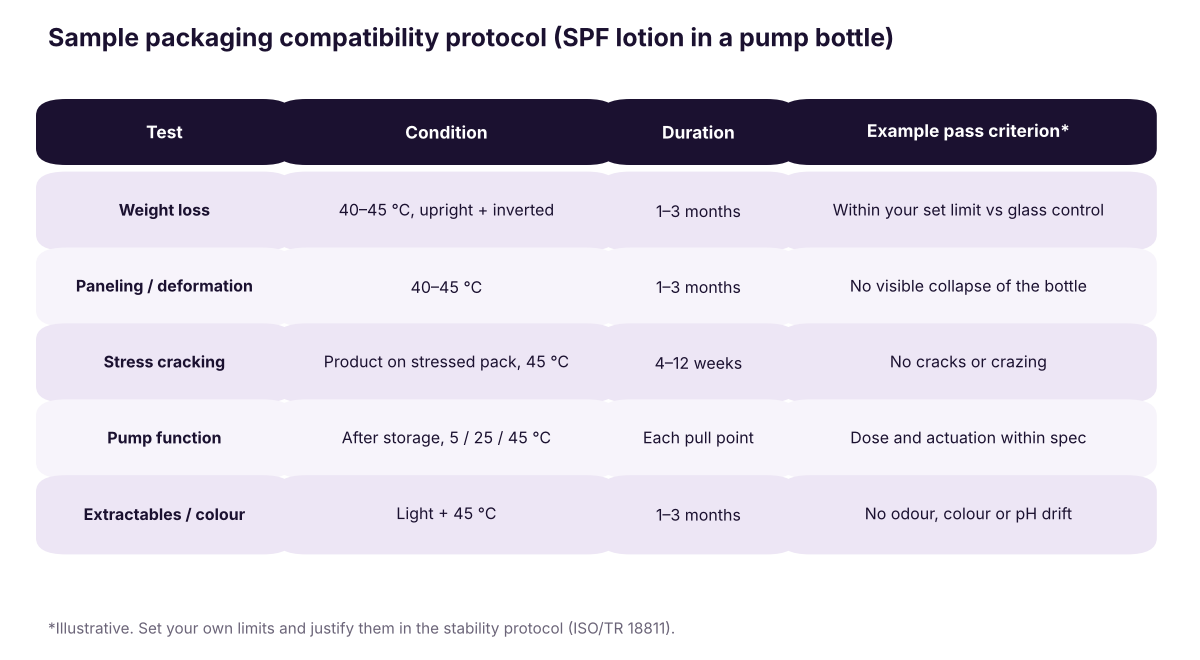
Industry guidelines say stability testing should use packaging made of exactly the same materials as the product on sale, with controls such as product in glass, and storage in several orientations [1]. ISO/TR 18811 does not set fixed conditions or pass criteria, so each brand defines and justifies its own protocol [2]. The protocol below is the kind CSL uses for an SPF lotion; your limits will differ.
| Test | Condition | Duration | What to look for |
|---|---|---|---|
| Weight loss | 40–45 °C, upright and inverted, with a glass control [1] | 1–3 months | Loss within your set limit compared with the control |
| Paneling | 40–45 °C | 1–3 months | No collapse or distortion of the pack |
| Stress cracking | Product on a stressed pack at 45 °C | 4–12 weeks | No cracks or crazing |
| Pump function | After storage at 5, 25 and 45 °C | Each pull point | Dose and actuation within specification |
| Extractables and appearance | Light exposure [1] and 45 °C | 1–3 months | No change in odour, colour or pH |
02Why compatibility matters for SPF and sun care
Sunscreens carry UV filters, emollients and sometimes alcohol, and they get left in hot cars and beach bags. The container can interact with the product through adsorption, corrosion, chemical reaction and migration [1]. In the EU, and in Great Britain under the retained UK Regulation, the safety report must cover the purity and stability of the packaging material [4][7], and the Commission guidelines add possible migration from the packaging [5]. The common failures are:
- Absorption and stress cracking. UV filters and preservatives can be absorbed into polyethylene bottles and change their mechanical properties [6].
- Water loss through thin walls, which concentrates the formula [1].
- Pumps clogging or under-dosing as viscosity changes with heat (CSL experience).
- Zinc oxide or titanium dioxide caking at the neck of mineral sunscreen packs (CSL experience).
03PET, HDPE, PP, airless and glass compared
| Material | Strengths | Watch for with SPF | Collection (UK/EU, 2026) |
|---|---|---|---|
| PET / PETG | Clear, rigid, good barrier | Stress cracking with some oils and filters | PET widely collected; PETG less so |
| HDPE and LDPE | Tough, good chemical resistance | Absorption of UV filters and preservatives [6]; weight loss in thin walls | HDPE widely collected |
| PP | Good chemical resistance | Weight loss in thin-walled packs | Collection varies by region |
| Airless pump | Limits air exposure | Piston sticking as viscosity changes | Mixed materials, harder to recycle |
| Glass with pump | Very low interaction; used as the test control [1] | Pump and gasket still at risk; breakable | Glass widely collected |
Switching to recycled or bio-based resin is a common sustainability goal, but for testing purposes it is a new pack. Repeat the key compatibility tests whenever resin, supplier or wall thickness changes. For an unknown pack, start with a packaging material teardown.
04How to read the results
Compare every pack sample with the glass control stored at the same condition. If the control changes too, the problem is likely the formula rather than the pack. Weight loss points to a weak barrier, discolouration near the wall suggests migration or extractables, and a sticking pump points to viscosity or component compatibility. Photograph samples at each pull point, and where results are borderline, extend real-time storage rather than order on accelerated data alone.
05Our recommendation
- Test the final pack, closure and pump, not a lab substitute.
- Test the smallest pack size in its worst orientation.
- Get your supplier to confirm the resin grade won't change after approval.
Only then lock in packaging volumes, which is where minimum order quantities come in. Previously in this series: what cosmetic formulation software can and can't predict.
Test your pack before you order
CSL runs pack compatibility and stability under one protocol, and helps you choose packaging during prototyping.
06Questions readers ask
What is paneling?
Paneling is when the walls of a plastic bottle collapse inwards, usually because volatile ingredients escape or the pack absorbs part of the formula.
How long does a packaging compatibility test take?
Accelerated work commonly runs one to three months, with confirmatory real-time storage continuing alongside it [1].
Do I need to retest if I switch to recycled plastic?
Yes. A different resin, supplier or wall thickness can change the barrier and how the pack interacts with the formula, so treat it as a new pack.
07References
- Cosmetics Europe, CTFA. Guidelines on stability testing of cosmetic products. Brussels: Cosmetics Europe; 2004 Mar. cosmeticseurope.eu
- International Organization for Standardization. ISO/TR 18811:2018. Cosmetics — Guidelines on the stability testing of cosmetic products. Geneva: ISO; 2018. iso.org
- International Organization for Standardization. ISO 22716:2007. Cosmetics — Good Manufacturing Practices (GMP) — Guidelines on Good Manufacturing Practices. Geneva: ISO; 2007 (confirmed 2022). iso.org
- Regulation (EC) No 1223/2009 of the European Parliament and of the Council of 30 November 2009 on cosmetic products, Annex I, Part A, point 4. Off J Eur Union. 2009;L342:59–209. eur-lex.europa.eu
- Commission Implementing Decision 2013/674/EU of 25 November 2013 on Guidelines on Annex I to Regulation (EC) No 1223/2009 on cosmetic products. Off J Eur Union. 2013;L315:82. eur-lex.europa.eu
- Briasco B, Capra P, Mannucci B, Perugini P. Stability study of sunscreens with free and encapsulated UV filters contained in plastic packaging. Pharmaceutics. 2017;9(2):19. doi:10.3390/pharmaceutics9020019
- Regulation (EC) No 1223/2009 as retained in UK law (UK Cosmetics Regulation), Annex I. legislation.gov.uk
Update log
- Published by Cosmetic Science Lab
This article is general technical information, not legal, regulatory or medical advice. Confirm requirements for your product and market before launch.