Why US sunscreens lag Europe: the FDA filter backlog and bemotrizinol
A European sunscreen can use more modern UV filters than a US one because the FDA treats every filter as a drug ingredient. Bemotrizinol, added in June 2026, is the first new US monograph filter since 1999. Here is how the backlog formed, what changed in 2026 and what brands must do. Part of our sun care series.
By Dr. Premalatha, Ph.D., Life Science, Regulatory Consultant, Cosmetic Science Lab

The data behind this article
- Scope
- UV filter rules in the EU, UK, US, India and GCC
- Key finding
- The EU lists more than 25 UV filters; the US monograph has 15 after the 2026 changes. Bemotrizinol, added in June 2026, is the first new US monograph filter since 1999.
- Caveat
- Twelve US filters still await data, and lists change, so check the FDA docket and the EU Official Journal
Quick answer
- In the US, any product with an SPF claim is a drug, and its filters must be on the FDA’s sunscreen monograph.
- In the EU, sunscreen is a cosmetic, and each filter must be on the Annex VI positive list.
- The US added its first new monograph filter since 1999, bemotrizinol, in June 2026, at up to 6% against 10% in the EU [3].
- Most modern European sunscreen filters, such as bisoctrizole, are still not permitted in the US.
Take-home message for formulators
- Build a filter gap table for each target market before you formulate.
- Bemotrizinol now works for the US, but at 6% and not in propellant aerosols, so check your level and format.
Take-home message for brand owners
- Ask your formulator which filters each market allows.
- Plan for two formulas if you sell in both the EU and the US.
01The rule: a drug in the US, a cosmetic in the EU
In the US, any product that claims an SPF is an over-the-counter (OTC) drug, and its filters must be on the FDA’s OTC sunscreen monograph, M020 [4]. In the European Union (EU), sunscreen is a cosmetic under Regulation 1223/2009, and each filter must appear in Annex VI with a maximum concentration [1]. Both systems aim to protect health, but they work differently. In the EU, the Scientific Committee on Consumer Safety reviews a filter’s dossier and advises the Commission [5]. In the US, the FDA must amend the monograph, which has proved slow.
02How the US backlog formed
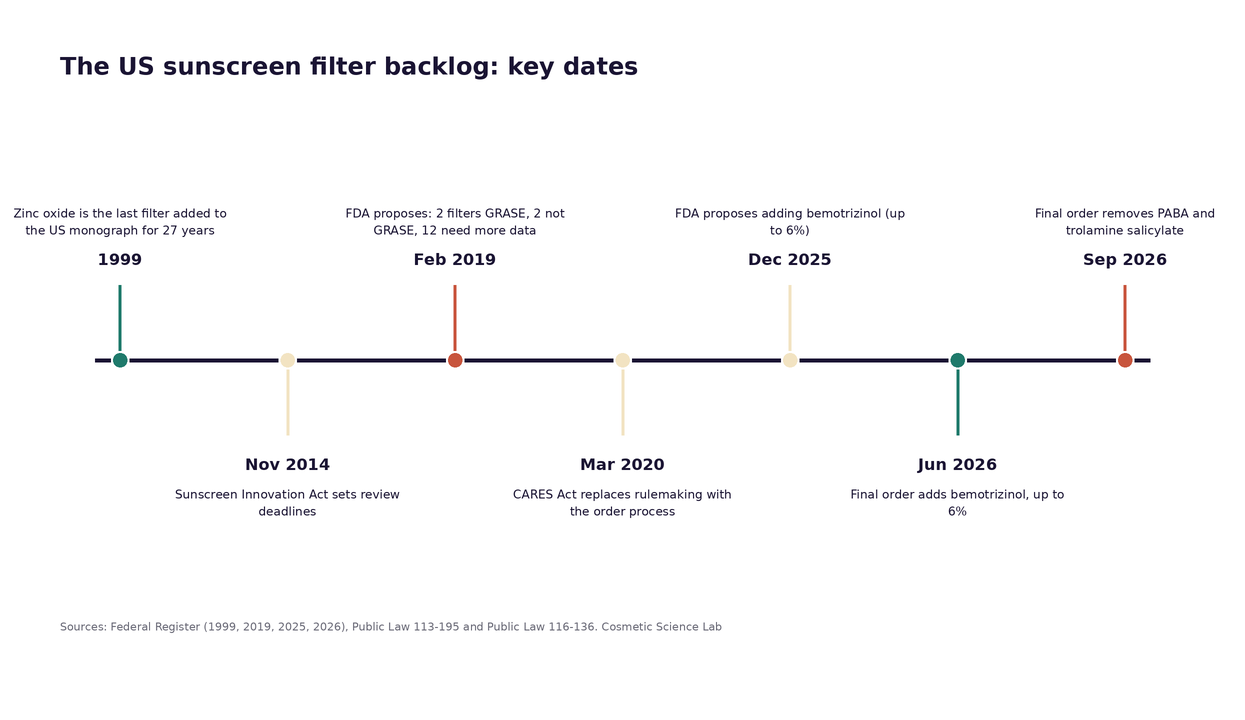
Zinc oxide was added to the US monograph in 1999 [6], and no filter followed for 27 years. From 2002 the time and extent application (TEA) process let ingredients with a track record abroad be considered for the US [7]. Several European filters entered it and then stalled. The Sunscreen Innovation Act of 2014 gave the FDA deadlines for pending requests [8], yet no new filter reached the list.
In February 2019 the FDA proposed that only zinc oxide and titanium dioxide are generally recognised as safe and effective (GRASE). It said PABA and trolamine salicylate are not GRASE, and it asked for more data on twelve others, including avobenzone, octocrylene, oxybenzone and ensulizole [2]. Those proposals moved into a 2021 proposed order. In September 2026 the FDA finalised only the PABA and trolamine salicylate part, removing both; the twelve filters still await data [2].
The concern was systemic absorption. A 2019 clinical trial found that several filters entered the bloodstream above the FDA’s threshold for further study, and its authors stressed that this did not mean people should stop using sunscreen [9]. The American Academy of Dermatology still advises a broad-spectrum, water-resistant sunscreen of SPF 30 or higher [10]. The Modernization of Cosmetics Regulation Act of 2022 (MoCRA) did not change this, because sunscreens stay in the drug system.
03Bemotrizinol: where it stands
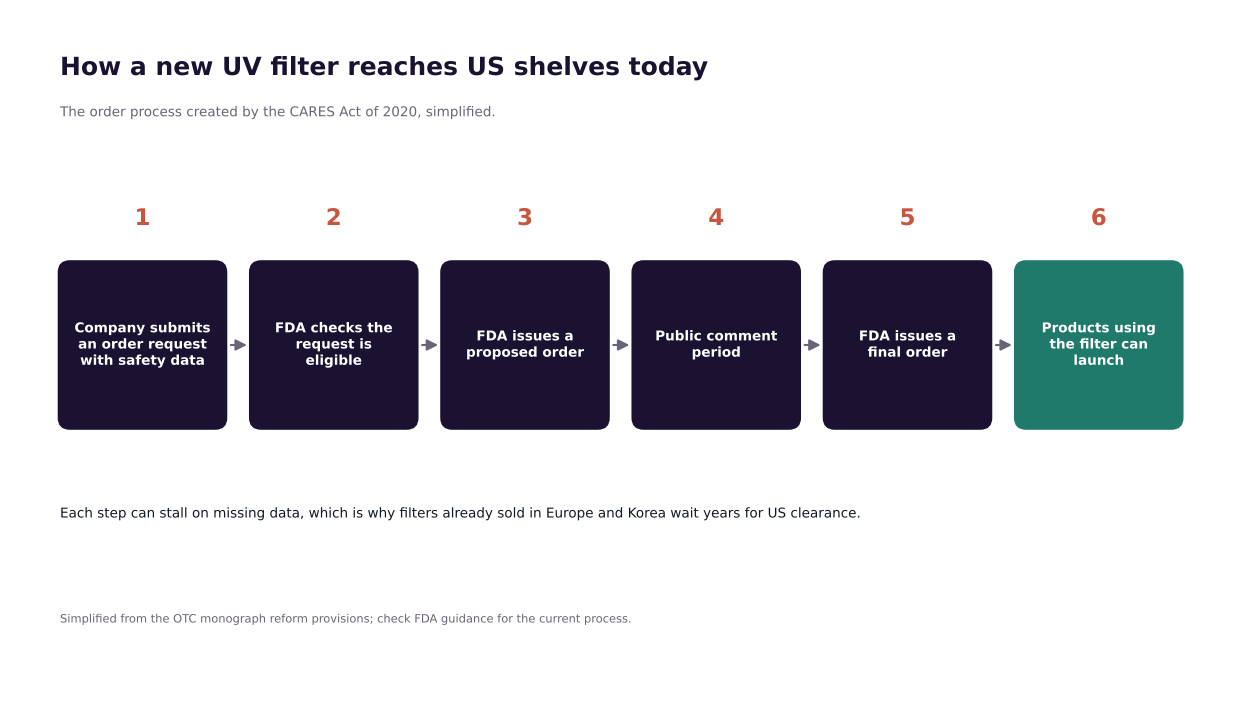
Bemotrizinol is a photostable filter that covers UVB and much of the UVA range, and the EU allows it at up to 10% [1]. Since the CARES Act of 2020, monograph changes follow an administrative order process: a request, a proposed order, public comment and a final order [13]. The supplier filed its request in September 2024. The FDA proposed an order in December 2025 and made it final on 10 June 2026, allowing bemotrizinol at up to 6% [3].
That makes it the first new active added to the US sunscreen monograph since 1999. (Ecamsule reached the US market in 2006, but only through a product-specific drug approval, not the monograph.) The order lists the dosage forms: oil, lotion, cream, gel, butter, paste, ointment, stick and spray, with sprays allowed only if no propellant touches the formula [3].
04EU, UK, US, India and GCC compared
The table shows the route a sunscreen must follow in five markets.
| Market | Classification | Filter route | Label and test rules |
|---|---|---|---|
| EU | Cosmetic | Annex VI positive list [1] | In vivo SPF; UVA protection factor at least one third of the labelled SPF and a critical wavelength of at least 370 nm [11] |
| UK | Cosmetic | Great Britain: UK Cosmetics Regulation, based on the EU text and amended separately; Northern Ireland follows EU rules [14] | Same approach, with a UK Responsible Person and SCPN notification |
| US | OTC drug | FDA monograph M020, changed by order [4] | FDA SPF and broad-spectrum tests and a Drug Facts label [12] |
| India | Cosmetic | Cosmetics Rules 2020; permitted UV filters listed in IS 4707 (Part 4) [15] | Check current CDSCO and BIS requirements |
| GCC | Cosmetic | GSO standards, largely EU-aligned; check each country | National rules, e.g. product notification with the SFDA in Saudi Arabia [16] |
05What a brand must do
- For the US: use only monograph filters at listed limits. Register the facility, list the product, test SPF and broad spectrum to the FDA method, and use the Drug Facts label.
- For the EU and UK: use only listed filters, complete a safety report, and test SPF and UVA protection with the ISO methods.
- On imports: a product with a filter that is not on the US monograph cannot be sold in the US as a sunscreen unless it has its own drug approval. Calling it a cosmetic does not help once it carries an SPF claim.
- Watch two places: the FDA docket for orders on the twelve pending filters, and the EU Official Journal for Annex VI changes.
Our guide to launching a sunscreen in the US, EU, UK, India and GCC turns these routes into a launch plan, and one sunscreen, four markets covers filters that travel.
Need a market-by-market filter check?
Talk to CSL about reviewing your formula and claims against the rules of each target market before you commit to a launch plan.
06Questions readers ask
Why does the EU have more filters?
Its cosmetics law lets a filter join the positive list after a safety review of its dossier, while the US needs an FDA order for each change.
Is bemotrizinol FDA approved?
Yes. An FDA final order of 10 June 2026 added it to the US sunscreen monograph at up to 6%.
Does the FDA think European sunscreen ingredients are unsafe?
No. It has asked for more data on some filters, not declared European ones unsafe.
Can a brand import a European sunscreen into the US?
Only if every filter is on the US monograph at US limits and the product meets drug rules, including the Drug Facts label. Otherwise it cannot be sold as a sunscreen.
Next in this series: mineral vs chemical sunscreen, and how the filters actually work.
07References
- Regulation (EC) No 1223/2009 of the European Parliament and of the Council of 30 November 2009 on cosmetic products, Annex VI (UV filters). Off J Eur Union. 2009;L342:59–209. EUR-Lex
- US Food and Drug Administration. Sunscreen drug products for over-the-counter human use; proposed rule. Fed Regist. 2019 Feb 26;84(38):6204–75. Carried into proposed order OTC000008 (2021); final order OTC000008-1 on PABA and trolamine salicylate, September 2026. FDA Q&A
- US Food and Drug Administration. Amending over-the-counter monograph M020: sunscreen drug products for over-the-counter human use; final order OTC000039 (bemotrizinol, up to 6%). Fed Regist. 2026 Jun 10;91:35220. Proposed order: Fed Regist. 2025 Dec 12;90:57765, docket FDA-2025-N-6494. Federal Register
- US Food and Drug Administration. OTC Monograph M020: Sunscreen drug products for over-the-counter human use. Final administrative order OTC000006; 2021, as amended 2026. fda.gov
- European Commission. Scientific Committee on Consumer Safety (SCCS). health.ec.europa.eu
- US Food and Drug Administration. Sunscreen drug products for over-the-counter human use; final monograph. Fed Regist. 1999 May 21;64(98):27666–93.
- US Food and Drug Administration. Additional criteria and procedures for classifying over-the-counter drugs as generally recognized as safe and effective and not misbranded; final rule. Fed Regist. 2002 Jan 23;67(15):3060–76 (21 CFR 330.14).
- Sunscreen Innovation Act, Pub L No. 113-195 (S. 2141), 128 Stat 2035 (2014 Nov 26). govinfo.gov
- Matta MK, Zusterzeel R, Pilli NR, Patel V, Volpe DA, Florian J, et al. Effect of sunscreen application under maximal use conditions on plasma concentration of sunscreen active ingredients: a randomized clinical trial. JAMA. 2019;321(21):2082–91. doi:10.1001/jama.2019.5586. PubMed
- American Academy of Dermatology. Sunscreen FAQs [Internet]. aad.org
- Commission Recommendation 2006/647/EC of 22 September 2006 on the efficacy of sunscreen products and the claims made relating thereto. Off J Eur Union. 2006;L265:39–43. EUR-Lex
- US Food and Drug Administration. Labeling and effectiveness testing; sunscreen drug products for over-the-counter human use; final rule. Fed Regist. 2011 Jun 17;76(117):35620–65. Requirements now sit in OTC Monograph M020. Federal Register
- Coronavirus Aid, Relief, and Economic Security (CARES) Act, Pub L No. 116-136, secs. 3851–3862, 134 Stat 281 (2020 Mar 27). congress.gov
- Cosmetic Toiletry and Perfumery Association. UK cosmetic regulations and amendments [Internet]. ctpa.org.uk
- Bureau of Indian Standards. IS 4707 (Part 4): Classification of cosmetic raw materials and adjuncts, permitted UV filters. New Delhi: BIS. Cosmetics Rules, 2020 (G.S.R. 763(E)). cdsco.gov.in
- GCC Standardization Organization. GSO 1943:2024 Cosmetic products: safety requirements. Saudi Food and Drug Authority, cosmetic product notification. sfda.gov.sa
Update log
- Published by Cosmetic Science Lab
This article is general technical information, not legal, regulatory or medical advice. Confirm requirements for your product and market before launch.