Korean sunscreen: why K-beauty filters aren’t in US products
Korean sunscreen can feel lighter partly because it can use UV filters the US does not permit. The US added bemotrizinol in June 2026, but bisoctrizole and DHHB are still off its list. Here is which filters differ, why the US is behind, and what it means for brands exporting. Part of our sun care series.
By Dr. Premalatha, Ph.D., Life Science, Regulatory Consultant, Cosmetic Science Lab
The data behind this article
- Scope
- UV filters allowed in South Korea, the EU and the US
- Key finding
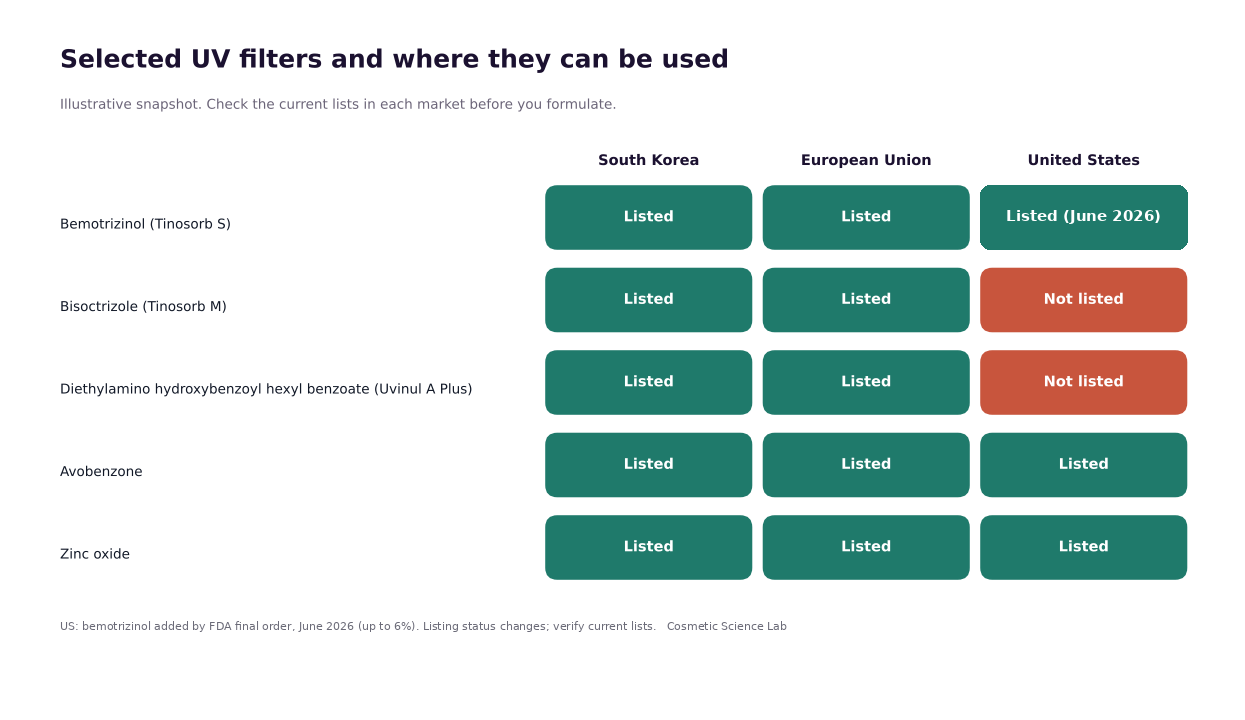
- Three newer filters are listed in Korea and the EU. The US added one of them, bemotrizinol, in June 2026; the other two are still not permitted.
- Caveat
- Filter lists change, so check the current lists before you formulate
Quick answer
- Korean sunscreen can use newer UV filters, such as bisoctrizole and diethylamino hydroxybenzoyl hexyl benzoate, that Korea and the EU list but the US does not permit.
- The US treats sunscreen as an over-the-counter drug. Until June 2026, when bemotrizinol was added at up to 6%, no filter had joined the US list since 1999 [8].
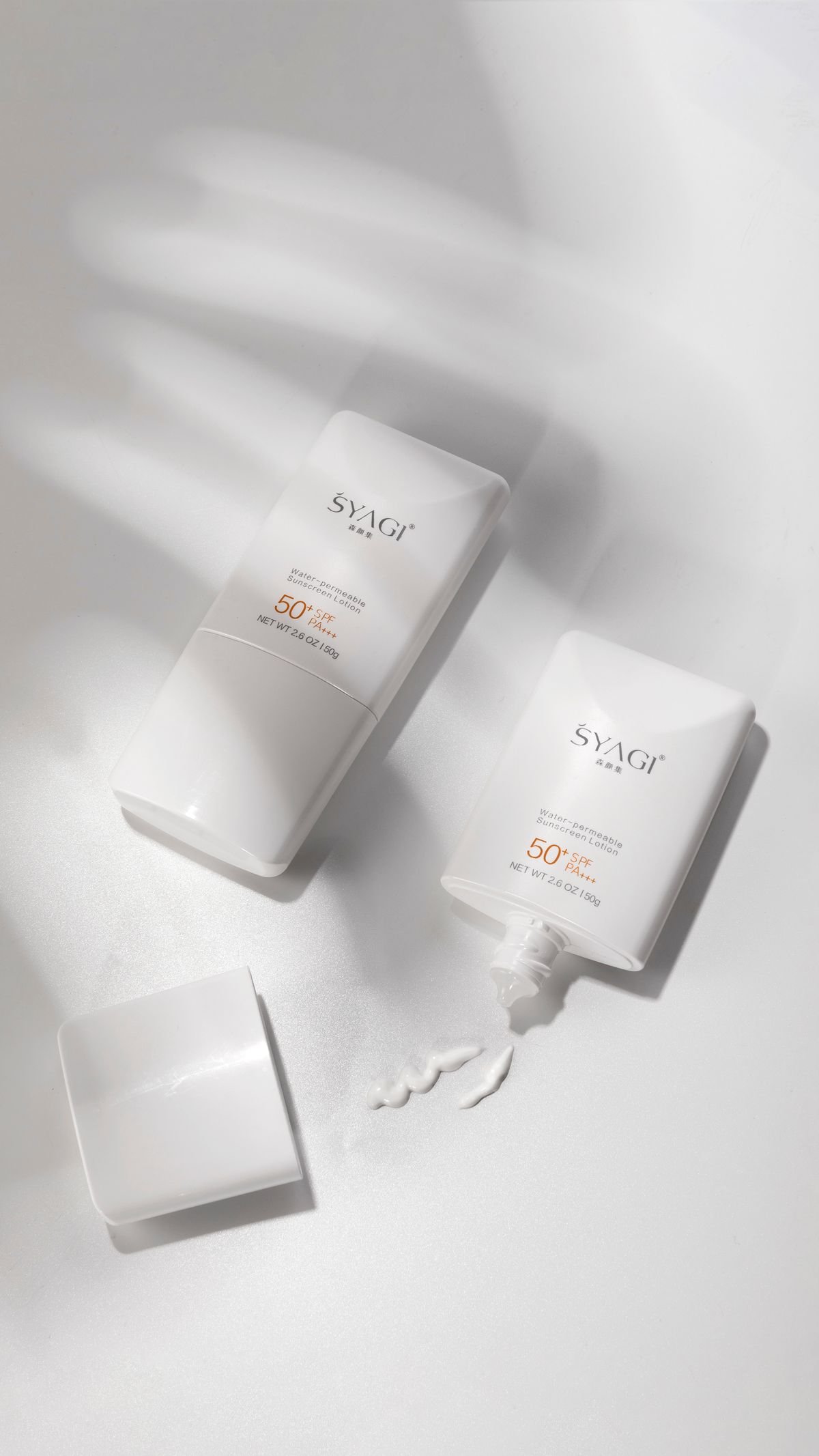
- SPF measures protection against sunburn, mainly UVB. The PA rating is the UVA label used in Korea and Japan.
- Brands selling in both markets usually need two formulas, one for the US and one for Korea and the EU.
Take-home message for formulators
- Map the filter list for each target market before you choose a UV system.
- Bemotrizinol can now go into a US sunscreen, but only at up to 6% (10% in the EU) and not in propellant aerosols [8]. Bisoctrizole and DHHB still cannot.
Take-home message for brand owners
- Decide your launch markets before you brief a lab, and ask whether you need one formula or two.
- Check current filter status, because the lists do change.
01What makes Korean sunscreen different
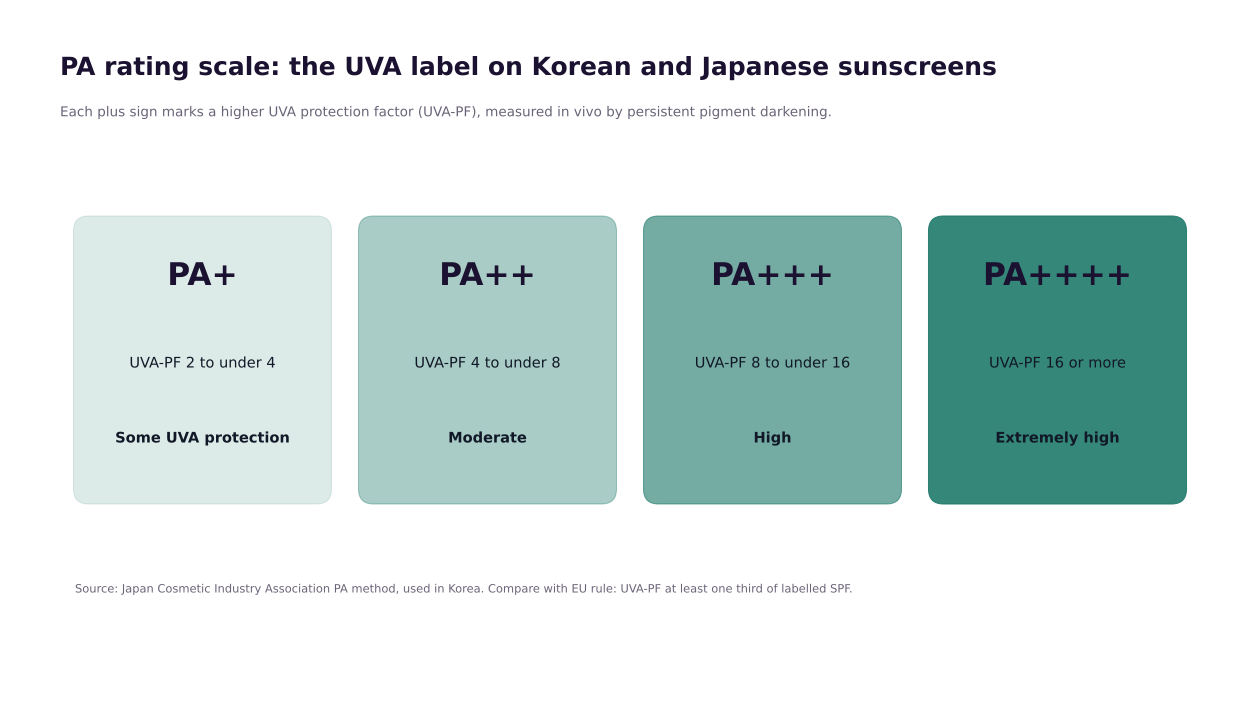
Korea regulates sunscreen as a functional cosmetic under its Ministry of Food and Drug Safety (MFDS), and its permitted filter list includes newer molecules [3]. Formulators use them to build light, transparent textures that still carry high UVA protection. Korean labels show an SPF value and a PA rating, a UVA scale that runs from PA+ to PA++++ [4].
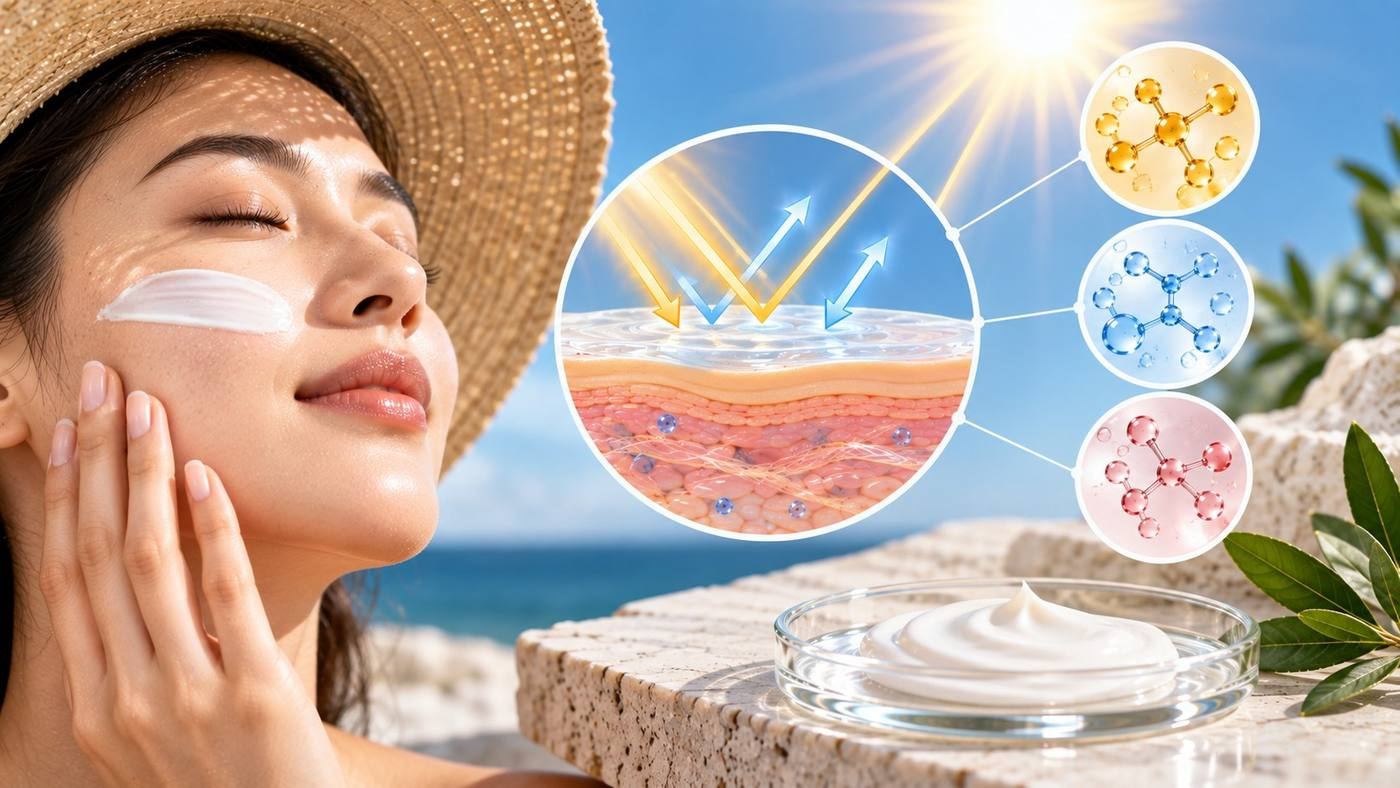
Three filters set these products apart: bemotrizinol (Tinosorb S), bisoctrizole (Tinosorb M) and diethylamino hydroxybenzoyl hexyl benzoate (DHHB, Uvinul A Plus). All three are photostable and cover much of the UVA range, which lets a formula reach high UVA protection without leaning on avobenzone. That is part of the cosmetic elegance shoppers notice.
02Filter approval by market
The table shows why one formula cannot cross the Pacific unchanged. Check limits against the current lists before you formulate [1] [3] [8].
| Filter | South Korea | EU | US |
|---|---|---|---|
| Bemotrizinol (Tinosorb S) | Listed | Listed, up to 10% | Listed since June 2026, up to 6% |
| Bisoctrizole (Tinosorb M) | Listed | Listed, up to 10% | Not permitted |
| DHHB (Uvinul A Plus) | Listed | Listed, up to 10% | Not permitted |
| Avobenzone | Listed | Listed, up to 5% | Listed, up to 3% |
| Zinc oxide | Listed | Listed, up to 25% | Listed, up to 25% |
03Why the US is still behind
The US regulates sunscreen as an over-the-counter (OTC) drug, not a cosmetic, so every filter must be on the FDA’s OTC sunscreen monograph [5]. Zinc oxide was added in 1999 [6]. The Sunscreen Innovation Act of 2014 set review deadlines [7], but no new filter followed for more than two decades.
In 2019 the FDA proposed that only zinc oxide and titanium dioxide are generally recognised as safe and effective, and asked for more data on twelve others, including avobenzone and octocrylene [2]. Those twelve are still waiting. The first change came through the newer order process: the FDA proposed bemotrizinol in December 2025 and added it by final order on 10 June 2026, at up to 6% [8]. Bisoctrizole and DHHB have no US order, so a formula built on them still cannot be sold in the US as a sunscreen.
Our guide on why US sunscreens lag Europe covers the backlog in depth.
04Myths about K-beauty sunscreen
- “Korean sunscreen is stronger.” SPF is measured in volunteers with closely aligned in vivo methods: ISO 24444 in Korea and the EU [9], and the FDA method in the US. A Korean SPF 50+ is not stronger than a US SPF 50+. The filter set, the UVA label and the texture differ.
- “The FDA has banned these filters.” It has not. The gap is mainly a slow review process, and the FDA has not declared bisoctrizole or DHHB unsafe.
- “Mineral sunscreen is always safer.” Mineral and chemical filters both protect when applied at the right amount, and each has trade-offs in texture, stability and appearance on different skin tones. See mineral vs chemical sunscreen.
05What to check on a label
- SPF and PA. SPF describes sunburn (mainly UVB) protection and PA describes UVA protection. More plus signs mean a higher UVA protection factor (UVA-PF) [4].
- The ingredient list. Look for bis-ethylhexyloxyphenol methoxyphenyl triazine (bemotrizinol), methylene bis-benzotriazolyl tetramethylbutylphenol (bisoctrizole) and diethylamino hydroxybenzoyl hexyl benzoate.
- The US Drug Facts panel. Sunscreens sold legally in the US carry one. Products shipped directly from Korea may not.
- Other claims. Words such as “reef safe” and “hypoallergenic” need their own substantiation and are treated differently in each market.
06For brands and formulators
Export plans start with the filter list. Brands that sell in both markets usually run two formulas: a US system, often avobenzone stabilised with octocrylene plus zinc oxide, and a Korea and EU system built on the newer filters. Bemotrizinol now narrows the gap, but at 6% in the US against 10% in the EU, so a formula that relies on it at higher levels still needs a US version. Our modern organic UV filters page covers each filter in more detail.
Texture is the next lever. Light formats such as sticks and serum textures depend on film formation and filter solubility. These choices change the in vivo SPF result, so test the final formula, not the prototype [9]. Zinc oxide formulas for deeper skin tones need dispersion work to avoid white cast, as our white cast worked example shows. The PA rating is a Korean and Japanese convention, so US and EU labels need their own UVA wording; our guide to in vivo and in vitro SPF testing explains which result supports which claim.
Need a sunscreen formulated for your target markets?
CSL formulation chemists build new formulas, reformulate products and match benchmarks, and you own the formula and its documentation.
07Questions readers ask
Is Korean sunscreen better than US sunscreen?
Not by default. Texture and UVA protection are often better because of the filters used, but SPF values mean the same thing.
Can I buy Korean sunscreen in the US?
Some products are sold, but US sunscreens must meet drug rules, including permitted filters and the Drug Facts label, so many imports do not comply.
What does PA++++ mean?
A UVA protection factor of 16 or higher, the top grade on the PA scale used in Korea and Japan [4].
Is bemotrizinol allowed in the US now?
Yes. An FDA final order of 10 June 2026 added it to the sunscreen monograph at up to 6%, in listed dosage forms that exclude sprays where propellant touches the formula [8].
Next in this series: why US sunscreens lag Europe, and where bemotrizinol fits.
08References
- Regulation (EC) No 1223/2009 of the European Parliament and of the Council of 30 November 2009 on cosmetic products, Annex VI (UV filters). Off J Eur Union. 2009;L342:59–209. EUR-Lex
- US Food and Drug Administration. Sunscreen drug products for over-the-counter human use; proposed rule. Fed Regist. 2019 Feb 26;84(38):6204–75. Carried into proposed order OTC000008 (2021); partly finalised September 2026. FDA Q&A
- Ministry of Food and Drug Safety (Korea). Regulation on safety standards of cosmetics: UV filters and functional cosmetics. mfds.go.kr
- International Organization for Standardization. ISO 24442:2022. Cosmetics — Sun protection test methods — In vivo determination of sunscreen UVA protection. Geneva: ISO; 2022. PA grading per the Japan Cosmetic Industry Association method, PA++++ added in 2013.
- US Food and Drug Administration. Sunscreen: how to help protect your skin from the sun [Internet]. Updated 2026 Oct 16; cited 2026 Nov 6. fda.gov
- US Food and Drug Administration. Sunscreen drug products for over-the-counter human use; final monograph. Fed Regist. 1999 May 21;64(98):27666–93.
- Sunscreen Innovation Act, Pub L No. 113-195 (S. 2141), 128 Stat 2035 (2014 Nov 26). govinfo.gov
- US Food and Drug Administration. Amending over-the-counter monograph M020: sunscreen drug products for over-the-counter human use; final order OTC000039 (bemotrizinol, up to 6%). Fed Regist. 2026 Jun 10;91:35220. Proposed order: Fed Regist. 2025 Dec 12;90:57765. Federal Register
- International Organization for Standardization. ISO 24444:2019. Cosmetics — Sun protection test methods — In vivo determination of the sun protection factor (SPF). Geneva: ISO; 2019 (Amd 1:2022). iso.org
Update log
- Published by Cosmetic Science Lab
This article is general technical information, not legal, regulatory or medical advice. Confirm requirements for your product and market before launch.