Mineral vs chemical sunscreen: how the filters actually work
Mineral and chemical sunscreen filters both work mainly by absorbing UV. Here is how each group works, how they compare, and which formulation variables decide performance. This page is the hub for our sun care series.
By Dr. Premalatha, Ph.D., Life Science, Regulatory Consultant, Cosmetic Science Lab

The data behind this article
- Scope
- Zinc oxide, titanium dioxide and organic UV filters
- Key finding
- Zinc oxide and titanium dioxide reflect only about 4–5% of UV; they protect mainly by absorbing it [1]
- Caveat
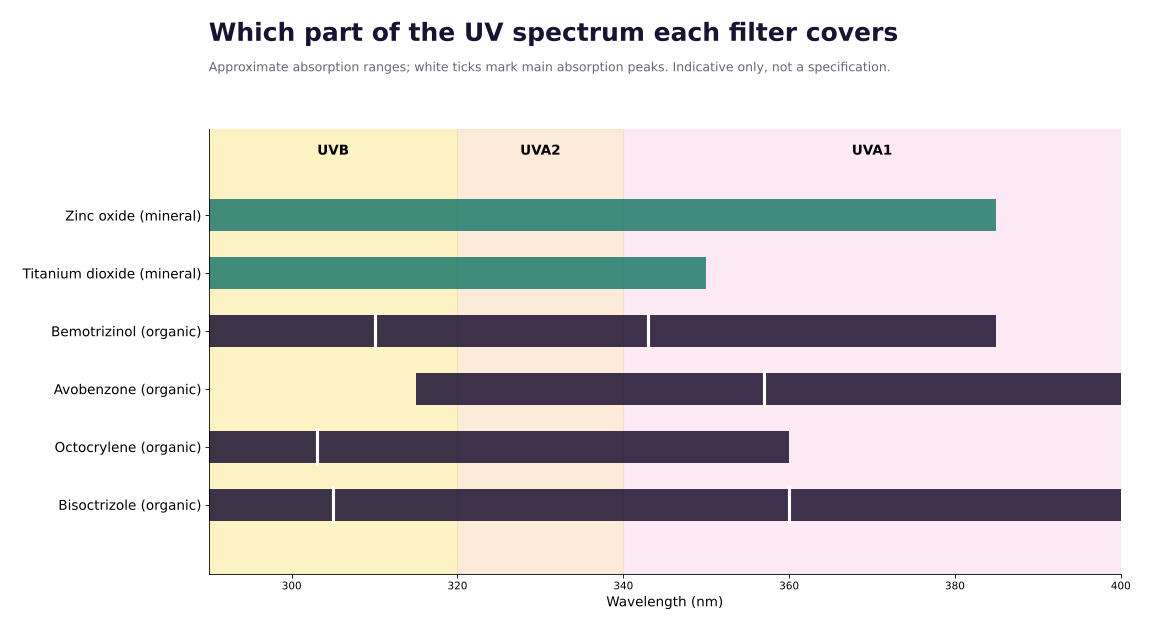
- Coverage ranges in Figure 1 are approximate
Quick answer
- Mineral filters, zinc oxide and titanium dioxide, mostly absorb UV. Chemical filters also absorb UV and mostly release the energy as heat.
- The old rule that minerals reflect and chemicals absorb is a simplification.
- The real differences in mineral vs chemical sunscreen are texture, white cast, photostability and the filters each market allows.
- Hybrid formulas combine both groups to cover UVB and UVA with a lighter feel.
Take-home message for formulators
- Choose the filter system for coverage and stability first, then fix texture.
- Test the final film, because use level alone does not set SPF.
Take-home message for brand owners
- Ask which filters your formula uses and why.
- Check how the product looks on deep skin tones before you commit to a mineral-only system.
01How mineral filters work
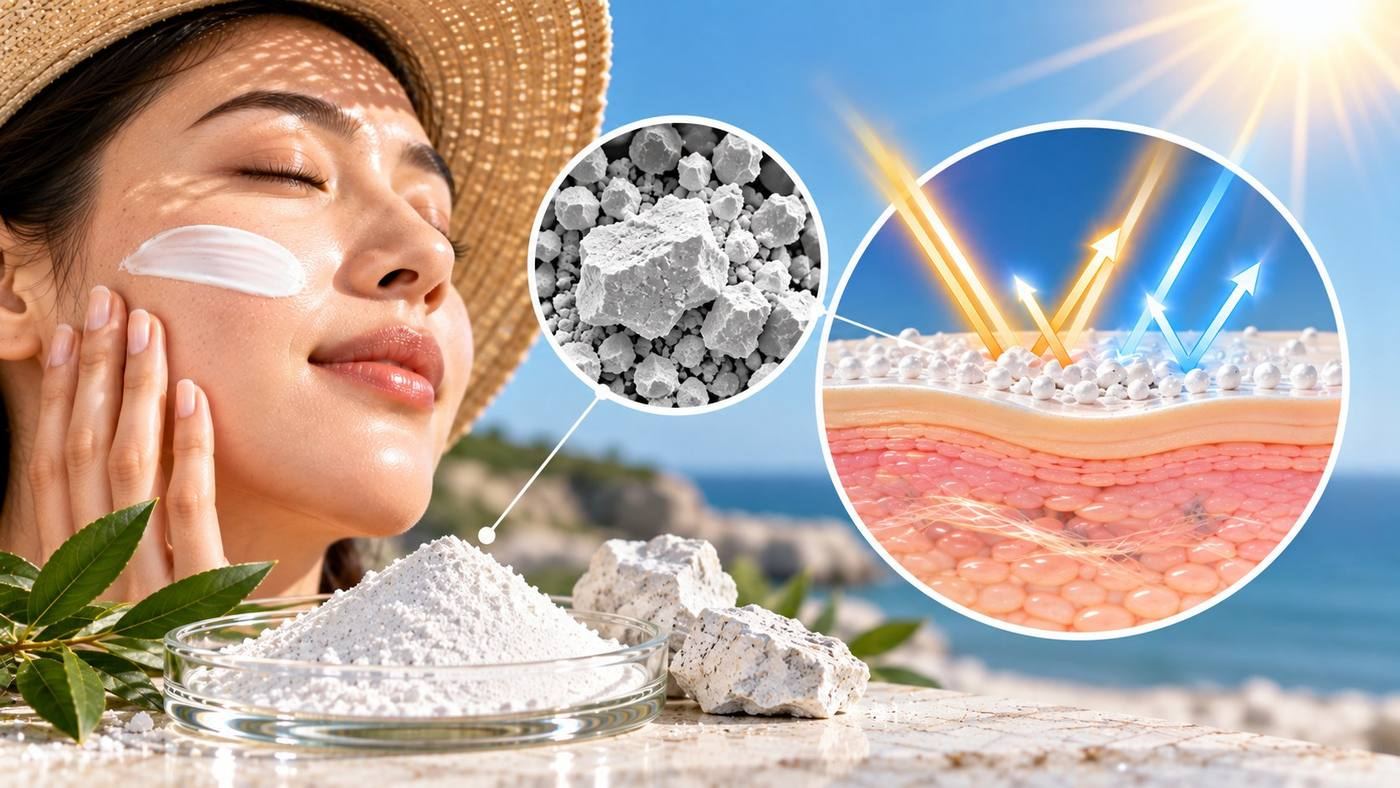
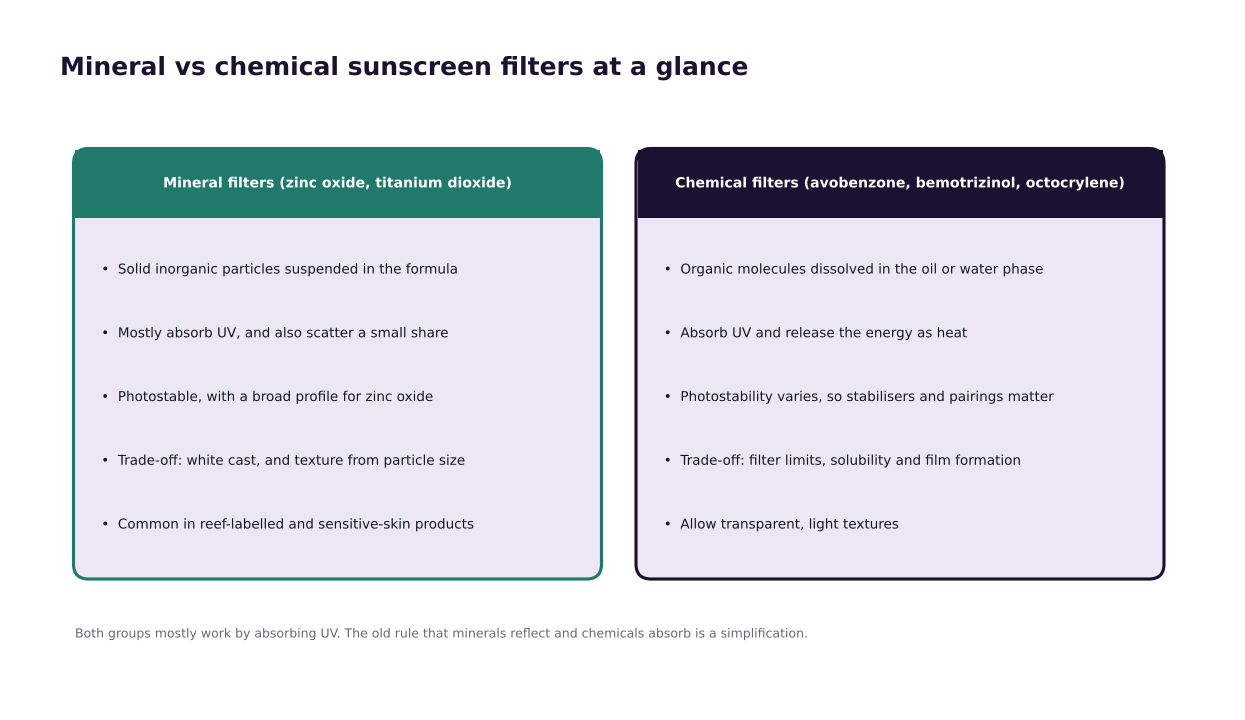
Zinc oxide and titanium dioxide are inorganic particles dispersed in the formula. A 2016 study measured how they handle UV and found that they reflect only about 4–5% of it across the UV range; they protect mainly by absorbing it [1]. Zinc oxide has a broad absorption curve that runs from UVB through most of the UVA. Titanium dioxide is strongest in UVB and weaker in long UVA [2] [3].
Particle size matters. Fine particles keep the film transparent but can shift the balance of UVA and UVB protection [2], and larger ones whiten the skin. In the EU, any ingredient used as a nanomaterial, filters included, is listed with “(nano)” on the label. Nano zinc oxide and titanium dioxide must also meet set specifications and may not be used where they could be inhaled, such as some sprays [6]. Our pages on zinc oxide and titanium dioxide cover grades and limits.
02How chemical filters work
Chemical filters are organic molecules dissolved or dispersed in the oil or water phase. The name suggests a reaction with the skin, but they do not react with it. Each molecule absorbs a photon, moves to an excited state and relaxes back, ideally releasing the energy as heat. Some relax cleanly and some do not. Bemotrizinol and bisoctrizole are photostable on their own and cover both UVB and UVA. Both have long been permitted in the EU and Korea at up to 10%, and the FDA added bemotrizinol to the US monograph in June 2026, at up to 6% [7].
Avobenzone is the most widely used UVA1 filter, and until 2026 the only organic one in US products. It degrades in sunlight unless it is stabilised [4], which is why it is often paired with a stabiliser such as octocrylene or bemotrizinol [5]. Our page on modern organic UV filters covers the newer molecules.
03The two groups side by side
| Mineral | Chemical | |
|---|---|---|
| Filters | Zinc oxide, titanium dioxide | Avobenzone, octocrylene, bemotrizinol and others |
| Main mechanism | Mostly absorption, minor scattering | Absorption, then release mostly as heat |
| Coverage | Zinc oxide broad; titanium dioxide weaker in long UVA | Varies by filter; most systems combine several |
| Typical limits | Up to 25% in the EU and the US [6] [8] | Varies; avobenzone is 3% in the US and 5% in the EU |
| Texture | Risk of white cast and a thicker feel | Light and transparent |
| Main risk | Dispersion and white cast | Photostability and solubility |
UV is split into UVB (280 to 320 nm; sunlight at ground level starts near 290 nm), UVA2 (320 to 340 nm) and UVA1 (340 to 400 nm). Broad-spectrum protection means covering all three. The EU expects a UVA protection factor of at least one third of the labelled SPF and a critical wavelength of at least 370 nm [9]. No single filter covers the whole range strongly enough at permitted levels, so products combine them. Our guide to in vivo and in vitro SPF testing explains how protection is measured.
04Formulation variables that decide performance
- Use level.
The legal maximum caps the filter, but more filter does not always give more SPF, because the film on skin decides how much of it works.
- Compatibility.
Avobenzone forms coloured complexes with iron and other metal ions, so chelators are used, and it degrades faster alongside octinoxate unless the system is photostabilised [10]. Zinc oxide can react with acidic ingredients and free fatty acids, which can change viscosity, so coated grades are common (CSL formulation experience).
- Process.
Oxides need high-shear dispersion. Crystalline organic filters need good solvents, such as emollient esters, to stay dissolved through cold storage.
- Film.
Film formers and emollients set how evenly the filter sits on skin and how water resistant it is. In vivo SPF is measured at 2 mg of product per square centimetre, so film uniformity shows directly in the result [11].
- Photostability.
Pair avobenzone with a stabiliser such as octocrylene or bemotrizinol [5], and check the SPF after light exposure, not only before.
05Common failure modes
- White cast from large oxide particles or poor dispersion. Our white cast worked example shows how to reduce it on deeper skin tones.
- Avobenzone photodegradation, which cuts UVA protection after sun exposure [4].
- Low SPF in the test, caused by an uneven film.
- Crystallisation of organic filters in cold storage.
- Lost water resistance, which fails the 40- and 80-minute immersion tests behind a water-resistant claim (two or four 20-minute cycles in ISO 16217) [11].
06Which should you choose?
Neither group wins on every measure. Mineral sunscreen suits many sensitive-skin and acne-prone products, though tolerance also depends on the vehicle, fragrance and emollients. Chemical sunscreen gives lighter textures. Hybrid products use both to cover UVB and UVA with a lower oxide load.
Sunscreen matters for skin cancer prevention: in a randomised trial in Australia, adults assigned to daily sunscreen use had fewer invasive melanomas in the 10 years that followed [12]. The best sunscreen is the one people apply at the right amount. Ask three questions: which markets you sell in, which skin tones you serve, and which texture your shoppers expect.
Pick filters by market first, coverage and stability second, and texture third. Mineral-only systems are a choice of positioning, not of safety, and they need dispersion work and testing on deep skin tones to succeed.
07Guides in this series
This page is the hub for our sun care series, which follows a sunscreen from market choice to launch.
- Korean sunscreen: why K-beauty filters aren’t in US products
Which filters Korea and the EU allow that the US does not, and what that means for exports.
- Why US sunscreens lag Europe
How the FDA filter backlog formed, and what the 2026 bemotrizinol order changes.
- Mineral vs chemical sunscreen (this page)
How the two filter groups work and which formulation variables decide performance.
- Launching a sunscreen in the US, EU, UK, India and GCC
Classification, testing, stability and registration, step by step.
- Worked example: reducing white cast in zinc oxide sunscreen
Tint, dispersion and refractive index, shown with illustrative numbers.
Related sun care reading: one sunscreen, four markets, in vivo vs in vitro SPF testing, why Gulf consumers skip sunscreen and antioxidants in sunscreen.
Need a sunscreen filter system for your product?
CSL formulation chemists build new formulas, reformulate products and match benchmarks, and you own the formula and its documentation.
08More guides: research to recalls
A second set of guides covers safety research, shelf life, label claims and what happens when a sunscreen fails its SPF test.
- Does sunscreen cause cancer? What the studies show
What the absorption, benzene and melanoma studies show, and what brands should test for.
- Octocrylene: limits, safety and formulation
One filter in depth: limits, photoallergy, benzophenone and the proposed EU restriction.
- Does sunscreen expire? Avobenzone and the 3-year rule
The US and EU date rules, why avobenzone breaks down, and the stability tests to run.
- SPF, UVA-PF, PA++++ and broad spectrum explained
What each label number measures and the test behind every claim.
- When SPF 50+ tests at SPF 4: the 2025 SPF failures
The 2025 Australian SPF failures, why labs disagree, and how brands respond.
- Worked example: fixing a sunscreen that tested at SPF 15
An illustrative project: benchmarking and reformulating a sunscreen that failed its SPF test.
09Questions readers ask
Is mineral sunscreen safer than chemical sunscreen?
Not by definition. In the US, the FDA has proposed that zinc oxide and titanium dioxide are safe and effective and has asked for more data on most organic filters; that does not make them unsafe [13]. The EU and Korea permit both groups after safety review. Choose by skin sensitivity, texture and the filters allowed in your market.
Does mineral sunscreen reflect UV?
Mostly no. Zinc oxide and titanium dioxide reflect only about 4–5% of UV and protect mainly by absorbing it [1].
Can a brand use both types in one product?
Yes. Hybrid sunscreens combine oxides and organic filters.
What is the best sunscreen for sensitive skin?
There is no single best choice. Mineral filters are a common starting point, but tolerance also depends on the vehicle, fragrance and emollients.
Next in this series: how to launch a sunscreen across the US, EU, UK, India and GCC.
10References
- Cole C, Shyr T, Ou-Yang H. Metal oxide sunscreens protect skin by absorption, not by reflection or scattering. Photodermatol Photoimmunol Photomed. 2016;32(1):5–10. doi:10.1111/phpp.12214. PubMed
- Smijs TG, Pavel S. Titanium dioxide and zinc oxide nanoparticles in sunscreens: focus on their safety and effectiveness. Nanotechnol Sci Appl. 2011;4:95–112. doi:10.2147/NSA.S19419. PubMed
- Schneider SL, Lim HW. A review of inorganic UV filters zinc oxide and titanium dioxide. Photodermatol Photoimmunol Photomed. 2019;35(6):442–6. doi:10.1111/phpp.12439. PubMed
- Mturi GJ, Martincigh BS. Photostability of the sunscreening agent 4-tert-butyl-4′-methoxydibenzoylmethane (avobenzone) in solvents of different polarity and proticity. J Photochem Photobiol A Chem. 2008;200(2–3):410–20. doi:10.1016/j.jphotochem.2008.09.007
- Chatelain E, Gabard B. Photostabilization of butyl methoxydibenzoylmethane (avobenzone) and ethylhexyl methoxycinnamate by bis-ethylhexyloxyphenol methoxyphenyltriazine (Tinosorb S), a new UV broadband filter. Photochem Photobiol. 2001;74(3):401–6.
- Regulation (EC) No 1223/2009 of the European Parliament and of the Council of 30 November 2009 on cosmetic products, Article 19(1)(g) and Annex VI; amended for zinc oxide by Regulation (EU) 2016/621 and for titanium dioxide by Regulation (EU) 2016/1143. EUR-Lex
- US Food and Drug Administration. Amending over-the-counter monograph M020: sunscreen drug products for over-the-counter human use; final order OTC000039 (bemotrizinol, up to 6%). Fed Regist. 2026 Jun 10;91:35220. Federal Register
- US Food and Drug Administration. OTC Monograph M020: Sunscreen drug products for over-the-counter human use. Final administrative order OTC000006; 2021, as amended 2026. fda.gov
- Commission Recommendation 2006/647/EC of 22 September 2006 on the efficacy of sunscreen products and the claims made relating thereto. Off J Eur Union. 2006;L265:39–43. EUR-Lex
- Sayre RM, Dowdy JC, Gerwig AJ, Shields WJ, Lloyd RV. Unexpected photolysis of the sunscreen octinoxate in the presence of the sunscreen avobenzone. Photochem Photobiol. 2005;81(2):452–6.
- International Organization for Standardization. ISO 24444:2019. Cosmetics — Sun protection test methods — In vivo determination of the sun protection factor (SPF) (Amd 1:2022); and ISO 16217:2020. Water immersion procedure for determining water resistance. Geneva: ISO. iso.org
- Green AC, Williams GM, Logan V, Strutton GM. Reduced melanoma after regular sunscreen use: randomized trial follow-up. J Clin Oncol. 2011;29(3):257–63. doi:10.1200/JCO.2010.28.7078. PubMed
- US Food and Drug Administration. Questions and answers: FDA’s regulatory actions on over-the-counter sunscreen [Internet]. Updated 2026 Sep. fda.gov
Update log
- Published by Cosmetic Science Lab
This article is general technical information, not legal, regulatory or medical advice. Confirm requirements for your product and market before launch.