Reducing white cast in zinc oxide sunscreen for darker skin tones
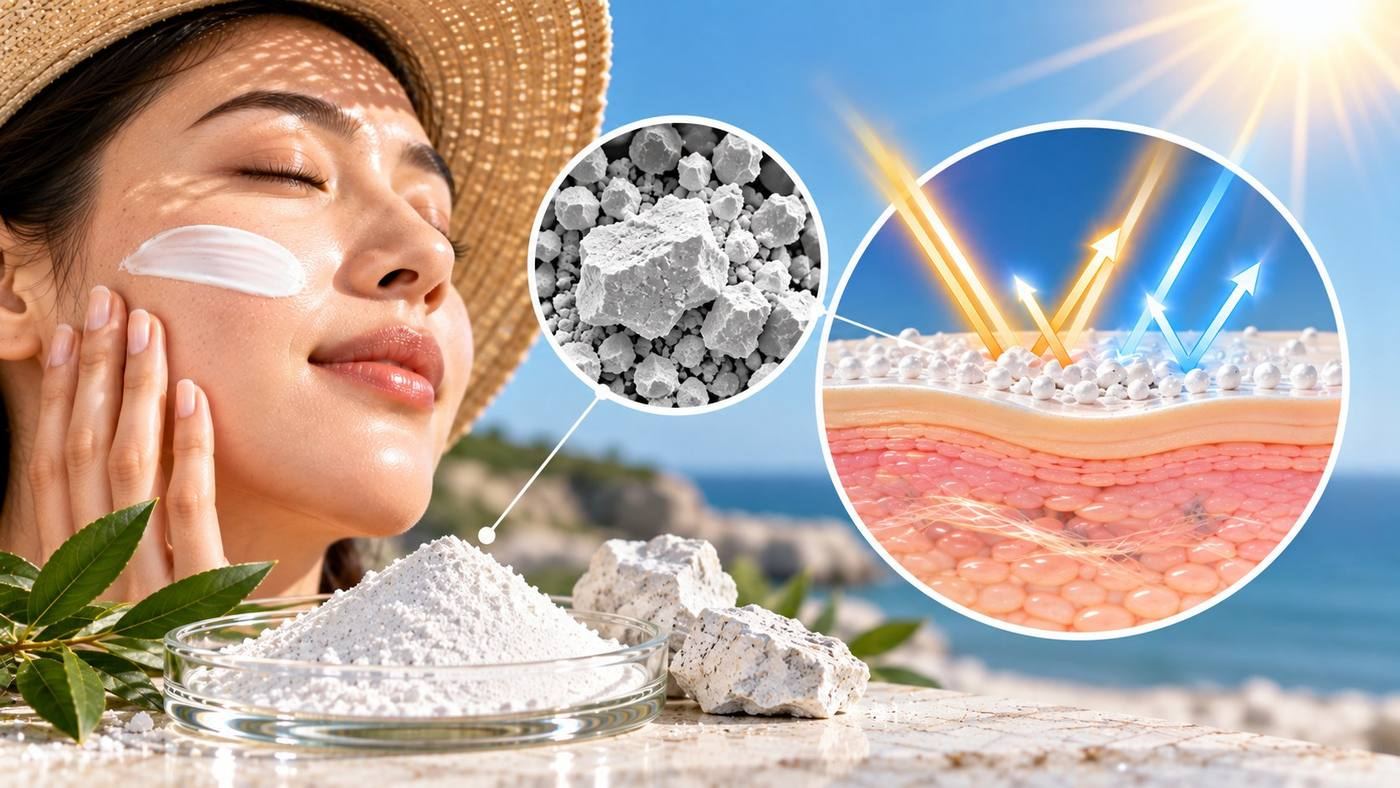
Sunscreen white cast on deeper skin tones comes from zinc oxide particles that scatter visible light. This worked example shows how iron oxide tinting, finer dispersion and emollient choice can cut measured whitening. The numbers are assumed for illustration and are not client data. Part of our sun care series.
By Dr. Premalatha, Ph.D., Life Science, Regulatory Consultant, Cosmetic Science Lab

Worked example. An illustrative project that shows the method CSL uses to reduce white cast. It is not a specific client, and every number on this page is assumed for illustration, not measured data.
Project snapshot (worked example)
- Brief
- Illustrative zinc oxide SPF 30 lotion for the EU and US, three shades
- Challenge
- Grey-white film on deep skin tones
- Approach
- Iron oxide tint, finer dispersion of a coated grade, higher refractive index emollients
- Measure
- ΔL* on a deep-skin panel, by colorimeter
- Result
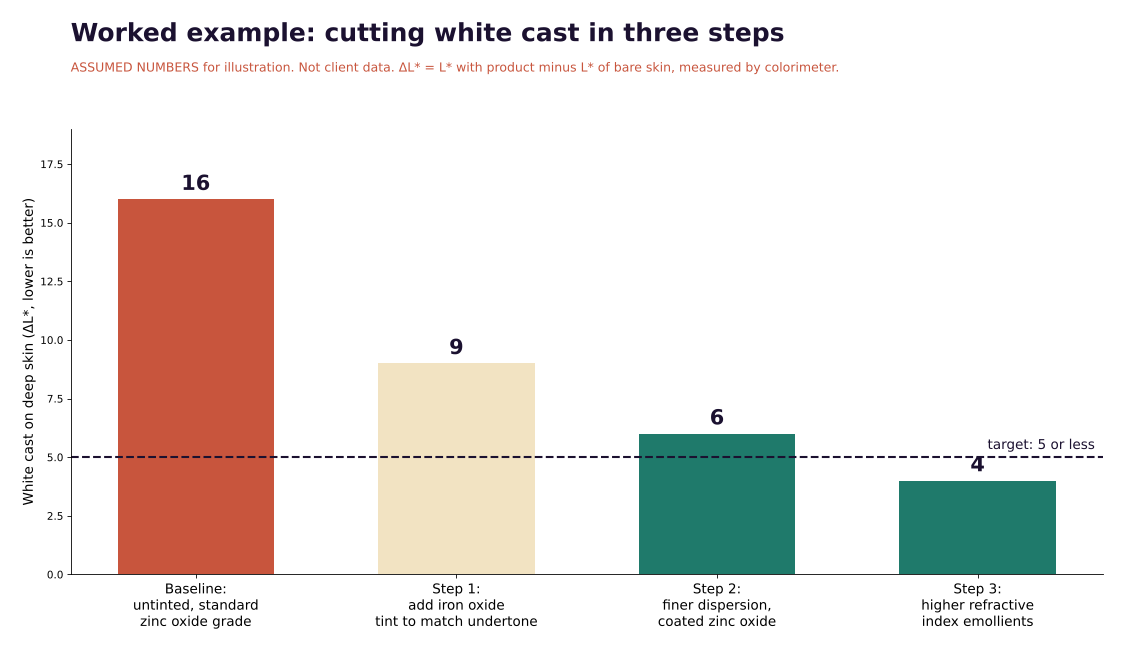
- ΔL* of 16 reduced to 4 (assumed numbers)
Quick answer
- Sunscreen white cast is visible light scattered by zinc oxide particles, and it shows more on deep skin.
- Three changes reduce it: tint with iron oxides, disperse a coated grade finely, and narrow the refractive index gap with the oil phase.
- Measure whitening as ΔL* on a deep-skin panel, not only on light skin.
- Retest SPF and UVA after every change, because a lower ΔL* does not guarantee the SPF.
Take-home message for formulators
- Measure whitening on deep skin early, and tint in several shades.
- Retest SPF after every change to dispersion or the oil phase.
Take-home message for brand owners
- Ask your formulator how the product looks on deep skin tones.
- Ask how the shade range was built before you commit to a mineral sunscreen.
01The brief (illustrative)
A brand sells a zinc oxide SPF 30 lotion. Customers with deep skin tones report a grey-white film that does not rub in. The brief is to reduce visible whitening on deep skin without lowering SPF or UVA protection, and without changing the filter system. Constraints: an SPF 30 target, EU and US markets, three planned shades, and a non-nano zinc oxide grade, which the brand chose to avoid “(nano)” labelling in the EU.
02Why zinc oxide leaves white cast
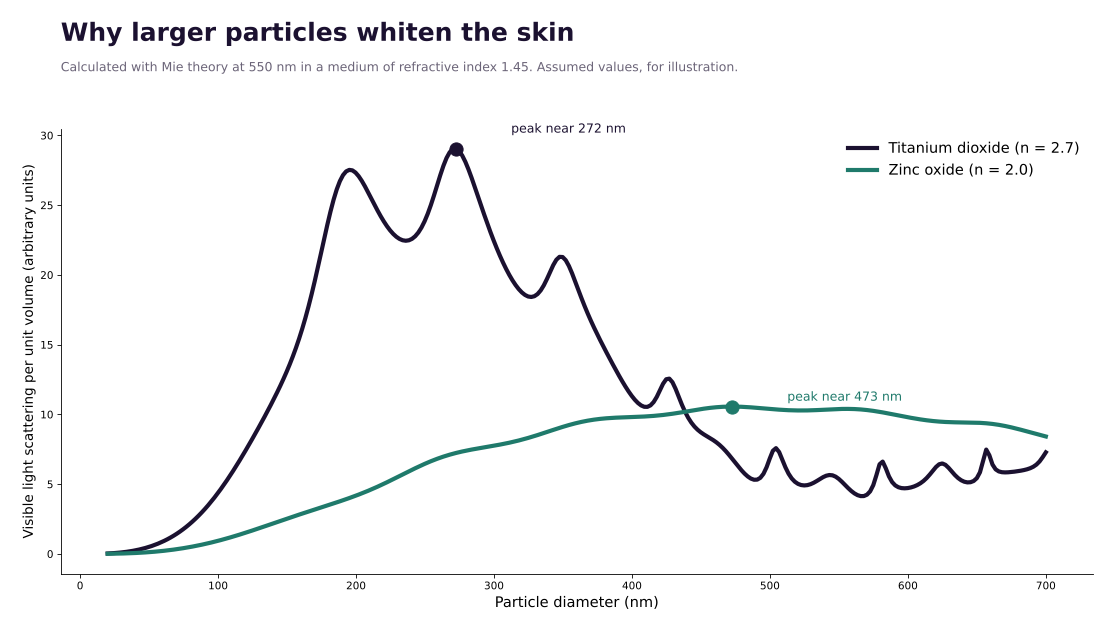
White cast is visible light scattering. Zinc oxide has a refractive index near 2.0, while cosmetic oils sit near 1.40 to 1.50 and the skin surface near 1.5, and that mismatch scatters light. Scattering also depends on particle size. Mie theory, the standard way to calculate how small spheres scatter light [2], shows scattering per unit volume peaking at a size comparable to the wavelength of light and falling steeply for particles well below it.
That is why large or clumped particles whiten and fine, well-dispersed ones look more transparent [1]. On light skin the film is hard to see. On deep skin the contrast is higher, so the same film shows more.
03How to measure it
Measure whitening with a colorimeter. Apply the product at 2 mg per square centimetre to a deep-skin panel, and record the change in lightness, ΔL*, as L* with product minus L* of bare skin. Recruit and describe volunteers by individual typology angle (ITA), an objective, measured index of skin colour [3] [4], rather than by self-reported Fitzpatrick phototype, which is based on how skin burns and tans [5].
ITA° = arctan((L* − 50) / b*) × 180 / π
On the widely used six-group scale, an ITA of minus 30 degrees or lower marks the darkest group, “dark” skin [4].
04The method: three changes
- Tint with iron oxides.
Blend yellow, red and black iron oxides to the undertone of the target skin tones, so the film darkens toward skin instead of looking grey-white. A tinted sunscreen needs several shades, and each colourant must be permitted in each market.
- Control particle size and dispersion.
Choose a coated zinc oxide grade, and disperse it with high shear or milling until agglomerates break, checking particle size by laser diffraction. Finer grades whiten less. In the EU, a material counts as a nanomaterial when it has one or more external dimensions of 1 to 100 nm; nano zinc oxide is permitted up to 25%, but it must be labelled “(nano)” and may not be used where it could be inhaled [6] [7]. Check the grade’s number-size distribution with the supplier. Because the brief keeps the grade non-nano, dispersion quality has to do the work.
- Narrow the refractive index gap.
Replace part of the dimethicone (refractive index about 1.40) with emollient esters and phenyl silicones of higher refractive index. The gap to zinc oxide stays large, so the gain is modest, but it adds to the other two changes.
05Trade-offs of each change
Each fix helps, and each has a cost that a real project would weigh:
- Iron oxide tint adds a shade range to manage and test.
- Finer dispersion can raise viscosity and process time, and must be checked for stability.
- Higher refractive index emollients change skin feel and can affect water resistance.
06Before and after (assumed numbers)
| Version | Change | ΔL* on deep skin (assumed) |
|---|---|---|
| Baseline | Untinted, standard zinc oxide grade | 16 |
| Version A | Add iron oxide tint | 9 |
| Version B | Finer dispersion, coated grade | 6 |
| Version C | Higher refractive index emollients | 4 |
The target in this example is a ΔL* of 5 or less.
07Reading the result
ΔL* is an instrument measure. Visual grading by a panel can disagree with it, so use both, and report the shade, the application amount and the panel size with the number.
08Outcome (illustrative)
In this example, Version C met the target. A real project would then re-run in vivo SPF, UVA and water resistance tests, check stability, and ask at least ten deep-skinned volunteers to grade the look. Our guide to SPF testing methods explains the checks. Tinted dispersions can flocculate or drift in shade over time, so the result should hold after storage, not only on day one.
09Questions to ask your formulator
- How does the product look on skin with an ITA below minus 30 degrees?
- Which zinc oxide grade is used, and is it nano under EU rules?
- How was SPF retested after each change?
- How many shades are planned, and how were they matched?
10What this example does not prove
A worked example with assumed numbers cannot show how a real formula behaves. Real ΔL* values depend on the zinc oxide grade, the vehicle, the application amount and the skin tone panel, and SPF and UVA protection must be retested after every change. Use this page as a method for fixing sunscreen white cast, not as a result.
Measure whitening on deep skin early, tint in several shades and test each one, retest SPF after every change to dispersion or the oil phase, and decide nano status before you pick the zinc oxide grade.
This worked example closes the series. Go back to the hub on mineral vs chemical sunscreen, read our zinc oxide ingredient page, or see how to launch a sunscreen brand.
Mineral sunscreen looking grey on deeper skin?
CSL formulation chemists build new formulas, reformulate products and match benchmarks, and you own the formula and its documentation.
11Questions readers ask
Why does zinc oxide sunscreen leave a white cast?
Zinc oxide particles have a much higher refractive index than the oils and skin around them, so they scatter visible light. Large or clumped particles scatter most.
Does a tinted sunscreen fix white cast?
Iron oxide tints help a lot, but they need several shades, and fine dispersion still matters.
Is nano zinc oxide allowed in the EU?
Yes, up to 25%, labelled “(nano)” and not in products that could be inhaled [7].
12References
- Smijs TG, Pavel S. Titanium dioxide and zinc oxide nanoparticles in sunscreens: focus on their safety and effectiveness. Nanotechnol Sci Appl. 2011;4:95–112. doi:10.2147/NSA.S19419. PubMed
- Bohren CF, Huffman DR. Absorption and scattering of light by small particles. New York: Wiley; 1983. doi:10.1002/9783527618156
- Chardon A, Cretois I, Hourseau C. Skin colour typology and suntanning pathways. Int J Cosmet Sci. 1991;13(4):191–208.
- Del Bino S, Duval C, Bernerd F. Clinical and biological characterization of skin pigmentation diversity and its consequences on UV impact. Int J Mol Sci. 2018;19(9):2668. doi:10.3390/ijms19092668. MDPI
- Fitzpatrick TB. The validity and practicality of sun-reactive skin types I through VI. Arch Dermatol. 1988;124(6):869–71.
- Regulation (EC) No 1223/2009 of the European Parliament and of the Council of 30 November 2009 on cosmetic products, Articles 2(1)(k), 16 and 19(1)(g). Off J Eur Union. 2009;L342:59–209. EUR-Lex
- Commission Regulation (EU) 2016/621 of 21 April 2016 amending Annex VI to Regulation (EC) No 1223/2009 (zinc oxide, nano form). Off J Eur Union. 2016;L106. EUR-Lex
Update log
- Published by Cosmetic Science Lab
This article is general technical information, not legal, regulatory or medical advice. Confirm requirements for your product and market before launch.