Launching a sunscreen in the US, EU, UK, India and GCC
How to launch a sunscreen brand starts with your markets, because the US treats sunscreen as a drug while the EU, UK, India and GCC treat it as a cosmetic. Here are the five steps and a planning timeline. Part of our sun care series.
By Dr. Premalatha, Ph.D., Life Science, Regulatory Consultant, Cosmetic Science Lab
Launch at a glance
- Sources
- FDA sunscreen monograph M020 [1]; EU cosmetics regulation [3]; ISO sun protection test methods [4]
- Scope
- US, EU, UK, India and GCC
- Key finding
- The route decides the work: the US treats sunscreen as an OTC drug, the other four markets as a cosmetic
- Caveat
- India and GCC rules change often, so confirm them locally; the timeline is indicative
Quick answer
- To launch a sunscreen brand, start with your markets: the US treats sunscreen as an OTC drug, and the EU, UK, India and GCC treat it as a cosmetic.
- Formulate to each market’s filter list; a single global formula can only use filters allowed everywhere.
- Test SPF in vivo, UVA protection and water resistance, using the ISO methods, or the FDA method for the US.
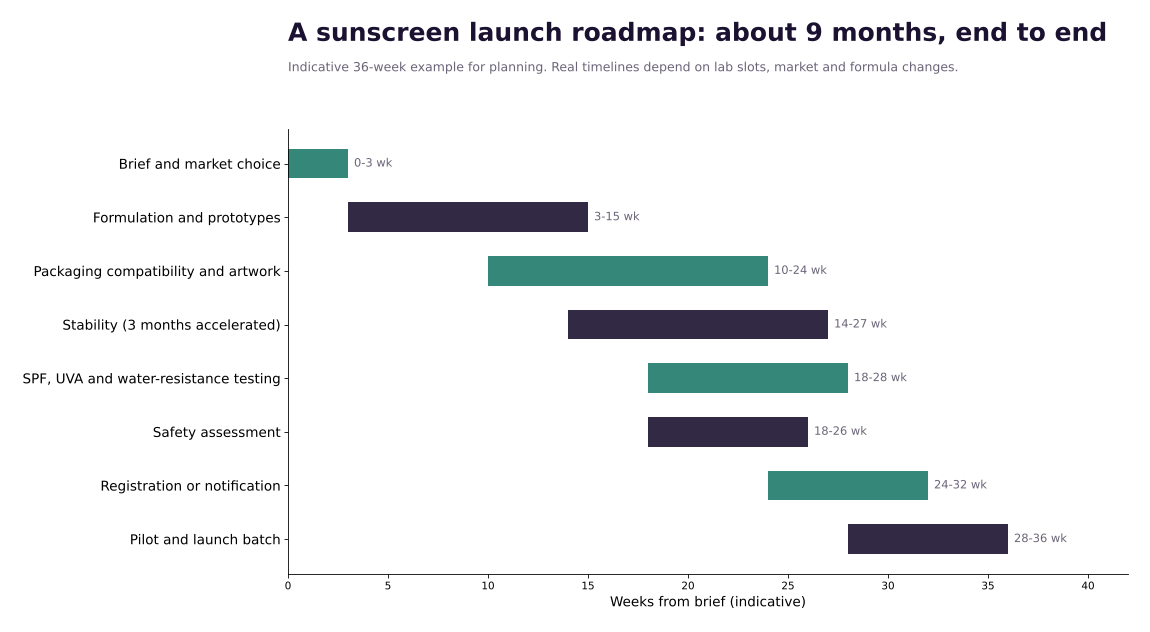
- Plan about eight to nine months from brief to launch batch, with stages overlapping; lab slots and registration set the pace.
Take-home message for formulators
- Lock the filter system early, then test the final film for SPF, UVA and water resistance.
- Any later change to the oil phase means retesting.
Take-home message for brand owners
- Settle your markets and claims before you brief a lab.
- Each market and each claim adds formulas, tests and files.
01Step 1: Choose your markets and route
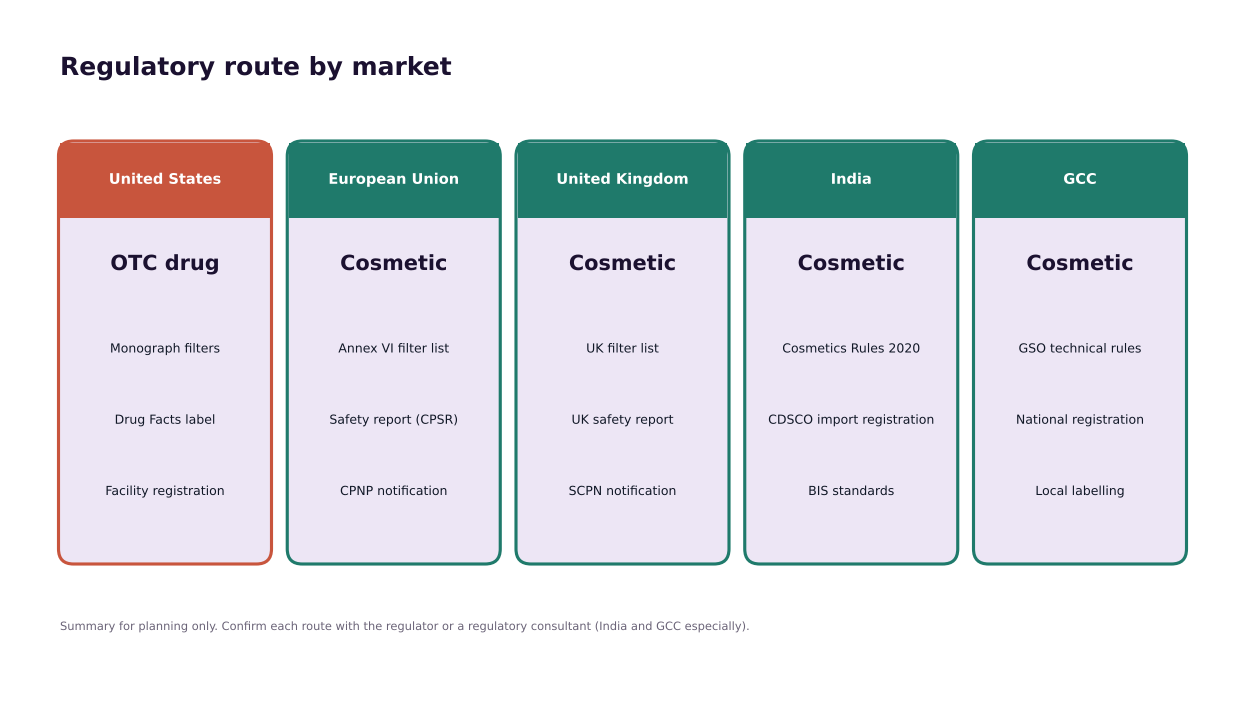
The route decides everything that follows, so settle it before you brief a lab. A drug route means monograph filters, a Drug Facts label and drug manufacturing rules. A cosmetic route means a safety report, a Responsible Person or local registrant, and a notification. Check the India and GCC rows with a local consultant, because requirements change.
| Market | Classification | Key files | Registration |
|---|---|---|---|
| US | OTC drug | Monograph M020 filters, Drug Facts label, drug GMP (21 CFR 211) [1] [2] | Establishment registration, labeler code and NDC, product listing in SPL format, yearly listing certification and the OMUFA facility fee [5] |
| EU | Cosmetic | Annex VI filters, safety report, product information file, GMP to ISO 22716 [3] [6] | Responsible Person and CPNP notification |
| UK | Cosmetic | UK filter list (now differs from the EU for some filters), UK safety report | UK Responsible Person; SCPN for Great Britain, EU CPNP for Northern Ireland [7] |
| India | Cosmetic | Cosmetics Rules 2020; UV filters in IS 4707 (Part 4); in vivo SPF to IS 17494:2025 [8] | Imports: registration certificate (Form COS-2). Local manufacture: state licence (Form COS-8) |
| GCC | Cosmetic | GSO 1943:2024 (safety, UV filters) and GSO 2528:2024 (claims), largely EU-aligned [9] | Differs by country: e.g. SFDA notification in Saudi Arabia; certificate of conformity plus emirate registration in the UAE |
02Step 2: Formulate to each market’s filter list
The US list is shorter than the EU list, and our guide on why US sunscreens lag Europe explains why. It is moving: in 2026 the FDA added bemotrizinol at up to 6% and removed PABA and trolamine salicylate [1] [10]. A single global formula must stay inside the filters allowed everywhere, at the lowest limit among your markets. Brands that want modern filters for Europe and a US-compliant version usually run two formulas.
Write each market’s allowed filters and limits into one filter gap table, and lock the oil phase early, because a change after the SPF test usually means retesting. The mineral vs chemical sunscreen hub explains the filters you will choose from.
03Step 3: Test the claims
- Water resistance. 40-minute and 80-minute immersion tests, following ISO 16217 or, for the US, M020.
- Newer methods. ISO 23675 (in vitro, double plate) and ISO 23698 (hybrid diffuse reflectance on skin) were published in December 2024 as alternatives to in vivo SPF [4]. Check that each market accepts them before you rely on them.
- Claims. Claim only what the tests support: SPF 50 needs an SPF 50 result, and broad-spectrum, UVA and water-resistant claims each have their own test.
Results can differ between methods and labs, as our guide to in vivo vs in vitro SPF testing explains, so confirm the SPF at an experienced lab before launch. See also our glossary entries on SPF and UVA protection.
04Step 4: Prove stability and safety
Run accelerated and real-time stability, including heat cycling [12], and check photostability for filters such as avobenzone. Add a preservative challenge test to ISO 11930 [13]. Test the pack with the formula, especially for pumps and sprays, as our packaging compatibility test guide explains. Labels also need an expiry date or a period after opening. For the EU and UK, a qualified safety assessor signs the safety report. In the US, the drug manufacturing rules apply.
05Step 5: Register, label and notify
- Appoint a Responsible Person for the EU and the UK.
- Plan registration or notification before launch in each market that requires it.
- Check each label for the market’s wording on SPF, UVA, water resistance and warnings.
- Keep the test reports and safety file where you can produce them on request.
06Choosing a development partner
Ask any lab or developer who owns the formula, which tests are included, where SPF testing is done, and how retests and formula changes are handled. A partner that covers formulation, testing and regulatory work in one team reduces hand-offs.
07Timeline ranges
As a planning example, formulation takes about 8 to 16 weeks, stability about 13 weeks of accelerated testing, and claim testing 4 to 10 weeks, followed by registration. Added end to end, that would be well over 36 weeks; because stability, claim testing and packaging work overlap, the plan below reaches a launch batch in about 36 weeks, or eight to nine months. These are approximate planning ranges, not guarantees. Lab slots, formula changes and market rules move them.
08What drives cost
We do not quote prices here, but these factors decide the budget: the number of markets, the number of claims, the number of formula rounds before the test version is locked, panel sizes and lab slots, and packaging choices including minimum order quantities. In the US, the yearly OMUFA facility fee is a fixed cost of the drug route [5]. In our experience, changes after a test are the most common avoidable cost, because each one can mean retesting.
Plan your sunscreen launch
Talk to CSL about product development for your target markets, from the brief to the pilot batch.
09Questions readers ask
Can I launch one sunscreen worldwide?
Rarely. Filter lists and limits differ, so most brands need at least two formulas.
Do I need to retest for each market?
Often yes, because methods and acceptance criteria differ, for example the FDA method against ISO 24444.
Can I sell a sunscreen as a cosmetic in the US?
Only if it makes no SPF or sun protection claim. Any such claim makes it a drug.
How long does it take to launch a sunscreen?
Plan about eight to nine months from brief to launch batch, with stability, claim testing and packaging work overlapping.
Launching a mineral sunscreen raises one common problem: white cast on darker skin. Next in this series: a worked example on reducing white cast in zinc oxide sunscreen.
10References
- US Food and Drug Administration. OTC Monograph M020: Sunscreen drug products for over-the-counter human use. Final administrative order OTC000006; 2021, as amended 2026 (testing in M020.80 and M020.90). fda.gov
- Current good manufacturing practice for finished pharmaceuticals. 21 CFR Part 211. eCFR
- Regulation (EC) No 1223/2009 of the European Parliament and of the Council of 30 November 2009 on cosmetic products. Off J Eur Union. 2009;L342:59–209. EUR-Lex
- International Organization for Standardization. ISO 24444:2019 (in vivo SPF); ISO 24443:2021 (in vitro UVA, Amd 1:2026); ISO 16217:2020 (water resistance); ISO 23675:2024 (in vitro SPF, double plate); ISO 23698:2024 (hybrid diffuse reflectance spectroscopy). Geneva: ISO. ISO 24444 · ISO 23675 · ISO 23698
- US Food and Drug Administration. How to list a drug [Internet]. Cited 2026 Nov 6. fda.gov
- International Organization for Standardization. ISO 22716:2007. Cosmetics — Good manufacturing practices (GMP). Geneva: ISO; 2007 (confirmed 2022). iso.org
- Office for Product Safety and Standards. Submit cosmetic product notifications (SCPN) [Internet]. GOV.UK. gov.uk
- Ministry of Health and Family Welfare (India). Cosmetics Rules, 2020. G.S.R. 763(E). Bureau of Indian Standards. IS 4707 (Part 4), permitted UV filters; IS 17494:2025 (ISO 24444:2019, MOD), in force from 10 Jan 2026. cdsco.gov.in
- GCC Standardization Organization. GSO 1943:2024 Cosmetic products: safety requirements; GSO 2528:2024 Cosmetic products: claims. Riyadh: GSO; 2024. gso.org.sa
- US Food and Drug Administration. Amending OTC monograph M020; final order OTC000039 (bemotrizinol). Fed Regist. 2026 Jun 10;91:35220. Federal Register
- Commission Recommendation 2006/647/EC of 22 September 2006 on the efficacy of sunscreen products and the claims made relating thereto. Off J Eur Union. 2006;L265:39–43. EUR-Lex
- International Organization for Standardization. ISO/TR 18811:2018. Cosmetics — Guidelines on the stability testing of cosmetic products. Geneva: ISO; 2018. iso.org
- International Organization for Standardization. ISO 11930:2019. Cosmetics — Microbiology — Evaluation of the antimicrobial protection of a cosmetic product. Geneva: ISO; 2019. iso.org
Update log
- Published by Cosmetic Science Lab
This article is general technical information, not legal, regulatory or medical advice. Confirm requirements for your product and market before launch.