Bisabolol in skin care: what the evidence shows for soothing skin
Bisabolol is a popular soothing ingredient from chamomile and candeia, but human trials of it on its own are few. CSL formulation scientists explain what the evidence does and does not support.
By CSL Formulation team · Evidence checked by CSL scientists
At a glance
- What it is
- Alpha-bisabolol (levomenol), a sesquiterpene alcohol from German chamomile and the candeia tree, also made synthetically
- Main benefits
- Calmer, more comfortable-looking skin; a small brightening effect in one controlled trial; helps other ingredients enter the skin
- Levels tested in trials
- 0.5% alone in the only vehicle-controlled trial; unstated levels in combination products; typical use 0.1% to 1%
- Time to results
- 2 to 8 weeks in the human studies found
- Watch for
- Rare allergy, mainly in people allergic to the daisy (Compositae) family; it can raise penetration of other ingredients
01What is it?
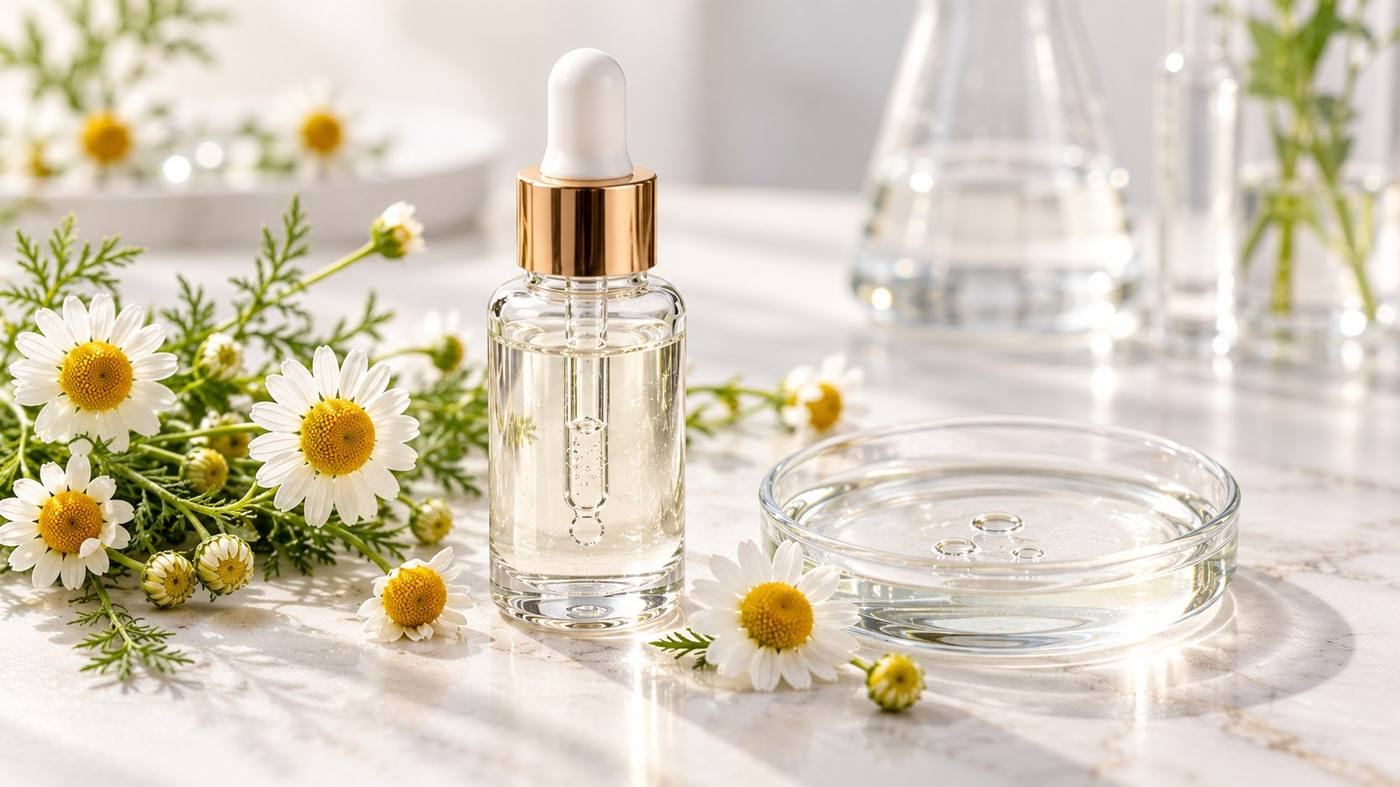
Bisabolol is an oily, almost colourless liquid found in chamomile essential oil and in candeia wood oil. Most cosmetic grades are the (−)-alpha form, either natural or nature-identical synthetic. It is used at low levels, usually well under 1%, as a soothing and comfort ingredient in creams, lip care and baby products.
02What it does
Laboratory and animal studies show that bisabolol damps down inflammatory signalling, which is the basis for its soothing reputation. It also loosens the lipids between skin cells, so it helps other ingredients pass into the skin. In people, the clearest result is a small reduction in measured skin colour over 8 weeks; the soothing benefit has been seen only in products that also contain other calming ingredients.
03The evidence
Studies below were checked against the publisher, DOI or journal record on 26 Sep 2026. We list design and size so you can judge the strength of each result.
| Study | Design | Who and how long | What it found |
|---|---|---|---|
| Lee et al. 2010, International Journal of Cosmetic Science (Wiley) Source | Randomised, double-blind, vehicle-controlled trial | 28 Korean women, 8 weeks, 0.5% alpha-bisabolol cream | Measured skin colour fell significantly more than with the vehicle from week 4; the dermatologist's pigmentation score also fell, but not significantly more than the vehicle. No side effects. |
| Varothai et al. 2024, International Journal of Dental Hygiene (Wiley) Source | Open-label pilot study, no control group | 20 adults with mild-to-moderate cheilitis (dry, chapped lips), 8 weeks, lip care with panthenol and bisabolol | Doctor and patient scores and instrument readings all improved from week 2 to week 8, with fewer flare-ups and no side effects. The design cannot show what bisabolol itself added. |
| Licari et al. 2017, Minerva Pediatrica Source | Assessor-blinded, three-centre study, no control group | 30 children with mild-to-moderate atopic dermatitis, 6 weeks, steroid-free cream with starch, glycyrrhetinic acid, zinc oxide and bisabolol | Eczema severity score fell by 74% (11.6 to 3.0); 87% of children improved by more than half, with one mild side effect. The effect cannot be credited to bisabolol alone. |
| Kadir and Barry 1991, International Journal of Pharmaceutics (Elsevier) Source | Laboratory study on human skin samples (not a clinical trial) | Excised human skin pretreated with bisabolol in propylene glycol | Penetration of two test drugs rose 17-fold and 73-fold, linked to more fluid skin lipids. This is the basis for bisabolol's role as a penetration enhancer. |
| Andersen (CIR) 1999, International Journal of Toxicology (SAGE) Source | Expert safety assessment | Review of animal, laboratory and human safety data; cosmetic use 0.001% to 1% | Concluded bisabolol is safe as used in cosmetics, with no sensitisation found in the tests reviewed, but warned that it may increase penetration of other ingredients. |
Bisabolol is a well-tolerated comfort ingredient with a long safety record, but the human evidence for it working on its own is thin: one small trial for brightening and none that isolate its soothing effect. Claims should stay modest and product-based, such as "helps soothe the look of dry, uncomfortable skin" or "formulated with bisabolol", supported by testing of the finished product.
04How CSL formulation scientists use it
- Typical use is 0.1% to 1%; the CIR assessment reported leave-on use up to 1%, and 0.5% is the level tested in the only vehicle-controlled trial.
- It is oil-soluble and fairly stable, so it is added to the oil phase or at the end of emulsions, and works well in lip care, baby care and after-sun products.
- Because it increases skin penetration, CSL formulation scientists review the whole formula, especially retinoids, acids, fragrance and preservatives, and confirm tolerance with finished-product testing.
- Source matters: confirm the grade (natural chamomile or candeia, or synthetic), its (−)-alpha-bisabolol content and its sustainability claims with the supplier.
05Regulatory and claims
The Cosmetic Ingredient Review Expert Panel concluded in 1999 that bisabolol is safe as used in cosmetics, and the conclusion was re-reviewed in 2015. CSL regulatory specialists confirm the status in each target market. Claims are kept cosmetic, for example "calms the look of redness" or "comforts dry lips", never "treats eczema" or "cures dermatitis".
06Questions brands ask
Is bisabolol proven to calm sensitive skin?
Not on its own. It calms inflammation in laboratory studies, and products containing it have helped dry lips and childhood eczema, but those products also contained other soothing ingredients and had no comparison group.
Does bisabolol brighten skin?
There is a small signal. One 8-week trial in 28 women found 0.5% bisabolol lightened measured skin colour more than the base cream, but the dermatologist's assessment did not differ significantly. It is best treated as a supporting ingredient, not a main brightener.
Can people with plant allergies use it?
Most can. Allergy is rare, but it has been reported mainly in people already allergic to the daisy family, which includes chamomile. Brands targeting very sensitive or atopic skin should include it in finished-product safety testing.
07References
- Lee J, Jun H, Jung E, Ha J, Park D. Whitening effect of alpha-bisabolol in Asian women subjects. Int J Cosmet Sci. 2010;32(4):299–303. Link
- Varothai S, et al. Efficacy of panthenol- and bisabolol-containing lip care as monotherapy for mild-to-moderate cheilitis. Int J Dent Hyg. 2024;22(3):711–716. Link
- Licari A, Ruffinazzi G, De Filippo M, et al. A starch, glycyrretinic, zinc oxide and bisabolol based cream in the treatment of chronic mild-to-moderate atopic dermatitis in children: a three-center, assessor blinded trial. Minerva Pediatr. 2017;69(6):470–475. Link
- Kadir R, Barry BW. α-Bisabolol, a possible safe penetration enhancer for dermal and transdermal therapeutics. Int J Pharm. 1991;70(1–2):87–94. Link
- Andersen FA. Final report on the safety assessment of bisabolol. Int J Toxicol. 1999;18(Suppl 3):33–40. Link
- Kamatou GPP, Viljoen AM. A review of the application and pharmacological properties of α-bisabolol and α-bisabolol-rich oils. J Am Oil Chem Soc. 2010;87:1–7. Link
- Ramazani E, Akaberi M, Emami SA, Tayarani-Najaran Z. Pharmacological and biological effects of alpha-bisabolol: an updated review of the molecular mechanisms. Life Sci. 2022;304:120728. Link
- Cosmetic Ingredient Review. Safety assessment of bisabolol as used in cosmetics (re-review, 2015). Link
Used in: Sensitive skin
Update log
- Evidence reviewed and page published by CSL scientists
This page summarises published research for brands and formulators. It is general information, not medical advice, and results in studies depend on the full formula tested.