Postbiotic lysates: what the evidence shows for calmer, stronger skin
Postbiotics are inactivated bacteria or their by-products. Some have placebo-controlled trials for reactive and dry skin. Here is what they show and how CSL formulation scientists use them.
By CSL Formulation team · Evidence checked by CSL scientists
At a glance
- What it is
- Non-living bacterial material: lysates of Vitreoscilla filiformis, Lactobacillus and related strains, or their metabolites
- Main benefits
- Calmer-looking, less reactive skin; better barrier and hydration readings; fewer visible blemishes in some trials
- Levels tested in trials
- 2% to 30% of the supplier ingredient; 5% Vitreoscilla filiformis lysate; 2% Bacillus coagulans metabolite; 3% Lactobacillus lysate blend
- Time to results
- 3 to 10 weeks in controlled studies
- Watch for
- Results are strain- and supplier-specific; most trials are small and industry-funded; one 2026 trial found no benefit
01What is it?
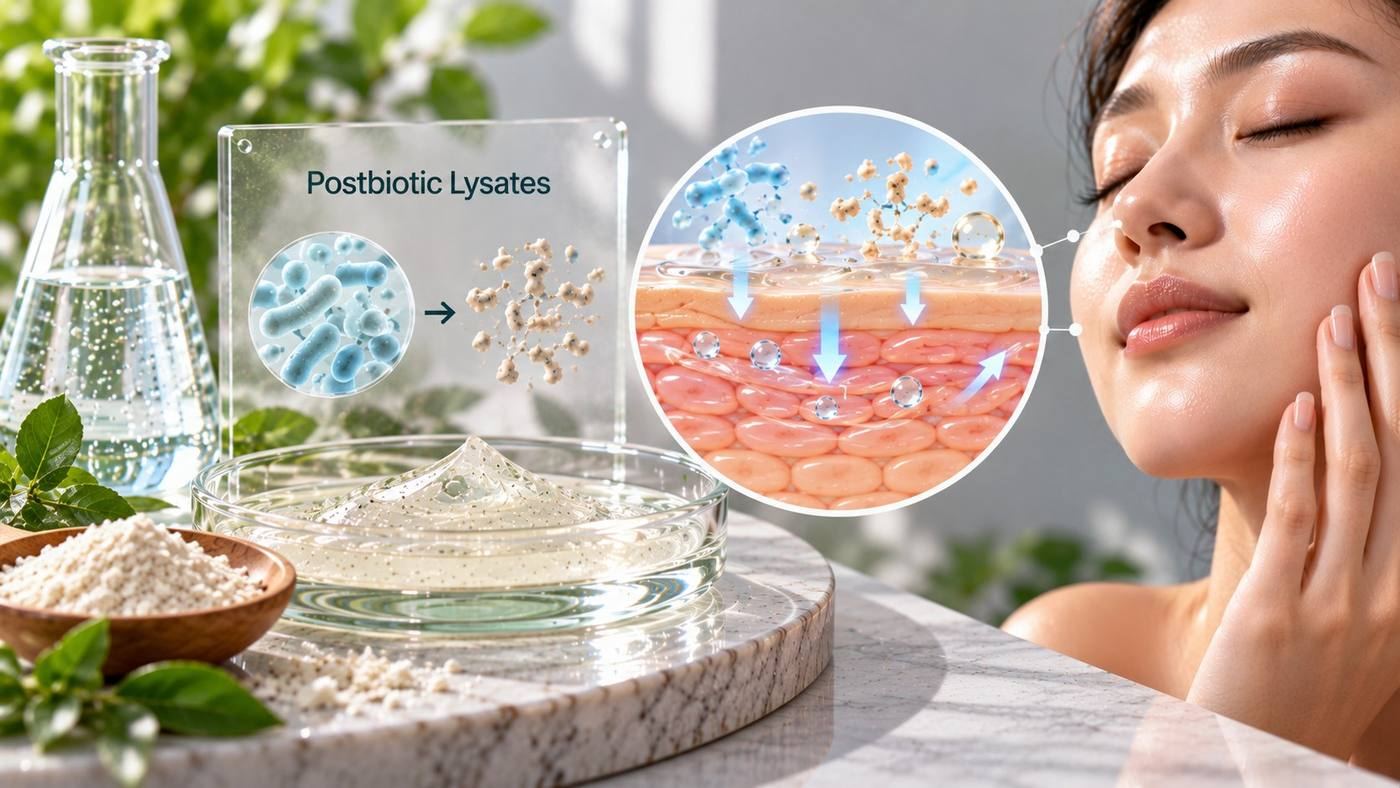
Postbiotics are bacteria that have been inactivated, broken open (lysed) or filtered to keep their by-products. They contain no live microbes, which makes them easier to formulate and preserve than probiotics. Each postbiotic comes from a specific strain, so results from one cannot be applied to another.
02What it does
Bacterial fragments and metabolites seem to talk to the skin's immune and barrier systems, calming reactivity and supporting the barrier. In trials this showed as less itching and redness, lower water loss, and in some acne studies fewer spots. Effects are usually moderate and appear within a few weeks.
03The evidence
Studies below were checked against the publisher, DOI or journal record on 26 Sep 2026. We list design and size so you can judge the strength of each result.
| Study | Design | Who and how long | What it found |
|---|---|---|---|
| Warp et al. 2026, Dermatology and Therapy (Springer Nature) Source | Systematic review | 33 studies, 2,112 people with acne; 6 topical postbiotic studies, mostly 3–8 weeks | Topical postbiotics reduced inflamed spots by about 46–55%, but trials were small, often open-label or split-face. The authors suggest them as add-ons, not replacements. |
| Salo et al. 2026, Frontiers in Medicine (Frontiers) Source | Randomised, double-blind, placebo-controlled split-body pilot | 13 adults with mild to moderate atopic dermatitis, 4 weeks plus 4 weeks follow-up, 3%, 10% and 30% Lactobacillus lactis lysate cream | Well tolerated, but no difference from placebo in severity, barrier function or quality of life. |
| Majeed et al. 2023, Clinical, Cosmetic and Investigational Dermatology (Dove Press) Source | Randomised, double-blind, placebo-controlled trial, manufacturer-funded | 56 healthy women, 10 weeks, 2% LactoSporin (Bacillus coagulans metabolite) cream | Crow's-feet wrinkles fell 22% versus almost no change with placebo; hydration and elasticity did not differ between groups. |
| Cui et al. 2023, Scientific Reports (Springer Nature) Source | Randomised study using each person as their own control, manufacturer-run | 52 adults, 30 days, lotion with 3% blend of four Lactobacillus ferment lysates | Water loss fell 26.8%, hydration rose 26.6% and redness fell 13.8% from baseline. |
| Seité et al. 2017, Clinical, Cosmetic and Investigational Dermatology (Dove Press) Source | Randomised, double-blind comparison of two emollients | 60 people with moderate atopic dermatitis, 1 month, emollient with Vitreoscilla filiformis biomass and mannose versus another emollient | Severity scores improved more with the Vitreoscilla emollient, alongside a shift in skin bacteria. |
| Gueniche et al. 2008, British Journal of Dermatology (Oxford) Source | Randomised, double-blind, placebo-controlled trial | 75 people aged 6–70 with atopic dermatitis, 30 days, 5% Vitreoscilla filiformis lysate cream | Severity score (P=0.0044) and itch (P=0.0171) fell more than with placebo, with better barrier readings. |
| Majeed et al. 2020, Cosmetics (MDPI) Source | Randomised, open-label comparison with 2.5% benzoyl peroxide, manufacturer-funded | 64 people with mild to moderate acne, 3 weeks, 2% LactoSporin cream | Open comedones fell 63% versus 50% with benzoyl peroxide; no irritation reported. Not blinded. |
Some postbiotics, especially Vitreoscilla filiformis lysate, have placebo-controlled evidence for calmer, better-protected skin, but the evidence is strain-specific, small and mostly industry-funded, and a 2026 trial found no benefit. Suitable claims are modest, such as “helps reduce the look of redness” or “supports the skin barrier”, tied to the exact ingredient and level tested.
04How CSL formulation scientists use it
- Use the supplier's tested strain at the level used in its trials, commonly 2% to 5% of the supplied ingredient. A different strain needs its own evidence.
- Postbiotics contain no live bacteria, so they fit standard preserved emulsions and serums. Check pH range, heat limits and colour or odour drift in stability testing.
- They pair well with barrier ingredients such as ceramides, glycerin and niacinamide in products for reactive, dry or blemish-prone skin.
- Ask suppliers for identity, strain name, inactivation method and microbiological specifications, plus any human data on the ingredient.
05Regulatory and claims
Bacterial lysates are used as cosmetic ingredients under INCI names such as Vitreoscilla ferment, Lactobacillus ferment lysate and Bifida ferment lysate. CSL regulatory specialists confirm the status in each target market before a formula is finalised. Avoid calling a product “probiotic” when it contains no live microbes, and keep claims cosmetic: “calms the look of sensitive skin”, not “treats eczema”.
06Questions brands ask
Is a postbiotic the same as a probiotic?
No. A probiotic contains live bacteria. A postbiotic contains inactivated bacteria or their by-products, which is why it can go into normal preserved products.
Do all bacterial lysates work the same way?
No. Effects depend on the strain and how it was made. Vitreoscilla filiformis lysate has the longest record, but a 2026 trial of a Lactobacillus lactis lysate found no benefit in atopic skin.
Can postbiotics replace acne actives?
Not on current evidence. Reviews suggest they may help alongside proven actives, but trials are small and short.
07References
- Warp PV, Bilik SM, Ferrari LM, et al. Prebiotics, probiotics, and postbiotics for acne vulgaris: a systematic review. Dermatol Ther (Heidelb). 2026;16(3):1531–1550. Link
- Salo, Remitz, Lauerma, Salava. Topical probiotic Lactobacillus lactis treatment in atopic dermatitis: a placebo-controlled pilot study on tolerability and efficacy. Front Med. 2026. Link
- Majeed M, Nagabhushanam K, Paulose S, Rajalakshmi HR, Mundkur L. A randomized double-blind, placebo-controlled study to evaluate the anti-skin-aging effect of LactoSporin. Clin Cosmet Investig Dermatol. 2023;16:769–782. Link
- Cui H, Feng C, Zhang T, et al. Effects of a lotion containing probiotic ferment lysate as the main functional ingredient on enhancing skin barrier: a randomized, self-control study. Sci Rep. 2023;13:16879. Link
- Seité S, Zelenkova H, Martin R. Clinical efficacy of emollients in atopic dermatitis patients – relationship with the skin microbiota modification. Clin Cosmet Investig Dermatol. 2017;10:25–33. Link
- Gueniche A, Knaudt B, Schuck E, et al. Effects of nonpathogenic gram-negative bacterium Vitreoscilla filiformis lysate on atopic dermatitis: a prospective, randomized, double-blind, placebo-controlled clinical study. Br J Dermatol. 2008;159(6):1357–1363. Link
- Majeed M, et al. Novel topical application of a postbiotic, LactoSporin, in mild to moderate acne: a randomized, comparative clinical study to evaluate its efficacy, tolerability and safety. Cosmetics. 2020;7(3):70. Link
Used in: Microbiome-friendly
Update log
- Evidence reviewed and page published by CSL scientists
This page summarises published research for brands and formulators. It is general information, not medical advice, and results in studies depend on the full formula tested.