Topical prebiotics: what the evidence shows for skin microbiome balance
Inulin and oligosaccharides are added to skin care to feed helpful skin bacteria. Human trials are few and small. Here is what they show and how CSL formulation scientists use prebiotics sensibly.
By CSL Formulation team · Evidence checked by CSL scientists
At a glance
- What it is
- Plant or dairy-derived sugars such as inulin, fructo-oligosaccharides (FOS), galacto-oligosaccharides (GOS) and alpha-glucan oligosaccharide
- Main benefits
- Support for a balanced skin microbiome; better hydration and barrier readings in small studies
- Levels tested in trials
- 7% GOS in a serum; inulin and FOS in a gel cream (level not stated); 6 g/L inulin in a bath
- Time to results
- 2 to 8 weeks in the studies available
- Watch for
- Few controlled trials; most studies use whole formulas, so the prebiotic's own effect is unclear
01What is it?
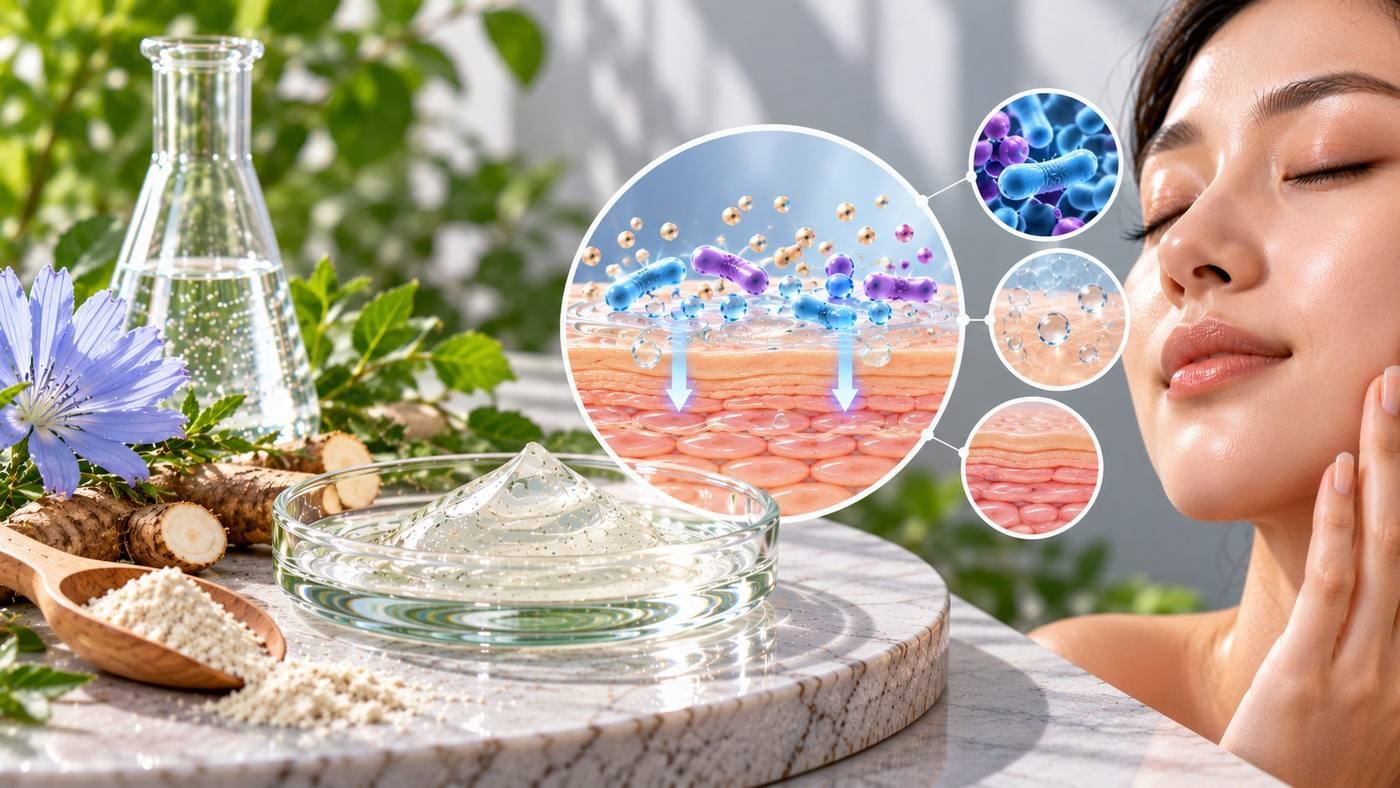
Prebiotics are sugars that some bacteria can use as food. In skin care the idea is to favour the skin's helpful bacteria over less welcome ones, without killing anything. Common choices are inulin, fructo-oligosaccharides and galacto-oligosaccharides. They are also humectants, so they help hold water in the skin.
02What it does
In lab work and small human studies, prebiotic formulas shifted the mix of skin bacteria and improved hydration and barrier readings. Some studies saw fewer acne spots or less redness. Because prebiotics are almost always tested inside a full moisturiser or cleanser, it is hard to say how much of the benefit comes from the prebiotic itself.
03The evidence
Studies below were checked against the publisher, DOI or journal record on 26 Sep 2026. We list design and size so you can judge the strength of each result.
| Study | Design | Who and how long | What it found |
|---|---|---|---|
| Warp et al. 2026, Dermatology and Therapy (Springer Nature) Source | Systematic review | 33 studies, 2,112 people with acne, 4–25 weeks, prebiotics, probiotics and postbiotics | Only one topical prebiotic study qualified; the authors rate evidence for topical prebiotics as limited and call for larger standardised trials. |
| Afzal et al. 2025, Journal of Cosmetic Dermatology (Wiley) Source | Open-label study, no control group, industry-funded | 30 adults with mild to moderate acne, 6 weeks, gel cream with inulin and FOS | Total spots fell 35.9% and skin bacteria shifted towards types linked with healthy skin. No comparison group, so the effect cannot be separated from time or routine. |
| Dumbuya et al. 2024, Journal of Drugs in Dermatology Source | Clinical study of a cleanser and moisturiser routine, industry-sponsored | 140 people with mild atopic-prone skin or severe dryness, from diverse ethnic groups; results at 4 weeks | The prebiotic routine reduced severity and improved barrier readings within 4 weeks. The published summary does not give the prebiotic ingredients or their levels. |
| Phan et al. 2023, Journal of Integrative Dermatology Source | Systematic review | 4 small trials of topical prebiotics in atopic-prone skin (22 to 60 people, 2 to 8 weeks) | Two trials showed clinically relevant improvement and two showed statistically significant but small changes. The authors call the results promising but not yet conclusive. |
| Noll et al. 2021, Microorganisms (MDPI) Source | Randomised, double-blind, placebo-controlled trial | 22 adults with atopic dermatitis, 14 days, daily bath with 6 g/L inulin, 3 g/L apple pectin and 2.88 g/L maltodextrin, with or without live bacteria | Both prebiotic and prebiotic-plus-bacteria baths lowered severity scores more than placebo; the combined bath did best. Groups had only 7 to 8 people each. |
| Hong et al. 2020, Journal of Personalized Medicine (MDPI) Source | Randomised, double-blind, placebo-controlled trial | 60 healthy adults, 8 weeks, serum with 7% galacto-oligosaccharides | Better water-holding and lower water loss than placebo, fewer Staphylococcus aureus and higher bacterial diversity (microbiome checked in 16 people). |
Prebiotics are gentle, safe humectants with an early but thin evidence base for microbiome support. The best controlled data are small, short trials of whole formulas. Suitable claims are modest, for example “supports the skin's natural balance” or “helps maintain a healthy-looking skin barrier”, backed by the finished product's own testing.
04How CSL formulation scientists use it
- Typical use is a few per cent of inulin, FOS or GOS in the water phase. The only controlled leave-on trial found used 7% GOS; CSL formulation scientists treat that as a guide, not a rule.
- Prebiotic sugars are water-soluble, heat-tolerant and easy to combine with humectants, ceramides and gentle cleansers. They can feed spoilage microbes too, so preservative efficacy testing is essential.
- Any claim about the microbiome needs product-level evidence, such as a before-and-after microbiome study on the finished formula, not just supplier data.
- Prebiotics suit cleansers, toners and moisturisers for dry, sensitive or blemish-prone skin, where the aim is balance rather than a dramatic visible change.
05Regulatory and claims
Inulin, fructo-oligosaccharides and galacto-oligosaccharides are common cosmetic ingredients. CSL regulatory specialists confirm the status in each target market before a formula is finalised. Claims such as “microbiome-friendly” must be supported by evidence on the finished product. Keep wording cosmetic, for example “supports the skin's natural balance”, not “treats eczema” or “cures acne”.
06Questions brands ask
Do prebiotics change the skin microbiome?
Small studies suggest they can shift the mix of skin bacteria. Changes were measured in a few people over weeks, and it is not yet clear how long they last or how much they matter for how skin looks.
Are prebiotics the same as probiotics?
No. Prebiotics are sugars that feed bacteria. Probiotics are live bacteria. Postbiotics are inactivated bacteria or their by-products. Each has its own, separate evidence.
Will a prebiotic cream help with spots?
One open study of an inulin and FOS gel cream saw about a third fewer spots in 6 weeks, but it had no comparison group. It is not a substitute for proven spot-care actives.
07References
- Warp PV, Bilik SM, Ferrari LM, et al. Prebiotics, probiotics, and postbiotics for acne vulgaris: a systematic review. Dermatol Ther (Heidelb). 2026;16(3):1531–1550. Link
- Afzal L, Dulai AS, Khan Z-e-h, et al. Open-label, prospective study of a prebiotic gel cream on its efficacy of mild to moderate acne management and effects on the functional skin microbiome. J Cosmet Dermatol. 2025;24(10):e70138. Link
- Dumbuya H, Podimatis K, Kerob D, Draelos ZD. Efficacy of a prebiotic skincare regimen on improving mild atopic dermatitis and severe xerosis in diverse ethnically patients. J Drugs Dermatol. 2024;23(3 Suppl 2):s12–s22. Link
- Phan K, Lee, Huynh, Hassan, Lio P. Topical prebiotics and microbiome metabolites: a systematic review of the effects of altering the skin microbiome in atopic dermatitis. J Integr Dermatol. 2023. Link
- Noll M, Jäger M, Lux L, Buettner C, Axt-Gadermann M. Improvement of atopic dermatitis by synbiotic baths. Microorganisms. 2021;9(3):527. Link
- Hong KB, et al. Changes in the diversity of human skin microbiota to cosmetic serum containing prebiotics: results from a randomized controlled trial. J Pers Med. 2020;10(3):91. Link
Used in: Microbiome-friendly
Update log
- Evidence reviewed and page published by CSL scientists
This page summarises published research for brands and formulators. It is general information, not medical advice, and results in studies depend on the full formula tested.