Cosmetic raw materials: specs, CoA and supplier qualification
A formula is only as good as the raw materials that go into it. This guide sets out which documents to request, what a specification should control and why, and how to qualify a supplier before the first lot arrives.
By Dr. Premalatha, Ph.D., Life Science, Regulatory Consultant, Cosmetic Science Lab

Raw materials at a glance
- Core documents
- Specification, CoA, TDS, SDS, allergen statement, REACH statement
- Per-lot check
- CoA results against your own specification
- Gmp basis
- ISO 22716: approved suppliers, inspection on receipt, release, quarantine of failed lots [1]
- Common mistake
- Accepting "conforms" without numbers
- Biggest hidden risk
- An unannounced change of source or grade
- Ingredient detail
- Ingredient A–Z
Quick answer
- Cosmetic raw materials should arrive with six documents: your specification, a lot-specific certificate of analysis (CoA), a technical data sheet (TDS), a safety data sheet (SDS), an allergen statement and a REACH statement. Qualify each supplier once, then check every lot's CoA against your specification before release.
- GMP under ISO 22716 means approved suppliers, inspection on receipt, documented release and quarantine of anything that fails [1].
- EU law requires GMP and a safety assessment that relies on raw material data [2].
- REACH registration falls on the EU manufacturer or importer at one tonne a year or more [3].
- A raw material can carry risk into the product: one 2022 US recall traced benzene to an aerosol propellant [6].
Take-home message for formulators
- Write your own specification; never rely only on the supplier's.
- Retest a material whenever the supplier, grade or origin changes.
Take-home message for brand owners
- Approve a backup source for every critical ingredient.
- Ask suppliers in writing to notify you of any change.
01Why cosmetic raw materials decide product quality
A formula typically combines a dozen or more ingredients, and each one brings its own impurities, moisture and microbial load. The EU requires products to be made under good manufacturing practice and to pass a safety assessment that uses raw material data, including impurities and traces of prohibited substances [2]. See our EU CPSR guide. If the input changes, the safety report, stability data and claims may no longer hold. That applies equally to skin care, hair care, body washes and other personal care products.
02The documents to request
| Document | What it proves | Red flag |
|---|---|---|
| Specification | The limits every lot must meet: identity, purity, pH, microbiology, impurities | No microbial or heavy-metal limits |
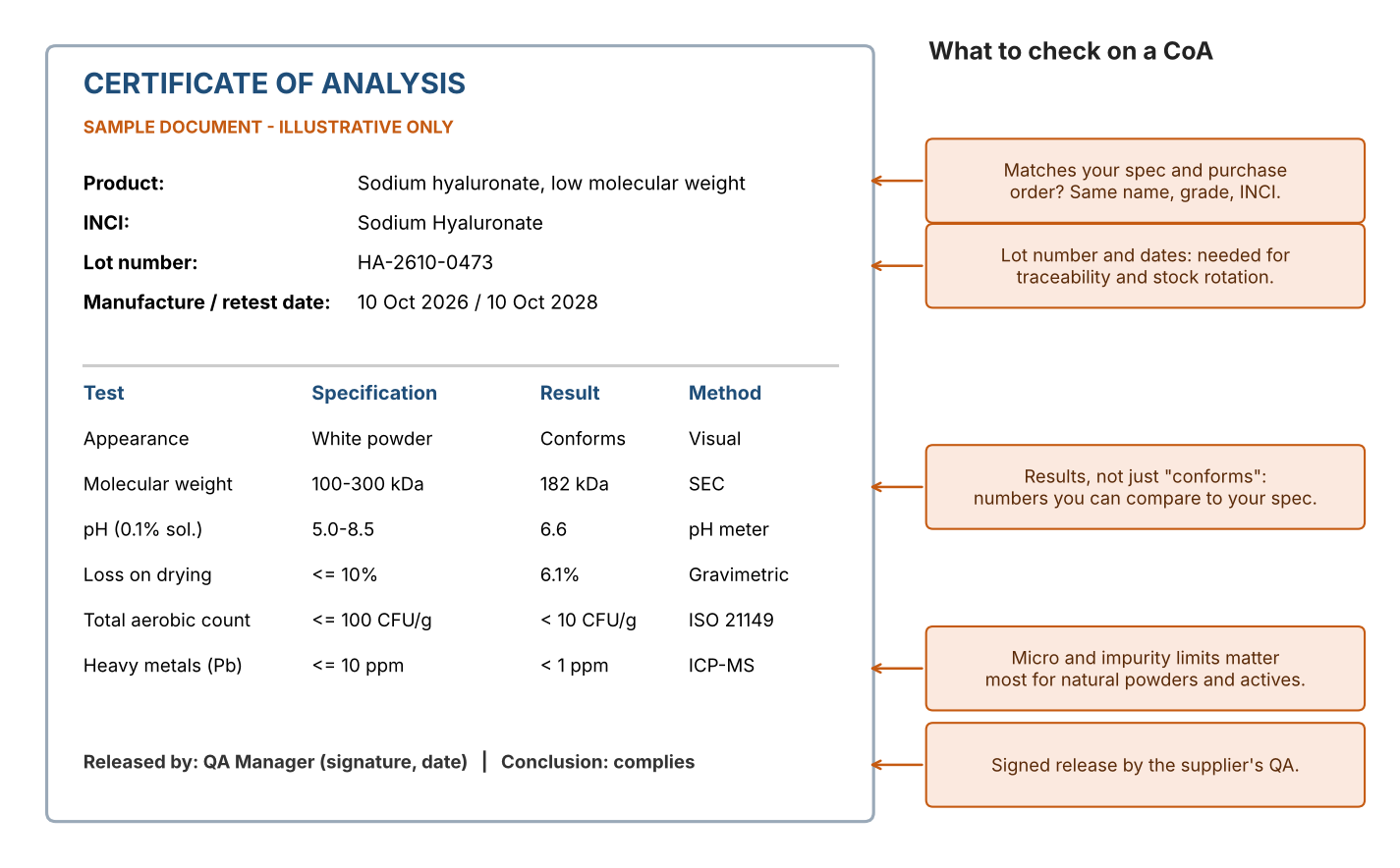
| Certificate of analysis (CoA) | Results for one lot against the specification, signed by the supplier's QA | "Conforms" with no numbers; generic CoA with no lot number |
| Technical data sheet (TDS) | Function, use level, solubility, processing advice | Use levels above legal limits |
| Safety data sheet (SDS) | Hazards, handling and storage; required for hazardous substances [3] | Out of date or wrong language |
| Allergen statement | Fragrance allergens present, for EU labelling | Missing for fragrance or botanical ingredients |
| REACH statement | Substance registered by the EU manufacturer or importer [3] | Supplier cannot name the registrant |
| Origin and certificates | Country of origin; halal, vegan or natural status (Halal cosmetics, Clean, natural & Ayurvedic) | Expired or not lot-linked |
| Animal testing statement | Confirmation that no animal testing was done to meet cosmetics requirements (EU marketing ban, Art. 18) [2] | Refusal to provide |
03The chemistry behind a specification
Two materials with the same INCI name can behave differently. The specification has to control what matters for your formula:
| Material | Critical spec parameters | Why |
|---|---|---|
| Hyaluronic acid (active ingredient) | Molecular weight range, assay, microbial count | Only low molecular weight hyaluronic acid reduced wrinkle depth in a 60-day trial, so molecular weight drives anti-ageing claims [5] |
| Benzyl alcohol | Purity, use level | Capped at 1% when used as a preservative (Annex V/34) and a labellable fragrance allergen (Annex III/45) [2][4] |
| Arrowroot powder and botanical powders | Total aerobic count, yeasts and moulds, moisture, heavy metals | Natural powders can carry high microbial loads and mineral impurities |
| Plant butters and oils for body butters (squalane) | Acid value, peroxide value, retest date | Oxidation shortens shelf life and causes off-odours |
| Surfactants for body washes (mild surfactants) | Active matter %, pH, preservative content | Active matter varies by grade and changes foam, viscosity and dosing |
04Evidence: what goes wrong
- Contaminated inputs reach consumers: in 2022, Unilever recalled US dry shampoos after its investigation identified the propellant as the source of benzene [6].
- Impurities have limits: Health Canada guidance treats lead above 10 ppm, arsenic or cadmium above 3 ppm, mercury above 1 ppm and antimony above 5 ppm as technically avoidable [7].
- Single-region supply breaks: Russia and Ukraine produced almost 60% of the world's sunflower oil in 2024/25 (12.0 of 20.4 million tonnes) [8], so one disrupted region can stop a formula. That is why our sourcing service qualifies a backup for critical oils.
- Traces must be justified: EU law allows traces of prohibited substances only when technically unavoidable and safe [2].
05How to qualify cosmetic ingredient suppliers
| Checklist item | What good looks like | Done |
|---|---|---|
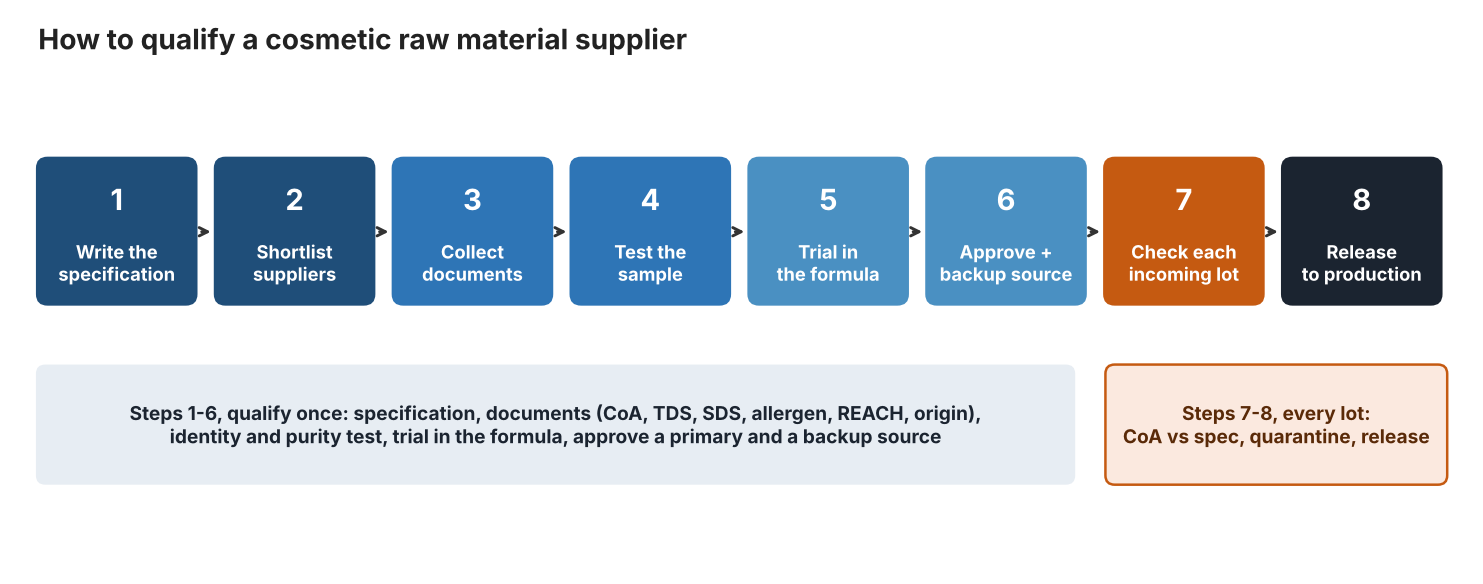
| Quality system | ISO 22716 or ISO 9001 certificate in date; GMP evidence and compliance record [1] | ☐ |
| Document pack | Spec, CoA, TDS, SDS, allergen, REACH, origin, animal testing statement | ☐ |
| CoA quality | Lot-specific, numeric results, signed release | ☐ |
| Sample testing | Identity and purity confirmed in your own or a partner lab | ☐ |
| Formula trial | Sample performs in your formula, including stability | ☐ |
| Supplier audit | Regular audits [1]; in our practice a questionnaire for low-risk items and an on-site or remote audit for actives and critical inputs | ☐ |
| Lot traceability | Each lot identified and tracked [1], with traceability back to the original manufacturer's batch | ☐ |
| Change notification | Written commitment to notify changes in source, process or grade | ☐ |
| Backup source | Second qualified supplier for critical ingredients | ☐ |
| Commercials | MOQ, lead time and retest period fit your plan | ☐ |
06Formulation and QA tips
- Hold every lot until the CoA is checked and any identity test is passed, and quarantine any lot that fails [1].
- Store as specified: keep moisture- and heat-sensitive materials, such as hyaluronic acid powder, sealed in controlled conditions and log storage records [1].
- Track retest dates and use stock first in, first out; retest before use if a lot passes its date.
- Be careful with wholesale repackers: small-pack raw materials bought wholesale are often repacked, and traceability to the original manufacturer can be lost. Ask for the original CoA.
- Re-run testing after a supplier change: a new source of the same INCI can shift stability or preservative performance; see the pre-launch testing checklist.
- Benchmark when in doubt: reverse engineering can confirm what a competitor's ingredient grade really is.
07For brands & formulators
Controlling cosmetic raw materials is cheaper than fixing a failed batch. Write the specification first, qualify suppliers against it, and check every lot. New founders can start at New brand? Start here.
Need raw materials sourced and qualified?
Our Sourcing & procurement team writes the ingredient specification, qualifies suppliers, tests samples, collects the document pack and delivers checked lots to your manufacturer, with no minimum order.
08Questions readers ask
What is a certificate of analysis for a cosmetic ingredient?
A lot-specific document from the supplier that lists each test, the specification limit and the actual result, signed off by the supplier's quality team.
What is the difference between a specification and a CoA?
The specification sets the limits a material must meet. The CoA reports the results for one lot against those limits.
How do I qualify cosmetic ingredient suppliers?
Write your own specification, collect the full document set, test a sample for identity and purity, trial it in the formula, then approve a primary and a backup source and check every incoming lot.
Does my brand need REACH registration for the ingredients it buys?
Registration falls on the EU manufacturer or importer of a substance at one tonne or more a year. Ask suppliers to confirm registration; safety data sheets apply regardless of volume.
09References
- Registrar Corp. ISO 22716 raw materials: GMP requirements for cosmetic ingredients. registrarcorp.com
- Regulation (EC) No 1223/2009 on cosmetic products, Articles 8, 10, 17 and 18 and Annexes I, III and V. Off J Eur Union. 2009;L342:59–209. eur-lex.europa.eu
- European Union. Your Europe: registering chemicals (REACH), frequently asked questions. europa.eu
- Safic-Alcan. Preservatives in cosmetics: EU regulatory guide 2026. 1 Jun 2026. safic-alcan.com
- Pavicic T, Gauglitz GG, Lersch P, Schwach-Abdellaoui K, Malle B, Korting HC, Farwick M. Efficacy of cream-based novel formulations of hyaluronic acid of different molecular weights in anti-wrinkle treatment. J Drugs Dermatol. 2011;10(9):990–1000. PMID: 22052267. PubMed
- US Food and Drug Administration. Unilever issues voluntary U.S. recall of select dry shampoos due to potential presence of benzene. Company announcement, 18 Oct 2022 (posted by FDA 21 Oct 2022). fda.gov
- Health Canada. Guidance on heavy metal impurities in cosmetics. Ottawa: Health Canada; 2012 (mercury limit amended). canada.ca
- US Department of Agriculture, Foreign Agricultural Service. Oilseeds: world markets and trade. Washington (DC): USDA FAS; Oct 2026. Table 13. fas.usda.gov
Update log
- Published by Cosmetic Science Lab
This article is general technical information, not legal, regulatory or medical advice. Confirm requirements for your product and market before launch.