DMDM hydantoin and formaldehyde releasers: what the chemistry and the evidence say
DMDM hydantoin preserves products by slowly releasing formaldehyde. Here is the chemistry, the contact dermatitis evidence, the new EU "releases formaldehyde" label rule, US state bans and the alternatives. Part of our preservation series.
By Dr. Premalatha, Ph.D., Life Science, Regulatory Consultant, Cosmetic Science Lab
At a glance
- What it is
- A formaldehyde-releasing preservative (INCI: DMDM Hydantoin)
- EU limit
- 0.6% in the ready-for-use product (Annex V) [1]
- EU label
- "Releases formaldehyde" where total formaldehyde released exceeds 0.001% [7]
- Main risk
- Allergic contact dermatitis in formaldehyde-sensitised people [2]
- US
- Washington State bans releasers from 1 Jan 2027 [10]
Quick answer
Take-home message for brand owners
- Check every market and retailer policy before choosing a releaser: US state bans are arriving.
- Budget for the label change or a reformulation.
Take-home message for formulators
- Measure formaldehyde release on aged samples, not just fresh batches.
- Avoid combining releasers: their contributions add up.
DMDM hydantoin is a preservative that works by slowly releasing small amounts of formaldehyde inside a water-based product. It is permitted in the EU at up to 0.6% [1] and remains in use because it is inexpensive and broad-spectrum. It is also a well-documented trigger of contact dermatitis in people already sensitised to formaldehyde [2]. This spotlight explains the chemistry, the evidence, the current rules and what formulators should check before choosing it.
01Why this ingredient keeps coming up
Preservatives have to kill microbes without harming the user, and that is a narrow window. Formaldehyde is a powerful antimicrobial, but it is classified by IARC as carcinogenic to humans (Group 1) [3] and is a classic skin allergen. Formaldehyde releasers were developed to deliver the antimicrobial effect from a stable parent molecule. Brands now face questions from retailers and consumers, because the word "formaldehyde" on a label is hard to explain to a shopper.
02The chemistry: an equilibrium, not a fixed dose
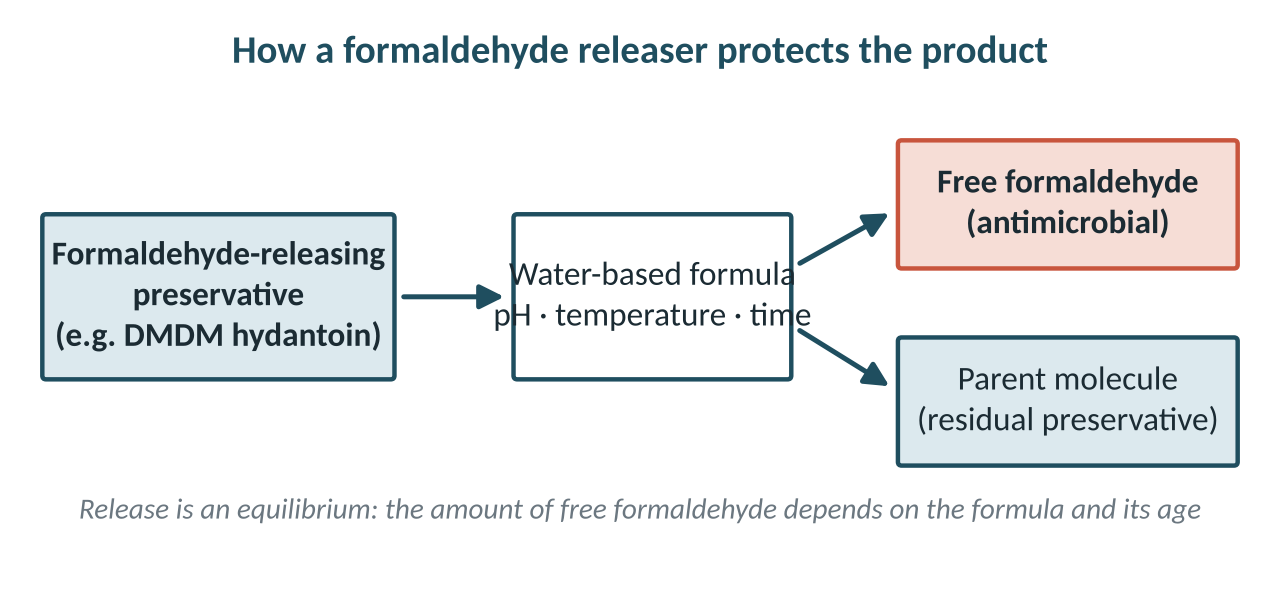
DMDM hydantoin carries two hydroxymethyl groups on a hydantoin ring. In water, these groups are in equilibrium with free formaldehyde, so the product always contains a small amount of formaldehyde that is replenished as it is consumed [2]. The family of releasers also includes quaternium-15, imidazolidinyl urea, diazolidinyl urea, bronopol and sodium hydroxymethylglycinate, and they differ widely in how much formaldehyde they release [4]. Quaternium-15 is no longer permitted in EU cosmetics: Regulation (EU) 2019/831 moved it from Annex V to Annex II [8].
The amount released is not a constant of the molecule. It changes with temperature, pH, the other ingredients and storage time [4]. Two creams with the same declared DMDM hydantoin level can therefore contain different amounts of formaldehyde, which is why a safety assessment based on the preservative level alone can understate or overstate the real exposure.
03What the evidence shows on contact dermatitis
The clinical picture is mainly allergic contact dermatitis. A two-part review of formaldehyde releasers in cosmetics found that people allergic to formaldehyde often, but not always, react to releasers, and that the relationship depends on the releaser and on how much formaldehyde it gives off in the product [2][4]. Reactions are most often reported in people who are already sensitised and who use leave-on or frequently repeated products. See our sensitive skin page for formulation choices in this area.
For consumers without formaldehyde allergy, the Cosmetic Ingredient Review (CIR) concluded in 1988 that DMDM hydantoin was safe as used at the concentrations then reported [5]. Hair loss is often cited online as a consequence of DMDM hydantoin, but causation has not been established in the sources cited here. The documented problem is allergic contact dermatitis, which can involve the scalp in a sensitised person.
04EU limits and labelling
In the EU, DMDM hydantoin is listed in Annex V of the Cosmetics Regulation with a maximum of 0.6% in the ready-for-use product [1]. Since Commission Regulation (EU) 2022/1181, any finished product containing an Annex V formaldehyde releaser must carry the warning "releases formaldehyde" where the total concentration of formaldehyde released exceeds 0.001% (10 ppm), whether it contains one releaser or several [7]. Products that met the old 0.05% rule could be placed on the market until 31 July 2024 and made available until 31 July 2026; that transition has now ended [7]. Formaldehyde and paraformaldehyde themselves are no longer permitted preservatives: Regulation (EU) 2019/831 moved them to Annex II, the list of prohibited substances [8]. Great Britain adopted the same 0.001% rule from 15 July 2026 [9].
Formulator check. Measure formaldehyde release in the finished product on aged samples with a validated method, such as HPLC after derivatisation. Release can change during storage, so a fresh batch alone does not show what a consumer will meet at month 12.
05The US position
At federal level, the US has no preservative positive list. Some states go further: California has banned formaldehyde, paraformaldehyde, methylene glycol and quaternium-15 in cosmetics since 1 January 2025 [11], and Washington State will prohibit intentionally added formaldehyde releasers, including DMDM hydantoin, imidazolidinyl urea, diazolidinyl urea, quaternium-15, bronopol and sodium hydroxymethylglycinate, from 1 January 2027, with retailer sell-through until 1 January 2028 [10]. Our guide to preservative rules by market compares the wider picture.
06How to recognise releasers on a label
On an ingredient list, formaldehyde releasers appear under their INCI names: DMDM Hydantoin, Imidazolidinyl Urea, Diazolidinyl Urea, 2-Bromo-2-Nitropropane-1,3-Diol (bronopol), Sodium Hydroxymethylglycinate and, outside the EU, Quaternium-15 [4]. People with a confirmed formaldehyde allergy are generally advised to avoid formaldehyde releasers; a dermatologist can confirm sensitisation by patch testing [2]. For brands, the European Commission's technical document on cosmetic claims states that a "free from formaldehyde" claim is not allowed if the product contains a formaldehyde-releasing ingredient [12].
07Formulation tips if you decide to use a releaser
- Keep the use level well inside the Annex V limit: allergic reactions are dose-related and elicitation thresholds in sensitised people are low [4].
- Avoid combining several releasers in one formula, since their formaldehyde contributions add up.
- As a precaution, avoid releasers in sprays, where inhalation adds exposure.
- Check the pH and temperature profile of the process.
Whatever preservative you choose, prove the system works. A challenge test to ISO 11930, interpreted with a microbiological risk assessment, confirms that the finished formula protects against bacteria, yeast and mould [6]. Our guide to preservative efficacy testing explains what it proves.
08Alternatives and what each one needs
Brands that move away from releasers usually choose phenoxyethanol, which Annex V allows at up to 1% [1], an organic acid system for low-pH products, or a mild preservative combined with a multifunctional booster. None is automatically gentler or stronger: phenoxyethanol is often combined with other preservatives to broaden its spectrum, and organic acids work only at low pH. Each option must be confirmed on the finished formula with a challenge test, because a preservative that works in one base can fail in another. Our guide to natural preservatives that pass a challenge test lays out the alternatives.
Reviewing a preservative system?
CSL screens alternatives to formaldehyde releasers and plans the testing that backs the choice.
09Questions readers ask
Is DMDM hydantoin banned in the EU?
No. It is permitted in Annex V at up to 0.6%. Products must be labelled "releases formaldehyde" when total formaldehyde released exceeds 0.001% (10 ppm).
Does DMDM hydantoin cause hair loss?
Causation has not been established in the sources cited here. The documented risk is allergic contact dermatitis in formaldehyde-sensitised people, which can involve the scalp.
How is a formaldehyde releaser different from formaldehyde?
A releaser is a parent molecule that slowly gives off formaldehyde in the product. The amount released depends on pH, temperature, formulation and age.
Is DMDM hydantoin banned in the US?
Not federally. California bans formaldehyde and quaternium-15, and Washington State bans formaldehyde releasers, including DMDM hydantoin, from 1 January 2027.
10References
- Regulation (EC) No 1223/2009 of the European Parliament and of the Council of 30 November 2009 on cosmetic products, Annex V (consolidated). Off J Eur Union. 2009;L342:59–209. EUR-Lex
- de Groot AC, White IR, Flyvholm MA, Lensen G, Coenraads PJ. Formaldehyde-releasers in cosmetics: relationship to formaldehyde contact allergy. Part 1. Characterization, frequency and relevance of sensitization, and frequency of use in cosmetics. Contact Dermatitis. 2010;62(1):2–17. doi:10.1111/j.1600-0536.2009.01615.x. DOI
- International Agency for Research on Cancer. Chemical agents and related occupations. IARC Monographs on the Evaluation of Carcinogenic Risks to Humans, Volume 100F. Lyon: IARC; 2012. IARC
- de Groot AC, White IR, Flyvholm MA, Lensen G, Coenraads PJ. Formaldehyde-releasers in cosmetics: relationship to formaldehyde contact allergy. Part 2. Patch test relationship to formaldehyde contact allergy, experimental provocation tests, amount of formaldehyde released, and assessment of risk to consumers allergic to formaldehyde. Contact Dermatitis. 2010;62(1):18–31. doi:10.1111/j.1600-0536.2009.01631.x. DOI
- Elder RL, editor. Final report on the safety assessment of DMDM hydantoin. J Am Coll Toxicol. 1988;7(3):245–77. doi:10.3109/10915818809023133. DOI
- International Organization for Standardization. ISO 11930:2019. Cosmetics – Microbiology – Evaluation of the antimicrobial protection of a cosmetic product (and Amd 1:2022). Geneva: ISO; 2019. ISO
- Commission Regulation (EU) 2022/1181 of 8 July 2022 amending the Preamble to Annex V to Regulation (EC) No 1223/2009 on cosmetic products. Off J Eur Union. 2022;L184:3. EUR-Lex
- Commission Regulation (EU) 2019/831 of 22 May 2019 amending Annexes II, III and V to Regulation (EC) No 1223/2009 on cosmetic products. Off J Eur Union. 2019;L137:29. EUR-Lex
- The Cosmetic Products Regulation (EC) No 1223/2009 (Restriction of Chemical Substances) (Amendment and Transitional Provisions) Regulations 2026. SI 2026/23. legislation.gov.uk
- Washington State Department of Ecology. WAC 173-339-110, Formaldehyde and formaldehyde releasers. Wash State Regist 25-18-057; 2025. Washington State Legislature
- California Assembly Bill 2762 (2020), Toxic-Free Cosmetics Act. LegiScan
- European Commission. Technical document on cosmetic claims, agreed by the Sub-Working Group on Claims. Brussels: European Commission; 2017. European Commission
Update log
- Published by Cosmetic Science Lab
This article is general technical information, not legal, regulatory or medical advice. Confirm requirements for your product and market before launch.