Worked example: a 'natural' cream that fails ISO 11930, and how to fix it
How a natural-certified face cream preserved with sodium benzoate and potassium sorbate would fail a challenge test at pH 5.8, how to diagnose it and how pH, preservative partners and process change the result. This is an illustrative worked example, not a client project. Part of our preservation series.
By Dr. Premalatha, Ph.D., Life Science, Regulatory Consultant, Cosmetic Science Lab
Worked example. This page is built from common patterns in natural-product testing. It does not describe a specific client project, and every value shown is illustrative, not measured.
At a glance
- Product
- Leave-on face cream, oil-in-water, COSMOS NATURAL-certified, in a jar (illustrative)
- Preservation
- Sodium benzoate, potassium sorbate and an essential-oil booster
- Problem
- P. aeruginosa and A. brasiliensis not controlled in the ISO 11930 test [1]
- Root cause
- pH 5.8: only about 2% of benzoic and 8% of sorbic acid active [7]
- Fix
- pH 4.9, chelator and multifunctional, process change, retest
Quick answer
- Why do natural creams fail ISO 11930? Usually not for exotic reasons: a pH too high for organic acids, ingredients that pull preservative out of the water phase, an ineffective booster and an open jar.
- Diagnose the mechanism before adding preservative: Annex V caps the dose [3].
Take-home message for brand owners
- A challenge test failure is information about mechanism, not a verdict on natural positioning.
- Build retest and stability time into the launch plan.
Take-home message for formulators
- pH is the cheapest lever for organic-acid systems; confirm it after processing.
- Screen several reformulations in parallel.
A challenge test failure in a natural cream rarely has an exotic cause. In this worked example, a leave-on face cream preserved with sodium benzoate, potassium sorbate and a plant-extract booster controls Staphylococcus aureus and Escherichia coli but not Pseudomonas aeruginosa, and gives weak control of Aspergillus brasiliensis. The reformulation changes pH, the preservative partners and the process, and the cream would then be retested. The steps apply to many natural formulas.
01The example formula
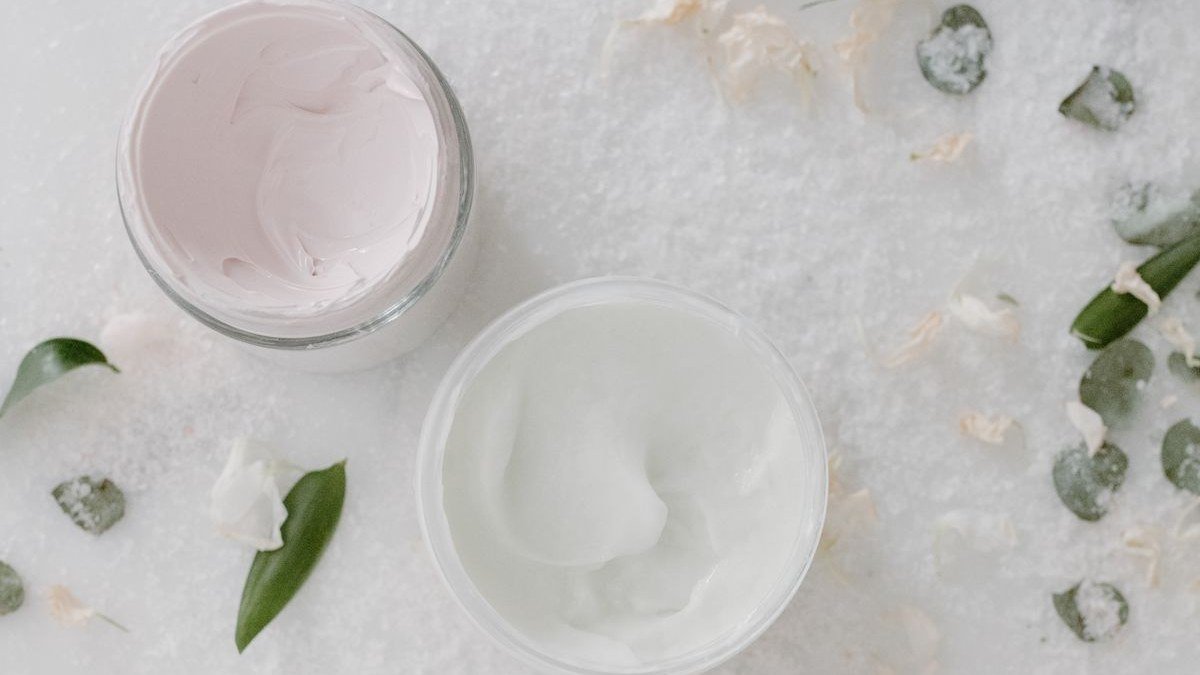
Imagine a brand selling a COSMOS NATURAL-certified moisturiser in a jar. The formula is an oil-in-water emulsion with plant oils, glycerin and a natural gum thickener, at pH 5.8 after adjustment. The preservative system is sodium benzoate and potassium sorbate within Annex V limits [3], plus an essential-oil-based booster chosen for its natural positioning. Assume launch is three months away.
02The problem
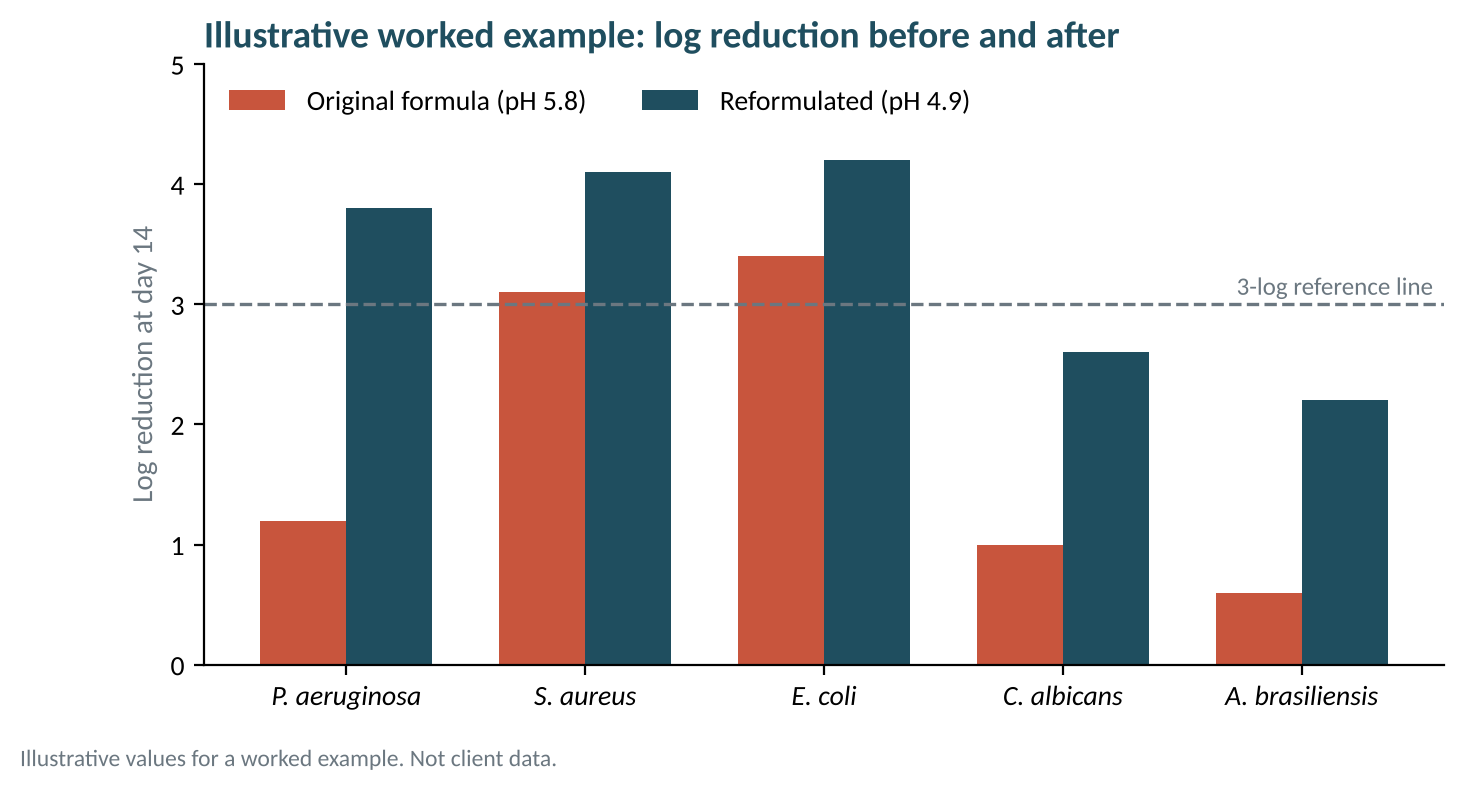
In this example, P. aeruginosa falls by only 1.2 log at day 14, short of the 3-log reduction that bacteria must reach by day 7 under criterion A and by day 14 under criterion B. A. brasiliensis falls by only 0.6 log at day 14, which puts at risk the 1-log reduction by day 28 that criterion A requires. A result that meets neither criterion means the formula is not adequately protected, so it needs reformulation and a retest before release. Meeting only criterion B is acceptable only when a documented microbiological risk assessment justifies it [1].
03Why natural systems fail more often
Natural-positioned formulas have fewer tools. Certification standards limit the preservatives available [4], the permitted organic acids work best at acidic pH [2][7], and plant oils, gums and sugars give microbes food. This formula also has a high water content and a pH chosen for skin feel rather than preservation. None of these is a flaw on its own; together they leave a very small margin, which is why screening before the formula is frozen matters. Our guide to natural preservatives that pass a challenge test explains each variable.
04Method: how to diagnose it
Start with the mechanism. At pH 5.8 only about 2% of benzoic acid (pKa 4.19) and 8% of sorbic acid (pKa 4.76) is in the undissociated, membrane-permeant form; at pH 4.9 these rise to roughly 16% and 42% [7]. The system is running well below its potential. Raising the dose alone cannot close the gap: in leave-on products Annex V caps benzoic acid and its sodium salt at 0.5% and sorbic acid and its salts at 0.6%, both expressed as acid [3]. The essential-oil booster is not delivering either: plant extracts lose much of their activity at the dilutions used in finished products [2].
Next, look at formula interactions. Non-ionic emulsifiers and oils can reduce the share of preservative available in the water phase, where microbes grow [2]. A jar also exposes the product to repeated finger contact during use. In this example, the process review shows that the preservative is added late in cool-down without a final pH check.
05Reformulation: what changes
- Lower the pH.
From 5.8 to 4.9 with a lactic acid solution, which raises the active fraction of both acids.
- Replace the booster.
Remove the essential oil and add a chelating agent and a multifunctional ingredient (for example a bio-based glycol) chosen from raw materials approved for COSMOS use. Chelating agents can boost preservatives by making bacterial membranes more permeable [2].
- Set the dose by testing.
Keep each preservative within its Annex V limit and at a level the challenge test shows to be effective; good preservation is often possible below the legal maximum [3][5].
- Fix the process.
Dissolve the preservatives in the water phase before emulsification, and check the final pH after cooling.
06Illustrative data: before and after
| Organism | Original (pH 5.8) | Reformulated (pH 4.9) |
|---|---|---|
| Pseudomonas aeruginosa | 1.2 | 3.8 |
| Staphylococcus aureus | 3.1 | 4.1 |
| Escherichia coli | 3.4 | 4.2 |
| Candida albicans | 1.0 | 2.6 |
| Aspergillus brasiliensis | 0.6 | 2.2 |
ISO 11930 is judged at days 7, 14 and 28, so day 14 alone does not decide pass or fail [1]. The pattern is realistic: lowering pH has the biggest effect on the organisms that escaped.
07Timeline of the fix
| Stage | Illustrative timing | What happens |
|---|---|---|
| Failure reported | Week 0 | ISO 11930 result shows two organisms not controlled |
| Diagnosis | Week 1 | pH, preservative level, booster and process reviewed |
| Screening | Weeks 2–5 | Three reformulated prototypes tested in parallel |
| Final test | Weeks 6–11 | Selected formula tested to ISO 11930 in the final jar |
| Stability | Months 3–6 | Accelerated study and a challenge test on an aged sample |
08Outcome and lessons
In this scenario the reformulated cream meets criterion A of ISO 11930 at all time points [1], and a three-month accelerated stability study shows that pH, viscosity and appearance hold [6]. The challenge test is repeated on an aged sample. Because that work runs to month six, launch moves back until it is complete. The brand keeps its natural positioning and launches only once preservation has been proven on the finished product in its final pack.
- Diagnose before you dose.
A failure is information about mechanism.
- Use pH first.
It is the cheapest lever for organic-acid systems, and must be confirmed after processing.
- Prove it on the real product.
Finished product, final pack, aged sample: not a lab prototype [1][6].
09What this example does not show
Every formula behaves differently, and lowering pH has side effects: a thickener can lose viscosity, an active can become less stable and skin feel can change, so monitor them in stability [6]. A lower pH is not a universal fix either: some products must sit near neutral and need a different approach. Before you finalise, check pH after processing, check each preservative against its Annex V limit [3], check for ingredients that bind preservatives, check the pack and screen before you freeze the formula. For planning the testing, see budgeting for a challenge test and stability study.
Has your formula failed a challenge test?
CSL diagnoses the cause, plans the reformulation and screens it before the final test.
10Questions readers ask
What happens if a cream fails ISO 11930?
It is not adequately protected, so it needs reformulation and a retest before release, unless criterion B is met and justified by a documented risk assessment.
Can I just add more preservative?
Rarely. Annex V caps the dose, and if pH is the problem more preservative will not help much.
Why lower the pH of a natural cream?
Benzoic and sorbic acids work in their undissociated form, which rises sharply as pH falls toward their pKa.
Does a jar make preservation harder?
Yes. A jar allows repeated finger contact, so the preservative system has to cope with more contamination than in a pump pack.
11References
- International Organization for Standardization. ISO 11930:2019. Cosmetics – Microbiology – Evaluation of the antimicrobial protection of a cosmetic product (and Amd 1:2022). Geneva: ISO; 2019. ISO
- Halla N, Fernandes IP, Heleno SA, Costa P, Boucherit-Otmani Z, Boucherit K, et al. Cosmetics preservation: a review on present strategies. Molecules. 2018;23(7):1571. doi:10.3390/molecules23071571. MDPI
- Regulation (EC) No 1223/2009 of the European Parliament and of the Council of 30 November 2009 on cosmetic products, Annex V (consolidated). Off J Eur Union. 2009;L342:59–209. EUR-Lex
- COSMOS-standard AISBL. COSMOS-standard: cosmetics organic and natural standard. Version 4.2. Brussels: COSMOS-standard AISBL; 2025. COSMOS
- Lundov MD, Moesby L, Zachariae C, Johansen JD. Contamination versus preservation of cosmetics: a review on legislation, usage, infections, and contact allergy. Contact Dermatitis. 2009;60(2):70–8. doi:10.1111/j.1600-0536.2008.01501.x. DOI
- Cosmetics Europe; CTFA. Guidelines on stability testing of cosmetic products. Brussels: Cosmetics Europe; 2004. Cosmetics Europe
- Hazan R, Levine A, Abeliovich H. Benzoic acid, a weak organic acid food preservative, exerts specific effects on intracellular membrane trafficking pathways in Saccharomyces cerevisiae. Appl Environ Microbiol. 2004;70(8):4449–57. doi:10.1128/AEM.70.8.4449-4457.2004. PMC
Update log
- Published by Cosmetic Science Lab
This article is general technical information, not legal, regulatory or medical advice. Confirm requirements for your product and market before launch.