Cosmetic preservative efficacy testing: what challenge tests prove for hygiene products
Hand washes, body washes and wipes are water-rich and opened with wet hands every day. Here is what a preservative challenge test proves for hygiene products, how criteria A and B really work and what "preservative-free" claims need. Part of our testing and safety series.
By Dr. Premalatha, Ph.D., Life Science, Regulatory Consultant, Cosmetic Science Lab
At a glance
- Test
- Preservative efficacy (challenge) test, ISO 11930 [1]
- Organisms
- Two Gram-negative bacteria, one Gram-positive, a yeast and a mould
- Time points
- Day 7, 14 and 28
- Products in focus
- Hand wash, body wash, intimate hygiene products, wet wipes
- Caveat
- Evidence of protection, not a guarantee; GMP still has to keep contamination out [4]
Quick answer
- What does a challenge test prove? That the preservative system brings deliberately added microbes down fast enough to meet defined criteria over 28 days [1].
- Criteria A is the target. Meeting only criteria B is acceptable when a documented risk assessment shows other protection, such as a protective pack [1].
- Microbiologically low-risk products can be justified by a risk assessment instead of a challenge test [5].
- A water-based product called "self-preserving" still has to pass a challenge test.
Take-home message for brand owners
- Plan the first challenge test during development, not after packaging is printed.
- Check "preservative-free" and "antibacterial" wording before it reaches a label.
Take-home message for formulators
- Test the lowest preservative level you plan to use.
- Watch for surfactants, polymers and pH shifts that weaken the preservative.
A bottle of hand wash looks simple, yet it is a water-rich product opened with wet hands in a damp room, every day, for months. Cosmetic preservative efficacy testing answers the question that matters: will the preservative system keep the product safe after it has been contaminated? This article explains what a challenge test proves for hygiene products, what it cannot prove and how to read the result. For the method in full, see our ISO 11930 preservative efficacy testing guide.
01What a preservative challenge test does
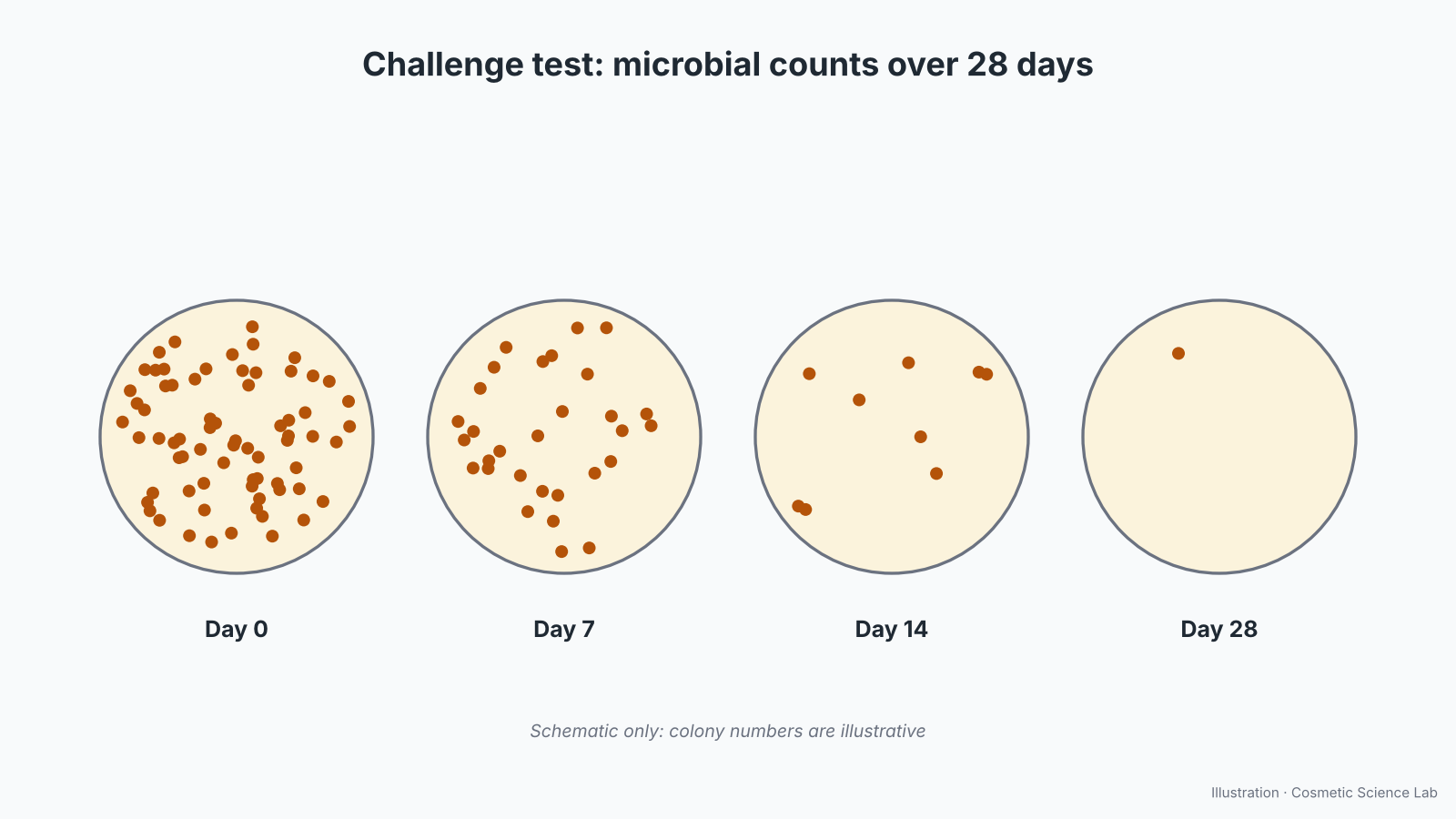
In a challenge test, a sample of the product is deliberately inoculated with defined microorganisms and then counted at set intervals to see how fast the numbers fall. ISO 11930 uses a panel of bacteria, a yeast and a mould: Pseudomonas aeruginosa, Staphylococcus aureus, Escherichia coli, Candida albicans and Aspergillus brasiliensis [1]. (The P. aeruginosa reference strain used in these methods, ATCC 9027, has since been reclassified as P. paraeruginosa.) Counts are taken after 7, 14 and 28 days and compared with the acceptance criteria.
The European Pharmacopoeia test for efficacy of antimicrobial preservation follows a similar logic, with its own criteria and time points; USP <51> is the US equivalent [2]. The test is run on the finished formulation. The pack is taken into account in the risk assessment that goes with it.
02What challenge tests prove, and what they do not
| Test | What it shows | What it does not show |
|---|---|---|
| Preservative challenge test | Whether the preservative system reduces added microbes over 28 days [1] | Whether the pack stays clean in daily use |
| Microbial limit test | Whether a batch is within limits for total counts and specified organisms [3] | Whether the product could resist future contamination |
| Stability study | Whether physical and chemical properties hold over time | Whether the preservative still works at the end of shelf life |
| Consumer in-use test | How the product behaves in real homes | Controlled reductions for specific organisms |
A challenge test is evidence of protection, not a guarantee. Good manufacturing practice, such as ISO 22716, still has to keep contamination out in the first place [4].
03Why hygiene products need extra care
Hand washes, body washes, intimate hygiene products and wet wipes are exposed to water, fingers and warm bathrooms. Their water content is high, and several features of their formulas can quietly weaken preservation. Some non-ionic surfactants and polymers can bind or inactivate certain preservatives. A change in pH can reduce activity. A pump bottle protects the contents better than an open jar, and wipes add the question of how much lotion actually sits in the pack. For these reasons, the microbial protection of personal-care and hygiene products should be tested early and again on aged samples, not once on a fresh batch.
04How a preservative efficacy study is designed
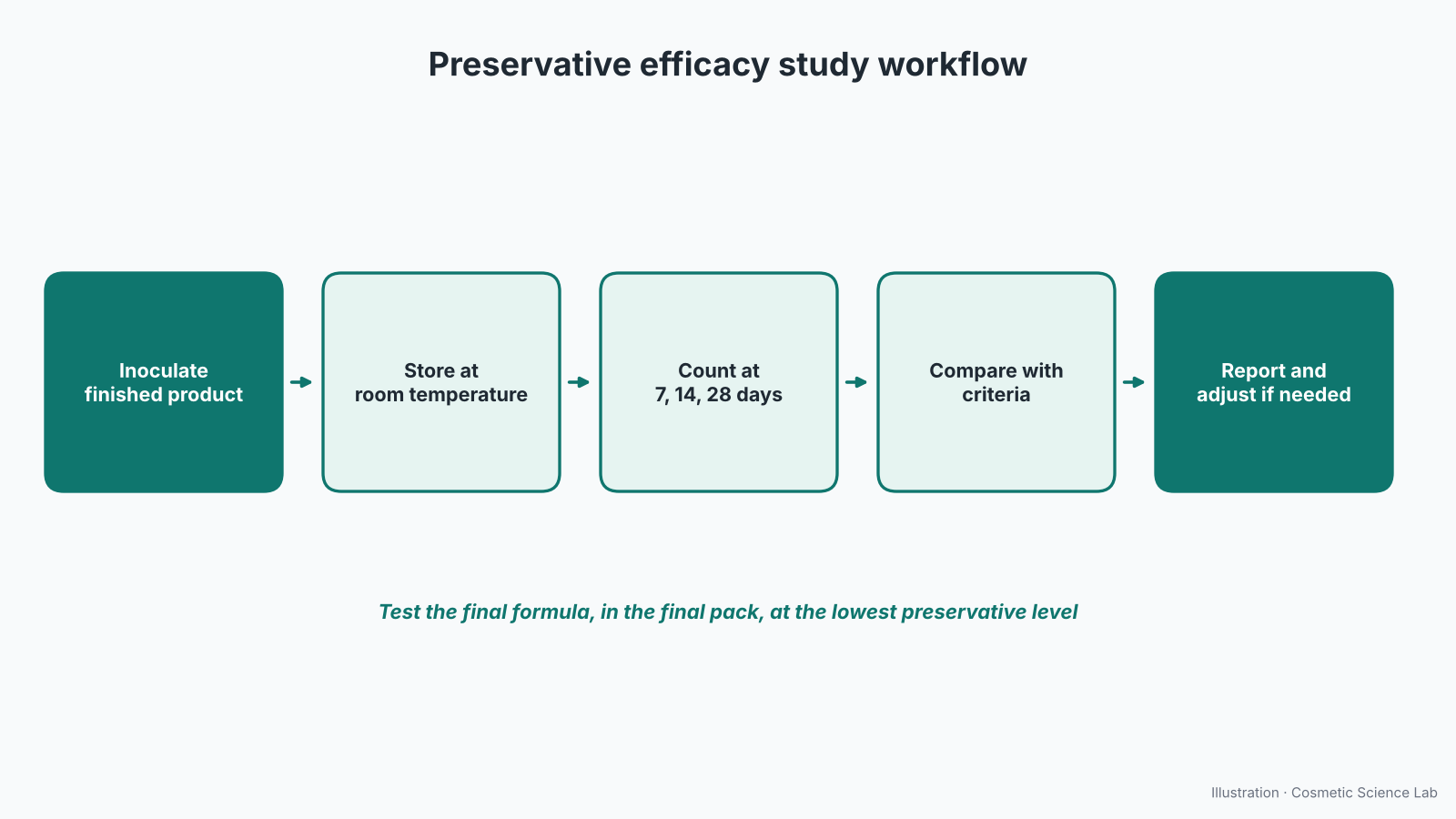
- Worst case: test the lowest preservative level you plan to use.
- Final pack in the risk assessment: record the real container and opening, because the pack is part of the protection argument.
- Aged samples: repeat on samples at the end of the stability period.
- Criteria A as the target: plan for criteria A and justify any reliance on criteria B in writing.
- Extra challenge: where heavy daily use is expected, consider a repeat-inoculation (rechallenge) test as well. This goes beyond ISO 11930.
05Choosing acceptance criteria
ISO 11930 defines two sets of acceptance criteria, A and B [1]. Criteria A is the target. A result that meets criteria B but not A is acceptable only when a documented risk assessment shows that other factors, such as a protective pack (pump, airless or single-use), give the product adequate protection. That justification belongs in the study report. Criteria B is not a lighter tier to pick because a product is rinse-off or mild.
06Typical failure patterns in hygiene formulas
- A mild, low-preservative formula that passes against bacteria but fails against mould.
- A preservative that works at one pH and loses activity after a small shift.
- A surfactant or polymer system that binds part of the preservative.
- A pack with a wide opening that allows repeated contamination.
- A batch made under poor hygiene, where the starting load is already high.
07Reading the result and responding to a failure
A pass means the product met the chosen criteria at each time point. A fail is information, not a verdict. The usual responses are to raise or combine preservatives, adjust pH, change an interfering surfactant or improve the pack. The study is then repeated on the revised sample, with the change recorded.
- Development.
Run the first test while the preservative system can still be changed easily.
- Confirmation.
Test the final formula, and record the final pack in the risk assessment.
- Aged samples.
Show that protection lasts to the end of shelf life.
08Preservative-free, self-preserving and antibacterial claims
Some formats can be microbiologically low risk, such as anhydrous products, products with very low water activity, high alcohol content or extreme pH, and products in packs that keep microbes out. ISO 29621 sets out how to document that, and a challenge test may then not be needed [5]. A water-based product described as "self-preserving" still has to pass a challenge test. In the EU, guidance on claims treats "preservative-free" as misleading if any ingredient has a preserving function, even one not listed as a preservative [6].
"Antibacterial" claims on a hygiene product are a separate matter: they need a different type of efficacy study and may fall under rules other than cosmetic law, so check them before they appear on a label. Our guide to microbiome-friendly claims and preservation covers the gentler end of the same question.
09Documents to keep on file
Keep the protocol, the organism list, the counts at every time point, the batch and pack details, any criteria B justification and the final conclusion in one place. In the EU, the cosmetic product safety report must include the product's microbiological quality and the results of preservation challenge testing (Regulation (EC) No 1223/2009, Annex I, Part A, section 4) [7]. Our EU safety assessment guide explains how this testing feeds the report, and our microbiology evidence library covers microbial limits and the skin microbiome.
Need a challenge test for a hygiene product?
CSL plans preservative efficacy testing alongside stability work, so a failure is found while the formula can still change.
10Questions readers ask
How long does a preservative challenge test take?
The ISO 11930 test runs for 28 days after inoculation, with counts at day 7, 14 and 28, plus time for set-up and reporting.
What is the difference between criteria A and B in ISO 11930?
Criteria A is the target. A product that meets only criteria B needs a documented risk assessment showing other protection, such as a protective pack.
Does a preservative-free product need a challenge test?
A water-based one does. A microbiologically low-risk product can instead be justified with a risk assessment under ISO 29621.
Does a challenge test replace a microbial limit test?
No. The limit test checks each batch's counts and specified organisms; the challenge test checks how well the preservative copes with added microbes.
11References
- International Organization for Standardization. ISO 11930:2019. Cosmetics – Microbiology – Evaluation of the antimicrobial protection of a cosmetic product (and Amd 1:2022). Geneva: ISO; 2019. ISO
- European Directorate for the Quality of Medicines & HealthCare. European Pharmacopoeia, chapter 5.1.3: Efficacy of antimicrobial preservation. Strasbourg: EDQM. EDQM
- International Organization for Standardization. ISO 17516:2014. Cosmetics – Microbiology – Microbiological limits. Geneva: ISO; 2014.
- International Organization for Standardization. ISO 22716:2007. Cosmetics – Good Manufacturing Practices (GMP) – Guidelines on Good Manufacturing Practices. Geneva: ISO; 2007. ISO
- International Organization for Standardization. ISO 29621:2017. Cosmetics – Microbiology – Guidelines for the risk assessment and identification of microbiologically low-risk products. Geneva: ISO; 2017.
- European Commission. Technical document on cosmetic claims, agreed by the Working Group on Cosmetic Products. Brussels: European Commission; 2017 (Annex III on "free from" claims applies from July 2019).
- Regulation (EC) No 1223/2009 of the European Parliament and of the Council of 30 November 2009 on cosmetic products. Off J Eur Union. 2009;L342:59–209. EUR-Lex
Update log
- Published by Cosmetic Science Lab
This article is general technical information, not legal, regulatory or medical advice. Confirm requirements for your product and market before launch.