Budgeting for a challenge test and stability study
Testing cost depends on how many formulas, packs and markets you test, not on a price per test. Here are the market checklist, timelines, cost drivers, a staged budget and how to brief a laboratory. Part of our preservation series.
By Dr. Premalatha, Ph.D., Life Science, Regulatory Consultant, Cosmetic Science Lab
At a glance
Quick answer
- What drives the cost of a challenge test and stability study? The number of formulas, packs and markets you test, the method required and how many retests you need, not a single price per test.
- Plan about five weeks per challenge test: 28 days of incubation plus set-up and reporting [1].
- Accelerated stability is an early signal; real-time data confirm the stated shelf life [2].
- Screen preservative systems before the formula is frozen: it is the cheapest place to fail.
Take-home message for brand owners
- Release budget gate by gate, and plan for at least one retest.
- Never save money by testing a different pack from the one you sell.
Take-home message for formulators
- Group similar formulas into families and test the worst case.
- Make enough sample for every time point before testing starts.
The cost of a preservative efficacy test depends on how many formulas, packs and markets you test, not on a single price per test. A challenge test needs 28 days of incubation [1], and stability testing runs for months [2]. This guide shows the sequence, the timelines and the cost drivers, so you can brief a laboratory and set a launch date that holds. It gives no prices, because quotes depend on scope.
01Step 1: a market-by-market checklist
Start with where you will sell, because each market asks for different evidence. The EU [4] and Great Britain [9] both require a cosmetic product safety report whose stability and microbiological sections include the challenge test results (Annex I, Part A); the EU also requires notification through the CPNP, and Great Britain through the SCPN. The US requires adequate safety substantiation, product listing and facility registration under MoCRA [5]. India requires registration of imported cosmetics under the Cosmetics Rules, 2020 [6], and GCC markets have country-level registration or notification requirements, so check each country. Our guide to preservative rules by market compares the rules.
02Step 2: the challenge test
A preservative efficacy test (PET), or challenge test, adds known microorganisms to the product and counts survivors over 28 days. ISO 11930 specifies five organisms and judges the log reductions against criteria A and B [1]. Pharmacopoeial methods such as Ph. Eur. 5.1.3 and USP <51> use different criteria and may be requested by some customers or markets [7][8]. Agree the method and criteria with the laboratory first, because they set the schedule. For what the test proves, see our guide to preservative efficacy testing.
03Step 3: the stability study
Stability testing checks that colour, odour, viscosity, pH and appearance hold through shelf life. Cosmetics guidance recommends storage at several temperatures, freeze–thaw cycles and light exposure where relevant, in the final pack [2]. It describes accelerated storage at 37 °C, 40 °C or 45 °C for 1, 2, 3 or more months, depending on product type, and sets no humidity condition [2]. The 40 °C/75% RH condition is borrowed from pharmaceutical guidance, where accelerated data cover at least six months [3]. ISO/TR 18811 reviews these methods and leaves the protocol to the manufacturer [10].
04Real-time vs accelerated stability: which do you need?
It is a question of risk and schedule. Accelerated storage raises temperature, so it can reveal an unstable emulsion, a colour change or a pH drift within months [2]. It cannot fully replace real-time data, because some changes do not speed up predictably with heat. Most programmes run both, using accelerated results as an early signal and real-time results to confirm the stated shelf life [2]. Shelf life and the period after opening are separate: in the EU a date of minimum durability is required when durability is 30 months or less, and a period-after-opening symbol otherwise [4]. The period after opening is usually supported by in-use or opened-pack evaluation, not by closed-pack stability alone.
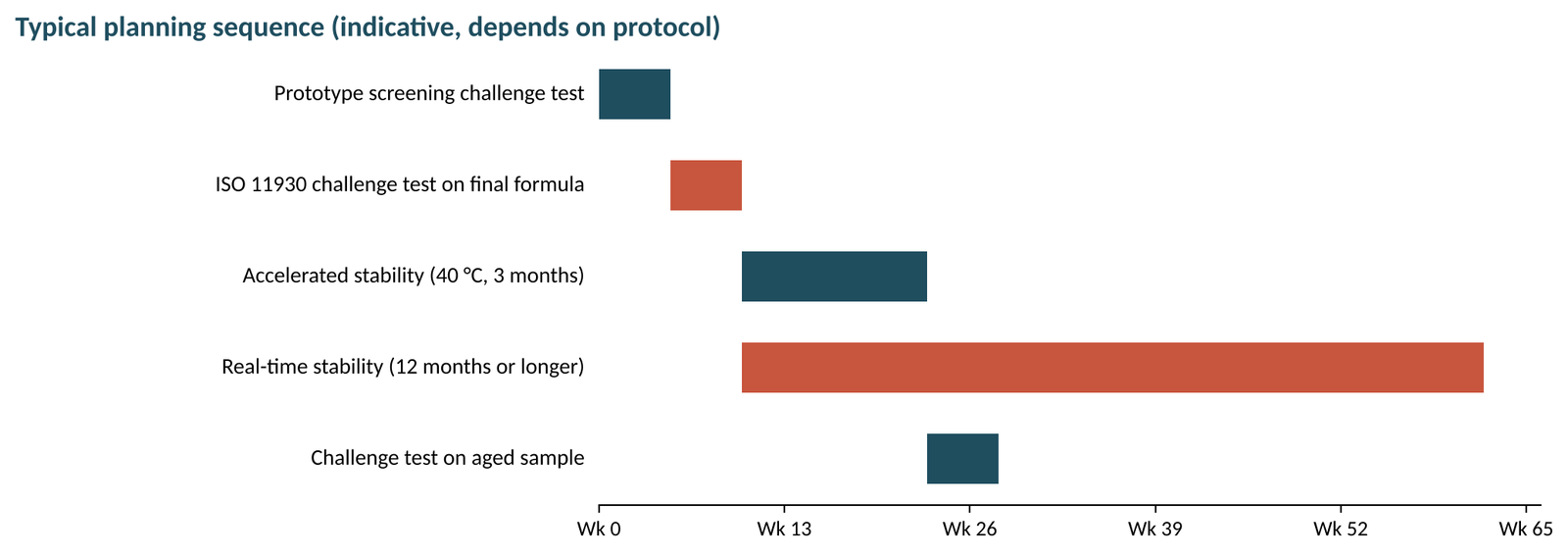
| Work package | Indicative duration | Notes |
|---|---|---|
| Prototype screening challenge test | About 5 weeks | Run on two or three candidate systems before the formula is frozen |
| ISO 11930 challenge test on final formula | About 5 weeks | 28 days of incubation [1] plus set-up and reporting |
| Accelerated stability | Commonly 1–3 months or more | Elevated temperature and freeze–thaw; early signal only [2] |
| Real-time stability | For the claimed shelf life (for example 12 months or more) | Confirms the stated shelf life |
| Challenge test on aged sample | About 5 weeks | Recommended practice to confirm preservation after storage |
Durations are illustrative planning assumptions, not standard requirements; confirm them with your laboratory.
05What drives the budget
- Formulas and bases.
Grouping similar formulas into families lets you test the worst case.
- Pack variants.
Stability must be shown in the pack sold.
- Method and organism panel.
Adding in-house isolates or a second method increases workload.
- Sample quantity.
Ask the laboratory what each test needs, and make enough batches for every time point.
- Retesting.
A failed test means reformulation and a repeat, so budget for at least one iteration.
06How to brief a laboratory
A clear brief prevents repeat testing. Give the laboratory the formula code and the final pack, the target markets and the method and criteria required, the number of batches available, and the storage conditions and time points you want. State what you will do if a result is out of specification, and ask for a protocol before work begins. Ask how much sample each test consumes; running short of sample is an avoidable cause of delay.
Budgeting tip. Screen at the prototype stage. A failed screening test costs weeks; a failed final test costs the launch date.
07A staged budget
Treat the programme as three gates. Gate one is screening: a challenge test on two or three candidate preservative systems, the cheapest place to learn that a system will not work. Gate two is the final ISO 11930 test on the frozen formula [1]. Gate three is stability testing plus, as recommended practice, a challenge test on an aged sample, which confirms that preservation holds through shelf life [2]. Release budget gate by gate, so a failure at gate one never becomes a failure at gate three.
Where to save: group formulas into families, test the worst case and screen before the formula is frozen. Where not to save: testing a different pack from the one you will sell, or skipping the aged sample. Those shortcuts move the risk to launch day. The natural preservatives guide explains how formulation choices affect the pass rate.
08Registration and timing
Registration runs in parallel with testing but depends on its results. In the EU the safety report must include stability and microbiological data, including challenge test results, so it cannot be signed before they exist [4]. Plan notification, label approval and importer documents to finish when the last required data point arrives, not after.
Planning a challenge test and stability programme?
CSL scopes the work gate by gate, so you know what each stage needs before you commit to a launch date.
09Questions readers ask
How long does a challenge test take?
The incubation period is 28 days under ISO 11930, so plan about five weeks with set-up and reporting.
Do I need real-time stability before launch?
Launching on accelerated data while real-time studies continue is common practice, but the decision rests with your safety assessor and any retailer requirements.
What accelerated stability conditions do cosmetics use?
Guidance describes storage at 37, 40 or 45 °C for 1, 2, 3 or more months, depending on the product, plus freeze–thaw and light where relevant.
Is the period after opening the same as shelf life?
No. Shelf life covers the closed pack; the period after opening is usually supported by in-use or opened-pack evaluation.
10References
- International Organization for Standardization. ISO 11930:2019. Cosmetics – Microbiology – Evaluation of the antimicrobial protection of a cosmetic product (and Amd 1:2022). Geneva: ISO; 2019. ISO
- Cosmetics Europe; CTFA. Guidelines on stability testing of cosmetic products. Brussels: Cosmetics Europe; 2004. Cosmetics Europe
- International Council for Harmonisation. ICH Q1A(R2): stability testing of new drug substances and products. Geneva: ICH; 2003. ICH
- Regulation (EC) No 1223/2009 of the European Parliament and of the Council of 30 November 2009 on cosmetic products. Off J Eur Union. 2009;L342:59–209. EUR-Lex
- US Food and Drug Administration. Modernization of Cosmetics Regulation Act of 2022 (MoCRA). Silver Spring (MD): FDA [cited 2026 Nov 17]. FDA
- Ministry of Health and Family Welfare (India). The Cosmetics Rules, 2020. New Delhi: CDSCO; 2020. CDSCO
- European Directorate for the Quality of Medicines & HealthCare. European Pharmacopoeia, chapter 5.1.3: Efficacy of antimicrobial preservation. Strasbourg: EDQM. EDQM
- United States Pharmacopeial Convention. USP–NF General Chapter <51> Antimicrobial effectiveness testing. Rockville (MD): USP.
- Office for Product Safety and Standards. Regulation 1223/2009 and the Cosmetic Products Enforcement Regulations 2013: Great Britain. London: GOV.UK. GOV.UK
- International Organization for Standardization. ISO/TR 18811:2018. Cosmetics – Guidelines on the stability testing of cosmetic products. Geneva: ISO; 2018. ISO
Update log
- Published by Cosmetic Science Lab
This article is general technical information, not legal, regulatory or medical advice. Confirm requirements for your product and market before launch.