Preservative rules by market: EU Annex V, UK, US, India and GCC compared
The EU and UK use a positive list, the US has none at federal level, India has a new BIS preservative list and the GCC applies a common technical regulation. Here is how each works, the traps in Annex V and the deadlines to watch. Part of our preservation series.
By Dr. Premalatha, Ph.D., Life Science, Regulatory Consultant, Cosmetic Science Lab
At a glance
Quick answer
- How do cosmetic preservative rules differ by market? The EU, UK, India, Japan and ASEAN use positive lists with limits; the US has no federal preservative list and puts safety on the brand; the GCC applies a common technical regulation with national registration.
- Since 31 July 2026, EU products with a formaldehyde releaser must say "releases formaldehyde" above 0.001% [16].
- US states are moving faster than federal law: Washington bans formaldehyde releasers from 1 January 2027 [21].
- Every choice still needs a challenge test on the finished product [12].
Take-home message for brand owners
- Keep one preservative matrix for every market you sell in.
- Watch for transition dates: they differ for placing on the market and making available.
Take-home message for formulators
- Check Annex V before the formula is frozen, not at dossier stage.
- Read limits "as acid" for salts and esters.
Cosmetic preservative regulations differ more by approach than by chemistry. The EU and UK allow only preservatives on a positive list, each with a maximum concentration [1][7]. The United States has no federal positive list for preservatives, and responsibility for safety sits with the brand [2]. India's Cosmetics Rules, 2020 require products to meet Bureau of Indian Standards specifications [8], and BIS now lists permitted preservatives, with restrictions, in IS 4707 (Part 3):2025 [3]. The GCC applies a common Gulf technical regulation, GSO 1943:2024, while each member state runs its own registration or notification [4]. A formula built for one market can fail in another.
01How each market approaches preservatives
In the EU, Article 14 of the Cosmetics Regulation makes Annex V the controlling list of preservatives, and each entry gives a maximum concentration, product-type limits and any required warning [1]. A substance that is not in Annex V cannot be added to protect the product, even if it is safe in other uses. Annex V is amended regularly, and amendments set separate dates for placing products on the market and for making them available, so each regulation has to be read for its own dates. See our EU market page.
The US took a different route. The Federal Food, Drug, and Cosmetic Act prohibits adulterated and misbranded cosmetics, and the Modernization of Cosmetics Regulation Act of 2022 (MoCRA) added facility registration, product listing, adverse-event reporting and a requirement for adequate safety substantiation [2][5]. It did not create a preservative positive list. At federal level only a handful of substances are prohibited or restricted by regulation, such as mercury compounds under 21 CFR 700.13 [6][19]. Some states go further: California has banned formaldehyde and quaternium-15 since 2025, and Washington will ban formaldehyde releasers from 1 January 2027 [20][21]. See our MoCRA guide.
02Comparison table
| Market | Governing rule | Approach | What a brand must show |
|---|---|---|---|
| EU | Regulation (EC) No 1223/2009, Annex V [1] | Positive list with maximum concentrations | Preservative in Annex V and within limits; safety assessment; label conditions and warnings |
| UK (Great Britain) | Cosmetics Regulation retained in GB law [7] | Positive list based on the EU text, with GB-specific updates | Same checks as the EU, plus a UK Responsible Person and GB notification |
| US | FD&C Act as amended by MoCRA [2][5] | No federal positive list; brand responsible for safety; some state bans | Safety substantiation, product listing, facility registration; state rules |
| India | Cosmetics Rules, 2020 (Rule 39); BIS IS 4707 (Part 3):2025 [3][8] | BIS list of preservatives allowed with restrictions | Preservative on IS 4707 (Part 3) within its conditions; CDSCO import registration for imports, or a state manufacturing licence |
| GCC | GSO 1943:2024 Gulf Technical Regulation [4] | Common technical regulation; national registration or notification | Registration in each member state; check the current GSO and national texts |
Other markets also use positive lists. Japan's preservative list sits in its Standards for Cosmetics [9], and Annex VI of the ASEAN Cosmetic Directive lists the preservatives that cosmetic products may contain [10]. Brands selling in several regions should treat the strictest entry as the design limit.
03Reading Annex V in practice
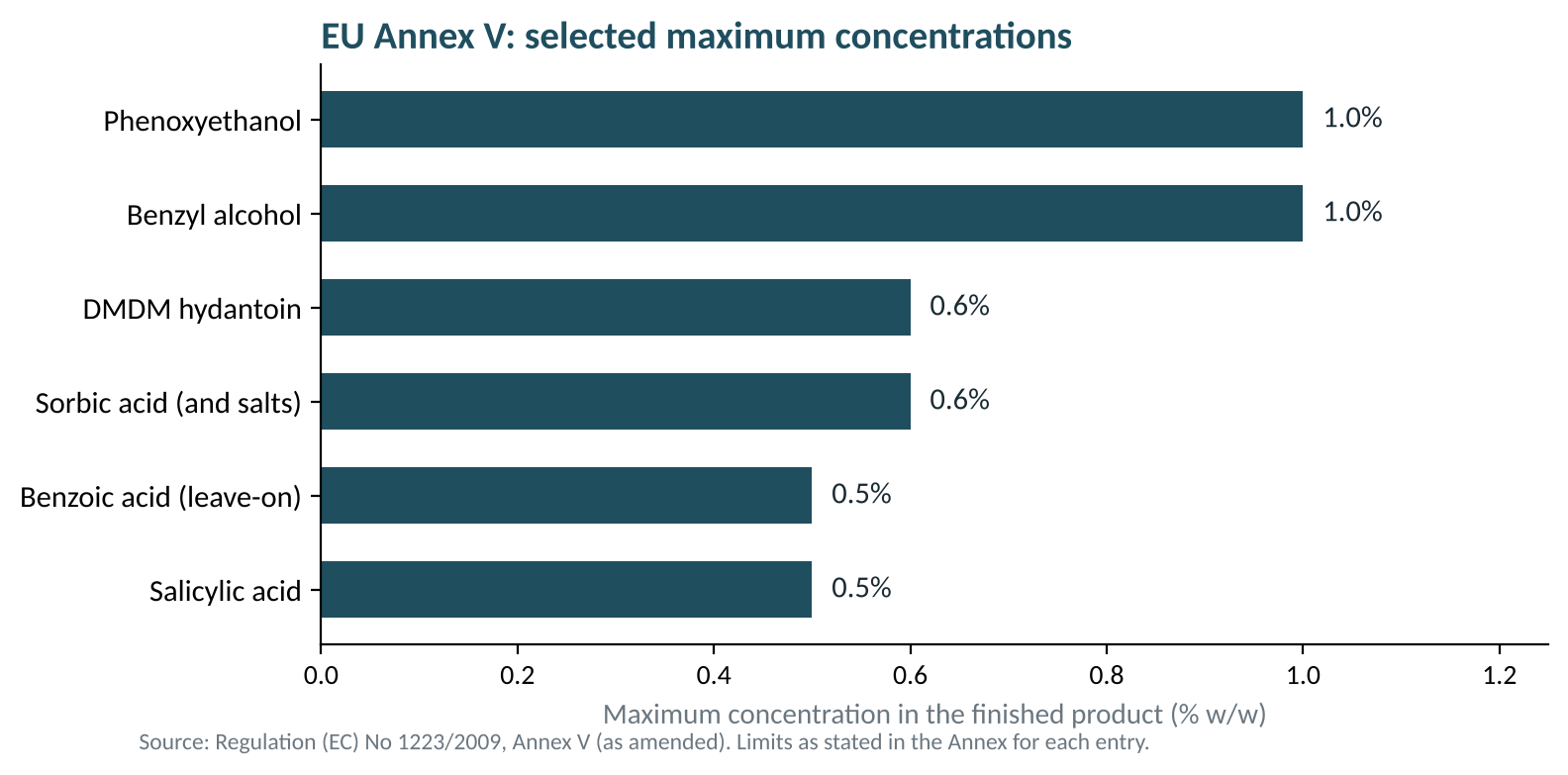
Each Annex V entry gives the substance, the maximum concentration in the finished product, the product types covered and any conditions or warnings [1]. Four traps cause most mistakes:
- Rinse-off versus leave-on.
Many entries set different limits for each.
- Salts and esters expressed as acid.
A 0.5% limit applies to the acid equivalent, not to the weight of the salt.
- Group limits.
Some entries cap a group: propylparaben and butylparaben together may not exceed 0.14% (as acid) [15].
- Age and body-area restrictions.
A listed preservative can still be barred for children under three or for the nappy area, so baby-care and lip products need a separate check [1].
04What a brand must do
List every preservative and every ingredient with a preservative effect in the formula. Check each against the market list and its limit, then check the form of the product: some entries apply only to rinse-off products, and some prohibit sprays or use in the nappy area. A well-known example is methylisothiazolinone, which the EU prohibited in leave-on products from 12 February 2017 [11] and limited to 0.0015% in rinse-off products from 2018 [14].
Next, document the choice. The EU safety report and product information file need the preservative rationale and the test evidence, and the same evidence supports US safety substantiation [1][2]. The standard evidence is a challenge test under ISO 11930 [12]; our guide to preservative efficacy testing explains it. A practical tool for multi-market brands is a master preservative matrix: one row per preservative, one column per market, with the limit and any warning in each cell.
Practical rule. Check Annex V before you finalise the formula, not after. An out-of-limit preservative found at dossier stage means reformulation and a repeat challenge test.
05Deadlines and change management
Preservative rules change continuously. EU amendments to Annex V arrive as Commission regulations with transition periods, and the US MoCRA registration and listing deadline of December 2023 was followed by FDA enforcement discretion until 1 July 2024 [5]. Watch the Official Journal, FDA announcements and US state legislatures, and re-check your portfolio when a rule is published. For India, see our Cosmetics Rules, 2020 formulation guide.
| Date | Market | Rule | Effect on preservatives |
|---|---|---|---|
| 2014 | EU | Regulation (EU) No 358/2014 [13] | Isopropyl-, isobutyl-, phenyl-, benzyl- and pentylparaben prohibited; triclosan restricted |
| 2014 | EU | Regulation (EU) No 1004/2014 [15] | Propyl- and butylparaben capped at 0.14% combined; banned in leave-on nappy-area products for under-threes |
| 2016 | EU | Regulation (EU) 2016/1198 [11] | Methylisothiazolinone prohibited in leave-on products (from 12 Feb 2017) |
| 2017 | EU | Regulation (EU) 2017/1224 [14] | Methylisothiazolinone in rinse-off products cut to 0.0015% (from 2018) |
| 29 Dec 2022 | US | MoCRA enacted [5] | Safety substantiation, listing and adverse-event reporting; no preservative list |
| 1 Jul 2024 | US | End of FDA enforcement discretion [5] | Facility registration and product listing enforced |
| 1 Jan 2025 | US (California) | AB 2762 [20] | Formaldehyde, paraformaldehyde, methylene glycol and quaternium-15 banned |
| 9 Feb 2026 | India | IS 4707 (Part 3):2025 [3] | Standalone BIS preservative list takes effect |
| 1 May 2026 | EU | Regulation (EU) 2026/78 [17] | o-Phenylphenol entry replaced: 0.2% rinse-off, 0.15% leave-on (as phenol) |
| 15 Jul 2026 | GB | SI 2026/23 [18] | "Releases formaldehyde" warning above 0.001%, as in the EU |
| 31 Jul 2026 | EU | Regulation (EU) 2022/1181 [16] | "Releases formaldehyde" warning above 0.001% applies to all products on the market |
| 1 Jan 2027 | US (Washington) | WAC 173-339-110 [21] | Formaldehyde releasers, including DMDM hydantoin, prohibited |
For one releaser in detail, read our DMDM hydantoin spotlight. Once you know which preservatives are allowed, the harder question is which of them work in a natural-leaning formula: see natural preservatives that pass a challenge test.
Selling in more than one market?
CSL checks your preservative system against each market's rules and builds the evidence file before launch.
06Questions readers ask
Does the US have a list of approved cosmetic preservatives?
No. Brands must substantiate safety, and only a few substances are restricted by federal regulation, but some states restrict additional preservatives.
Can I use one formula in the EU and the GCC?
Often yes, but you must confirm it against the current GSO 1943 text and the registration rules of each member state.
Which list sets preservative limits in India?
BIS IS 4707 (Part 3):2025, in force since 9 February 2026, under the Cosmetics Rules, 2020.
Do EU preservative limits apply to the salt or the acid?
Usually to the acid. Many Annex V entries express salts and esters as the parent acid, so convert before you dose.
07References
- Regulation (EC) No 1223/2009 of the European Parliament and of the Council of 30 November 2009 on cosmetic products, Annex V (consolidated). Off J Eur Union. 2009;L342:59–209. EUR-Lex
- Office of the Law Revision Counsel. 21 U.S.C. Chapter 9, Subchapter VI: Cosmetics (§§361–364j). United States Code, 2024 ed. GovInfo
- Bureau of Indian Standards. IS 4707 (Part 3):2025. Classification of cosmetic raw materials and adjuncts – Part 3: List of preservatives allowed in cosmetics with restrictions. New Delhi: BIS; 2025.
- GCC Standardization Organization. GSO 1943:2024. Cosmetic products – Safety requirements of cosmetics and personal care products (Gulf Technical Regulation). Riyadh: GSO; 2024. GSO
- US Food and Drug Administration. Modernization of Cosmetics Regulation Act of 2022 (MoCRA). Silver Spring (MD): FDA [cited 2026 Nov 17]. FDA
- 21 CFR 700.13. Use of mercury compounds in cosmetics. eCFR
- Office for Product Safety and Standards. Making cosmetic products available to consumers in Great Britain. London: GOV.UK. GOV.UK
- Ministry of Health and Family Welfare (India). The Cosmetics Rules, 2020. New Delhi: CDSCO; 2020. CDSCO
- Ministry of Health and Welfare (Japan). Standards for Cosmetics. MHW Notification No. 331 of 2000. MHLW
- ASEAN. ASEAN Cosmetic Directive, Annex VI: List of preservatives which cosmetic products may contain. Release 22 June 2026. ASEAN
- Commission Regulation (EU) 2016/1198 of 22 July 2016 amending Annex V to Regulation (EC) No 1223/2009 on cosmetic products. Off J Eur Union. 2016;L198:10. EUR-Lex
- International Organization for Standardization. ISO 11930:2019. Cosmetics – Microbiology – Evaluation of the antimicrobial protection of a cosmetic product (and Amd 1:2022). Geneva: ISO; 2019. ISO
- Commission Regulation (EU) No 358/2014 of 9 April 2014 amending Annexes II and V to Regulation (EC) No 1223/2009 on cosmetic products. Off J Eur Union. 2014;L107:5. EUR-Lex
- Commission Regulation (EU) 2017/1224 of 6 July 2017 amending Annex V to Regulation (EC) No 1223/2009 on cosmetic products. Off J Eur Union. 2017;L174:16. EUR-Lex
- Commission Regulation (EU) No 1004/2014 of 18 September 2014 amending Annex V to Regulation (EC) No 1223/2009 on cosmetic products. Off J Eur Union. 2014;L282:5. EUR-Lex
- Commission Regulation (EU) 2022/1181 of 8 July 2022 amending the Preamble to Annex V to Regulation (EC) No 1223/2009 on cosmetic products. Off J Eur Union. 2022;L184:3. EUR-Lex
- Commission Regulation (EU) 2026/78 of 12 January 2026 amending Regulation (EC) No 1223/2009 as regards the use in cosmetic products of certain substances classified as carcinogenic, mutagenic or toxic for reproduction. Off J Eur Union. 2026. EUR-Lex
- The Cosmetic Products Regulation (EC) No 1223/2009 (Restriction of Chemical Substances) (Amendment and Transitional Provisions) Regulations 2026. SI 2026/23. legislation.gov.uk
- US Food and Drug Administration. Prohibited and restricted ingredients in cosmetics. Silver Spring (MD): FDA. FDA
- California Assembly Bill 2762 (2020), Toxic-Free Cosmetics Act. LegiScan
- Washington State Department of Ecology. WAC 173-339-110, Formaldehyde and formaldehyde releasers. Wash State Regist 25-18-057; 2025. Washington State Legislature
Update log
- Published by Cosmetic Science Lab
This article is general technical information, not legal, regulatory or medical advice. Confirm requirements for your product and market before launch.