Natural preservatives that pass a challenge test: what the system needs
Sodium benzoate and potassium sorbate can pass ISO 11930, but only in a narrow window of pH, dose and formula compatibility. Here is what "natural" means for preservatives, why pH decides everything and how to prove a system works. The hub of our preservation series.
By Dr. Premalatha, Ph.D., Life Science, Regulatory Consultant, Cosmetic Science Lab
At a glance
- Typical system
- Sodium benzoate and potassium sorbate, often with a chelator
- Key lever
- Formula pH: only the undissociated acid is active
- EU limits
- Benzoic acid 0.5% leave-on; sorbic acid 0.6% (as acid) [5]
- Proof
- ISO 11930 challenge test on the finished product [9]
- Caveat
- COSMOS classes these acids as permitted non-natural ingredients [4]
Quick answer
- Can a natural-certified preservative system pass a challenge test? Yes, but only inside a narrow design window of pH, use level and formula compatibility, and only testing the finished product proves it [9].
- Ingredients that are not in Annex V, such as bio-based glycols, cannot be the preservative; they can only support it [5].
- Grapefruit seed extract and most essential oils are not dependable preservatives [8].
Take-home message for brand owners
- "Natural" positioning narrows your preservative options, so budget for screening.
- Check the certification standard and Annex V before you brief a lab.
Take-home message for formulators
- Design pH first, then dose.
- Confirm final pH after cooling and on aged samples.
Certification-friendly preservatives such as sodium benzoate and potassium sorbate can pass an ISO 11930 challenge test, but only inside a narrow design window: the formula pH must be low enough, the use level right and nothing in the formula binding or inactivating them. Whether a system passes depends on the whole formula and pack, and only a test on the finished product can show it [9]. Outside that window, natural-positioned products fail, and contaminated products are a real hazard [2].
01What "natural" actually means for a preservative
There is no legal definition of "natural" for cosmetics in the EU, so natural preservatives are defined by standards rather than by law. The ISO 16128 standards give a voluntary framework for calculating natural and organic content [3]. The COSMOS-standard, used by certifiers such as Ecocert, allows a short list of preservatives of petrochemical origin: benzoic, sorbic, salicylic and dehydroacetic acids and their salts, plus benzyl alcohol. They are temporarily allowed, reviewed at each revision and cannot be certified as organic [4]. In other words, the usual "natural" preservatives are nature-identical molecules made synthetically. Whatever the label says, in the EU every preservative must still be listed in Annex V and used within its limit [5]. See our clean and natural sector page for the wider brief.
02The mechanism: why pH decides everything
Benzoic and sorbic acids are weak acids. The undissociated form crosses the microbial cell membrane, so activity falls as pH rises [1]. With pKa values of about 4.2 for benzoic acid and 4.76 for sorbic acid [10][11], the undissociated share at pH 4.5 is roughly 33% and 65%; at pH 5.5 it falls to about 5% and 15% (Henderson–Hasselbalch). This pH dependence explains most failures of these systems: a cream at pH 5.8 can fail with the same dose that works at pH 4.8.
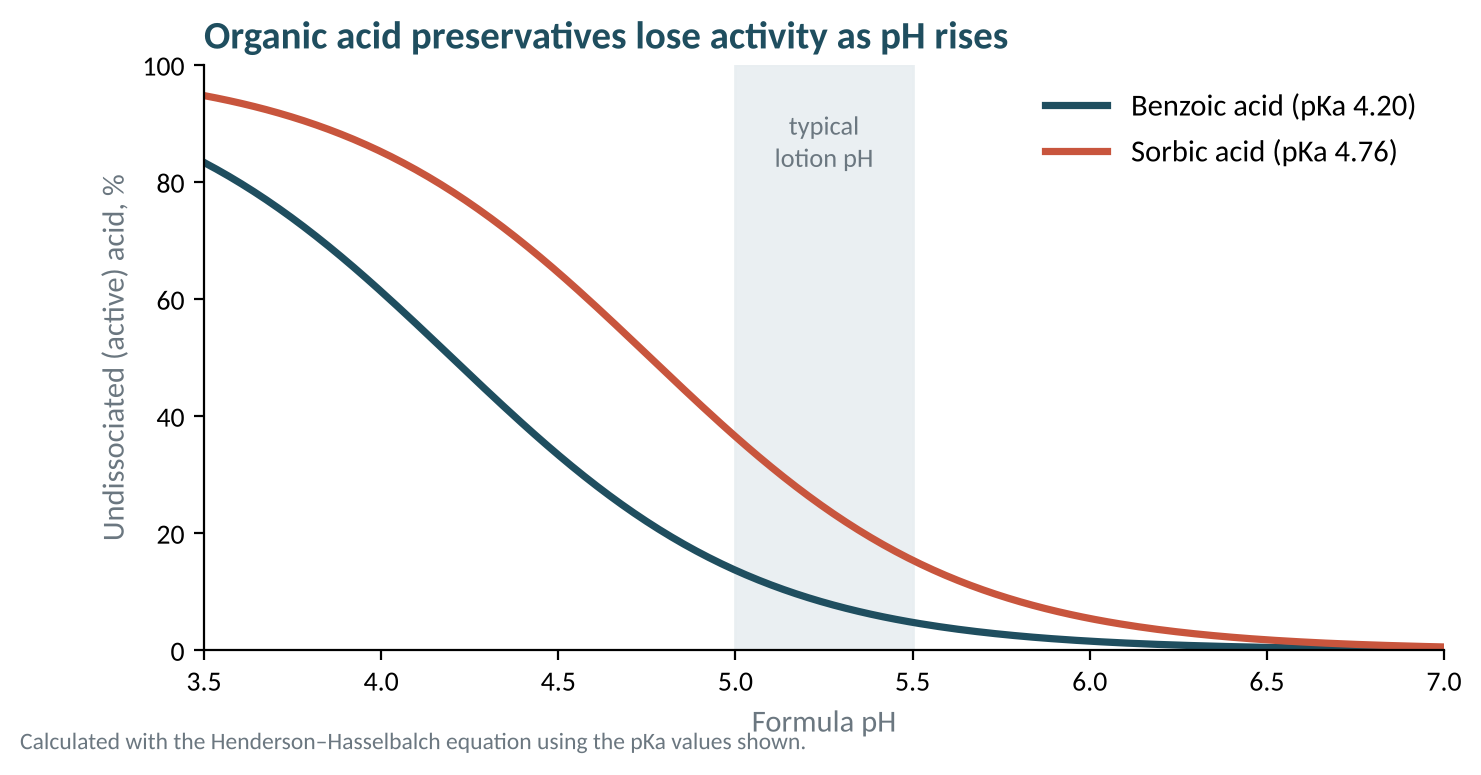
Annex V caps the dose, so pH becomes the main lever. In the EU, benzoic acid and its sodium salt are allowed at up to 0.5% (as acid) in leave-on products, 2.5% in rinse-off and 1.7% in oral products. Sorbic acid and its salts are allowed at up to 0.6% (as acid). Salicylic acid and its salts are allowed at up to 0.5% (as acid), not in products for children under three except shampoos. Dehydroacetic acid is allowed at up to 0.6% (as acid), not in sprays, and benzyl alcohol at up to 1.0% [5]. Always check the current consolidated Annex V.
03Formulation variables that decide the result
| Variable | Why it matters | What to do |
|---|---|---|
| Use level | Annex V caps the dose; over-preservation raises allergy concerns | Use the lowest level that passes the challenge test, within the Annex V maximum [2][5] |
| pH | Controls the active, undissociated fraction | Target below about pH 5 for sodium benzoate and below about pH 5.5 for potassium sorbate [10][11] |
| Compatibility | Surfactants, thickeners and oils can bind or partition the preservative | Test the full formula, not the preservative alone |
| Process | Heat and late additions affect solubility and distribution | Dissolve acids in the water phase and confirm final pH after cooling |
Combinations matter too. Organic acids are generally stronger against yeast and mould than against Gram-negative bacteria such as Pseudomonas, so a system often needs a bacteria-active partner and a chelating agent. Multi-component systems follow the hurdle principle, borrowed from food science [7] and applied to cosmetics [6], in which several mild barriers together give protection that no single one provides.
04Three routes to a natural-leaning system
- Acid-based system.
For products that can sit at a low pH, such as many creams and lotions: sodium benzoate and potassium sorbate with a chelator. Simple and inexpensive, but it limits the formula to a pH that suits both the skin and the other ingredients.
- Combination system.
A multifunctional ingredient such as a bio-based glycol supports a smaller dose of an Annex V organic acid. Ingredients not listed in Annex V cannot be used or described as the preservative; their role must be a different, documented function, and the system must still pass the challenge test [5].
- Design-led protection.
Anhydrous formats, low water activity and protective packaging reduce how much preservative is needed [6]. Some low-risk formats can be justified without a challenge test under ISO 29621 [12].
05Common failure modes
- pH drift: a formula that starts at pH 5.0 and creeps upward during shelf life loses acid activity.
- Essential oils and plant extracts as the preservative: they can show activity in vitro, but often only at levels that raise irritation and sensitisation concerns.
- Grapefruit seed extract: laboratory work traced the activity of commercial extracts to synthetic preservatives they contained, notably benzethonium chloride, with triclosan and methylparaben in some samples [8].
- Skipping the final-pack check: packaging changes exposure to air and users' fingers.
06Reading a failing result
Which organism survives tells you where to look. A bacterial survivor, most often Pseudomonas, points to weak control of Gram-negative bacteria, so review chelation and the bacteria-active partner. A mould or yeast survivor points to low acid activity, so review pH and the antifungal component. An open jar invites finger contamination, so the pack belongs in the review too. Our worked example of a natural cream that failed ISO 11930 follows this diagnosis step by step.
07How to prove a natural system works
As for any system, ISO 11930 tests the finished product against Pseudomonas aeruginosa, Staphylococcus aureus, Escherichia coli, Candida albicans and Aspergillus brasiliensis over 28 days, and judges the result against criteria A and B [9]. Criterion A is the more demanding. Criterion B is acceptable only when a documented risk assessment shows that factors outside the formula, such as protective packaging (pumps, single-dose units), keep the risk acceptable [9]. A failed test is information, not a verdict: it tells you which organism escapes and why. Read our guides to ISO 11930 preservative efficacy testing and budgeting for a challenge test and stability study.
If a formaldehyde releaser is on your shortlist, read our DMDM hydantoin spotlight; for limits by market, see preservative rules by market.
Building a natural-positioned formula?
CSL designs preservative systems around pH, pack and certification, and screens them before the formula is frozen.
08Questions readers ask
Are sodium benzoate and potassium sorbate natural?
They are nature-identical salts made synthetically. COSMOS allows them as non-natural ingredients that cannot be certified organic.
What pH does sodium benzoate need to work?
Below about pH 5. At pH 5.5 only about 5% of benzoic acid is in its active, undissociated form.
Is grapefruit seed extract a natural preservative?
Not a dependable one. Studies traced the activity of commercial extracts to synthetic preservatives they contained.
Can a natural cream skip the challenge test?
A water-based cream cannot. Only microbiologically low-risk formats can be justified by risk assessment under ISO 29621.
09References
- Halla N, Fernandes IP, Heleno SA, Costa P, Boucherit-Otmani Z, Boucherit K, et al. Cosmetics preservation: a review on present strategies. Molecules. 2018;23(7):1571. doi:10.3390/molecules23071571. MDPI
- Lundov MD, Moesby L, Zachariae C, Johansen JD. Contamination versus preservation of cosmetics: a review on legislation, usage, infections, and contact allergy. Contact Dermatitis. 2009;60(2):70–8. doi:10.1111/j.1600-0536.2008.01501.x. DOI
- International Organization for Standardization. ISO 16128-1:2016. Guidelines on technical definitions and criteria for natural and organic cosmetic ingredients and products – Part 1: Definitions for ingredients. Geneva: ISO; 2016. ISO
- COSMOS-standard AISBL. COSMOS-standard: cosmetics organic and natural standard. Version 4.2. Brussels: COSMOS-standard AISBL; 2025. COSMOS
- Regulation (EC) No 1223/2009 of the European Parliament and of the Council of 30 November 2009 on cosmetic products, Annex V (consolidated). Off J Eur Union. 2009;L342:59–209. EUR-Lex
- Kabara JJ, editor. Preservative-free and self-preserving cosmetics and drugs: principles and practice. New York: Marcel Dekker; 1997.
- Leistner L. Basic aspects of food preservation by hurdle technology. Int J Food Microbiol. 2000;55(1–3):181–6. doi:10.1016/S0168-1605(00)00161-6. DOI
- von Woedtke T, Schlüter B, Pflegel P, Lindequist U, Jülich WD. Aspects of the antimicrobial efficacy of grapefruit seed extract and its relation to preservative substances contained. Pharmazie. 1999;54(6):452–6. PubMed
- International Organization for Standardization. ISO 11930:2019. Cosmetics – Microbiology – Evaluation of the antimicrobial protection of a cosmetic product (and Amd 1:2022). Geneva: ISO; 2019. ISO
- National Center for Biotechnology Information. PubChem compound summary for CID 243, benzoic acid. Bethesda (MD): NCBI [cited 2026 Nov 17]. PubChem
- National Center for Biotechnology Information. PubChem compound summary for CID 643460, sorbic acid. Bethesda (MD): NCBI [cited 2026 Nov 17]. PubChem
- International Organization for Standardization. ISO 29621:2017. Cosmetics – Microbiology – Guidelines for the risk assessment and identification of microbiologically low-risk products. Geneva: ISO; 2017. ISO
Update log
- Published by Cosmetic Science Lab
This article is general technical information, not legal, regulatory or medical advice. Confirm requirements for your product and market before launch.