"Paraben-free" and "preservative-free" claims: what regulators allow
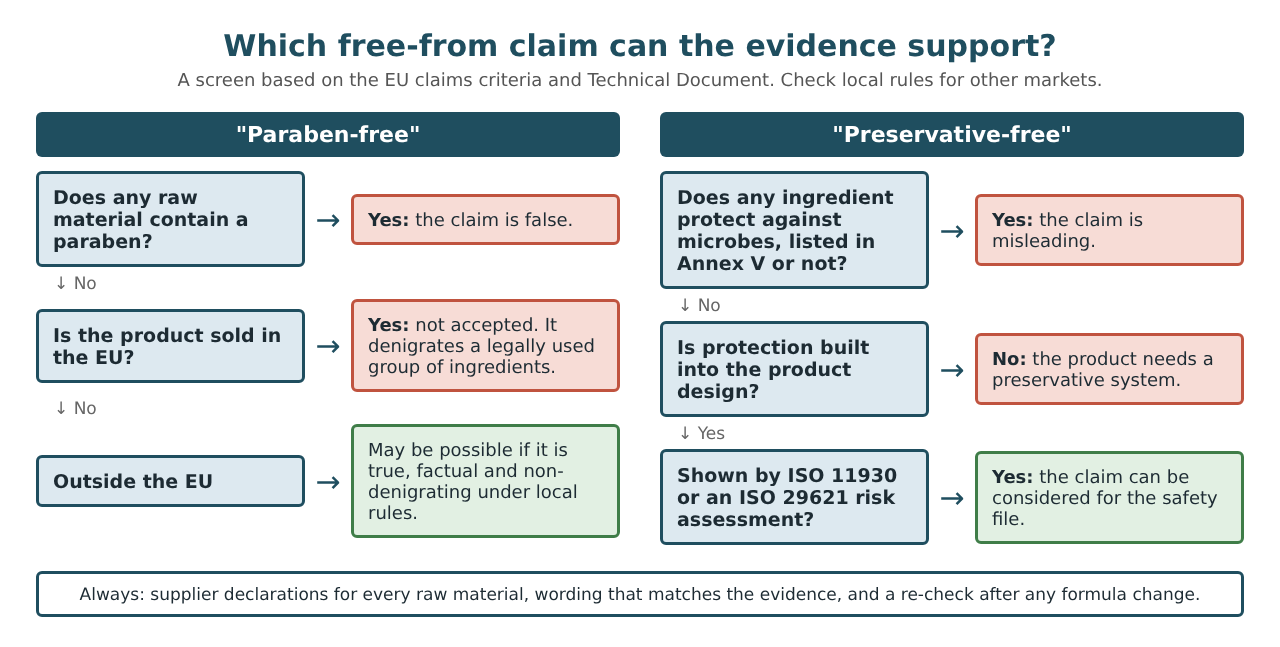
In the EU, "paraben-free" is not accepted because it denigrates a legal ingredient group, and "preservative-free" fails if any ingredient protects against microbes. Here are the rules, the evidence and the mistakes that get claims challenged. Part of our preservation series.
By Dr. Premalatha, Ph.D., Life Science, Regulatory Consultant, Cosmetic Science Lab
At a glance
Quick answer
- Can I put "paraben-free" on pack in the EU? Not under the Commission's claims guidance, which has applied since July 2019: it treats "free from parabens" as denigrating a legally used group of ingredients [2].
- "Preservative-free" fails if any ingredient protects the product against microbes, even one not listed in Annex V [2].
Take-home message for brand owners
- Check every free-from claim for each market before artwork is final.
- A claim must still be true after every formula change.
Take-home message for formulators
- Multifunctional ingredients such as caprylyl glycol count as protection for claim purposes.
- Collect signed supplier declarations, not marketing sheets.
"Paraben-free" and "preservative-free" are two of the most common words on a cosmetic pack, and two of the easiest to get wrong. In the EU, the Commission's claims guidance says a "free from parabens" claim should not be used, because it denigrates a group of ingredients that is legal within set limits [2]. A preservative-free claim is possible, but only when no ingredient in the formula protects it against microbes and the product is protected another way [2]. This guide sets out the rules, the evidence and the mistakes that get claims challenged.
01The legal basis for free-from claims
Article 20 of the Cosmetics Regulation prohibits wording that implies a product has characteristics or functions it does not have [1]. Commission Regulation (EU) No 655/2013 sets six common criteria that every claim must meet: legal compliance, truthfulness, evidential support, honesty, fairness and informed decision-making [3]. The Technical Document on cosmetic claims, agreed by the Commission's working group, explains how those criteria apply. Its Annex III on free-from claims has applied since 1 July 2019 [2]. The document is guidance, not law, but national authorities use it when they assess claims.
Annex III covers free-from claims and claims with a similar meaning [2]. The rules that matter most here are these:
- Truthfulness: the claim must be true for the whole product, including what raw materials bring in.
- Fairness: it must not denigrate an ingredient that is legally used.
- Honesty: a claim about an ingredient category, such as preservatives, fails if another ingredient performs that function.
A free-from claim can be acceptable when it helps a specific group of users make an informed choice. The guidance gives "free from alcohol" on a family mouthwash as an example [2].
02What the regulation says about parabens
Parabens are not banned as a class. Annex V allows methylparaben and ethylparaben up to 0.4% (as acid) for a single ester and 0.8% for mixtures of esters [1]. Propylparaben and butylparaben are limited to 0.14% combined, and they may not be used in leave-on products for the nappy area of children under three [5]. Five parabens were prohibited in 2014: isopropyl-, isobutyl-, phenyl-, benzyl- and pentylparaben [4]. Because the permitted parabens are legal, the guidance treats "paraben-free" as a claim that unfairly implies they are unsafe. A brand can still choose not to use parabens. In the EU it should not advertise that choice on pack [2].
03Why preservative-free is a different problem
Water-containing products support microbial growth, so a product without a preservative must be protected in another way. Common routes are:
- anhydrous formats
- low water activity
- extreme pH or high alcohol content
- single-use or one-way packs
Combining several mild barriers is known as hurdle technology [6][9]. "Self-preserving" formulas often rely on ingredients that happen to have antimicrobial effects, such as glycols and glyceryl esters [7]. That is where claims break down: the guidance says "preservative-free" is wrong if the product contains an ingredient with antimicrobial properties, even one that is not on the Annex V list [2].
Choosing the preservative system itself is covered in our guide to natural preservatives that pass a challenge test, and the limits by market in preservative rules by market.
04A worked claim review
Consider a brand that wants to print "paraben-free and preservative-free" on a cream it will sell in the EU. The first step is a formula review with supplier declarations for every raw material.
- Parabens: the declarations confirm that no raw material contains a paraben. The claim is true, but in the EU it is still not accepted because it denigrates parabens [2]. Rewording it as "formulated without parabens" does not help, since the guidance also covers claims with a similar meaning.
The EU pack therefore carries neither claim. The preservation system is described and justified in the product safety report, which must include the challenge test results [1]. Where the brand wants to state what the product does offer, a positive and evidenced claim is safer than a "free from" one.
05Evidence you need
| Claim wording | Evidence | Risk if the evidence is missing |
|---|---|---|
| Paraben-free (outside the EU, where local rules allow it) | Formula review, signed supplier declarations for every raw material, and analysis where carry-over is possible | Claim is false if any raw material contains a paraben |
| Preservative-free | Formula review for any ingredient with an antimicrobial function, a protective product design, and an ISO 11930 challenge test or an ISO 29621 low-risk assessment [8][9] | Misleading claim and a microbiological safety risk |
| Free from [named ingredient] | Specification and supplier data showing the ingredient is absent, and a reason the claim helps users choose [2] | Denigration or a misleading implication |
ISO 11930 tests the finished formulation, and the packaging enters through the microbiological risk assessment [8]. ISO 29621 sets out when a product is low-risk enough that a challenge test is not needed [9]. Claims that go further, such as "suitable for sensitive skin", need their own evidence, usually a clinical or consumer test.
06Common mistakes that get claims challenged
- Swapping, then claiming.
A paraben is replaced with another ingredient that does the same job, and the product is then labelled preservative-free.
- Trusting marketing sheets.
A supplier's brochure is used in place of a signed declaration.
- Copying competitors.
Wording is taken from another brand without checking it against the brand's own formula or market.
- Forgetting variants and markets.
A claim must hold for every variant and in every market where it appears [3].
- Skipping change control.
The formula changes but the claim is not re-checked. A claims check in change control prevents most of these errors.
07Cost and time drivers
Claims work grows with:
- the number of raw materials that need declarations
- the number of markets
- whether analytical checks are needed
- whether a further claim needs a panel study
An ISO 11930 challenge test runs for 28 days after inoculation, plus preparation and reporting [8]. Request supplier declarations early, because they often hold up artwork sign-off. To schedule the testing, see budgeting for a challenge test and stability study.
08Outside the EU
In the United States, a cosmetic is misbranded if its labelling is false or misleading in any particular, and a free-from claim is judged against that standard [10]. US law does not define "paraben-free" or "preservative-free", and it has no equivalent of the EU denigration guidance. A paraben-free claim that is true may therefore be usable in the US but not in the EU. Brands selling in several markets often keep free-from wording off shared packs. Check each market's labelling and advertising rules before artwork is final.
Need a claim checked before artwork is final?
CSL reviews claim wording against the formula, the supplier documents and each target market.
09Questions readers ask
Can I say "paraben-free" if I use a different preservative?
Not in the EU: the Commission's claims guidance treats it as denigrating parabens, which are legal within limits. Elsewhere it may be possible if it is true and not misleading under local rules.
Is "preservative-free" allowed if I use a multifunctional ingredient?
No, not if the ingredient protects the product against microbes. The guidance looks at function, not only the Annex V list.
Does "formulated without parabens" avoid the problem?
No. The EU guidance applies to claims with a similar meaning to "free from", so rewording does not change the assessment.
Which products can be genuinely preservative-free?
Mainly products with protection built into their design, such as anhydrous formats, very low water activity, high alcohol, extreme pH or single-use packs, confirmed by a challenge test or an ISO 29621 risk assessment.
10References
- Regulation (EC) No 1223/2009 of the European Parliament and of the Council of 30 November 2009 on cosmetic products, Article 20, Annex I and Annex V (consolidated). Off J Eur Union. 2009;L342:59–209. EUR-Lex
- Sub-Working Group on Claims. Technical document on cosmetic claims, agreed by the Sub-Working Group on Claims (version of 3 July 2017), Annex III: "free from" claims. Brussels: European Commission; 2017. European Commission
- Commission Regulation (EU) No 655/2013 of 10 July 2013 laying down common criteria for the justification of claims used in relation to cosmetic products. Off J Eur Union. 2013;L190:31–4. EUR-Lex
- Commission Regulation (EU) No 358/2014 of 9 April 2014 amending Annexes II and V to Regulation (EC) No 1223/2009 on cosmetic products. Off J Eur Union. 2014;L107:5. EUR-Lex
- Commission Regulation (EU) No 1004/2014 of 18 September 2014 amending Annex V to Regulation (EC) No 1223/2009 on cosmetic products. Off J Eur Union. 2014;L282:5. EUR-Lex
- Kabara JJ, editor. Preservative-free and self-preserving cosmetics and drugs: principles and practice. New York: Marcel Dekker; 1997.
- Halla N, Fernandes IP, Heleno SA, Costa P, Boucherit-Otmani Z, Boucherit K, et al. Cosmetics preservation: a review on present strategies. Molecules. 2018;23(7):1571. doi:10.3390/molecules23071571. MDPI
- International Organization for Standardization. ISO 11930:2019. Cosmetics – Microbiology – Evaluation of the antimicrobial protection of a cosmetic product (and Amd 1:2022). Geneva: ISO; 2019. ISO
- International Organization for Standardization. ISO 29621:2017. Cosmetics – Microbiology – Guidelines for the risk assessment and identification of microbiologically low-risk products. Geneva: ISO; 2017. ISO
- Misbranded cosmetics, 21 U.S.C. § 362. Federal Food, Drug, and Cosmetic Act, Chapter VI. LII
Update log
- Published by Cosmetic Science Lab
This article is general technical information, not legal, regulatory or medical advice. Confirm requirements for your product and market before launch.